If you want to build a powerful, reliable serve, you have to start with the fundamentals. It’s not the sexy part of tennis, but it’s the most important. A great serve is a chain of coordinated movements, and it all begins with four key pieces: the Continental grip, a solid stance, a repeatable ball toss, and a fluid swing path.
Get these right, and you’re building a weapon. Get them wrong, and you’ll always be just putting the ball in play.
Building a Consistent Serve From the Ground Up
A monster serve isn’t something you’re born with; it’s built, piece by piece. Think of it like a series of checkpoints. If one link in that chain is weak—let’s say your toss is all over the place—the whole motion falls apart, no matter how much heat you’re trying to bring.
The real goal here is to build a motion that feels so natural you don’t even have to think about it, especially when the pressure is on. First point of the match or staring down a break point, you need a serve you can trust. That trust comes from a rock-solid foundation.
Why the Continental Grip Is Non-Negotiable
If there’s one thing you absolutely must do, it’s learning to serve with a Continental grip. People call it the “hammer grip” for a reason—you can find it by holding the racket like you’re about to hammer a nail. To get specific, your index finger’s base knuckle should sit on the second bevel of the handle (for a righty).
I know, I know—it feels weird at first. Most players new to it feel like the racket face is completely open. But this grip is the master key. It’s what allows your forearm to pronate naturally through the ball, which is where real racket-head speed comes from. It also lets you hit flat, slice, and kick serves without ever changing your grip. Trying to serve with your forehand grip is like putting a speed governor on your car.
Pro Tip: Don’t bail on the Continental grip just because it feels awkward. Dedicate a few hitting sessions to just tapping serves in at 50% power. Get a feel for how the strings should meet the ball. That initial discomfort is a small price to pay for the huge advantages you’ll unlock down the road.
Platform vs. Pinpoint Stance: Which Is for You?
Your stance is your launchpad. It’s all about balance and setting up the kinetic chain to generate power. The two main styles you’ll see are the platform and the pinpoint stance.
Platform Stance: Here, your feet stay apart the whole time, roughly shoulder-width. It’s what guys like Roger Federer use. This stance gives you an incredibly stable base and often leads to a smoother, more rhythmic motion.
Pinpoint Stance: This one starts with your feet apart, but you slide your back foot up to meet the front one right before you launch into the air. Think Nick Kyrgios. The idea is to gather all your momentum into one explosive upward drive.
So, which is better? There’s no single right answer. The platform stance is usually easier for beginners because it takes some of the balance guesswork out of the equation. The pinpoint can give you a bit more pop, but the timing has to be perfect. The best advice is to try both and see what feels more comfortable and powerful for your body.
Want to dive deeper into building a strong athletic base? Check out some of our other educational resources on athletic development.
Mastering the All-Important Ball Toss
Let’s be blunt: the toss is everything. A bad toss guarantees a bad serve. It’s that simple. The single biggest mistake I see club players make is flicking their wrist or bending their elbow, which sends the ball on a wild goose chase.
The secret to a great toss is to keep it dead simple. Hold the ball in your fingertips (not your palm!), and just lift it with a straight, relaxed arm. Your arm should move like an elevator going straight up, not like a catapult. The motion comes from your shoulder, nothing else.
This table is a great little cheat sheet to keep the core ideas in mind.
Serve Fundamentals At a Glance
| Component | Objective | Key Tip |
|---|---|---|
| Grip | Unlock versatility and natural power | Stick with the Continental grip. It’s the key to every serve. |
| Stance | Build a stable, balanced foundation | Choose between platform or pinpoint based on what feels right. |
| Toss | Create a consistent, reliable contact point | Lift with a straight arm from the shoulder. No wrist flick! |
For a flat serve, you want the toss to be slightly in front of your lead foot and inside the baseline. The peak of the toss should be just a bit higher than where you can reach with your racket fully extended. This positioning forces you to hit up and through the ball, which is exactly where power comes from. Nail the toss, and the rest of the serve has a fighting chance.
The Biomechanics Behind an Explosive Serve
Ever watch a pro serve and wonder how they generate so much pace with what looks like zero effort? The secret isn’t just raw strength—it’s about transferring energy perfectly up through the body. This concept is called the kinetic chain, and it’s the key to unlocking serious power.
Think of it like cracking a whip. The power starts in your hand, but it’s the smooth, accelerating flow of energy all the way to the tip that creates that explosive snap. Your serve works the exact same way. It all starts from the ground up: your legs load up, that energy shoots through your core and shoulders, and finally, it’s unleashed through the racket. When every link in that chain fires in perfect sequence, you get massive racket head speed without feeling like you’re muscling the ball.
This entire sequence is set up by your fundamentals.
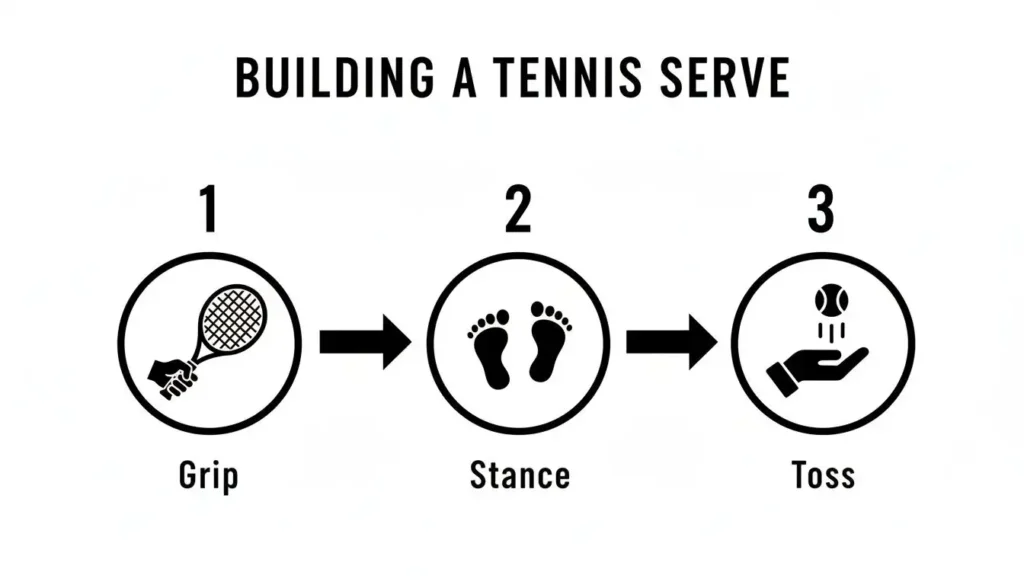
As you can see, a powerful serve is built on a solid foundation of grip, stance, and a consistent toss. Get these right, and you’re ready to build the chain reaction.
The Trophy Pose and Explosive Drive
The make-or-break moment in the kinetic chain is the transition out of the ‘trophy pose.’ This isn’t just for a cool photo op; it’s the critical loading phase where your body coils like a spring, storing up all that potential energy. Your tossing arm is up, racket is dropped back, and your hips and shoulders are turned away from the net, ready to uncoil.
From here, the magic happens. The uncoiling needs to be explosive and timed just right. It all starts with a huge push from your legs, driving your hips up and forward into the court. Your leg drive is the engine. Plain and simple.
A common mistake I see is players doing a slow, deep knee bend, thinking that’s where power comes from. It’s not. It’s the speed of your upward drive that matters. A quick, aggressive push from your legs and hips will generate far more racket speed than a lazy, sluggish bend. This is what gets you up to a higher contact point.
“The serve isn’t about muscle; it’s about momentum. The goal is to transfer ground force into racket speed as efficiently as possible. A break anywhere in the kinetic chain leaks power.”
From Hip Drive to Shoulder Rotation
Once your legs fire, that energy surges up through your core. Your hips should lead the way, beginning to rotate open. This pulls your torso and serving shoulder around violently. The separation you create between your hips and shoulders produces a powerful stretching effect, known as the stretch-shortening cycle, which slingshots your arm forward at incredible speed.
This isn’t just old-school coaching wisdom. Modern biomechanics backs it up. A recent French study, which aligns with over 15 years of data from the Kovacs Institute’s famous 8-Stage Model, confirms that racket speed is directly linked to how fast you can shift from loading to the cocking phase, all driven by that upward push from your back hip. You can read more about the findings on serve mechanics from the Kovacs Institute.
The takeaway? The speed of your hip rotation is a massive factor in how fast you can swing. Your arm is just the last piece of the puzzle, riding the wave of momentum created by your lower body.
Here’s a great drill to feel this connection:
- Get into your serving stance without a racket.
- Move into your trophy pose.
- Now, focus only on driving your back hip up and forward explosively.
- Notice how that single motion naturally pulls your shoulder and arm through, without you even trying to swing.
This simple exercise helps you isolate the feeling of starting the serve from the ground up. If you can master an explosive hip drive and keep that kinetic chain connected, you’re on your way to a bigger, better, and more reliable serve. It’s also one of the best ways to avoid shoulder injuries down the road. For more on that, check out some of our articles on health and athletic wellness.
Mastering the Three Essential Serve Types
A blistering serve is a huge weapon, but a predictable one is a liability. Once your opponent knows where that big serve is going every time, its power evaporates. Real dominance from the service line comes from variety, and that means getting comfortable with the three essential serves: the flat, the slice, and the kick.
When you can call on any of these tennis serve techniques at will, your serve transforms from a single weapon into a full arsenal. You suddenly have the tools to pick on an opponent’s weakness, adapt to tricky match situations, and keep them guessing on every single point.
Let’s break down how to build each one.

The Flat Serve: Pure Power and Intimidation
The flat serve is all about one thing: raw, unadulterated speed. This is your go-to first serve when you’re gunning for an ace or a quick, unreturnable ball. The whole idea is to channel every bit of your body’s momentum directly through the back of the tennis ball.
The swing path is pretty straightforward. You want to make contact at the absolute peak of your reach with a square racket face. Think of it like throwing a hammer straight at your target.
To really crush a flat serve, you need to nail these elements:
- Grip: A solid Continental grip is non-negotiable.
- Toss Location: Get the toss slightly in front of your lead shoulder and just inside the baseline. This naturally pulls your body forward and into the court, helping you hit through the ball.
- Contact Point: This is everything. You have to make contact with a fully extended arm to get maximum leverage and hit down into the service box.
The signature of a great flat serve is the sound—a clean, loud “thwack” with almost no audible spin. When you need to hit a clutch ace down the “T,” this is the serve you’ll want to trust.
The Slice Serve: Creating Width and Deception
Next up is the slice, a masterclass in spin and strategic placement. Instead of plowing through the back of the ball for power, the slice brushes along the side of it, creating nasty sidespin. This makes the ball curve through the air and then skid low after the bounce, often dragging your opponent way outside the court.
Think of the tennis ball as a clock face. For a flat serve, you hit the back at 6 o’clock. For a slice, you’re “slicing” across the side of the ball, making contact somewhere around the 3 o’clock position (for a right-hander).
This different contact point demands a few adjustments. You’ll need to toss the ball a little more to the right of your body (if you’re a righty). This small change allows your racket to swing around the ball naturally. The curve you get is perfect for serving wide in the deuce court to open things up or for jamming a right-handed player on the ad side.
The real beauty of the slice is its versatility. It can be a reliable first serve that sets up an easy putaway, or a tricky second serve that stays low and is incredibly difficult for opponents to attack effectively.
The Kick Serve: The Ultimate Second Serve Weapon
Finally, we have the kick serve. It’s arguably the most complex of the three, but it’s also the most valuable weapon you can develop, especially for your second serve. A good kick serve is defined by its heavy topspin, which makes the ball dive down into the box and then jump high and aggressively after the bounce—often right up to your opponent’s shoulder.
The motion itself feels totally different. Instead of swinging through the ball, you’re swinging sharply up and across it.
Here’s a look at the key components of the kick serve:
- The Toss: This is the biggest change. You have to toss the ball more behind your head, almost over your non-hitting shoulder. This position forces you to arch your back and creates the upward angle you need.
- The Swing Path: The feeling you’re chasing is brushing up the back of the ball. Using our clock analogy again, you’re swinging from roughly 7 o’clock up toward 1 o’clock.
- Body Action: To make it all work, you need to stay sideways longer and use your legs to explode vertically. That upward drive is what gives you the space to swing up at the ball.
Once you master this serve, you gain an incredible margin for error. The topspin literally pulls the ball down over the net, allowing you to hit it with pace while still clearing the net by a safe distance. For opponents, returning a high-bouncing kick serve is a nightmare, often forcing a weak, defensive reply that you can pounce on. It’s the ultimate tool for starting the point on your terms, even on your second try.
To help visualize how these serves differ, let’s put them side-by-side. Each serve has a unique combination of toss, swing, and strategic goal.
Comparing the Flat, Slice, and Kick Serves
| Serve Type | Primary Goal | Toss Location | Swing Path | Best Used When |
|---|---|---|---|---|
| Flat | Maximum speed, aces | Slightly in front, into the court | Directly through the back of the ball | On first serves, when you feel confident, or need a free point. |
| Slice | Create width, pull opponent off court | To the side of the body (e.g., to the right for a righty) | Around the side of the ball (like 3 o’clock) | Serving wide, jamming opponents, or as a reliable first serve. |
| Kick | High bounce, safety, weak returns | Over and slightly behind the head | Up the back of the ball (like 7 to 1 o’clock) | As a high-percentage second serve, or to disrupt a returner’s rhythm. |
Understanding these differences is the first step. The real magic happens when you can execute all three, leaving your opponent completely off-balance.
Serving to the Deuce and Ad Courts Isn’t the Same Game
Ever wonder why your slice serve is a killer on one side of the court but just sits up and begs to be hit on the other? It’s not your imagination. A one-size-fits-all approach to your tennis serve techniques is a surefire way to hit a ceiling with your game.
The best servers I’ve worked with understand this intuitively: the deuce court and the ad court are two completely different puzzles. They demand subtle, but critical, shifts in your stance, your toss, and how you rotate through the ball. Nail these adjustments, and your serve goes from predictable to a genuine weapon.
The geometry of the court is the real boss here. Think about it. The angle you need to create to pull a righty way off the court with a wide slice from the deuce side is completely different from hitting that same wide serve from the ad side. If you’re not adjusting, you’re basically telling your opponent exactly where the ball is going.
Why Your Body Has to Adapt
Your entire setup, from your feet to your shoulders, has to be calibrated for the side you’re on. You’ve got three main targets: the “T,” the body, and the wide corner. Getting the ball to those spots effectively from the deuce court requires a different physical sequence than from the ad court.
This isn’t just coaching talk; there’s science to back it up.
A 2021 study on elite junior players found some fascinating biomechanical differences when they served from the deuce versus the ad side, even when their serves clocked in around the same 151 km/h. The data showed that on the ad side, players naturally used a steeper front-foot angle. On the deuce side, they generated a greater range of motion in their upper torso rotation.
Your body already knows it needs to make these changes. The trick is to make them conscious, deliberate, and razor-sharp.
Deuce Court Strategy (For a Right-Hander)
For most righties, the deuce court feels like home base for power. It’s the natural side for flattening out a serve down the “T” or carving a slice out wide that just keeps moving away from the returner.
The Wide Slice: To get that serve to skid off the court, you have to toss the ball slightly more to your right (around 1 o’clock). This position practically forces your body to open up, letting your racket swing around the outside of the ball to generate that wicked sidespin. Your front foot should also point a bit more parallel to the baseline to help that rotation happen smoothly.
Down the T: For that big, flat serve down the middle, your toss needs to shift. Think more out in front and just a hair to the left (closer to 12 o’clock). This position helps you stay sideways longer and encourages you to drive up and forward into the court, creating a more direct, linear path to the target.
Key Takeaway: Serving on the deuce court is often about maximizing torso rotation to create nasty angles wide, while the “T” serve is all about controlled, linear power straight through the court.
Ad Court Strategy (For a Right-Hander)
The ad court is where things get interesting. It opens up different tactical doors. That wide slice that was so effective on the deuce side now becomes a jamming serve into a righty’s body. And for many players, this is where the kick serve truly comes alive, targeting an opponent’s weaker backhand return.
The Wide Serve (Kick or Slice): Pulling a player wide on the ad side requires a different toolkit. The high-bouncing kick serve is king here. To hit it well, your toss has to be more directly over your head, or even slightly behind you (think 11 o’clock). This lets you swing up on the ball with a brushing motion (like painting from 7-to-1 on a clock face) to generate the heavy topspin. You’ll feel your front foot naturally angle more sharply toward the net post to make this happen.
Down the T (Flat or Slice): Attacking the “T” from the ad court is a great play, especially with a slice that curves away from the returner. The toss stays slightly to the right, similar to the deuce court slice, but your body uncoils more directly toward your target. You’re using that sidespin to bend the ball into the corner.
Getting comfortable with these court-specific tweaks is what elevates your serve. You stop just starting the point and start dictating it. By tailoring your toss, stance, and swing to the unique angles of each side, you’ll keep your opponent guessing and give yourself the upper hand from the very first shot.
Correcting the Most Common Serve Flaws
Even the pros get into bad habits. The serve is such a complex chain of movements that it’s incredibly easy for one tiny flaw to creep in and sabotage the whole thing. The good news? Most serving problems aren’t some unsolvable mystery. They’re common issues, and they have proven fixes. The first step is always figuring out what’s really going wrong.
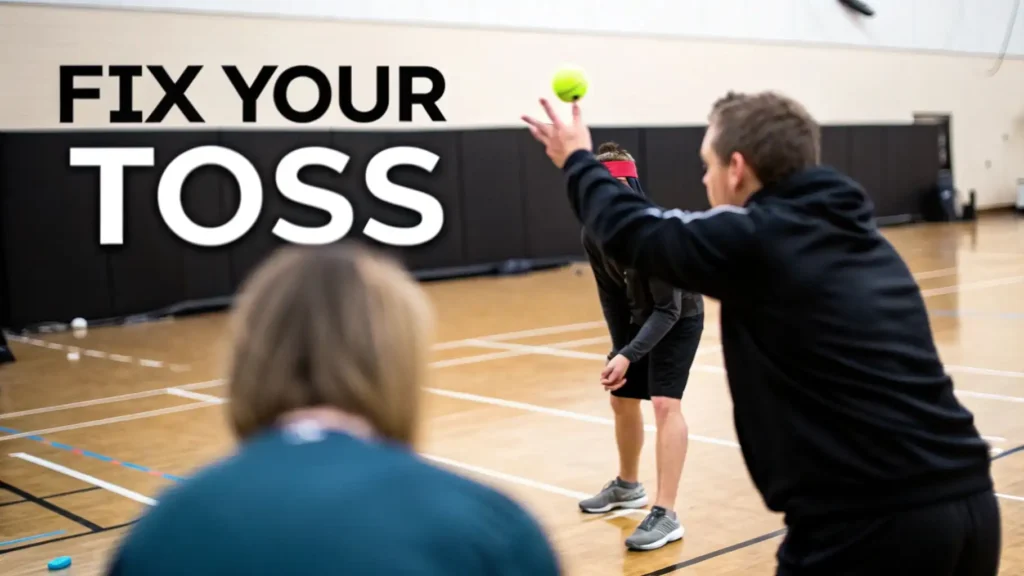
One of the most persistent problems I see on the court is an inconsistent ball toss. If your toss is all over the place, you’re forced to adjust your swing on the fly every single time. That leads to miss-hits, a major loss of power, and a whole lot of frustration. A shaky toss is almost always caused by an overactive wrist or a bent elbow, introducing way too many moving parts into what should be a simple motion.
Fixing the Unreliable Ball Toss
To build that rock-solid consistency you’re after, you have to simplify the toss. The goal is to make your non-hitting arm act like an elevator, just lifting straight up from the shoulder. Keep your arm relaxed and straight, with the ball resting gently on your fingertips—never squeeze it in your palm.
Give this simple drill a try:
- Go to the service line, but leave your racket behind for now.
- Put a cone (or just your racket head) on the ground exactly where you’d want the ball to land for a perfect flat serve. This is usually slightly in front of your lead foot.
- Practice tossing the ball with that straight-arm motion, trying to get it to land right on your target without moving your feet.
- Do this 10-15 times before you even think about swinging. You’re building crucial muscle memory here.
This drill basically forces you to use your shoulder for the lift, taking that flicky, unreliable wrist out of the equation. Once you can nail the target consistently, your brain starts to lock in what a perfect toss actually feels like.
Curing the Dreaded Waiter’s Serve
Another incredibly common and power-sapping flaw is what we call the “waiter’s serve.” This is when a player opens their racket face up to the sky way too early, looking like a waiter carrying a tray of drinks. This move completely kills the powerful shoulder rotation and forearm pronation that generates serious racket-head speed.
The root of this problem is usually an improper racket drop and a failure to hit a good trophy pose. When your body doesn’t coil correctly, the arm tries to compensate by just muscling the ball over the net. It’s a weak “pushing” motion and a surefire way to strain your shoulder.
To fix this, you have to get a feel for the racket dropping on its edge.
- The Shadow Swing Drill: Stand sideways and just go through your serving motion slowly, without hitting a ball. When you get to the trophy pose, consciously let the racket head drop behind your back. The key is to make sure the strings are pointing to the side, not up at the sky.
- Feel the “Scratch”: As the racket drops, you should feel the edge of the frame almost “scratching” your back. This is your checkpoint—it confirms you’re in the right loaded position to uncoil with maximum force.
Crucial Insight: Real serving power doesn’t come from pushing the ball. It’s generated by the rapid uncoiling of your body and the whip-like pronation of your forearm as you make contact. The waiter’s serve eliminates this entire sequence.
Overcoming Weak Leg Drive and a Short Follow-Through
Finally, a huge amount of power gets left on the table when players either forget about their lower body or cut their motion short. A serve that relies only on the arm is always going to be a weak serve. Think of your legs as the engine; they need to drive explosively upward to kickstart the whole kinetic chain.
A short, jerky follow-through is another big one. Players often slam on the brakes right after contact, which not only robs them of speed but also puts a ton of stress on the shoulder joint. A full, relaxed follow-through is the sign of an efficient motion because it lets your arm decelerate safely.
Here are two quick checkpoints you can use:
- Jump and Serve: Really focus on jumping up and into the court as you hit. This drill forces you to engage your legs. You should feel your whole body moving forward through the shot, not falling backward.
- Finish with Style: Make a conscious effort to finish your follow-through with the racket ending up down by your opposite hip. This encourages a fluid, complete swing and protects your shoulder by spreading the deceleration forces across your entire body.
Fixing these fundamental flaws in your tennis serve techniques will pay off in a big way.
Common Questions (and Real Answers) About the Serve
Look, even with the best instruction in the world, you’re going to have questions. The serve is a tricky, multi-part motion, and it’s totally normal for things to feel a little “off” as you work on it. This is where we get into the nitty-gritty—the stuff that comes up on the court when you’re trying to put all the pieces together.
Think of this as your own personal coaching session. Let’s tackle the hurdles I see players struggle with time and time again.
How Can I Get More Speed Without My Control Going Out the Window?
This is the million-dollar question, isn’t it? Everyone wants a bigger serve, but a 100 mph serve that lands six feet out is just a fast way to lose a point. The secret isn’t about muscling the ball with your arm; it’s about channeling energy efficiently.
True power starts from the ground up. You need an explosive leg drive to initiate the entire sequence. That energy then whips up through your hips and torso as they rotate. But the real magic, the part that generates that satisfying “pop,” is forearm pronation. It’s that natural, lightning-fast inward snap of your forearm right through the contact point. It’s a whip, not a push.
To get a feel for this, try serving at about 70% effort. Backing off the gas allows you to focus on the fluid motion and proper mechanics without getting tense. Once that smooth, whip-like action feels second nature, you can start adding pace. A controlled 90 mph ace is infinitely better than a wild miss.
My Ball Toss Is a Mess. Why Can’t I Get It Consistent?
An inconsistent toss will kill your serve before you even start your swing. It’s the single biggest saboteur of a reliable serve, period. If you’re constantly chasing your toss, you’ll never develop a repeatable motion.
Nine times out of ten, the problem is a jerky elbow or a flick of the wrist. You’re trying to throw the ball up instead of placing it.
The fix? Simplify everything. Your tossing arm should be straight, relaxed, and act like an elevator rising smoothly from your shoulder. Don’t grip the ball in your palm; rest it gently on your fingertips. Now, just lift.
Here’s a can’t-miss drill: Take your racket and lay it on the court where you want the ball to land. Now, stand in your service stance and, without swinging, practice tossing the ball so it lands right on the racket strings. Do it ten times in a row. Once you master the toss, the rest of the serve becomes dramatically easier.
What’s the Actual Difference Between a Kick and a Slice Serve?
Great question. Both are spin serves, but they have completely different missions on the court, and that comes down to the swing path and how the racket “brushes” the ball.
The Slice Serve: Think of brushing the side of the ball, like you’re hitting it from the 3 o’clock to the 9 o’clock position. This creates sidespin. The ball will curve sharply in the air (away from a righty’s forehand) and skid low after the bounce. It’s the perfect tool for dragging your opponent way off the court to open things up.
The Kick Serve: This is all about brushing up the back of the ball, more like a 7 o’clock to 1 o’clock motion. This creates heavy topspin (and some sidespin). The ball dives down into the box with a high margin of safety, then kicks up high and away from the returner, forcing a weak, defensive reply. It’s the king of second serves for a reason.
Mastering these techniques isn’t just about the physical grind; it’s about staying focused and mentally sharp. For more on that, check out our guide on mental health and self-care tips for athletes. A clear mind is just as crucial as a clean service motion.
At maxijournal.com, we’re dedicated to bringing you clear, actionable insights across a wide range of topics, from sports and health to technology and the arts. Explore more articles and join our community of curious readers at https://maxijournal.com.
Discover more from Maxi Journal
Subscribe to get the latest posts sent to your email.