Is there an end to the universe? The short answer is yes, probably—just not in the way you might be picturing. The question isn’t about flying a spaceship to some cosmic wall at the edge of everything. It’s actually about two completely different ideas: one about space, and one about time.
Decoding the End of the Universe
When we talk about the “end,” we’re really juggling two separate questions. Getting the distinction straight is the first step toward understanding where all of this is headed. One question deals with the physical layout of the cosmos, while the other is about its ultimate destiny.
An Edge in Space?
First, let’s tackle the idea of a physical boundary. Does the universe have an edge you could fall off of? The scientific consensus right now is a firm no. Most of our observations suggest the universe is “flat” and likely stretches on infinitely in every direction.
Even if it is finite, that doesn’t mean it has a border. Think about sailing across the ocean on Earth. You can travel in a straight line forever and you’ll never hit a “wall”—you just loop back around to where you started. A finite universe could work the same way, just in more dimensions.
To help clarify this, let’s break down the two ways we can interpret this question.
Two Meanings of the Universe’s End
| Type of ‘End’ | Guiding Question | What It Means for the Cosmos |
|---|---|---|
| Spatial End | Does the universe have a physical boundary or edge? | Is there a point where space itself stops? |
| Temporal End | Will the universe exist forever as it is now? | Is there a final state or transformation awaiting the cosmos in the distant future? |
As you can see, one is a question of cosmic geography, while the other is a question of cosmic destiny. It’s this second question where things get really interesting.
The Question of Time and Destiny
The second, far more dramatic question is about the universe’s ultimate fate. Will it look more or less the same a trillion years from now, or is it hurtling toward a radical transformation? This is where the real cosmic drama lies.
Cosmologists have cooked up several powerful theories describing how our universe might meet its final act. These aren’t just wild guesses; they’re grounded in physics and supported by what we see happening in the cosmos right now.
The star of this show is dark energy, a mysterious force making up about 68% of the universe. It’s the stuff causing space to expand faster and faster. Whatever dark energy turns out to be will almost certainly seal our fate.
The question is no longer if the universe will end, but how. The evidence overwhelmingly points toward a universe in constant, accelerating change, leading to an eventual, definitive transformation.
Scenarios for a Cosmic Finale
The ultimate destiny of everything is one of the biggest questions in all of science. In this guide, we’ll walk through the leading theories that scientists are debating today. These potential cosmic futures include:
- The Big Freeze (or Heat Death): A slow, quiet fade into a cold, dark, and empty void as the universe expands forever.
- The Big Crunch: A dramatic reversal where gravity wins, expansion grinds to a halt, and everything collapses back in on itself.
- The Big Rip: A violent finale where dark energy grows so powerful it tears apart galaxies, stars, planets, and eventually every single atom.
By looking at the evidence for each of these scenarios, we can start to piece together a clearer picture of where our cosmic journey is taking us.
The Big Freeze: A Slow Fade to Black
Out of all the ways our universe could end, the Big Freeze is currently the top contender. Sometimes called the Heat Death, it’s not some dramatic, fiery explosion. Think of it more as a slow, quiet, inevitable fade into absolute darkness. This scenario is the cornerstone of our Standard Model of Cosmology because it lines up perfectly with what we see today: a universe that’s expanding, and that expansion is speeding up.
Picture the cosmos as a vast piece of dark fabric. Something we call dark energy is constantly pulling on this fabric, stretching it out in every direction. This relentless expansion means that everything not gravitationally tethered to us—every distant galaxy, every far-flung cluster—is being shoved farther and farther away. Over billions of years, they’ll recede so far, so fast, that their light will simply never reach us again.
The Lights Go Out
The first stages of the Big Freeze will be almost unnoticeable. For any civilization looking up at the sky, the view will just get emptier over cosmic timescales. Distant galaxies will slip over the cosmic horizon, their light stretched into nothingness.
Eventually, the universe’s raw fuel for making new stars—all the interstellar gas and dust—will be used up. No new stars will ignite. The ones that are still shining will begin to burn out one by one, like the last embers of a dying fire.
The ultimate fate of the universe isn’t a sudden cataclysm but a quiet, drawn-out process of thermodynamic equilibrium. It’s a future where activity ceases, energy dissipates, and everything settles into a final, unchanging state of cold and darkness.
The leading theory, which is backed by the Lambda-CDM model, suggests that expansion will win the cosmic tug-of-war for good. This is mostly thanks to dark energy, which makes up about 68% of the cosmos. Ever since Edwin Hubble’s 1930s discovery that galaxies are flying away from us, we’ve learned the universe just doesn’t have enough stuff in it for gravity to ever pull it all back together. It would need about 17 times more matter than we’ve ever observed.
The result? In about 100 billion years, star formation will have completely stopped, leaving behind only the cold remnants of what once was. You can dive deeper into the data shaping this cosmic forecast by reading up on the ultimate fate of the universe.
A Universe of Remnants
Once the very last star has flickered out, the universe will enter a new, dark era dominated by what’s left behind. The future will be populated only by the quiet ghosts of stars.
- White Dwarfs: The dense, cooling cores left over from stars like our Sun.
- Neutron Stars: The incredibly compact remains of much larger stars.
- Black Holes: The final stop for the most massive stars, where gravity is so intense that not even light can get out.
This “degenerate era” will last for an almost unimaginable stretch of time. Over trillions upon trillions of years, these stellar corpses will slowly cool off and radiate away whatever energy they have left, eventually becoming inert black dwarfs. The universe will be a silent graveyard, its silence broken only by the rare, random collision of these dark objects.
Even black holes, the undisputed champions of gravity, aren’t forever. According to the theory of Hawking radiation, they too will eventually evaporate. This process is unbelievably slow—a supermassive black hole from a galaxy’s center might take 10^100 years to finally disappear.
After the last black hole has fizzled out into a faint puff of particles, the universe will at long last approach its ultimate state: heat death. The cosmos will be a nearly perfect vacuum—a vast, cold, and uniform void chilling out near absolute zero. In this final state, no work can be done, no information can be sent, and time itself may lose all meaning. This is the end the Big Freeze predicts—not with a bang, but with an endless, silent whimper.
The Big Rip: A Violent End for Spacetime
While the Big Freeze offers a slow, quiet fade into nothingness, another theory paints a far more violent picture. This scenario, known as the Big Rip, isn’t a gentle slide into darkness. It’s a terrifying crescendo where the very fabric of spacetime gets torn to shreds. It all comes down to a different flavor of dark energy.
Instead of the steady, constant push we usually associate with dark energy, the Big Rip imagines a runaway version called phantom energy. Think of it like inflating a balloon, but the air pressure isn’t constant—it gets stronger every single second. At first, the expansion is manageable. But soon, the pressure becomes so immense that the rubber simply can’t hold on, and the whole thing explodes.
Phantom energy would work the same way, getting more potent and more repulsive over time. Eventually, its outward shove would become so powerful that it would overwhelm every other force in the universe, including the gravity holding everything—from galaxies to atoms—together.
The Countdown to Cosmic Oblivion
If the Big Rip is our destiny, the end won’t happen all at once. It would be a progressive, systematic demolition of cosmic structures, starting with the biggest and working its way down to the subatomic level in the final moments.
This terrifying countdown would unfold in stages:
- Galaxy Clusters Unbound: First, the immense gravity holding together huge clusters of galaxies would give way. Entire clusters would fly apart as phantom energy wins the cosmic tug-of-war.
- Galaxies Unravel: Next up, individual galaxies like our own Milky Way would be dismantled. Stars would be flung out into the rapidly expanding void, their ancient orbits shattered forever.
- Solar Systems Disintegrate: The gravitational bonds within solar systems would be the next to snap. Planets would be torn away from their host stars and sent careening into the darkness.
- Worlds Shatter: Eventually, the repulsive force of phantom energy would become so dense that planets and stars themselves couldn’t hold their own shape. They would explode, ripped apart by the runaway expansion of space itself.
This timeline illustrates the slow progression of the Big Freeze, where cosmic expansion leads to a cold, dark end.
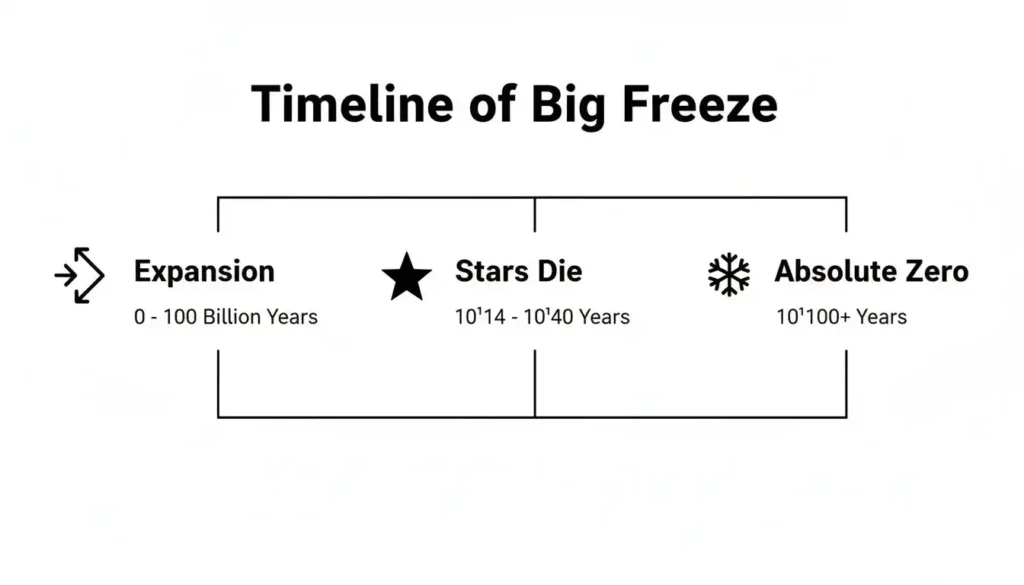
The visualization shows a universe that expands until all stars die out, ultimately reaching a state of absolute zero.
The Physics of Phantom Energy
This isn’t just a wild sci-fi idea; it’s grounded in real cosmological equations. The Big Rip’s fate hinges on a value cosmologists call the equation of state parameter, or w. This number basically describes dark energy’s pressure relative to its density. In the standard cosmological model that leads to the Big Freeze, w is exactly -1.
But what if future observations show that w is just a tiny bit less than -1—say, -1.01? That’s when dark energy becomes “phantom.” Its density would actually increase as the universe expands, triggering that runaway effect. Some calculations suggest that if w is negative enough, the Big Rip could happen in as little as 22 billion years. You can dive deeper into how scientists are tearing apart the universe with these calculations.
In the final fraction of a second, the phantom energy would overpower the strong nuclear force. Atoms themselves would be ripped apart into their constituent protons, neutrons, and electrons, reducing all of existence to a sea of fundamental particles flying apart faster than light.
Right now, our best measurements of w put it incredibly close to -1, but there’s still a margin of error. This means the Big Rip, while definitely considered the underdog compared to the Big Freeze, remains a physically possible end for our universe. As our telescopes get better and our data gets sharper, we’ll either rule out this dramatic finale for good or find the first hints that our cosmos is headed for a truly spectacular end.
The Big Crunch: An Old Theory’s Surprising Comeback
For a long time, the Big Crunch was the reigning champ of cosmic endings. It was the perfect, symmetrical bookend to the Big Bang—an idea with a certain elegant logic.
Think about throwing a ball into the air. It shoots upward, fights gravity, slows down, hangs for a split second, and then falls right back to where it started. The Big Crunch suggested the entire universe would do the same. The initial shove of the Big Bang sent everything flying apart, but if there was enough “stuff” (mass) in the cosmos, its collective gravity should eventually win the tug-of-war, halt the expansion, and pull everything back in.
A Universe in Rewind
In this scenario, the cosmic movie would play in reverse. Galaxies would stop their headlong rush away from us and begin hurtling back toward one another. Over billions of years, the universe would shrink, getting hotter and denser until it ended in a final, violent collapse—crushing all matter and energy back into the single, infinitely hot point from which it all began.
This theory just felt right. It had a neat, tidy sense of balance. Some physicists even took it a step further, proposing a cyclical universe where our Big Crunch would ignite the next Big Bang in an endless cosmic rebirth.
But science cares more about evidence than poetry. In the late 1990s, astronomers studying distant supernovae found something that blew everyone’s mind: the expansion wasn’t slowing down. It was speeding up. This bombshell discovery led to the idea of dark energy and seemed to hammer the final nail in the Big Crunch’s coffin. The theory was tossed onto the scrap heap of cosmic history.
The Return of the Crunch
So, why are we even talking about it? Because in science, you never say never. The Big Crunch is making a tentative comeback, all thanks to one giant cosmic mystery: dark energy. We know something is pushing the universe apart, but we have almost no idea what it is or if it will behave the same way forever.
What if dark energy isn’t a constant? What if it’s a dynamic field that can change over time? This is where the plot thickens.
“The central idea is that dark energy is not constant, but instead its strength varies over time. If its repulsive force weakens enough, or even flips to become attractive, gravity could regain control and trigger a cosmic collapse.”
Suddenly, the door for the Big Crunch is cracked open again. If dark energy decays or switches sides, the universe’s expansion could slow, stop, and reverse. The “ball” would finally come plummeting back down.
New Clues and Cosmic Timelines
This isn’t just wild speculation, either. Fresh data from heavy hitters like the Dark Energy Survey (DES) in Chile and the Dark Energy Spectroscopic Instrument (DESI) in Arizona is challenging old assumptions. Some models even propose that dark energy’s behavior is tied to hypothetical particles called axions. These particles could provide a constant push now but eventually tip the scales toward a negative, attractive force later on.
Physicist Henry Tye at Cornell did the math on one such model, predicting a Big Crunch could be in our future—about 20 billion years from now. That would put the universe’s total lifespan at a cool 33 billion years. You can dive into the nitty-gritty of this forecast and see how physicists predict a Big Crunch end for the universe.
This cosmic endgame would be the ultimate reversal of fortune.
- The Turnaround: First, the accelerating expansion would grind to a halt over billions of years.
- The Contraction: Then, the cosmos would begin its long, slow fall inward as galaxies rushed toward a single point.
- The Final Moment: In its last moments, the universe would become a blazing inferno, ripping atoms apart before collapsing into a final singularity.
While the Big Freeze remains the frontrunner, the quiet resurrection of the Big Crunch is a potent reminder of how much we still don’t know. Our cosmic fate isn’t written in stone just yet.
How We Search for Clues to the Universe’s Fate
The grand cosmic theories—the Big Freeze, Big Rip, and Big Crunch—aren’t just wild speculation. They’re built on decades of painstaking observation and cosmic-scale detective work. Since we can’t fast-forward time to see what happens, scientists have to get clever, using powerful tools to look back in time and across immense distances to piece together our ultimate destiny.
So how do they do it? To figure out where the universe is heading, cosmologists focus on a few key pieces of evidence. Think of them as cosmic clues that help build and test the models that predict our future.
Reading the Universe’s Baby Pictures
One of the most powerful tools we have is the Cosmic Microwave Background (CMB). This is the universe’s baby picture, a faint glow of light left over from the Big Bang just 380,000 years after it all began. This ancient light fills all of space, giving us a perfect snapshot of the infant cosmos.
By studying tiny temperature fluctuations in the CMB, scientists can learn incredible things about how the universe was structured at the very beginning. These tiny variations in temperature seeded the formation of galaxies and everything we see today, influencing how the universe has expanded over the last 13.8 billion years. The data from the CMB strongly suggests our universe is geometrically “flat,” a critical finding that favors the endless expansion seen in a Big Freeze scenario.
The Cosmic Microwave Background isn’t just a historical artifact; it’s a blueprint for the future. The patterns encoded within this ancient light set the initial conditions for the cosmic tug-of-war between gravity and dark energy that will determine our ultimate fate.
Standard Candles and Cosmic Distances
Another crucial technique is using “standard candles”—celestial objects with a known, consistent brightness. The most famous of these are Type Ia supernovae, which are the spectacular explosions of white dwarf stars. Because they all go off with nearly the same intrinsic luminosity, astronomers can use them like cosmic light bulbs.
By comparing how bright a supernova appears from Earth to its known true brightness, we can calculate its distance with astonishing precision. This is exactly how, in 1998, two separate teams of scientists made a shocking discovery: not only is the universe expanding, but its expansion is speeding up. This was the first direct proof of dark energy, the mysterious force now at the heart of every “end of the universe” theory.
Mapping the Cosmic Web
To get a better handle on how dark energy is behaving right now, scientists are undertaking massive projects to map the universe in three dimensions. Surveys like the Dark Energy Spectroscopic Instrument (DESI) are in the process of creating the largest 3D map of the cosmos ever, charting the precise locations of tens of millions of galaxies.
These maps show us the “cosmic web”—the large-scale structure of the universe, with its vast voids and long filaments of galaxies. By measuring how galaxy clusters are distributed and how that pattern has evolved over billions of years, we can track the history of cosmic expansion with incredible detail. This helps nail down the properties of dark energy, getting us closer to knowing if it’s a constant force (leading to a Big Freeze) or something more volatile that might cause a Big Rip.
If you’re fascinated by how we process such vast amounts of cosmic data, you might be interested in our guide to the essentials of data science.
The Hubble Tension: A Cosmic Puzzle
Even with all these powerful methods, a major puzzle has emerged that could rewrite everything we think we know. It’s called the Hubble Tension. Simply put, our two best ways of measuring the universe’s current expansion rate—the Hubble Constant—are giving us two different answers.
- Early Universe Method: When we use data from the CMB (the universe’s baby picture) to predict how fast the universe should be expanding today, we get one value.
- Late Universe Method: When we measure the expansion rate directly using supernovae and other objects in the nearby, “late” universe, we get a different, slightly faster value.
This isn’t just a rounding error; it’s a nagging disagreement that hints our standard model of cosmology might be missing something important. Solving the Hubble Tension could reveal new physics, a different nature for dark energy, or, ultimately, a completely different answer to the question of how the universe will end.
Beyond Our Universe’s End: What About Shape and Multiverses?
So far, we’ve looked at the dramatic ways our own universe might end. But what if the question “is there an end to the universe” is bigger than just our cosmic bubble? To really stretch our minds, we need to zoom out and grapple with two genuinely mind-bending ideas: the universe’s overall shape and the possibility that it’s not the only one.
First, let’s talk about the shape, or topology, of the cosmos. As we touched on earlier, this has nothing to do with a literal “edge” but everything to do with the fundamental geometry of spacetime. All our best evidence currently points to a “flat” universe, which suggests it just keeps going, forever.
But that’s not the only option on the table, and the alternatives are pretty wild.
The Shape of Everything
To make this easier, picture space as a simple two-dimensional surface. Its geometry could take one of three basic forms, and each one completely changes the answer to whether space is finite or infinite.
- Flat (like a sheet of paper): This is the leading theory. In a flat universe, two parallel lines will stay parallel forever. Spatially, this means the universe is infinite. There’s no physical boundary.
- Closed (like the surface of a sphere): If there’s enough mass and energy, gravity would eventually curve spacetime back onto itself. This kind of universe is finite but has no boundary. If you traveled in a perfectly straight line, you’d eventually end up right back where you started.
- Open (like a saddle): In this scenario, spacetime curves outward. Parallel lines would drift further and further apart over cosmic distances. Just like a flat universe, this one would also be infinite.
Our observations strongly favor a flat universe, which fits neatly with the endless Big Freeze scenario. But the universe’s geometry is just one piece of a much, much larger puzzle. What if our entire cosmos is just a tiny part of a grander reality?
Are We Living in a Multiverse?
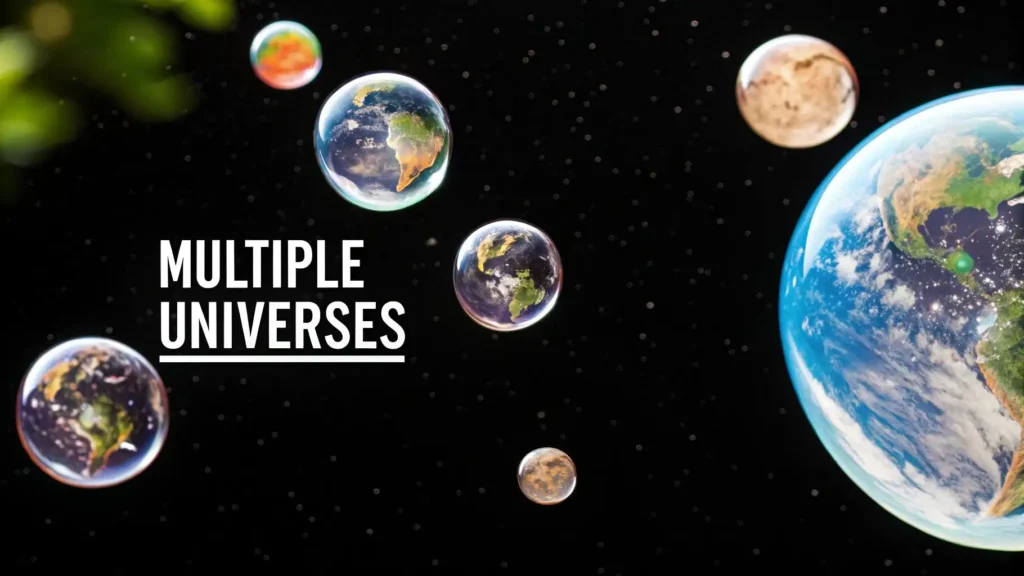
The idea of a multiverse—that our universe is just one among many—has moved from science fiction to theoretical physics. It’s not just a cool trope for movies; it’s a concept that naturally pops out of some of our most advanced cosmological theories, especially eternal inflation.
Eternal inflation proposes that the Big Bang wasn’t a one-off event. It pictures an endless, inflating “ocean” of spacetime that is constantly spawning new “bubble” universes. Each of these bubbles could have its own unique set of physical laws.
Think about what that means. While our universe might be destined for a quiet, cold end, it could be just one of countless others. Some of those other universes might be collapsing in a Big Crunch as we speak. Others could be getting ripped apart by a Big Rip. Some might have physics so bizarre that stars could never form or where gravity works in reverse.
This adds a profound philosophical layer to our whole question. The end of our universe, whether it’s trillions or just billions of years away, might not be the end. It could simply be one chapter closing in an infinitely large cosmic book. It’s a perspective that reminds us that even when we ponder the ultimate end, there might always be another beginning just beyond the horizon of what we can see.
Answering Your Cosmic Questions
After a journey through such vast, mind-bending possibilities, it’s completely normal to have a few questions buzzing around. Let’s tackle some of the most common ones and bring these cosmic ideas back down to Earth.
So, Will the Universe Definitely End?
In a word, yes. At least, the universe as we know it is destined for a fundamental transformation in the unimaginably distant future. The concept of an “end” doesn’t mean it will just vanish into nothingness. Instead, it will evolve into a state where stars, galaxies, and life as we understand them are simply impossible.
The leading theory, based on everything we know about dark energy, points to a Big Freeze, also known as Heat Death. In this scenario, the cosmos slowly fades into a cold, dark, and utterly empty void. But science is never static. New discoveries could always shift the odds toward a more dramatic finale, like a Big Crunch or a Big Rip.
Which Theory About the Universe Is Most Likely?
Right now, the Big Freeze is the clear frontrunner. It just fits so well with the Standard Model of Cosmology and our best observations, especially the data we’ve gathered from the Cosmic Microwave Background. All the evidence shows the universe’s expansion is speeding up, which is exactly what you’d expect if a constant dark energy is pushing everything apart.
That said, the “most likely” theory is always a moving target, waiting for the next big piece of data to come in.
While the Big Freeze has the strongest evidence today, cosmology is a field full of surprises. A slight, unexpected measurement in the nature of dark energy could easily elevate a competing theory from a long shot to a serious contender overnight.
Does the Universe Have an Edge?
Nope, there is no physical edge or boundary to fall off of. Our best evidence strongly suggests the universe is geometrically “flat,” which means it most likely stretches out infinitely in all directions.
Even if it turned out the universe was finite, it would probably be “closed” in on itself, like the surface of a sphere. You could travel in a straight line forever and eventually loop right back to where you started, never hitting a wall. In either mainstream scientific view, the idea of sailing off the edge of the cosmos is pure science fiction. If you’re tackling big questions like this for a project, check out our guide on how to write a research paper without the stress.
At maxijournal.com, we dive deep into the fascinating questions that shape our world, from the edge of the universe to the latest in technology and culture. Explore our daily articles for more insights that spark your curiosity at https://maxijournal.com.
Discover more from Maxi Journal
Subscribe to get the latest posts sent to your email.