A science and technology magazine isn’t just a collection of articles; it’s a bridge. It takes the often dense, complex world of scientific research and technological breakthroughs and translates it all into engaging, understandable stories for the rest of us. Think of these magazines as expert curators, sifting through the noise in fields like AI, health, and space exploration to show you what really matters.
What Is a Science and Technology Magazine Today

The best way to picture a modern science and tech magazine is as a skilled interpreter. Its core job is to close the gap between the professional laboratory and natural human curiosity. In a world overflowing with information, these publications perform a critical service by digging through thick academic papers and technical press releases.
They hunt down the most important developments and wrap them in context, clarity, and a compelling story. This is how abstract data becomes something that clicks with readers, showing how a discovery made halfway across the world could one day change their daily lives.
Beyond Print Pages
The idea of a “science magazine” has exploded far beyond its paper-and-ink roots. Today, these publications are vibrant digital hubs that offer a rich, multimedia experience designed for how we consume content now. This shift is crucial for making complex subjects feel less intimidating.
Instead of just pages of text, you’ll now find:
- Interactive Infographics: These aren’t just pictures; they’re hands-on tools that let you play with data and see how complex systems work.
- Video Documentaries: Short films that can take you right inside a research lab or use slick animations to explain a tough concept.
- Engaging Podcasts: Nothing beats hearing from the source. These podcasts feature interviews with the leading scientists and engineers who are actively shaping our future.
This multi-platform approach makes sure that scientific knowledge isn’t locked away for an exclusive club but is open to anyone with a curious mind. You can dive deeper into this world by checking out our articles on the latest developments in science.
A great science and technology magazine does more than report facts; it ignites curiosity. It connects the dots between a lab experiment and its potential to change the world, making readers feel like part of the journey of discovery.
Ultimately, these magazines help create a more informed public. By delivering reliable, well-researched information, they give readers the tools to understand the forces shaping our world, from medical advances to the thorny ethical debates surrounding artificial intelligence. They are absolutely vital for building scientific literacy.
How Digital Media Transformed Scientific Publishing

The leap from glossy print pages to interactive digital platforms has completely rewired the landscape for science magazines. It’s a shift that has democratized knowledge, pulling groundbreaking research out of exclusive academic circles and putting it into the hands of anyone with an internet connection. A huge driver behind this was the audience’s growing hunger for more dynamic, engaging content.
Online publishing offers an undeniable edge, especially in fast-moving fields like genetics or AI. Discoveries can now be shared globally in minutes, not months, radically accelerating the pace of innovation and public awareness. It’s a world away from the static, lengthy timelines of traditional print.
The Shift To Dynamic Engagement
Going digital wasn’t just about changing the delivery method; it transformed the entire experience. Today’s readers expect a lot more than just text on a page. Modern platforms for a science and technology magazine are built from the ground up for interaction and rich media.
This new model is packed with features that were simply impossible in print:
- Multimedia Integration: Think videos showing experiments in action, podcasts with leading researchers, and interactive data visualizations that bring complex topics to life.
- Open-Access Models: A growing number of publications are now offering articles for free, tearing down the paywalls that once restricted access to crucial scientific information.
- Personalized Content Streams: Digital tools, often powered by AI, can now create a custom reading journey for you, suggesting articles based on your specific interests.
This richer, more accessible approach has made scientific conversations far more inclusive and engaging for a much broader audience. If you’re curious about the engines behind these recommendations, you might be interested in our deep dive in this complete explainer on data science for beginners.
Market Growth And Accessibility
This digital movement isn’t just a trend; it’s a massive economic engine. The global scientific and technical publication market hit a staggering $12.20 billion in 2024 and is on track to reach $13.76 billion by 2033. This growth is overwhelmingly driven by online platforms that expand accessibility and market reach.
Right now, North America is leading the charge, commanding over 35% of the market share, thanks in part to heavy adoption by universities and research institutions. You can explore more data on how digital platforms are driving the scientific publication market.
The transition to digital publishing did more than put magazines online; it fundamentally changed the relationship between the publisher, the scientist, and the public. It created a dynamic ecosystem where information flows faster and more freely than ever before.
What this all means is that a science and technology magazine is no longer just a passive source of information. It’s an active community hub where readers can comment, share, and discuss the latest breakthroughs. This fosters a more vibrant and informed global conversation about our shared future, and the digital format ensures these critical stories reach the widest possible audience.
The Anatomy of a Great Science Magazine
Ever wonder what makes a top-tier science and technology magazine tick? Think of it less like a collection of articles and more like a carefully crafted experience. Each section has a job to do, but they all flow together to create something that both informs and genuinely sparks curiosity. Once you understand the moving parts, you can spot a quality publication from a mile away.
The main event, of course, is the feature articles. These are the deep dives, the cover stories that really sink their teeth into a subject. A feature on gene editing, for instance, won’t just throw the science at you. It’ll introduce you to the researchers behind the breakthroughs, unpack the ethical minefield, and explore what it could all mean for our daily lives.
Core Content Pillars
But a magazine can’t survive on blockbuster features alone. To keep you coming back, it needs variety. The best ones are built on a few other pillars that deliver fresh information for every mood and time constraint.
First up, you’ll almost always find a news section. These are quick, punchy updates on the latest discoveries, studies, and tech rollouts. They’re the pulse of the magazine, covering everything from a newly spotted exoplanet to a major leap in battery chemistry. This is your “what’s happening right now” briefing.
Then there’s the expert interview or opinion column. This is where the human element really shines through. Hearing a leading astrophysicist get excited about the future of space exploration or reading a sharp critique of AI development adds a personal perspective that pure reporting just can’t deliver.
To give you a clearer picture of how these sections come together, here’s a quick breakdown of what you can expect to find inside the average science and tech publication.
Key Sections Found in Modern Science and Technology Magazines
| Section Type | Primary Goal | Example Content |
|---|---|---|
| Feature Articles | Provide in-depth, long-form exploration of a single, significant topic. | A 10-page story on the race to build a quantum computer. |
| News Briefs | Deliver timely, short updates on recent discoveries and industry events. | A 200-word summary of a new study on plastic-eating bacteria. |
| Expert Columns | Offer a personal, authoritative perspective on a current issue or trend. | An opinion piece by a bioethicist on the future of human cloning. |
| Interviews | Give readers direct access to the thoughts of leading figures in the field. | A Q&A with the lead engineer of NASA’s latest Mars rover. |
| Reviews | Help readers navigate new products, books, and media. | A hands-on review of a new consumer drone or a critique of a science documentary. |
| “How It Works” | Break down complex scientific or technological concepts in an accessible way. | A visual infographic explaining how mRNA vaccines function. |
As you can see, each part plays a specific role in creating a well-rounded reading experience, guiding you from quick updates to deep analysis.
Reviews and Exploratory Content
Finally, the best magazines know that science and tech don’t exist in a vacuum. They’re part of our culture, which is where reviews and more foundational content come into play.
- Book Reviews: These sections vet the latest science and tech books, helping you decide what’s worth adding to your nightstand.
- Gadget and Tech Reviews: From lab gear to the newest smartphone, these articles offer hands-on analysis of the tools shaping our world.
- Explanatory Sections: Often called something like “The Basics” or “Explained,” these pieces demystify fundamental concepts for readers, building a solid knowledge base.
A truly exceptional science magazine doesn’t just present facts; it curates an intellectual journey. Each section is a deliberate step, guiding the reader from breaking news to deep analysis and finally to thoughtful reflection on what it all means for our future.
Once you start recognizing these distinct components—the news, the features, the columns, and the reviews—you’ll have a much better handle on how a great magazine is put together. And with that knowledge, you can easily find the one that perfectly fuels your own curiosity.
How to Choose the Right Magazine for You
Finding the perfect science and technology magazine isn’t about grabbing the one with the flashiest cover. It’s about finding a publication that clicks with your personal curiosity. With a sea of options out there—from broad, reader-friendly publications to dense academic journals—the real trick is to know what you’re looking for. A good first step? Think about your own expertise and what you want to get out of reading.
Are you a casual reader just looking to keep up with the biggest breakthroughs? Or maybe you’re a pro in your field and need to stay on top of the latest research. Answering that one question will instantly cut the field of choices down to size.
Define Your Interests and Scope
First off, think about the magazine’s scope. Some publications, like Scientific American or Wired, cast a wide net, covering everything from astrophysics to AI, sometimes in the very same issue. These are fantastic if you have a broad curiosity and love seeing how different fields connect.
Then you have the specialists. You can find magazines laser-focused on niche topics like astronomy, bioengineering, or software development. If you’re passionate about one particular subject, a specialized magazine offers a level of depth and detail a generalist publication just can’t touch.
To figure out your best fit, ask yourself a few questions:
- Do I like learning a little bit about a lot of different things?
- Is there one specific area of science or tech I really want to dive deep into?
- Am I more interested in practical, real-world applications or the heavy theoretical stuff?
Assess the Audience and Voice
Once you’ve got the scope figured out, it’s time to check out the magazine’s intended audience and editorial voice. This is key to making sure the content hits the right note for you. It’s like picking a tour guide for a trip—you want someone who speaks your language.
The best science magazine for you is one that feels like a conversation you want to be a part of. It should challenge you just enough to keep you engaged without making you feel overwhelmed or talked down to.
For example, a magazine targeting academics is going to be packed with dense, peer-reviewed articles loaded with technical jargon. On the flip side, a magazine for the general public, like Popular Science, will use analogies and great storytelling to make complex ideas feel exciting and easy to grasp. The tone can swing from super formal to witty and conversational. The best way to get a feel for a magazine’s personality is to spend a few minutes reading sample articles on their website. See if it resonates with you.
Verify Credibility and Digital Presence
Finally, in an era where anyone can publish anything, credibility is everything. Look for magazines that are transparent about their sources, feature articles by actual experts, and have a solid editorial reputation. A quality science and tech publication isn’t afraid to show its work and be open about its review process.
A magazine’s digital presence is also a huge tell these days. The industry is making a major move online, with digital sales becoming a massive revenue driver. This market is expected to hit $5,500 million by 2025, all thanks to the demand for credible, easy-to-access research. You can learn more about the growth of the science magazine market to see just how big this shift is. A slick website with deep archives, video content, and active social media channels is usually the sign of a healthy, forward-looking publication.
How to Pitch Your Story and Get Published
Making the jump from being an avid reader to a published contributor is a goal for many, and it’s a lot more doable than you might imagine. The secret isn’t just about having a brilliant idea; it’s about framing that idea in a way that makes an editor’s life easier. And that process always starts with some serious homework.
Before you write a single word of your pitch, you need to become a student of your target magazine. Get your hands on at least five or six recent issues and really soak them in. Pay close attention to the tone, the article structure, and the level of expertise they expect from their writers. This is how you learn to speak their language.
Crafting the Perfect Query Letter
Your query letter—your pitch—is your handshake, your first impression. It has to be sharp, confident, and interesting enough to cut through the noise of a packed inbox. You’re not just selling a story; you’re selling yourself as the perfect person to tell it.
A killer query letter always has three key ingredients:
- The Hook: Kick things off with an opening line that grabs the editor by the collar. What’s the most fascinating, surprising, or urgent part of your story? Lead with that.
- The Summary: Give them the “what” and the “why.” Briefly lay out what the article will cover, the main points you’ll explore, and most importantly, why their specific audience will care.
- The Bio: A quick paragraph about you. Why are you the right person for this story? Mention your credentials, your passion for the topic, and link to any previous work you’re proud of.
Nailing the Headline and Angle
A great headline is half the battle. You want something that’s both clever and clear. Brainstorm a few options that capture the heart of your story without giving everything away.
Your angle is even more crucial. What’s the fresh perspective you’re bringing to the table? Instead of a broad pitch like “The Future of AI,” get specific. Try something like, “How AI is Finally Letting Small Farms Predict and Stop Crop Disease.” Now that’s a story.
An effective pitch is proof that you’ve done your homework. It tells the editor you not only have a great idea but also that you understand their magazine’s voice and audience. It shows you’ll be a reliable partner, not just another writer.
This visual guide breaks down the core elements to consider when selecting a science magazine to pitch.
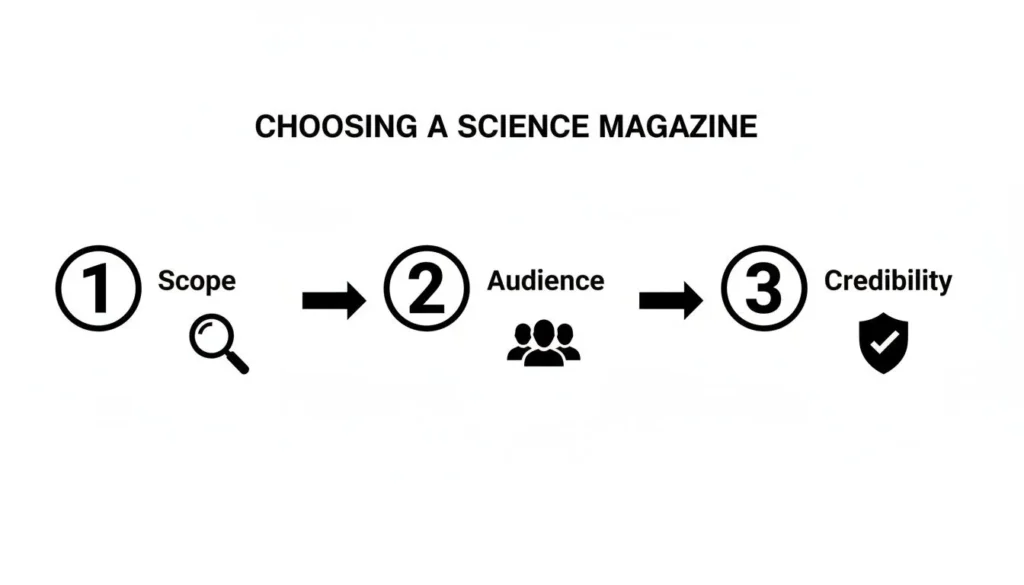
Getting these three pillars right—scope, audience, and credibility—means your pitch will land in a place where it naturally belongs. That targeted approach is what dramatically increases your odds of getting that “yes” from an editor.
Finally, a simple but critical step: follow the submission guidelines on the magazine’s website perfectly. Editors are swamped, and they’re looking for professionals who can follow directions.
Once you feel ready to share your expertise, why not start by seeing what we’re looking for? You can learn more and write for our publication. Combine a fantastic idea with a polished pitch, and you’ll be well on your way from reader to published author.
Why Science Media Is More Influential Than Ever
In a world overflowing with information—and a fair bit of misinformation—a quality science and technology magazine is more than just a good read. It’s an anchor. These publications cut through the static, delivering properly vetted, insightful stories about the very forces that are busy shaping our collective future.
They do more than simply report on the latest lab breakthrough. Their real job is to build scientific literacy. By taking incredibly complex topics, from public health emergencies to the ethics of artificial intelligence, and making them accessible, they give everyday readers the tools to understand the world around them. For a healthy, well-informed society, that’s not a nice-to-have; it’s essential.
The Growing Market for Knowledge
This renewed importance isn’t just a feeling; it’s a powerful economic trend. We’re seeing public interest in science and technology hit an all-time high, which in turn has created a massive market for publications that can feed that curiosity. People want reliable information, and they’re willing to pay for it.
The numbers don’t lie. The global science magazine market was already valued at $2,035.33 million back in 2021, and it’s on track to rocket toward $5,500 million by 2025. That growth is being powered by a strong compound annual growth rate (CAGR) of 8.5%, showing a real public hunger for solid scientific knowledge. You can dig deeper into the science magazine market’s impressive growth projections to see for yourself.
In an age of rapid change, science communication is not a luxury but a necessity. It is the essential framework that helps us navigate an increasingly complex world, turning groundbreaking discoveries into shared human understanding.
This trend really highlights the value of platforms dedicated to clear, engaging science communication. They don’t just inform and educate; they spark curiosity and inspire the next generation of innovators and problem-solvers. The future for any modern science and technology magazine isn’t just looking secure—it’s absolutely vital for tackling the challenges and grabbing the opportunities that lie ahead.
Frequently Asked Questions
Jumping into the world of science and technology magazines, whether as a reader or a writer, can definitely spark a few questions. Let’s tackle some of the most common ones we hear.
Are Science Magazines Peer Reviewed?
That’s a fantastic question, and it really gets to the core of what makes these publications tick. The short answer is no, not in the strict, academic sense. Formal peer review is the gauntlet that scholarly papers run, where experts in a specific field pick apart research before it’s published in a journal.
Magazines play a different game. They’re built for a wider audience, so while they skip the formal peer-review process, the good ones are absolutely obsessed with accuracy. They rely on what you could call journalistic rigor. Articles are typically written by seasoned science journalists or field experts, and then a sharp editorial team vets every single fact. So, it’s less about academic gatekeeping and more about rigorous fact-checking.
How Much Do Science Magazines Pay Writers?
Ah, the million-dollar question (well, not quite). Pay rates for a science and technology magazine are all over the map. There’s no single answer, as it really depends on a few key things:
- The Publication: A big-name international magazine has deeper pockets than a smaller, niche blog. It’s just a fact of life.
- Article Type: A quick 500-word news piece won’t pay the same as a sprawling, 3,000-word feature that took you a month to research.
- Writer’s Experience: If you’re a veteran writer with a killer portfolio, you’re in a much better position to negotiate for higher rates.
As a ballpark figure, you can see rates anywhere from $0.50 to over $2.00 per word for established print and digital magazines. Some online spots might offer a flat fee per article, which could range from a couple hundred bucks to a few thousand.
The best advice? Do your homework. Most publications that accept pitches will have a “Write for Us” or submission guidelines page that often mentions their pay scales.
How Do I Find Magazines Accepting Submissions?
Finding the perfect home for your story idea is half the battle. Your first move should be to create a shortlist of magazines that vibe with your topic and your personal writing style. Read them. Get a feel for what they publish.
Once you have a list, head to their websites. You’re looking for a link that says “Submissions,” “Pitches,” or “Write for Us.” That page is your treasure map. It will tell you exactly what kinds of stories they’re hungry for, who to email, and how to format your pitch. Following those instructions to the letter is the single best way to get an editor’s attention. And hey, there’s no shame in starting with smaller publications to get some clips under your belt.
Here at maxijournal.com, we’re always on the lookout for fresh voices and captivating stories that explore that amazing space where science, technology, and culture collide. We’d love for you to add your perspective to our community. Check out our latest articles or pitch your own story at https://maxijournal.com.
Discover more from Maxi Journal
Subscribe to get the latest posts sent to your email.