If you’re looking to learn how to meditate for stress relief, the simplest way to begin is to find a quiet spot for just five minutes. Sit down comfortably, close your eyes if you’d like, and bring your attention to the natural rhythm of your breath. That’s it.
The idea isn’t to force your mind into silence—that’s a recipe for frustration. Instead, the goal is to gently observe your thoughts as they come and go, without getting tangled up in them. This simple act of focused breathing is powerful; it interrupts your body’s automatic stress response and pulls you into the present moment.
Your First Steps Into Mindfulness
When you’re already feeling stretched thin, the thought of adding meditation to your day can feel like just another chore. But really, meditation is about subtracting, not adding. It’s a dedicated moment to pause, breathe, and simply reconnect with yourself.
The biggest myth that trips people up is the idea that you have to achieve a completely blank mind. This belief stops so many people before they even have a chance to see the benefits. Let’s be clear: a wandering mind is completely normal. It’s literally what minds are designed to do.
The real practice isn’t about stopping your thoughts; it’s about noticing when your mind has wandered and gently, without criticism, guiding your focus back to your breath. Each time you do this, you’re building your “mindfulness muscle.”
To get you started, here’s a quick look at the core components. Think of this as your basic toolkit.
A Simple Meditation Framework for Stress Relief
| Component | Simple Action | Why It Helps |
|---|---|---|
| Quiet Space | Find a spot where you won’t be interrupted for 5 minutes. | Reduces external distractions so you can focus inward. |
| Comfortable Posture | Sit upright but relaxed, on a chair or cushion. | Supports alertness without creating physical strain. |
| Focus Point | Pay attention to the sensation of your breath. | Anchors your mind to the present moment. |
| Gentle Redirection | When your mind wanders, kindly guide it back to your breath. | Builds resilience and trains your attention. |
This framework isn’t about perfection; it’s about practice. Every time you sit down, you’re giving yourself a small gift of peace.
Why Mindfulness Works for Stress
Mindfulness isn’t just a mental exercise; it directly changes your body’s physical response to stress. When you feel anxious, your sympathetic nervous system—your “fight-or-flight” mode—kicks into high gear, flooding your body with stress hormones like cortisol.
Meditation does the opposite. It helps activate your parasympathetic nervous system, often called the “rest-and-digest” system. This simple shift has some pretty profound effects:
- It slows your heart rate and breathing, sending a powerful signal to your entire body that you are safe.
- It reduces muscle tension, helping you release the physical tightness you might not even realize you’re carrying around your shoulders or jaw.
- It creates mental space, allowing you to step back and observe stressful thoughts instead of being completely swept away by them.
This isn’t just feel-good talk; it’s backed by solid science. Research consistently shows that meditation can provide stress and anxiety relief that rivals established therapeutic methods.
For instance, a landmark 2022 study found that a mindfulness program produced a 20% reduction in anxiety symptoms—an outcome on par with what you’d see from common medications.
Ultimately, learning how to meditate for stress relief is less about chasing a state of perfect calm and more about learning to be present with your experience, whatever it may be. This approach not only offers immediate relief but also builds long-term emotional balance and resilience. For more ways to support your well-being, you can explore other mental health and self-care tips.
Creating Your Personal Meditation Space
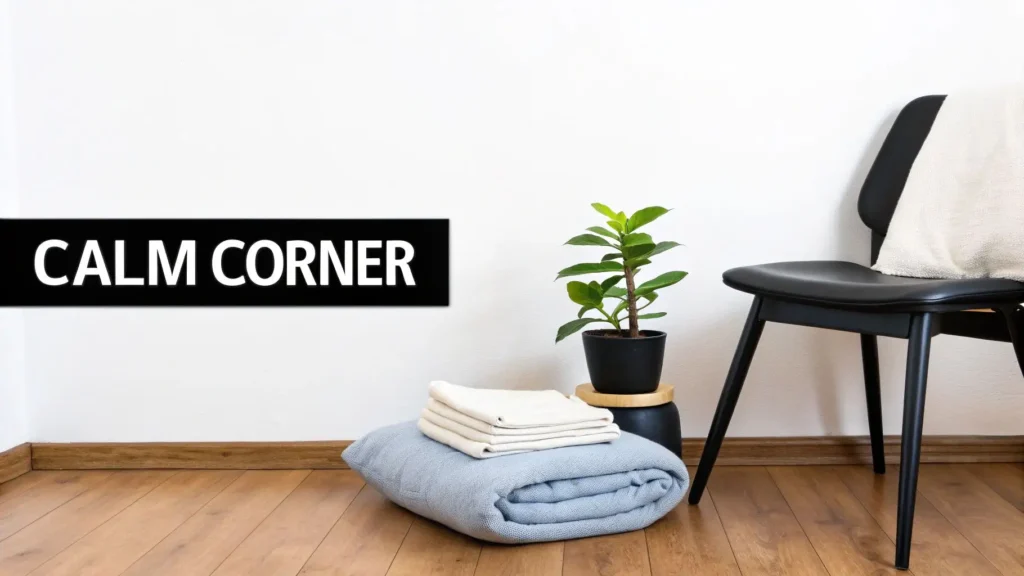
Where you choose to meditate can make a huge difference in your ability to relax and focus. Now, you don’t need a dedicated, sound-proof room—that’s a luxury most of us don’t have. All you really need is a quiet little corner where you can signal to your brain that it’s time to switch off and unwind.
Consistency is the secret sauce here. Think of it like your bed: when you climb in, your brain knows it’s time to sleep. By returning to the same spot for meditation, you’re training your mind to settle down more quickly, making your practice that much more effective from the get-go.
Designing a Simple and Serene Spot
Forget about fancy decor or expensive gear. The goal is just to create a calming atmosphere by minimizing distractions and inviting a little peace. The key word is simplicity.
Start by tidying up the area just a bit. A cluttered space often leads to a cluttered mind, so clearing even a small patch can work wonders. Then, maybe add a few simple things that make you feel calm.
- A comfortable seat: This could be anything—a supportive chair, a few firm pillows stacked up, or even a folded blanket on the floor.
- Soft lighting: Harsh overhead lights are the enemy of relaxation. Try a small lamp with a warm-toned bulb to create a much softer, more inviting ambiance.
- Minimal distractions: Try facing a wall instead of a window or a busy part of the room. And definitely put your phone on silent and place it just out of arm’s reach.
This small, intentional setup is a powerful cue for your nervous system. It says, “This space is for rest and recovery,” which is a crucial first step when you’re learning how to meditate for stress relief.
Your meditation space isn’t about looking perfect for a photo. It’s about creating a functional sanctuary that invites you to just pause and be present. It should feel supportive, not stressful.
Finding a Posture That Works for You
Let’s bust a myth: you do not have to sit in a painful, cross-legged lotus position. The right posture is simply one that allows you to be both alert and relaxed without any physical strain. Your body should be supporting your mind, not distracting it with aches and pains.
The main goal is to maintain a naturally straight spine. This alignment is fantastic for promoting clear breathing and helps keep you from nodding off. Slouching can compress your diaphragm and make you feel sleepy, while sitting ramrod straight creates tension you just don’t need.
Here are a few comfortable and effective options to try:
- Sitting in a Chair: Honestly, this is a great choice for most people. Just sit with your feet flat on the floor, your back straight but not stiff, and let your hands rest comfortably in your lap.
- Sitting on a Cushion: If you prefer sitting on the floor, a firm cushion or a traditional zafu can help elevate your hips above your knees. This little trick makes it much easier for your spine to lengthen naturally.
- Lying Down: This is obviously super relaxing, but it comes with a warning—it’s very easy to fall asleep. If you do lie down, try keeping your legs uncrossed and your arms resting at your sides with palms facing up. A slight bend in your knees can also help ease any pressure on your lower back.
Experiment a little! See what feels best for your body on any given day. Remember, discomfort is a distraction. The goal is to find a stable, sustainable posture that allows your focus to turn inward, paving the way for some genuine stress relief.
Breathing Techniques to Instantly Calm Your Nerves
When stress crashes over you, your breath is the most powerful tool you have to get your head above water. It’s always there, ready to go, and learning to use it deliberately can pull your nervous system out of high alert and back to a state of calm within minutes.
Think of your breath as an anchor in a storm of spiraling thoughts. When you focus on the simple, physical feeling of air moving in and out of your body, you give your brain something solid to hold onto. This yanks your attention out of future worries and plants it firmly in the present moment.
This isn’t about forcing some kind of perfect, yogi-level deep breath. It’s simply about paying attention.
That simple act triggers your parasympathetic nervous system—the body’s natural “rest-and-digest” mode. It’s like flipping a switch that tells your brain the danger has passed. Your heart rate slows, your muscles loosen, and your mind gets a chance to clear.
The 4-7-8 Breathing Method
The 4-7-8 method is a classic for a reason. It’s incredibly effective at quieting a racing mind, especially if you’re trying to fall asleep or you’re in the middle of a high-anxiety moment. The structure is dead simple, which is exactly what you need when you feel like you’re losing control.
Here’s how you do it:
- Let all the air out of your lungs with a whooshing sound.
- Close your mouth and breathe in quietly through your nose for a count of four.
- Hold that breath for a count of seven.
- Exhale completely through your mouth—making that whoosh sound again—for a count of eight.
That’s one cycle. Try to do it three or four times in a row.
The real magic is in that long, controlled exhale. It’s a powerful signal to your body to relax. Don’t get too hung up on the exact numbers; just focus on making your exhale roughly twice as long as your inhale.
This technique is like a natural tranquilizer for your nervous system. The counting breaks the cycle of anxious thoughts, and the extended exhale forces a physiological shift toward calm.
You’re not alone in turning to practices like this. A global survey showed that meditation use grew from 29% in 2018 to an expected 35% by 2025. More and more people are looking for these tools to find a little stability in a chaotic world.
Simple Box Breathing
Box breathing, or four-square breathing, is a go-to for people who need to stay calm under intense pressure—think Navy SEALs, athletes, and surgeons. Its steady, even rhythm is fantastic for grounding yourself when your thoughts are all over the place.
The pattern is easy to remember because it’s perfectly symmetrical, just like a box.
- Breathe in through your nose for four counts.
- Hold your breath for four counts.
- Breathe out through your mouth for four counts.
- Hold your breath again for four counts.
As you go, try visualizing yourself drawing a square in your mind’s eye. Each side of the square is a four-second step. This little mental trick adds another layer of focus, making it that much harder for distracting thoughts to sneak in. If this clicks with you, our guide on how to calm anxiety naturally is a great place to explore next.
The beauty of these techniques is that you can do them anywhere, anytime, and no one has to know. At your desk before a big presentation, stuck in traffic, or even in a crowded grocery store. By mastering these simple patterns, you’re giving yourself an on-demand stress-relief tool you can use for the rest of your life.
Your First Guided Meditation for Stress Relief
Alright, let’s put theory into practice. Below is a simple, 10-minute guided meditation I’ve designed specifically to help you unwind and release stress. Don’t worry about “doing it right”—that’s not what this is about. Just find a comfortable spot, press play on the video, or follow the script below.
Think of this as a practical tool for your first few sessions. It’s here to help you get a feel for the rhythm of a mindfulness practice and build the confidence to eventually guide yourself.
Settling In (The First 2 Minutes)
Start by finding a posture that feels supportive. You could be sitting in a chair with your feet planted firmly on the floor, or maybe on a cushion on the ground. Whatever you choose, let your spine grow tall without being rigid, and allow your hands to rest gently in your lap or on your knees.
You can close your eyes if you feel comfortable doing so, or you can just soften your gaze and let it rest on a spot on the floor a few feet in front of you.
Take a slow, deep breath in through your nose. As you exhale through your mouth, imagine you’re letting go of any little bits of tension you’re holding onto. Let’s do that two more times. Use each exhale as a quiet signal to your body that it’s okay to relax right now.
Now, bring your awareness to the points where your body makes contact with the surface beneath you. Feel the solid weight of your body, grounded and completely supported. There’s absolutely nothing you need to do at this moment except just be here.
Focusing on the Breath (3 Minutes)
Gently shift your attention to the natural, easy rhythm of your breath. You don’t need to change it, force it, or control it at all. The goal is simply to notice it.
Pay attention to the subtle sensations—the feeling of the air as it enters your nostrils, the way your lungs expand, and the release as the air flows back out. You might notice the gentle rise and fall of your chest or belly with each cycle.
Your breath is your anchor to the present moment. It’s completely natural for your mind to wander off; that’s literally what minds are built to do. When you realize your thoughts have drifted to your to-do list, a memory, or a worry, just gently notice it without any judgment. Then, kindly escort your focus back to the simple sensation of breathing in and breathing out. Every single time you do this, you are strengthening your meditation muscle.
This gentle return to the breath is the heart of the practice. It’s not about forcing a blank mind, but about patiently and kindly redirecting your attention, over and over again.
The Body Scan (4 Minutes)
Now, we’re going to broaden our awareness to include the whole body. Start by bringing your attention all the way down to your feet. What do you notice there? Maybe some warmth, coolness, tingling, or just the feeling of pressure against your shoes or the floor. You don’t have to change a thing; just observe with curiosity.
Slowly, let your awareness travel up through your legs and into your hips and pelvis. Feel the sensation of sitting. Continue guiding your attention upward into your lower back and abdomen, allowing your belly to be soft.
Move that focus to your chest and upper back, then let it flow down your arms to the very tips of your fingers. See if you’re holding any tension in your hands—if so, just let them soften. Finally, bring your awareness to your neck, your jaw, and the muscles in your face. Let go of any clenching in your jaw and soften the tiny muscles around your eyes.
Closing the Practice (The Final Minute)
For these last few moments, gently release your focus from any one thing. Simply sit, being aware of your entire experience—your body, your breath, the state of your mind—without needing it to be any different than it is.
Bring your attention back to the easy rhythm of your breath one last time. When you feel ready, slowly start to wiggle your fingers and toes, bringing a little movement back into your body.
Take one final, deep, refreshing breath in. As you exhale, gently open your eyes, allowing a soft awareness of the room to return. Before you jump up, just take a moment. Notice how you feel.
Navigating Common Roadblocks in Your Practice
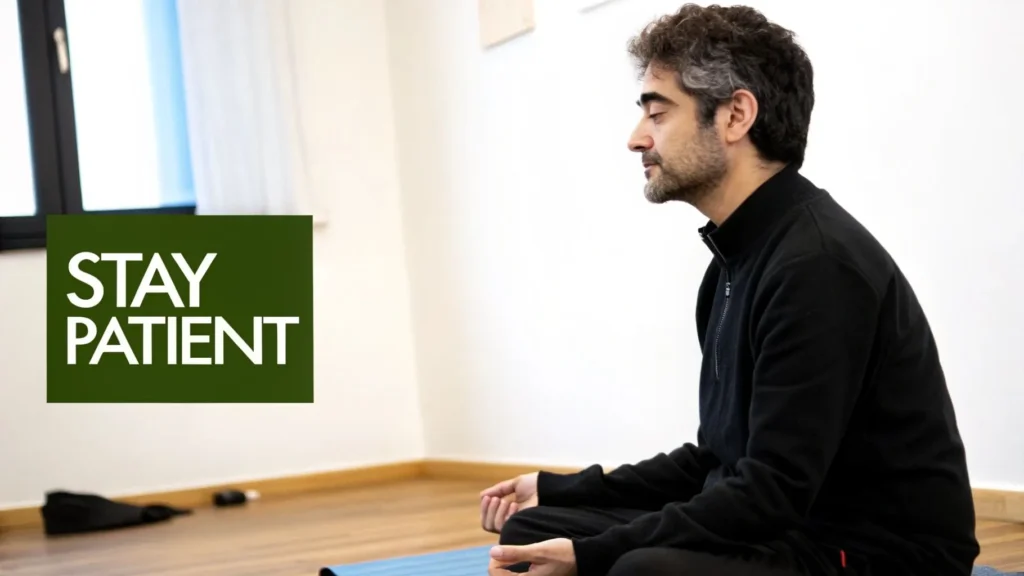
Let’s be honest: when you first learn how to meditate for stress relief, you’re going to run into some bumps. A mind that won’t quit, a sudden wave of sleepiness, or just plain old impatience—these aren’t signs you’re doing it wrong.
They are universal. Every single person who has ever tried to meditate has wrestled with these exact same feelings.
The trick is to stop seeing them as failures. Instead, think of them as chances to practice a little compassion and gently steer yourself back on course. That shift in perspective is the practice of mindfulness, right there in a nutshell.
The Problem of the Wandering Mind
Your brain is built to think. It plans, it worries, it remembers, it wanders. Expecting it to go completely silent is like asking your heart to stop beating—it’s just not going to happen.
The real “work” in meditation isn’t about forcing silence. It’s about what you do the moment you realize your mind has drifted off to plan dinner or replay a conversation from yesterday.
Catching yourself is a moment of success. You’ve become aware! The next step is incredibly simple: without judgment, gently guide your focus back to your anchor, which is usually your breath. This cycle of noticing and returning, again and again, is what builds mental muscle.
The goal isn’t an empty mind, but a mind you can gently guide back home. Each return is a small victory that builds mental clarity and reduces your reactivity to stress.
This simple, powerful practice has caught on in a big way. The global meditation market was valued at an incredible USD 7.51 billion in 2025 and is projected to hit USD 17.78 billion by 2032. Why? Because it works. If you’re curious, Coherent Market Insights has some fascinating data on its growth.
Dealing with Drowsiness and Discomfort
It’s completely normal to feel sleepy when you meditate, especially if you’re lying down or practicing at the end of a long day. Your body has a deep-seated association between relaxation and sleep.
If you find yourself nodding off, don’t just give in. Try a few simple adjustments:
- Sit More Upright: A straight spine naturally encourages alertness. Try sitting on the edge of your chair or propping your hips up on a cushion.
- Open Your Eyes: Instead of closing your eyes completely, let them rest with a soft, unfocused gaze on a spot a few feet in front of you.
- Practice Earlier: For many people, meditating first thing in the morning is a total game-changer for energy levels.
Physical discomfort—an aching back, restless legs, a crick in your neck—is also part of the deal. The answer isn’t to power through the pain. Mindfully and slowly, shift your position until you’re more comfortable. The goal is to support your practice, not to endure it. Learning to navigate these little hurdles is a huge part of effective stress management.
Common Meditation Obstacles and Gentle Solutions
Everyone hits these walls. It’s not a sign you’re failing; it’s a sign you’re human. Here’s a quick troubleshooting guide for the most common challenges people face when they start meditating.
| Common Challenge | Why It Happens | A Gentle Solution |
|---|---|---|
| “I can’t stop thinking!” | Your brain is a thinking machine. It’s doing its job. | Celebrate the moment you notice your mind has wandered. That awareness is the goal! Then, gently guide your focus back to your breath. |
| Falling Asleep | Your body equates deep relaxation with sleep, especially when you’re tired. | Sit up straighter, open your eyes slightly with a soft gaze, or try meditating in the morning when you’re more alert. |
| Impatience or Boredom | You’re used to constant stimulation. Sitting in stillness can feel unproductive at first. | Acknowledge the feeling without judgment (“Ah, there’s boredom”). Shorten your sessions to just 3-5 minutes and build up slowly. |
| Physical Discomfort | An aching back, numb legs, or general fidgeting is very common. | Don’t force yourself to stay perfectly still. Mindfully adjust your posture. Use cushions or a chair to support your body. |
| Strong Emotions Arise | When you quiet the external noise, internal feelings (sadness, anger, anxiety) can surface. | See this as a healthy release. Acknowledge the emotion, breathe into it, and allow it to be there without needing to fix it. |
| “Am I doing this right?” | The desire for a “perfect” session can create self-doubt and anxiety. | If you are sitting and breathing with the intention to be present, you are doing it right. There’s no other benchmark. |
Remember, the goal isn’t to eliminate these obstacles. The practice is learning how to meet them with kindness and patience, over and over again.
Your Top Questions About Meditating for Stress
When you start learning how to meditate for stress, a lot of questions pop up. That’s a good thing! It means you’re really digging in and getting curious about your practice. Here are some straightforward answers to the questions I hear most often from beginners.
How Long Should I Meditate to Feel Less Stressed?
When you’re just starting, consistency beats duration, every single time.
Aiming for just 5 to 10 minutes a day is a fantastic goal. Honestly, it’s highly effective. Research has shown that even these quick, daily sessions can make a real difference in lowering cortisol levels and calming your nervous system.
It’s much better to have a successful 5-minute practice every day than to shoot for 30 minutes and only manage it once a week. Once that daily habit feels natural, you can think about adding more time if it feels right. But the real magic comes from showing up consistently, not from watching the clock.
What’s the Difference Between Mindfulness and Meditation?
This is a really common point of confusion, but the distinction is pretty simple when you break it down.
- Mindfulness is the quality of being present and fully aware, right here, right now, without judging what’s happening. You can be mindful anytime—while you’re doing the dishes, walking to your car, or really listening to a friend.
- Meditation is the formal practice you do to get better at being mindful. Think of it as the workout you do at the gym to build a muscle.
So, meditation is the time you set aside to train your “mindfulness muscle.” That’s the muscle you can then use all day long to stay grounded.
Here’s a good way to think about it: Meditation is the rehearsal; mindfulness is the performance in your everyday life. The more you rehearse, the more naturally you can tap into that calm awareness when things get hectic.
What if I Don’t Feel Calmer Right Away?
This is completely normal, and trust me, almost everyone feels this way at first. The point of meditation isn’t to force yourself to feel calm. Some days you’ll sit down and feel a sense of peace. Other days, you’ll feel restless, bored, or maybe even more anxious than when you started.
The real practice is just showing up and noticing whatever is there, without labeling it “good” or “bad.” The deep, lasting benefits—like a genuine reduction in your overall stress levels—build up slowly over time. Don’t let one “bad” session discourage you. The important changes are happening under the surface.
Is It Okay if My Mind Wanders Constantly?
Yes, one hundred percent. A wandering mind doesn’t mean you’re failing; it just means you have a normal human brain. Our minds are built to think, plan, and drift off.
The actual “work” of meditation happens the moment you notice your mind has wandered. That little flash of awareness is a win. The next step is to gently, without any judgment, guide your focus back to your anchor (like your breath). Every time you complete that cycle—wandering, noticing, and returning—you are actively strengthening your ability to focus and building resilience to stress.
maxijournal.com offers a wealth of articles and guides to support your journey toward a calmer, more balanced life. Explore our daily content at https://maxijournal.com to find more practical tips on health, wellness, and personal growth.
Discover more from Maxi Journal
Subscribe to get the latest posts sent to your email.