If you want to boost your team’s productivity, you have to stop thinking about hours logged and start building an environment that encourages efficient, high-impact work. It’s a subtle but powerful shift. When you nail the fundamentals—clear goals, smart systems, and genuine employee wellbeing—you’ll see your team become more engaged, innovative, and flat-out effective.
Beyond Buzzwords: What Productivity Actually Means
Let’s be real. When most managers hear “improve employee productivity,” their minds immediately jump to tracking hours or counting completed tasks. But real productivity isn’t about busyness; it’s about creating value.
Think about it: one person can spend eight hours bouncing between pointless meetings, while another spends four hours shipping a critical new feature. Who was more productive? The goal isn’t just activity; it’s maximizing meaningful output.
This distinction has never been more important. Disengaged employees are costing the global economy a staggering $8.9 trillion annually. With only 21% of the workforce feeling truly engaged, the lost potential is massive. A recent two-point dip in engagement alone cost the U.S. economy $438 billion in lost productivity. If you want to see the full financial picture, you can dig into more productivity statistics.
A Practical Framework For Lasting Results
To build a high-performing culture, you need to ditch the quick fixes and adopt a framework that actually lasts. Everything in this guide is built on three pillars that work together to create an environment where people can do their best work.
To help you get started, here’s a quick overview of the foundational areas every leader must address to foster a genuinely productive work environment.
The Three Pillars of Sustainable Productivity
| Pillar | Core Principle | Key Actions |
|---|---|---|
| Clear Goals | Everyone knows what to do and why it matters. | Define team-wide objectives (OKRs), set individual performance targets, and constantly communicate the big-picture vision. |
| Smart Systems | Workflows should reduce friction, not create it. | Audit and streamline processes, adopt tools that actually help, and aggressively eliminate bottlenecks. |
| Genuine Wellbeing | Burned-out people can’t be productive. Period. | Promote work-life balance, provide mental health resources, and create a culture of psychological safety. |
These three pillars—Goals, Systems, and Wellbeing—flow together to create the foundation for productivity that sticks.
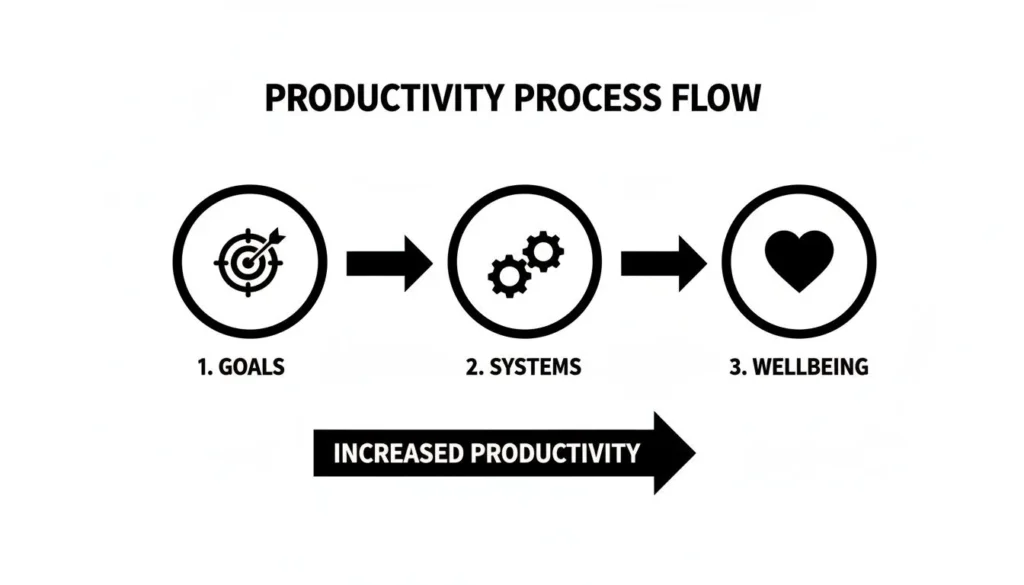
The key thing to remember is that these elements are completely interconnected. A weakness in one area will always undermine the others, stopping you from seeing any real, lasting gains.
The most profound productivity gains don’t come from pushing people harder. They come from creating a system where it’s easier for talented people to do great work.
This approach reframes productivity from a top-down order to a shared goal. It’s about empowering people, not policing them. By focusing on these core pillars, you can stop chasing temporary boosts and start building a resilient, effective, and truly engaged team for the long haul. The rest of this guide will give you actionable strategies to bring each of these pillars to life.
Finding the Friction in Your Team’s Workflow

Before you can fix anything, you have to know what’s actually broken. It’s tempting to throw a new project management tool or another weekly meeting at your team, but that rarely works. Why? Because you’re treating a symptom, not the disease.
The first real step to boosting your team’s output is to play detective. You need to hunt down the friction points—the little (and big) things that are quietly gumming up the works and slowing everyone down.
These roadblocks are often hidden in plain sight. It might be a convoluted approval process that bounces a simple task between three different managers. Or maybe it’s outdated software that forces people into hours of manual data entry. To truly understand how to improve employee productivity, you have to look past the obvious signs like missed deadlines and dig for the why.
This isn’t just a feel-good exercise; it’s a business necessity. The cost of guesswork is staggering. Actively disengaged workers cost U.S. companies between $483 to $605 billion each year in lost output. That’s a clear signal that figuring out what’s frustrating your team is non-negotiable. You can find more data on the impact of disengagement on productivity here.
Your Diagnostic Toolkit
To get the real story, you’ll need to use a few different methods to gather honest feedback. Just having an “open-door policy” isn’t enough. Let’s be real—most people hesitate to speak up, especially if the problem is a process their own manager created.
Here are a few practical ways to uncover what’s really going on:
- Anonymous Surveys: Use a simple tool like Google Forms to ask pointed questions. Don’t be generic. Ask things like, “What’s the one task that takes way too much of your time for way too little value?” or “If you had a magic wand, what’s one process you would eliminate tomorrow, and why?” Anonymity is your secret weapon for getting the unfiltered truth.
- “Stay” Interviews: Most companies wait for the exit interview to ask what went wrong. That’s too late. Instead, conduct regular “stay” interviews. These are just informal one-on-one chats focused on what keeps a great employee with your company and what would make their job even better. You’ll fix problems before they become reasons to leave.
- Simple Process Mapping: You don’t need a Six Sigma black belt for this. Just grab a whiteboard and ask your team to walk you through a common task, like onboarding a new client or submitting an expense report. As you draw out every single step, you’ll immediately see where the delays, duplicate work, and unnecessary handoffs are hiding.
Here’s how this plays out in the real world: A marketing agency I know was frustrated with how long it took to launch campaigns. Management assumed it was a motivation problem and started planning team-building events. But an anonymous survey told a different story. The real culprit was a new asset approval system that required sign-offs from four different people, two of whom were almost never available. The “motivation” problem was actually a process bottleneck.
From Feedback to Actionable Insights
Once you’ve collected all this feedback, your job is to connect the dots. Start organizing the comments into themes and look for patterns. Are multiple people griping about the same clunky software? Are different teams all mentioning communication gaps with the same department?
A simple table can help turn a pile of comments into a clear picture:
| Friction Point | Who It Affects | Potential Root Cause |
|---|---|---|
| Slow report generation | Sales & Marketing Teams | Manual data pulling from three separate systems |
| Unclear project ownership | Engineering Department | Lack of a clear RACI chart for new features |
| Frequent interruptions | All Teams | Culture of “urgent” emails for non-urgent tasks |
This approach takes you from vague complaints to an evidence-based diagnosis of your team’s specific challenges. You’re no longer guessing. Now, you have a roadmap that points directly to the areas where change will make the biggest difference.
This diagnostic work is the foundation for everything else. Skip it, and you’ll just end up fixing the wrong problem.
Setting Clear Goals and Designing Smart Systems

If you want to know how to improve employee productivity, it all starts with clarity. When everyone on the team knows exactly what the target is, the usual distractions and busywork just seem to fade away. Focus sharpens, and energy gets channeled into what really matters.
Many leaders lean on established frameworks like OKRs (Objectives and Key Results) or SMART goals to give this process some much-needed structure.
OKRs are great for setting ambitious, outcome-driven goals over shorter cycles, pushing teams to innovate. SMART goals, on the other hand, are all about nailing down the specifics: Specific, Measurable, Achievable, Relevant, and Time-bound targets that create a clear path to follow.
They aren’t mutually exclusive. Think of it this way:
- Use OKRs when you need to rally the team around a big, innovative outcome, not a checklist of tasks.
- Choose SMART goals when hitting precise milestones and deadlines is critical for accountability.
- You can even combine them, using an OKR for the big picture and SMART goals to define the steps to get there.
Imagine a marketing team gearing up for a product launch. Their OKR might be to drive 20% more demo signups in Q3. Suddenly, everyone from the content writer to the ad specialist understands how their individual work connects directly to that high-level business outcome.
Applying Frameworks in the Real World
Let’s switch gears to an engineering squad on a tight deadline for a new release. They might use SMART goals to map out each development sprint. They’ll define hyper-specific tasks, like “complete all API integration tests within three days” or “resolve all critical bugs by Friday.”
When you connect these small, tangible tasks back to the company’s broader vision, it gives developers a clear signal that their work has a real impact. It’s not just about closing tickets; it’s about moving the needle.
Key takeaway: Clear goals cut through the noise. They make it incredibly easy for every single person to see how their daily contributions matter to the bigger picture.
But having goals is only half the battle. You also need to build smart systems that clear the path for your team, removing the frustrating obstacles that get in the way of high-value work.
Designing Workflows That Actually Flow
This is where process mapping and clarifying roles become your best friends.
Start by grabbing a whiteboard (or a virtual one) and charting out every single step in a critical process, from kickoff to completion. I guarantee you’ll find bottlenecks you never knew existed—things like manual approvals that take days or redundant data entry that eats up hours.
Look for a few common culprits:
- Stalls: Identify any step where work sits idle for more than 24 hours.
- Handoffs: Flag areas with repeated back-and-forths that create confusion over who owns what.
- Automation Opportunities: Pinpoint recurring tasks like generating weekly reports or consolidating data that a machine could do better and faster.
I’ve seen teams save 2-3 hours per person per week just by implementing a simple automation tool for their routine status updates. It’s a game-changer.
Once you’ve mapped the process, you can build a simple table to show the team the potential wins.
| Step | Current Time | Optimized Time |
|---|---|---|
| Manual report run | 2 hours | 10 minutes |
| Email approvals | 3 days | 4 hours |
| Data consolidation | 5 hours | 30 minutes |
When you put it in black and white like this, it becomes painfully obvious where you need to focus your improvement efforts.
From Company Strategy to Daily Tasks
The final piece is connecting the dots. Break down the big-picture company strategy into concrete team objectives, and then into individual responsibilities. This creates a clear line of sight, ensuring every task ties back to a measurable outcome.
- Start with your top-level company goals.
- Define how each team’s objectives will contribute to those goals.
- Assign a specific owner for each objective.
- Set measurable milestones and regular check-in dates to keep things on track.
This isn’t a “set it and forget it” plan. Regular check-ins turn your strategy into a living, breathing document that guides daily decisions and reinforces a sense of ownership.
When every single to-do list item aligns with a larger mission, daily tasks stop feeling like a grind and start feeling purposeful.
With goals and systems in sync, your team will spend less time debating what to do next and more time actually doing it. This is the foundation for scaling productivity without burning everyone out.
Here are a few tips to keep in mind:
- Keep it simple. Communicate goals in plain language, not corporate jargon.
- Automate the boring stuff. Free up your team’s brainpower for complex, creative work.
- Review your workflows. A quick quarterly check-in can catch process drift before it becomes a problem.
I once worked with a startup that cut its product launch time by a staggering 30%. They did it by implementing OKR-driven sprints and automating their entire testing suite. That one change freed up their engineers to focus on innovation instead of spending their days on repetitive bug fixes.
Best Practices to Remember
At the end of the day, clarity and structure don’t just make teams more efficient; they make them happier. When you embed goal reviews and workflow audits into your regular operations, these habits become second nature.
- Set your quarterly OKRs, but break them down into monthly SMART milestones to make progress feel more tangible.
- Empower your teams to refine their own systems. Don’t create an approval bottleneck.
- Use simple, visual dashboards to keep everyone updated on progress.
Nailing your goal-setting and system design is the first—and most important—step toward building a high-performing team.
Investing in People with Growth and Wellbeing

You can have the most brilliant systems and perfectly defined goals, but those only create the opportunity for high performance. At the end of the day, it’s your people who have to execute.
This is why investing in their skills and health isn’t some fluffy perk—it’s one of the most powerful levers you can pull for sustainable productivity. A team that feels stagnant or burned out will never hit its potential, no matter how optimized your processes are. A human-centric approach, focusing on growth and wellbeing, delivers incredible returns.
Cultivating a Culture of Continuous Growth
The days of mandatory, one-size-fits-all training modules are long gone. The most productive teams today are built on a culture of continuous learning, where people are genuinely motivated to upskill because it aligns with their own career goals.
This isn’t just a trend; it’s a core business strategy. In fact, 51% of executives now name upskilling as their top priority for business transformation. The data backs this up: high-performing employees with over ten years of experience can be up to eight times more productive than their peers. You can find more of these insights on productivity drivers.
To build this kind of environment, you have to move beyond the checklist and offer growth opportunities people actually care about.
- Mentorship Programs: Pairing junior employees with senior leaders is a game-changer. It’s an invaluable way to transfer institutional knowledge and builds a much stronger, more connected team.
- Access to Learning Platforms: Give your team subscriptions to platforms with a wide range of courses. When you empower people to choose what they learn—from new software to leadership training—they take ownership of their development.
- Dedicated Growth Time: Carve out a few hours each month for learning. This sends a clear signal that development is a real priority, not just an afterthought.
I once worked with a tech company that introduced “Growth Fridays,” protecting the last two hours of the day for online courses or personal projects. Within six months, they saw a noticeable jump in cross-functional problem-solving because people were voluntarily learning skills outside their core roles.
Championing Holistic Employee Wellbeing
Productivity takes a nosedive when people are running on fumes. A real commitment to wellbeing is the foundation of any resilient, high-performing workforce. This goes so much deeper than offering a gym membership—it’s about creating a culture where rest is respected and mental health is taken seriously.
Burnout isn’t a personal failing; it’s an organizational problem. When people feel constantly overloaded, their creative and analytical abilities plummet. The only real solution is to build structural support that prevents burnout before it even starts. For a closer look at this, check out our guide on how to improve work-life balance.
This means putting meaningful initiatives in place that give people the flexibility and support they need to thrive, both inside and outside the office.
Practical Wellbeing Initiatives That Actually Work
To make a real difference, focus on policies and behaviors that foster a healthier work environment. It’s less about grand, one-off gestures and more about consistent, daily support that shows you value your team as people, not just producers.
Here are a few high-impact strategies I’ve seen work wonders:
- Flexible Schedules: Let people adapt their start and end times or offer hybrid work. Trusting your team to manage their own time reduces stress and almost always leads to more focused, effective work.
- Champion Mental Health Resources: Don’t just have an Employee Assistance Program (EAP)—actively promote it. Make sure access is confidential and easy. Normalizing conversations around mental health is key to reducing stigma.
- Encourage Disconnecting: Leaders have to walk the talk. That means no 10 PM emails and genuinely encouraging people to use their vacation time to fully recharge.
- Protect “Deep Work” Time: Block out “no-meeting” periods on the calendar. This gives everyone the uninterrupted time they need to concentrate on complex tasks, which is critical for roles that require deep focus.
By investing in both professional growth and personal wellbeing, you create a powerful, self-reinforcing cycle. Skilled, healthy, and motivated employees are more engaged, more innovative, and, ultimately, far more productive. This isn’t a soft skill—it’s a fundamental business driver.
Choosing Your Tech and Building a Culture of Connection
Giving your team the right tools and fostering a strong sense of community can absolutely supercharge their output. But here’s the thing: just throwing more software at a problem rarely works. The real key is to pick technology that actually reduces friction and implement it in a way that brings people closer, not pushes them apart.
Too often, new tools just add another layer of complexity. I’ve seen teams juggling one app for chat, another for project tracking, and a third for documentation. This kind of fragmentation forces people to constantly switch contexts, which is a known productivity killer. The goal should always be to find platforms that play nicely together, creating a single source of truth where information can flow freely.
Selecting Technology That Serves People
When you’re looking at new software, the most important question isn’t “What are all the fancy features?” but rather, “What problems will this actually solve for my team?” Start by looking back at the friction points you uncovered earlier. If slow approvals are a major bottleneck, then you should be looking for a project management tool with clear, automated approval workflows.
Before you pull the trigger and commit, get your team involved.
- Run a Pilot Program: Let a small group test out the top contenders in their actual day-to-day work. Their feedback is gold—it’ll tell you which tool will genuinely make their lives easier.
- Prioritize Integration: Make sure any new tool gets along with your existing systems. A platform that automatically syncs with your calendar, email, and file storage will save countless hours of manual work.
A classic mistake is choosing a tool that’s incredibly powerful but also incredibly complicated. If a platform requires a week of training just to do the basics, it’s probably going to hurt productivity more than it helps. Simplicity and a great user experience are just as important as a long feature list. While there are plenty of great productivity apps for students that nail ease of use, you can find a guide with insights into the best productivity apps that have lessons applicable in any professional setting.
The best technology feels invisible. It just works, seamlessly supporting how your team wants to operate, rather than forcing them into some rigid, unnatural process.
Building a Culture of Genuine Connection
While tools are important, they’re only half the story. A strong sense of community is a massive, and frankly, often-underestimated driver of performance. This isn’t just a warm-and-fuzzy idea; it’s a measurable business advantage. In fact, organizations with connected employees see productivity jumps of 20-25%. Fostering a collaborative environment isn’t just “nice to have”—it translates directly into serious performance gains. You can dive deeper into the full research on productivity statistics to see the numbers for yourself.
This sense of connection is especially critical in remote or hybrid teams where those spontaneous “water cooler” moments just don’t happen. As a leader, you have to be intentional about creating opportunities for people to build relationships that go beyond project updates and status meetings.
Practical Strategies for Fostering Team Cohesion
Building genuine connection isn’t about one-off team-building events. It requires consistent effort and is really about weaving opportunities for interaction into the fabric of your weekly routine.
- Facilitate “Non-Work” Interactions: Set up dedicated channels for sharing hobbies, celebrating personal wins, or just casual chit-chat. Simple things like virtual coffee breaks or a weekly “show and tell” can do wonders for team morale.
- Champion Recognition: Make it ridiculously easy for people to publicly praise their colleagues. A dedicated Slack channel where anyone can give a “shout-out” reinforces a culture of appreciation and makes people feel seen and valued.
- Encourage Cross-Functional Collaboration: Intentionally create project teams with members from different departments. This not only sparks fresh ideas but also breaks down organizational silos and helps people build a much broader network within the company.
For example, a software company I worked with launched a “buddy system” that paired new hires with veterans from totally different departments for their first 90 days. It was a simple idea, but it dramatically improved new employee retention and got them up to speed on the company culture way faster. It created strong bonds that lasted long after the onboarding period was over, fostering a more supportive and collaborative vibe for everyone.
Measuring What Matters and Driving Continuous Improvement
Let’s be clear: boosting productivity isn’t a one-and-done project you can just check off a list. It’s a living, breathing cycle of measuring, listening, and tweaking your approach over time. To get this right, you have to track the metrics that actually move the needle and build a culture where getting better is just part of the daily routine.
This means looking past the easy-to-track vanity metrics. Simply counting how many tasks someone completes doesn’t tell you much. Instead, you need Key Performance Indicators (KPIs) that tell a real story. For a software team, that might mean tracking project cycle times from the first line of code to launch. For an HR department, it could be the employee Net Promoter Score (eNPS), a powerful gauge of team morale and loyalty.
These are the kinds of numbers that give you true insight into your team’s health and effectiveness, arming you to make much smarter decisions.
Creating a Rhythm of Review
Collecting data is pointless if it just sits in a spreadsheet. You need to establish a consistent rhythm for actually looking at your KPIs. This could be a monthly leadership huddle or a dedicated quarterly deep-dive with the whole team. The point is to sit down, look at the trends, and start asking good questions.
Are cycle times slowly creeping up? Let’s figure out why. Did the eNPS score take a dip last month? What was going on in the business that might have caused that? These review sessions are where the magic happens—turning raw data into a concrete game plan for the next month or quarter. It’s how you discover what really works for improving productivity in your specific environment.
Building Powerful Feedback Loops
Metrics show you the what; feedback from your people tells you the why. You can’t have one without the other. This is where strong, consistent feedback loops come into play.
- Constructive Check-ins: It’s time to evolve one-on-one meetings from dry status updates into genuine coaching sessions. Make space to talk about wins, what’s blocking them, and where they want to grow in their career.
- Celebrate Wins: When someone does great work, make it known. Publicly celebrating even small victories builds incredible momentum and reinforces the exact behaviors you want to see more of. This is a cornerstone of many successful employee engagement strategies.
- Embrace Iteration: You have to create an environment where people feel safe to say, “Hey, I think this process is broken, can we try something else?” without fearing blame if it doesn’t work out perfectly.
This simple shift changes everything. Productivity stops being a top-down mandate and becomes a shared responsibility. It turns into a collaborative effort where everyone is genuinely invested in finding smarter ways to work together.
This whole approach is about achieving more without just asking people to work longer hours. Just look at recent U.S. data, which showed labor productivity jumping by 4.9% in a single quarter. The incredible part? Output was up 5.4% while the hours people worked barely budged. It’s definitive proof that real gains come from efficiency, not exhaustion. You can dig into more of these productivity findings if you’re curious.
Burning Questions Answered
Even the best-laid plans run into trouble on the ground. When you’re trying to lift team productivity, you’re going to hit some tricky situations. Here are my straight-up answers to the questions I get asked most often by leaders.
How Can I Boost Productivity Without Micromanaging?
This is a classic, and the answer is simpler than you think: shift your focus from activities to outcomes.
Real productivity isn’t about watching the clock or tracking every little task. It’s about your team hitting clear, meaningful goals that you’ve all agreed on. Your job is to set those objectives and then get out of the way.
Trust your people to figure out how to get there. Your role transforms from a taskmaster into a facilitator. Instead of asking, “What did you get done today?” in your check-ins, try asking, “What’s getting in your way, and how can I help remove it?” This single change builds incredible levels of trust and ownership, which are far more powerful than hovering over someone’s shoulder.
What’s the Fastest Way to See an Improvement?
If you’re looking for a quick win, find and destroy a known bottleneck. I guarantee every single team has one—that one clunky process, useless meeting, or ancient piece of software that everyone complains about but has just learned to live with.
Don’t just guess what it is. Pull your team aside and ask them directly: “If you could eliminate one thing that slows you down every week, what would it be?” You’ll get an earful. It might be a weekly report that takes four hours to build, a standing meeting that could have been an email, or a login system that always seems to be down.
Fixing that one specific, high-pain point does two things instantly: it gives an immediate boost to efficiency and shows your team you’re actually listening. It’s a tangible win that builds momentum while you work on the bigger, long-term improvements.
Can We Just Buy a Tool to Solve Our Productivity Problems?
In a word: no. Technology is an accelerator, not a magic bullet. If you have a broken, inefficient process, throwing a fancy new tool at it just helps you do the wrong thing faster.
I always tell leaders to think of it like this: if your team’s workflow is a winding, pothole-filled road, giving them a Ferrari won’t solve the problem. You need to pave the road first.
Always, always, always fix your process before you invest in a new platform. Once you have a logical, streamlined way of working, then you can find technology that supports that smarter workflow. Remember the golden rule here: people and processes always come before platforms.
At maxijournal.com, we publish daily insights on business, technology, and more to help you lead smarter. Explore our articles for more practical strategies at https://maxijournal.com.
Discover more from Maxi Journal
Subscribe to get the latest posts sent to your email.