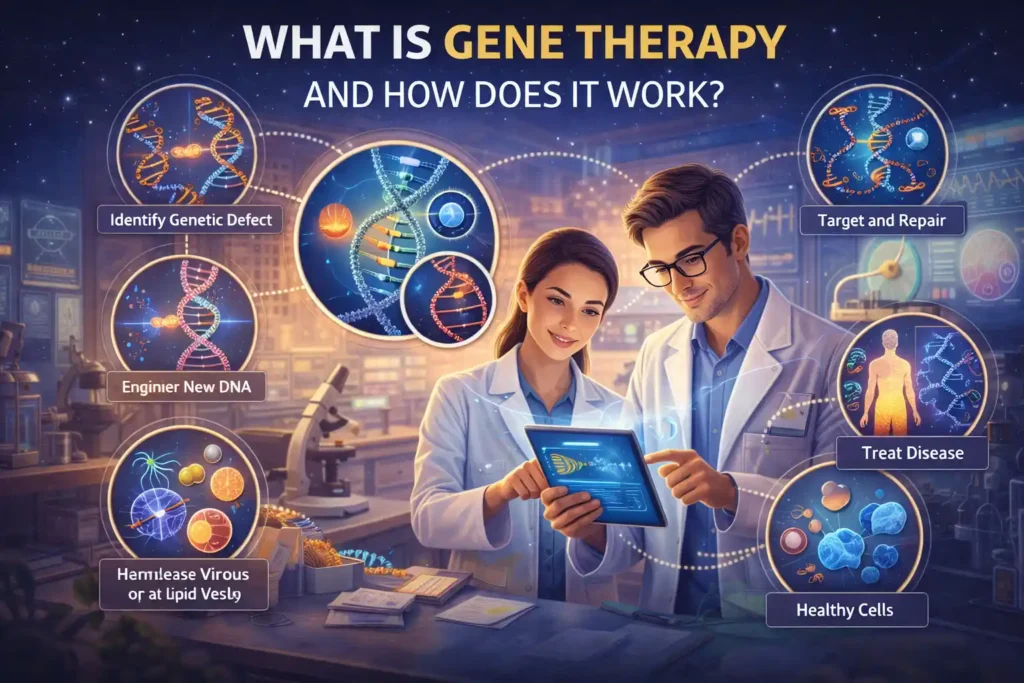
At its core, CRISPR is surprisingly simple. Think of it as a biological search-and-replace tool. It uses a guide molecule to find a specific spot in the DNA and a protein enzyme to make a cut, acting just like a pair of molecular scissors. This lets scientists add, remove, or alter genetic material with incredible precision.
The Bacterial Secret That Sparked a Revolution
The story of CRISPR isn’t some tale of a lone genius having a “eureka!” moment. It’s the result of a slow-burning scientific mystery that took decades for different scientists around the world to piece together. And it didn’t start in a futuristic gene-editing lab—it began with researchers noticing something weird in the DNA of bacteria.
They kept finding these strange, repeating clusters of genetic code, but no one knew what they were for. This journey shows how basic, curiosity-driven research can sometimes lead to the biggest breakthroughs. Scientists were just trying to figure out how bacteria stay alive. In the process, they uncovered an ancient and elegant defense system that would eventually give us the power to rewrite the code of life itself.
From Oddity to Immune System
For a long time, these repeating DNA sequences were just a biological curiosity. Back in 1987, a Japanese scientist named Yoshizumi Ishino and his team were the first to formally note these peculiar patterns in the E. coli genome. It wasn’t until 2002 that the name CRISPR—an acronym for Clustered Regularly Interspaced Short Palindromic Repeats—was officially created. You can see the full story unfold in this CRISPR discovery timeline from UC Berkeley.
The real breakthrough came in 2005. Three separate research groups all noticed the same crucial detail: the “spacer” DNA tucked between the repeating sequences was a perfect match for the DNA of viruses that attack bacteria (called bacteriophages).
This was the “aha!” moment. It became clear that CRISPR wasn’t just random genetic junk. It was a sophisticated, adaptive immune system. The bacteria were literally snipping out pieces of viral DNA and storing them like mugshots to recognize and destroy those viruses if they ever invaded again.
This ancient defense mechanism provided the perfect blueprint for a powerful new technology.
Repurposing a Natural Defense
Once scientists understood how CRISPR worked in bacteria, the next question was obvious: could we hijack it? Could this bacterial “search and destroy” system be programmed to find and cut any DNA sequence we wanted, not just viral DNA?
The answer, it turned out, was a resounding yes.
By 2012, groundbreaking work from research teams led by Jennifer Doudna and Emmanuelle Charpentier showed that the system could be harnessed for programmable gene editing in all sorts of organisms. This work, which rightly earned them a Nobel Prize in Chemistry in 2020, involved boiling down the natural system into just two essential parts:
- A guide RNA (gRNA): Think of this as a programmable “GPS” molecule. You can design it to match any specific gene you want to target.
- A Cas enzyme (like Cas9): These are the molecular “scissors” that do the actual cutting. The gRNA leads them right to the target.
By simply creating a custom guide RNA, scientists could now point the Cas enzyme to almost any spot in the genome of a plant, animal, or human cell and make a clean, precise cut. This repurposed bacterial tool became the foundation of modern gene editing, opening up possibilities that once felt like pure science fiction. The fact that this incredibly powerful system was derived from such a simple, elegant mechanism in nature is exactly what makes it so effective.
How CRISPR Finds and Cuts DNA
At its core, the CRISPR system is an elegant two-part machine built for precision. The best way to think about it is like a biological GPS navigator paired with a set of molecular scissors. These two components work in perfect harmony to find a specific sequence of DNA and make a precise cut, opening the door for all kinds of genetic modifications.
To really get how CRISPR works, we need to meet its two main stars: the guide RNA (gRNA) and the Cas9 protein. These are the core pieces that scientists adapted from a bacteria’s natural immune system. They turned it into a programmable gene-editing tool where the guide RNA provides the “address” and the Cas9 protein brings the “action.”
The Guide RNA Is Your GPS
The guide RNA is a short, custom-made piece of RNA that acts as the targeting system. Its job is to lead the Cas9 protein to one very specific spot within the vast library of an organism’s genome. Imagine the genome is a massive, multi-volume encyclopedia and the gene you want to edit is a single sentence on one of its millions of pages.
Scientists design the gRNA with a sequence that is a perfect mirror image of the target DNA they want to change. This “search query” is typically about 20 genetic letters (nucleotides) long. When the gRNA and Cas9 protein are put into a cell, the gRNA immediately starts scanning the DNA, hunting for its exact match.
It’s a remarkably efficient search. The gRNA-Cas9 complex zips along the DNA strands until it finds the one spot—out of billions—that perfectly matches its programmed sequence. This specificity is what makes CRISPR so powerful.
Cas9: The Molecular Scissors
Once the guide RNA finds its target, the second component swings into action: the Cas9 protein. Cas9 is a type of enzyme known as a nuclease, which means its entire job is to cut nucleic acids like DNA. It’s the “molecular scissors” of the CRISPR system.
As the guide RNA locks onto the target DNA, the Cas9 protein gets into position. It then makes a clean slice through both strands of the DNA double helix. This creates what’s known as a double-strand break (DSB).
This break is the critical event that kicks off the whole gene-editing process. It’s a huge red flag for the cell, signaling that its DNA is damaged and needs immediate repair. How the cell chooses to fix this break is where the real “editing” happens, but we’ll get into that in the next section.
For now, let’s break down how these two parts work together in a clear, step-by-step process.
The Three Key Steps of CRISPR-Cas9 Gene Editing
| Step | Component | Action |
|---|---|---|
| 1. Targeting | Guide RNA (gRNA) | Scans the genome to find the specific 20-nucleotide DNA sequence that matches its programmed code. |
| 2. Binding | gRNA + Cas9 Complex | The gRNA locks onto the target DNA, positioning the Cas9 protein at the precise location for the cut. |
| 3. Cutting | Cas9 Enzyme | The Cas9 protein’s nuclease domains snip both strands of the DNA, creating a double-strand break (DSB). |
This simple three-step dance—target, bind, cut—is what allows CRISPR to be so precise and effective.
CRISPR’s magic really lies in this elegant mechanism. The Cas9 enzyme pairs with a custom guide RNA (gRNA) to scan DNA, hunting for a 20-nucleotide sequence matching the gRNA, but only if it’s next to a specific three-letter sequence called a PAM (Protospacer Adjacent Motif). Once it finds a match, Cas9 unwinds the DNA double helix, and its two nuclease domains—HNH and RuvC—snip both strands, creating that all-important double-strand break.
The infographic below helps visualize the historical journey from the initial discovery of these weird DNA repeats to finally understanding what they do.
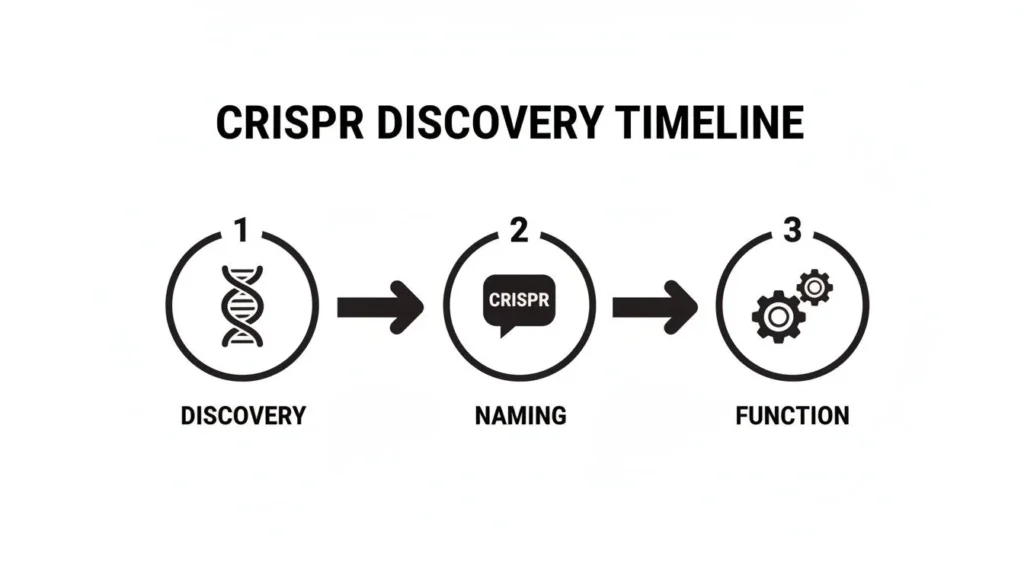
As the timeline shows, the path from observing a biological curiosity to repurposing it as a functional tool required piecing together multiple discoveries over many years. This careful, methodical work is also fundamental to related fields like bioinformatics, which you can learn about in our article on what is bioinformatics. By understanding the sequence, targeting it, and making a cut, the CRISPR-Cas9 system sets the stage for a new era of genetic possibilities.
How Cells Repair DNA After the Cut
Here’s a common misconception: CRISPR-Cas9 doesn’t actually do the editing. Its job is to act like a pair of molecular scissors, making a clean, precise cut across both strands of the DNA. Once that double-strand break is made, Cas9’s work is over. The real magic happens next.
A cell simply can’t function with broken DNA, so it immediately deploys its own powerful, built-in repair machinery to fix the damage. It’s this natural response that scientists cleverly hijack to make their desired genetic changes.
The cell has two main repair strategies it can fall back on. One is a fast-and-messy patch job, and the other is a careful, blueprint-guided reconstruction. By nudging the cell toward one pathway or the other, we can either shut a gene down or completely rewrite its code.
The Demolition Crew: Non-Homologous End Joining
The cell’s first responder and default repair mechanism is a process called Non-Homologous End Joining (NHEJ). Think of it as the cell’s emergency demolition crew. When a double-strand break happens, NHEJ’s only goal is to slam the two broken ends back together as fast as humanly—or cellularly—possible.
Speed is the priority here, not accuracy. This process is notoriously sloppy. Before sealing the break, the cellular machinery often nibbles away a few DNA letters (nucleotides) or shoves a few random ones in.
This might sound like a major bug, but for scientists looking to disable or “knock out” a gene, it’s the perfect feature. These tiny, random insertions or deletions, known as indels, are just enough to garble the gene’s instructions. This usually causes what’s called a frameshift mutation, scrambling the genetic recipe so badly that the cell can no longer build a working protein from it.
By calling in the cell’s own messy repair crew, scientists can effectively silence a problematic gene, like one causing a genetic disease. It’s the biological equivalent of snipping a critical wire to shut down a faulty machine.
The Renovation Team: Homology Directed Repair
The cell’s second, more elegant option is Homology Directed Repair (HDR). If NHEJ is a demolition crew, HDR is a meticulous renovation team that works from a detailed blueprint to ensure a perfect repair. The cell uses HDR when a template is available to guide the reconstruction.
This is where scientists can step in and provide their own custom-made DNA template right alongside the CRISPR machinery. This template is designed with two key features: it contains the new, desired genetic sequence, and it has “homology arms”—stretches of DNA on either side that perfectly match the DNA surrounding the cut.
Once the cut is made, the cell’s HDR machinery spots this template and uses it as a guide to rebuild the broken section, incorporating the new sequence in the process. This opens the door to incredibly precise edits:
- Fixing a typo: Scientists can supply a template carrying the healthy version of a gene to correct a disease-causing mutation.
- Adding a new feature: The template can contain a whole new gene or even a fluorescent tag, allowing researchers to “knock in” new functions or track proteins as they move around the cell.
This is how CRISPR goes from being a simple pair of scissors to a true “find and replace” tool. It’s the difference between knocking down a wall (NHEJ) and carefully rebuilding it with a brand-new window (HDR).
Expanding the CRISPR Toolkit Beyond Cas9
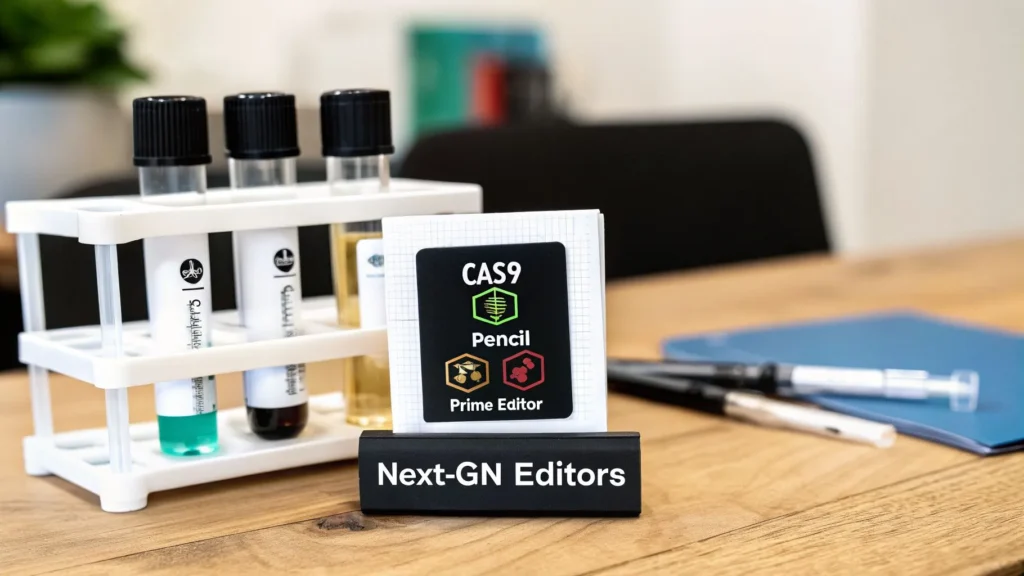
While Cas9 gets all the headlines, it’s really just the first star player to emerge from a massive and still-growing biological toolbox. The original CRISPR-Cas9 system is a workhorse, brilliant at making precise, double-stranded cuts in DNA. But science never stands still; there’s always a push for more precision, more control, and more options.
It wasn’t long before researchers realized that nature had more than one type of molecular scissors. At the same time, labs began engineering entirely new systems that could do more than just cut. These next-gen editors have blown the doors wide open, giving us tools that act less like scissors and more like a fine-tipped pen or even a “search and replace” function for the genome.
To really get a handle on what CRISPR can do, you have to look beyond Cas9. These newer tools are making gene editing safer, more efficient, and capable of tackling a much wider range of genetic problems.
Cas12a and Other Natural Variants
Soon after Cas9’s rise to fame, scientists found another powerhouse enzyme called Cas12a (you might see it called Cpf1 in older papers). It does the same basic job—slicing DNA—but with a few key differences that make it a fantastic alternative in certain situations.
For one, Cas9 makes a clean, blunt cut across both DNA strands. Cas12a, on the other hand, makes a “staggered” cut. This leaves a little overhang of single-stranded DNA, which can be incredibly useful when researchers want to insert new genetic material more efficiently.
On top of that, Cas12a is a bit smaller than Cas9, making it easier to pack into the viral vectors used to deliver it into cells. It also recognizes a different PAM sequence, which gives scientists more flexibility in choosing where to edit. The discovery of enzymes like Cas12a proved there’s more than one way to edit a gene.
Base Editors: The Molecular Pencils
One of the biggest leaps forward came with the invention of Base Editors. These tools were specifically designed to solve a major headache with the original CRISPR system: its reliance on double-strand breaks and the cell’s often unpredictable DNA repair pathways. Snapping both strands of DNA is a big deal for a cell, and sometimes it leads to unwanted genetic rearrangements.
Base editors elegantly sidestep this problem by not making a break at all.
Think of it like this: if you wanted to fix a single typo in a long sentence, you wouldn’t cut out the whole word and paste in a new one. You’d just use a pencil and an eraser to change one letter. That’s exactly how a base editor works.
These tools are a fusion of two parts: a modified Cas9 protein that can find and latch onto DNA but can’t cut it, and another enzyme that can chemically convert one DNA base (or “letter”) into another. This allows for incredibly precise single-letter changes, like turning a C into a T, without ever snapping the DNA backbone. This level of precision is crucial for correcting the thousands of genetic diseases caused by single-letter point mutations.
Prime Editors: A Genetic Search and Replace
If base editors are pencils, then Prime Editors are the “find and replace” function from your word processor. They take precision to a whole new level. They can do more than just swap single letters—they can also make small insertions and deletions with incredible accuracy, all while still avoiding those risky double-strand breaks.
A prime editor is a clever combination of a modified Cas9 and an enzyme called reverse transcriptase. It uses a supercharged guide RNA that not only has the target address but also carries the new genetic information to be written in.
Once the prime editor finds its spot, it just nicks one strand of the DNA. The reverse transcriptase enzyme then uses the guide RNA’s built-in template to directly “write” the new genetic sequence into that spot. This process is more versatile than base editing and is widely considered one of the safest and most precise gene-editing methods we have today. This evolution from simple cuts to complex data manipulation mirrors progress in other fields, as detailed in our explainer on what is data science.
Comparing Major CRISPR Systems and Editors
With so many tools available, it helps to see how they stack up. While Cas9 is the famous original, the newer editors offer specialized abilities for different tasks.
| System | Key Feature | Primary Use Case |
|---|---|---|
| CRISPR-Cas9 | Makes a double-strand break (DSB) in DNA. | Gene knockout (disabling a gene) or large insertions/deletions. |
| CRISPR-Cas12a | Creates a “staggered” DSB, leaving a DNA overhang. | Useful for inserting new DNA sequences more efficiently. |
| Base Editor | Chemically converts one DNA base to another without a DSB. | Correcting single-letter point mutations that cause disease. |
| Prime Editor | “Searches and replaces” small DNA sequences; makes single-strand nicks. | Precise, small-scale insertions, deletions, and all base conversions. |
This table gives a quick overview, but the key takeaway is that the CRISPR toolkit is diverse and growing. Scientists can now pick the right tool for the job, whether they need a sledgehammer, a scalpel, or a fine-tipped pen.
Real World Applications of Gene Editing
The true test of any scientific breakthrough isn’t what happens in a lab—it’s how it changes our lives. For CRISPR, that leap from a fascinating concept to a world-altering tool is happening right now. Its knack for precisely editing DNA isn’t just some academic curiosity; it’s a practical solution being aimed at some of humanity’s biggest challenges in medicine, agriculture, and our fundamental understanding of biology.
These applications prove CRISPR is no longer the stuff of science fiction. It’s here, actively working to improve our health, secure our food supply, and crack the codes of complex diseases. The examples that follow aren’t just hypotheticals—they are tangible, real-world successes that show just how powerful this technology has become.
A New Dawn in Medicine
One of the biggest moments in modern medicine came in late 2023 when the U.S. FDA gave its blessing to the very first CRISPR-based therapy. The treatment, called Casgevy, offers a functional cure for sickle cell disease—a brutal, painful genetic blood disorder that affects millions of people around the globe.
The process is remarkable. Doctors take a patient’s own stem cells, use CRISPR to edit a specific gene that tells the body to start making healthy fetal hemoglobin again, and then infuse those corrected cells back into the patient. For many, the results have been nothing short of life-changing, freeing them from the chronic pain that once defined their existence.
But sickle cell is just the beginning. Clinical trials are already underway for a whole host of other conditions:
- Hereditary Blindness: In a bold move, researchers are injecting CRISPR machinery directly into patients’ eyes to fix the mutation responsible for a form of inherited blindness.
- Cancers: Several trials are focused on supercharging a patient’s own immune cells (T-cells), editing them to become more effective hunters and killers of cancer cells.
- Chronic Infections: Scientists are exploring how to use CRISPR to literally snip the DNA of persistent viruses like HIV out of infected human cells, offering a potential path to a true cure.
These applications show how gene editing can bring hope where there was none, shifting the goal from just managing symptoms to delivering potential one-time cures. You can explore the wider context of what is gene therapy and how does it work in our dedicated guide.
Revolutionizing Agriculture and Food Security
With a growing global population and a changing climate, we urgently need more resilient and nutritious food. CRISPR is handing farmers and scientists a tool to speed up crop improvement, doing so with a level of speed and precision that traditional breeding methods just can’t match.
Instead of inserting foreign DNA, gene editing lets scientists make tiny, targeted tweaks to a plant’s own genes. This can awaken beneficial traits that were already hiding in a species’ genetic code.
For instance, researchers have used CRISPR to create tomatoes that pack more Vitamin D, wheat with lower gluten, and mushrooms that don’t turn brown. These aren’t just minor upgrades; they tackle real problems like malnutrition and food waste head-on.
In another practical application, scientists are editing crops for better resistance to drought, heat, and disease. By switching off genes that make a plant susceptible to certain pests, they can create tougher varieties that need fewer pesticides and can grow in tougher climates. This has huge implications for making our food supply stable and secure for generations to come.
Accelerating Scientific Research
Beyond the headline-grabbing therapies and super-crops, one of CRISPR’s most immediate impacts is as a workhorse in the research lab. Before CRISPR, figuring out what a single gene did was a slow, agonizingly expensive process. A scientist might spend years trying to “knock out” one gene in a lab mouse just to see what would happen.
Now, that process can be done in a fraction of the time. Researchers can quickly and easily edit genes in cell cultures or model organisms like mice and zebrafish to finally understand their role in health and disease. This has put the pace of discovery into overdrive.
Scientists can now systematically switch off thousands of genes, one by one, to pinpoint which ones are essential for a cancer cell’s survival or which are tangled up in the progression of Alzheimer’s. This is the kind of foundational knowledge that paves the way for the next generation of effective drugs and treatments.
The Ethical Challenges of Rewriting Life
The power to edit the very code of life is one of the biggest scientific leaps of our time, but it doesn’t come without some serious soul-searching. As CRISPR starts to move from the lab into the real world, its capabilities are forcing us to confront not just the technical hurdles, but also some profound ethical dilemmas. The conversation is no longer just about how it works, but about where we, as a society, should draw the line.
This technology holds incredible promise for treating devastating diseases, but it also carries the heavy weight of unintended consequences. Before we can responsibly wield this powerful tool, we need to be brutally honest about its limitations and set some clear boundaries, making sure the future we build with it is both equitable and safe.
Technical Hurdles on the Path to Perfection
As precise as modern CRISPR systems are, they aren’t perfect. One of the biggest technical headaches is the risk of off-target effects. This happens when the CRISPR machinery cuts the wrong spot in the genome simply because that spot has a DNA sequence very similar to the intended target.
While newer editors have gotten much better at avoiding this, even a single accidental edit could have disastrous results, potentially shutting down a healthy gene or, in the worst-case scenario, triggering cancer. Scientists work tirelessly to design high-fidelity enzymes and run exhaustive screening tests to catch these mistakes, but the possibility—however small—remains a major safety concern.
Another huge challenge is delivery. Just getting the CRISPR machinery to the right cells inside a living, breathing person is a massive logistical puzzle.
- Ex Vivo Editing: For diseases like sickle cell, the most successful approach so far is to take cells out of the body, edit them in a lab, and then infuse them back in. This gives scientists much more control.
- In Vivo Editing: But for conditions affecting solid organs like the liver or brain, the editing has to happen inside the body. This means packing the CRISPR system into a delivery vehicle—often a harmless virus—that can navigate to the correct tissue without getting obliterated by the immune system.
Cracking the delivery code is absolutely critical to unlocking CRISPR’s full therapeutic potential.
The Bright Line Between Somatic and Germline Editing
The most heated ethical debate raging around CRISPR centers on a crucial distinction between two kinds of editing.
Somatic cell editing targets the non-reproductive cells of one specific person. Any genetic changes are confined to that individual and can’t be passed down to their children. This is the approach used in all current clinical trials, like the one for sickle cell disease.
Germline editing, on the other hand, targets reproductive cells—sperm, eggs, or embryos. Any edits made here would become heritable, meaning they would be passed on to all future generations.
This is the ethical red line. While somatic editing is about curing a disease in one person, germline editing would permanently alter the human gene pool. This opens up a Pandora’s box of questions about consent (an embryo can’t consent to have its DNA changed), unforeseen health effects for generations to come, and the thorny social implications of creating “designer babies.”
Because of these profound concerns, germline editing is currently banned in most countries. There’s a broad consensus in the scientific community that this shouldn’t even be attempted until we fully understand its safety and ethical ramifications and have a global agreement on how—or if—to proceed.
Frequently Asked Questions About CRISPR
As CRISPR starts to leap from the lab bench into our lives, it’s completely natural to have questions. What can it really do? How safe is it? Let’s clear up some of the most common questions with straightforward answers about this groundbreaking technology.
Is CRISPR Technology Safe for Humans?
This is the big one, and the short answer is: safety is the absolute highest priority. The main technical hiccup scientists worry about is something called “off-target effects”—what if the enzyme snips the wrong part of the DNA? To get around this, researchers have engineered incredibly precise, high-fidelity enzymes and even developed newer methods like base and prime editing. These advances dramatically lower the risk of an accidental cut.
Before any CRISPR therapy ever reaches a patient, it has to go through years of intense clinical trials to prove it’s both safe and effective. For the treatments that have been approved, these trials have been successful. That said, long-term monitoring is still a crucial part of the process to make sure everything remains safe for years to come. It’s also important to remember that using CRISPR to edit human embryos (germline editing) is banned in most countries. The safety and ethical questions there are just too big to ignore for now.
Can CRISPR Cure Any Genetic Disease?
In theory, the potential is massive. CRISPR could treat a huge range of diseases that come from a single faulty gene—think cystic fibrosis, Huntington’s disease, or muscular dystrophy. To make it work, scientists need two things: they have to know the exact genetic typo causing the problem, and they need a reliable way to get the CRISPR machinery to the right cells in the body.
But we’re not quite there yet. For more complex conditions like heart disease or diabetes, which are caused by a mix of many genes plus environmental factors, CRISPR isn’t a silver bullet cure. Instead, it’s an incredibly powerful tool for researchers to figure out how these diseases work, which in turn helps them develop other effective treatments.
How Much Does CRISPR Treatment Cost?
Right now, CRISPR therapies are incredibly expensive. The very first FDA-approved treatment, which targets sickle cell disease and is called Casgevy, has a staggering price tag of over $2.2 million for a single patient. This jaw-dropping number reflects the massive costs of research, development, years of clinical trials, and the complex, personalized manufacturing required for each person.
While the initial price is sky-high, many experts believe the cost will come down over time as the technology matures and the manufacturing process gets more efficient. Still, figuring out how to make these life-changing treatments affordable and accessible to everyone who needs them is one of the biggest challenges our healthcare system will face in the years ahead.
Discover more from Maxi Journal
Subscribe to get the latest posts sent to your email.