You’re probably here because Dungeons & Dragons looks fun, but also a little intimidating. Maybe you’ve seen a table full of dice, heard people talk about armor class and spell slots, and thought, “I’d love to try this, but I have no idea what’s happening.”
That’s normal. Almost everyone starts there.
The good news is that learning how to play Dungeons and Dragons is less like studying for an exam and more like joining a game night where one person describes a wild situation and everyone else decides what to do next. The rules matter, but they exist to support the story, not to trap you. And if you’re worried about cost, social awkwardness, or slowing the group down, those concerns are common too. Beginner guides often focus on mechanics and skip the parts that make a first campaign feel comfortable and doable.
This guide takes the friendlier route. I’ll walk you through the basics, explain the dice without jargon overload, show you what a session feels like, and spend real time on two things new players need most: group dynamics and affordable ways to start.
What Is Dungeons and Dragons Anyway?
A first D&D session often begins with a sentence like this:
“You stand at the mouth of a cave. Rain taps against your cloak. From somewhere inside, you hear metal scraping on stone.”
Then the Dungeon Master, or DM, asks, “What do you do?”
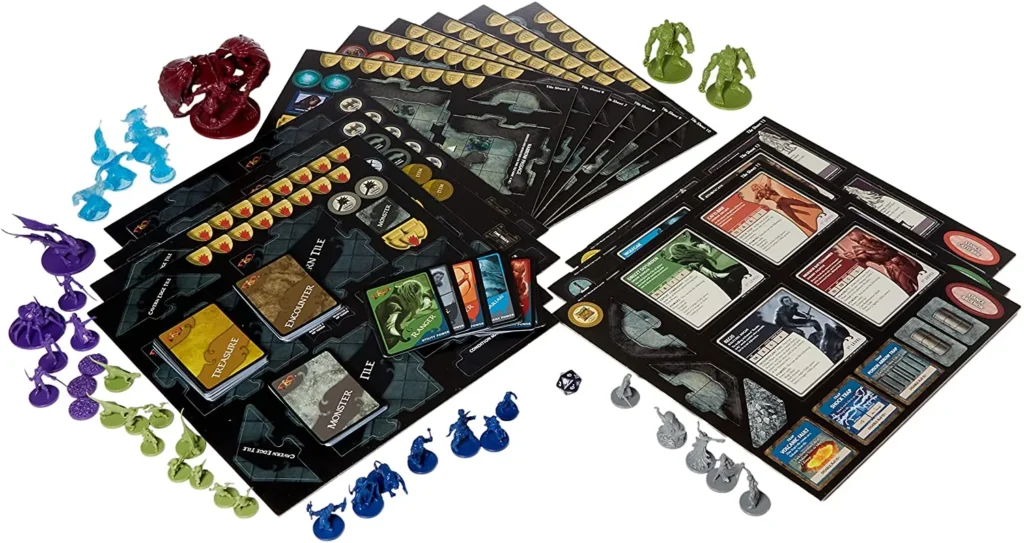
That question is the heart of Dungeons & Dragons. One person describes the world. Everyone else plays a character inside it. Together, you build a story by making choices, taking risks, talking to strange people, sneaking into dangerous places, and sometimes fighting monsters.
D&D is a tabletop roleplaying game. It isn’t a board game in the usual sense, and it isn’t about beating the other players. It’s collaborative. The DM plays the world, the townsfolk, the villains, the weather, the locked doors, and the dragons. The players each control one adventurer and decide how that character thinks, acts, and reacts.
A game might feel like fantasy improv with a few rules attached. If your character wants to climb a wall, charm a guard, search a chest, or swing a sword, the DM tells you what to roll and what happens next. Success can lead to treasure or a dramatic escape. Failure can lead to trouble, comedy, or a new problem to solve.
D&D works best when everyone treats the table like a shared story, not a competition.
That’s why people stick with it. You’re not just moving pieces. You’re making memories. One group might spend a whole night negotiating with goblins instead of fighting them. Another might turn a bakery delivery into a disaster because someone tried to tame a horse indoors.
If you enjoy video games, fantasy novels, improv, puzzles, or hanging out with creative friends, D&D has a lane for you. Some players love strategy. Some love acting in character. Some just want to roll dice and laugh when everything goes wrong.
If you want more approachable game writing after this, the gaming section at Maxi Journal is a good place to keep browsing.
Gathering Your Party and Essential Gear
Before anyone rolls a die, you need two things sorted out. Who are you playing with, and what do you really need to start?

Who does what at the table
The Dungeon Master runs the game. They describe scenes, play non-player characters, set challenges, and keep the session moving. They don’t need to memorize everything. A good beginner DM mostly needs curiosity, patience, and a willingness to say, “Let’s make a ruling and keep going.”
The players each make one character. Their job is simple in theory and endless in practice. Listen to the situation, decide what your character does, and work with the group.
A healthy beginner group usually works well when everyone understands these basics:
- The DM isn’t your enemy. They present obstacles, but they’re also trying to help everyone have fun.
- Your character can be flawed. Your behavior at the table shouldn’t make the game harder for everyone.
- Team play matters. D&D gets better when players share the spotlight instead of competing for it.
How to find a group
Your first group doesn’t need to be perfect. It needs to be welcoming.
Start with people you already know. Friends, siblings, classmates, coworkers, and partners are often easier than jumping into a room full of strangers. If nobody has played before, that’s fine. A beginner-only table can be a great place to learn because everyone’s expectations are low and curiosity is high.
If your personal circle isn’t interested, try these paths:
- Local game stores: Many host open tables, learn-to-play nights, or community boards.
- Libraries and community centers: Some run casual game groups.
- Online play: Virtual tabletops and video calls make it possible to join from home.
- Friend-of-a-friend tables: Often the easiest way in, because someone can introduce you.
Practical rule: Choose kind people before experienced people. A patient group teaches faster than a rules expert with no social grace.
What you need, and what you don’t
A lot of guides say you only need “a few supplies,” but they often skip the financial side. As noted in this beginner guide discussing the cost barrier and lack of clear free alternatives, new players can feel pushed toward buying multiple books before they even know if they like the hobby.
You can start much more easily.
Free start
This is enough for a first game:
- Basic rules: Use the free official rules online.
- A character sheet: Print one or use a digital version.
- Dice app or shared dice: Physical dice are nice, but not mandatory.
- Paper or notes app: Track inventory, names, and silly plans.
- A group chat or call: That’s your organizing hub.
Budget-friendly start
If you want a little more structure:
- One starter product: A starter set can help a new DM a lot.
- One set of physical dice per player: Convenient, not essential.
- Pencils and printed sheets: Low-tech and reliable.
- A simple map or grid: Optional, but helpful for combat.
Full bookshelf start
This is for people who already know they’re in:
- Player’s Handbook
- Monster Manual
- Dungeon Master’s Guide
You do not need all of that on day one.
Accessibility matters
Affordable play also means flexible play. Some groups do better with shorter sessions, digital sheets, text recaps between games, or less background noise. Some players need visual reminders, slower turn pacing, or permission to ask rules questions without feeling embarrassed.
That isn’t extra. That’s good table design.
Understanding Core Mechanics and Rolling Dice
The DM says, “The bridge is collapsing. What do you do?”
One player grabs the ropes. Another sprints for the other side. A third tries to calm the panicking mule. In moments like that, D&D uses a simple rule to decide what happens next: roll a d20, add a modifier, compare the total to a target number.
That one pattern runs most of the game. Once you know it, the rules stop feeling like a wall of terms and start feeling more like a conversation with guardrails.
The basic formula
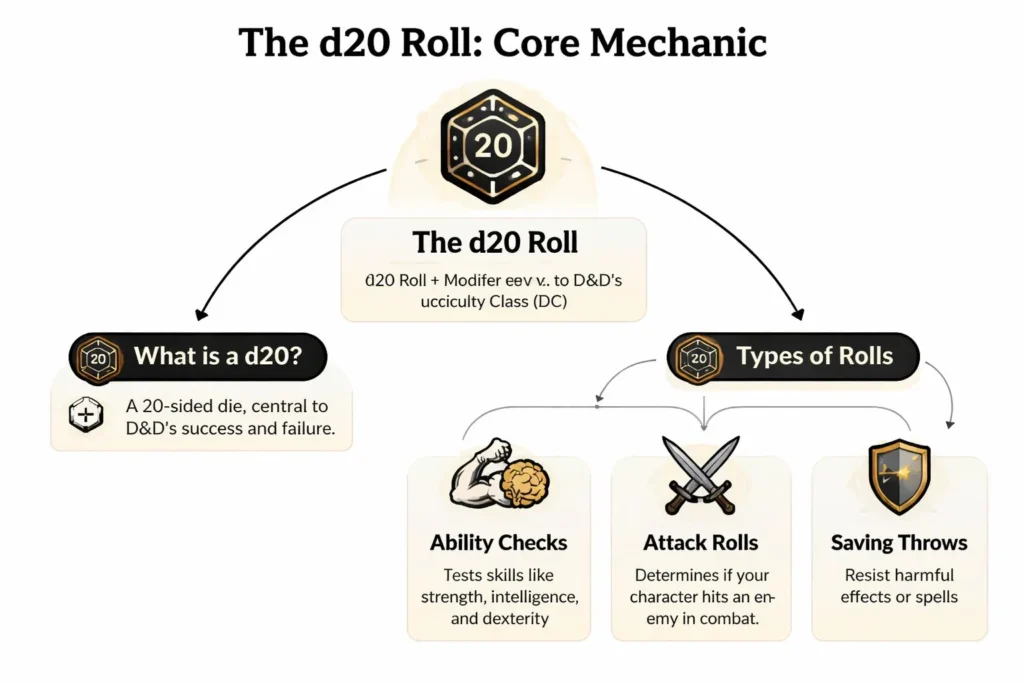
A d20 is a twenty-sided die. You roll it when the outcome is uncertain and the result matters.
The usual pattern is:
d20 + modifier vs. DC or AC
Here’s what those letters mean:
- DC means Difficulty Class. It is the number you need to meet or beat for tasks like climbing, persuading, noticing, or sneaking.
- AC means Armor Class. It is the number you need to meet or beat when you attack a creature.
So if you shove against a stuck stone door, the DM might call for a check. If you swing a sword at a goblin, you make an attack roll. If a spell blasts toward you and you try to avoid the worst of it, you make a saving throw.
Different situations. Same engine.
The six ability scores
Your character has six core stats, called ability scores. They shape what your character tends to be good at, and they create the modifiers you add to rolls, as outlined in Northern Illinois University’s D&D capstone research on the game’s core math and character system.
The modifier formula is:
(score – 10) / 2, rounded down
So an 18 gives you a +4 modifier. According to the same NIU analysis, that relationship between scores and modifiers is one of the basic pieces of D&D’s math.
Here’s the quick version:
| Ability Score | What It Measures | Used For… |
|---|---|---|
| Strength | Physical power | Melee attacks, lifting, forcing doors |
| Dexterity | Agility and reflexes | Ranged attacks, stealth, initiative, dodging |
| Constitution | Toughness and stamina | Hit points, endurance, resisting strain |
| Intelligence | Reasoning and memory | Knowledge, investigation, learned magic |
| Wisdom | Awareness and intuition | Perception, insight, survival, some spells |
| Charisma | Presence and force of personality | Persuasion, deception, intimidation, leadership |
These numbers are rules, but they are also roleplay cues. A high Charisma character does not need to sound like a stage actor at the table. A low Strength character is not useless. The scores tilt the odds, a bit like choosing the right tool for a job.
What that means in play
Say your ranger has Dexterity 16. Sneaking through tall grass or firing a shortbow will usually feel easier because that stat supports those actions.
Now say your fighter has Strength 8. You can still try to shove a crate, climb a wall, or wrestle a bandit. You just succeed less often.
That distinction matters for group dynamics too. New players sometimes feel pressure to be good at everything. D&D works better when each character has a few strengths, a few weak spots, and room to rely on the party. Those gaps give other players chances to shine.
If you have played games where personality choices affect how a character functions, you may recognize the pattern from this guide to Persona 5 answers and social decisions. D&D does it with more freedom, because your choices come from conversation instead of fixed menu options.
A high stat improves your chances. It does not promise success.
Where ability scores come from
You usually do not invent these numbers from scratch. Common methods include rolling 4d6 and dropping the lowest die, along with point buy and the standard array. According to the same NIU analysis, that rolling method tends to produce above-average adventurers without making every character identical.
For a first campaign, keep the goal simple:
- Pick a class that sounds fun.
- Put your best score where that class uses it most.
- Leave room for flaws.
That last part is good for the table, not just the rules. Perfect characters are harder to roleplay and often less fun to support. The wizard who forgets social cues or the brave cleric with terrible stealth gives the group something to react to.
Three roll types to remember
You do not need every rule term on day one. Start with these three:
- Ability checks: Can you do the thing?
- Attack rolls: Do you hit the target?
- Saving throws: Can you resist the thing happening to you?
If that feels simple, good. It is supposed to. D&D has plenty of details, but the heart of play is still a group of people describing actions, rolling dice, and reacting together. The math keeps the game fair. The table makes it memorable.
Bringing Your First Character to Life
Character creation looks complicated until you stop treating it like paperwork.
Start with a person.

Maybe your character is a quiet temple guard who left home after failing to protect someone important. Maybe she jokes when she’s nervous and pretends she isn’t scared. Maybe she wants to look brave so badly that she volunteers for dangerous jobs before thinking them through.
That’s already more useful than a page of stats.
Start with a simple concept
A good first character fits in one sentence.
Try one of these shapes:
- The reliable protector who steps between danger and the group
- The curious scholar who always wants to open the dusty book
- The fast-talking trickster who can’t resist a risky idea
- The wanderer looking for a missing mentor, sibling, or friend
You don’t need an epic backstory. You need a reason to join the adventure and a personality the other players can interact with.
If you enjoy character-driven games, you might like seeing how personality choices shape play in articles like this Persona 5 answers guide, where decisions affect how a character feels and functions. D&D works the same way, just with more freedom.
Race and class give shape to the idea
Once you know who your character is, you choose the broad fantasy framework.
Species or ancestry choices such as elf, dwarf, halfling, or human help define background flavor, physical traits, and sometimes special features.
Class matters even more for play. It tells you your character’s main role.
Here’s the beginner-friendly version:
- Fighter: Straightforward, durable, great for learning combat
- Rogue: Sneaky, skillful, mobile
- Cleric: Mix of support, defense, and divine magic
- Wizard: Powerful spells, but more rules to track
- Ranger: Good blend of combat and exploration
- Bard: Social, magical, flexible, often a great party glue character
A gruff dwarf who protects people naturally fits a fighter or cleric. A curious elf who loves old ruins might become a wizard or rogue. Don’t force the concept. Let it click.
Fill the sheet in layers
Most first-time confusion comes from trying to understand every box at once. Don’t.
Work in this order:
- Name and concept
- Class
- Ability scores
- Key features and equipment
- Short personality notes
Write down one ideal, one fear, and one habit. That’s enough roleplaying fuel for several sessions.
If you can answer “What does my character want?” and “How do they act under stress?” you’re ready to play.
A quick visual walkthrough can help if you want to see the process in action.
Don’t overbuild your first hero
New players sometimes write a novel before session one. Then the game starts, and half of it never matters.
Leave gaps on purpose. You can discover things during play.
Maybe you thought your paladin was stern and serious, but after two sessions she turns out to be the funniest person at the table. Maybe your rogue begins as selfish and slowly becomes protective. That growth is part of the fun.
Your first character doesn’t need to be the most original fantasy hero ever made. They need to be playable, understandable, and interesting enough that you want to hear what happens next.
The Flow of a Game Session
The first few minutes of a session often sound like this: the DM describes a dark hallway, one player wants to inspect the floor, another wants to talk through a plan, and someone asks, “Do I roll for that?” That little moment is D&D in miniature. People listen, ask questions, make choices, and the rules step in only when the outcome is uncertain.
Once you see that pattern, a session feels much easier to follow.
Most games move between three modes: exploration, social scenes, and combat. They are less like separate minigames and more like parts of the same conversation. You investigate a ruin, meet someone inside it, then end up in a fight because of what you said or failed to notice. The flow is usually natural, even when the story gets chaotic.

Exploration feels like poking at a mystery
The DM paints the scene, and the players test its edges.
“You enter a ruined chapel. The roof has collapsed. There’s a dry fountain in the center, and footprints in the dust that stop at the far wall.”
Now the table starts pulling on threads. One player checks the fountain. Another watches the doorway. Someone else studies the footprints. Good exploration comes from specific questions, because specific questions give the DM something concrete to answer.
“I search the room” works, but “I check the fountain basin for a hidden latch” works better.
This part of the game rewards curiosity more than perfect rules knowledge. If you are unsure what to do, ask yourself one simple question: what would my character focus on first? A cautious ranger notices exits. A greedy rogue checks for valuables. A cleric might look for signs of desecration. Your character’s priorities help you choose without freezing up.
Social scenes run on clear intent
Roleplaying is often easier than it looks. You do not need an accent, a dramatic speech, or improv training. You just need to decide what your character wants from the conversation.
You can say, “I tell the guard we’re expected inside,” or “My cleric tries to calm her down and asks what she saw.” Both are real roleplaying. One is first person. One is third person. Both move the scene forward.
That matters because social scenes are not only about acting. They are also about reading people, picking an approach, and working together as a group. If one player is eager to bargain while another wants to threaten, pause for a second and get on the same page. New groups often focus so hard on the fantasy story that they forget the human part at the table. A quick out-of-character check, like “Are we trying charm first?” saves confusion and keeps everyone involved.
If you like story-heavy campaigns in games, the appeal is similar to a focused single-player narrative. The difference is that here, no script limits you. That is one reason people who enjoy story modes, like the kind discussed in a Call of Duty campaign overview, often end up liking tabletop games too.
Good roleplaying means making understandable choices, not giving a perfect performance.
Combat has a sequence you can learn fast
Combat is the most structured part of the game, which is helpful for beginners. Once a fight starts, everyone takes turns in order. The official D&D Basic Rules explain the basics: roll initiative with a d20 plus your Dexterity modifier, then take your turn using movement, an action, and sometimes a bonus action or reaction.
That can sound like a lot on paper. At the table, it usually clicks after a round or two.
A beginner combat round
Let’s say goblins jump out from behind broken carts.
Roll initiative
Everyone rolls a d20 and adds their Dexterity modifier. Highest result goes first.Take turns in order
On your turn, you can move up to your speed and take an action.Choose your action
Common actions include attacking, casting a spell, dashing, helping, or disengaging.Roll to hit if needed
For a weapon attack, roll a d20 and add the relevant modifiers. If the total meets or beats the target’s Armor Class, you hit.Roll damage
On a hit, roll the weapon’s damage die and add the listed modifier if appropriate.End your turn
Then the next creature acts.
A simple mental model helps here. Your turn is your small window to affect the scene. Where do you move? What do you try? What do you save for later? A fighter may rush forward and hold the line. A wizard may stay back and protect their spell slots. A rogue may look for cover and wait for the right opening.
You do not need to optimize every turn to have fun. You just need to stay engaged and know your main options.
One rule that causes a lot of confusion
Advantage and disadvantage are common points of confusion for new players. As noted earlier in the Basic Rules, the mechanic itself is simple:
- Advantage: roll two d20s, use the higher one
- Disadvantage: roll two d20s, use the lower one
The tricky part is spotting when it applies. Hidden attackers, helpful allies, harmful conditions, and some spells can all affect the roll. If you are not sure, ask.
A good table habit is to pause before an important roll and say, “Any advantage or disadvantage here?” That keeps mistakes small and teaches the group the rules through repetition.
It also keeps the pace friendly. Beginner sessions run best when people help each other remember the process instead of worrying about getting every detail right or buying every accessory at once. A pencil, a few dice, and a patient group are enough to make a great night.
Navigating Common Pitfalls for New Adventurers
Knowing the rules helps. Knowing how to be good company helps more.
A lot of beginner advice stops at character sheets and combat turns, but many new groups struggle with something else entirely: the human side of the table. As discussed in this article on beginner D&D guidance and overlooked group dynamics, issues like player conflict, mismatched expectations, and social anxiety often matter more than the rules in determining whether a campaign lasts.
Start with a session zero
Before the first adventure, spend time talking as real people.
This conversation is often called session zero, and it solves more problems than any rulebook. You don’t need a formal checklist, but you should agree on a few basics:
- Tone: Silly treasure hunt, serious fantasy drama, or something in between
- Boundaries: Topics people don’t want in the game
- Style: Heavy roleplay, tactical combat, mystery-solving, casual chaos
- Scheduling: How long sessions run and how often you meet
- Table etiquette: Phones, interruptions, snacks, and punctuality
This isn’t overkill. It’s how groups avoid resentment later.
A campaign doesn’t fall apart because someone forgot a modifier. It falls apart when people assume they want the same game and never check.
Handle different playstyles with generosity
Most tables mix personalities.
One player wants to speak in character for every tavern scene. Another mostly wants exciting combat. Someone else likes puzzles. Another person is shy but strongly invested. None of those are wrong.
Problems start when players act like their style is the “real” way to play. A strong group makes room for variety. If you love roleplay, leave space for the tactician. If you love battle maps, don’t mock the player who wants to negotiate with every monster.
Try these habits:
- Share spotlight: If you’ve spoken a lot, ask another player what their character thinks.
- Invite quieter players in: “What does your ranger notice?” works wonders.
- Disagree in character carefully: Party tension can be fun. Personal tension usually isn’t.
- Support the DM: Learn your own abilities so they don’t have to carry every detail.
Avoid freezing on your turn
New players often panic in combat because they want the perfect move. That leads to long pauses, frustrated tables, and a feeling that combat is harder than it is.
You don’t need perfect. You need ready.
When your turn is coming, decide on a default action. Attack the nearest threat. Help an ally. Move to cover. Cast the spell you know best. If circumstances change, adjust. If not, act.
The smoothest players aren’t always the smartest ones. They’re the ones who stay engaged between turns and keep the group moving.
Your First Quest and Where to Go Next
You don’t need to wait until you “fully understand” D&D to start. You need a small problem, a few characters, and a willingness to improvise.
Try this opening quest:
The local baker’s prize-winning pies keep disappearing at night. Witnesses swear they saw “rat-men” dragging pastry trays into a storm drain behind the shop. The baker offers a small reward to anyone brave enough to investigate.
That setup gives you everything you need for a first adventure. A clear goal. A simple mystery. A reason to explore. A possible sewer crawl. Some nervous townsfolk. Maybe the rat-men are thieves, maybe they’re hungry, maybe they’re hiding from something worse deeper underground.
A beginner DM can run that in three acts:
- Talk to townsfolk and inspect the bakery
- Follow clues into the sewers
- Confront the pie thieves and decide what to do
That last part matters. D&D gets interesting when the answer isn’t only “fight.”
For next steps, keep your resource list tight:
- D&D Starter Set: Good if you want a guided first campaign
- D&D Beyond basic tools: Useful for character sheets and rules lookup
- Free basic rules: Best first read for any new player or DM
- A simple notebook or shared document: Track names, clues, loot, and promises made to NPCs
If you’re brand new, resist the urge to collect everything at once. Play one short adventure first. Learn by doing. Let the funny mistakes happen. Ask questions out loud. Most tables would rather help an eager beginner than sit with someone pretending to understand.
D&D has room for cautious players, loud players, storytellers, tacticians, artists, and complete newcomers. You do not need a perfect voice, perfect rules knowledge, or a huge budget.
You just need a group, a starting point, and the willingness to say, “I open the door.”
If you enjoy clear, approachable guides on games, entertainment, education, and more, visit maxijournal.com. It’s a great place to find fresh reading and discover thoughtful writing across a wide range of topics.
Discover more from Maxi Journal
Subscribe to get the latest posts sent to your email.