Argentina’s inflation rate was 32.60% year over year in March 2026, down from 33.20% in February. At the same time, monthly inflation has been falling, which creates the central paradox of Argentina right now. Prices are rising more slowly than before, but they’re still rising fast enough to keep households, employers, and visitors under pressure.
That gap matters because it changes how people read the news. A lower monthly number can sound like the crisis is over. It isn’t. The current argentina inflation rate tells a more complicated story: policy has slowed the pace of acceleration, but it hasn’t yet restored normal price stability.
For a global audience, Argentina is more than an economic outlier. It’s a live case study in what happens when a country spends decades breaking trust in its currency, then tries to rebuild credibility under intense political and social pressure. That’s why this isn’t only a story about central banks and exchange rates. It’s also a story about grocery budgets, wage negotiations, tourist spending, and whether businesses can set prices without guessing.
Understanding the 2026 Argentina Inflation Rate
The simplest way to understand the argentina inflation rate in 2026 is to separate two truths that can both be real at once. First, inflation has cooled from much worse levels. Second, 32.60% year over year in March 2026, after 33.20% in February, is still a crisis-level rate for everyday life, as shown in Argentina inflation data from Trading Economics.
That’s why the monthly slowdown can be misleading if you stop there. A monthly decline tells you the fever is lower. It doesn’t tell you the patient is healthy. For residents, that means salaries can still lag behind prices. For companies, it means contracts and budgets remain exposed. For travelers, it means the cost of a trip can still shift in ways that feel abrupt.
What matters most: falling monthly inflation is progress, but annual inflation is still high enough to distort decisions about saving, pricing, hiring, and spending.
Argentina’s problem also fits a broader pattern seen in stressed economies. Short-term improvement can coexist with deep structural fragility, much like the tensions visible in other crisis-hit economies discussed in this analysis of Russia’s economy. The common lesson is that stabilization isn’t the same thing as trust.
Why the headline number doesn’t tell the whole story
Annual inflation measures how much prices changed over a full year. Monthly inflation captures the latest pace. When monthly readings fall, policymakers can claim momentum. But households don’t buy groceries once a year. They experience inflation as a constant series of resets.
A worker may hear that inflation is “coming down” and still find that rent, transport, and food feel unstable. A business owner may see calmer monthly data and still avoid long-term commitments because cost visibility remains poor. The annual rate is what keeps that caution alive.
Why readers outside Argentina should care
Argentina compresses several economic lessons into one country. It shows how inflation isn’t just a statistic. It becomes a social condition. Once people stop trusting the currency, every transaction gets harder. Every plan gets shorter. Every forecast becomes provisional.
A History of Argentina’s Chronic Inflation
Between 1975 and 1991, prices in Argentina rose by a cumulative 20 billion times, and annual inflation topped 3,000% in 1989, according to Citéco’s history of hyperinflation in Argentina. Those figures explain why inflation in Argentina is more than a policy problem. It is a lived memory that still shapes how residents save, how businesses set prices, and why travelers quickly learn that posted prices can age badly.

Argentina did not arrive at hyperinflation overnight. After World War II, recurring fiscal deficits, periodic currency devaluations, and weak confidence in state institutions pushed the economy into a pattern of chronic inflation. The 1975 Rodrigazo accelerated that process. From that point on, inflation stopped being a temporary shock and became part of daily economic behavior.
That distinction matters. In a country with chronic inflation, people do not wait for official data releases to react. Households spend salaries quickly, shopkeepers reset prices often, landlords shorten terms, and importers build exchange-rate risk into every quote. Inflation starts to reorganize time itself. Planning horizons shrink.
The 1991 Convertibility Plan showed that Argentina could crush inflation quickly under a hard monetary rule. The peso was pegged 1:1 to the US dollar, and inflation fell from 1,344% in 1990 to 17.5% in 1992, as Citéco notes in its account of the program. For residents, that brought temporary relief and restored a measure of predictability. For businesses, it made pricing and contracting possible again.
But convertibility solved the symptom faster than the underlying credibility problem. A rigid exchange-rate anchor can stop a panic, yet it cannot by itself fix weak public finances, low trust in institutions, or the political temptation to reverse course when growth stalls. That is why Argentina’s inflation history reads less like a straight line and more like repeated stabilization attempts followed by renewed stress.
A short visual overview helps place that cycle in context.
For readers trying to understand the practical consequences, the historical lesson is simple. Once people expect the value of money to erode, they change behavior before any new crisis fully arrives. Residents rush to convert pesos into goods or dollars. Companies avoid long fixed-price commitments. Travelers who rely on old budgets or stale exchange assumptions can misjudge costs within days.
That historical memory is one reason inflation remains difficult to contain even when monthly data improves. Policy has to slow price growth. It also has to rebuild trust among people who have seen stabilization plans succeed briefly, then fail.
The Key Drivers Behind Argentina’s Inflation
From 2020 to September 2023, Argentina’s money supply expanded 9.8x, reaching 22 trillion pesos. The same period fed into an estimated 2024 inflation rate of 250%. That link between peso creation and prices is one of the clearest parts of the story, according to The Daily Economy’s inflation and money supply analysis.
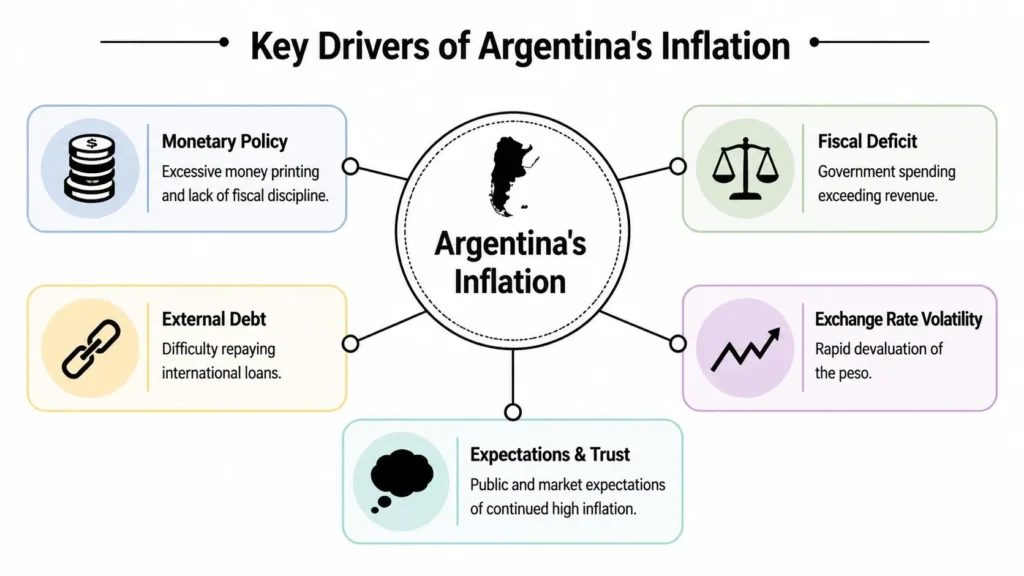
Money growth alone does not explain why inflation stays so persistent. Argentina’s problem is a reinforcing cycle in which fiscal weakness, peso issuance, exchange-rate fears, and defensive behavior by households and firms all push in the same direction.
The inflation loop in plain English
A government that cannot finance itself cheaply often falls back on the central bank. More pesos then circulate in an economy where confidence in the currency is already thin. Businesses respond by marking up prices before replacement costs rise further, while households try to spend or convert pesos quickly. That behavior weakens demand for the currency again.
The result is inertia. Inflation keeps going because everyone adjusts in anticipation of everyone else adjusting.
Five channels matter most:
- Fiscal pressure: the state needs financing and struggles to borrow on terms the market trusts.
- Monetary expansion: more pesos enter circulation and dilute confidence in the currency.
- Exchange-rate anxiety: importers, savers, and consumers expect the peso to lose value.
- Price resetting: firms update prices early to protect margins against future cost jumps.
- Trust erosion: residents reduce peso holdings and shorten the time between earning and spending.
This matters beyond macroeconomics. A resident paid monthly sees wages lose purchasing power before the next paycheck. A local business has to rewrite price lists and supplier terms more often. A traveler who budgets in pesos weeks in advance can find hotel, meal, or transport costs materially different by arrival.
Why food feels the crisis first
Inflation is harder to absorb when it hits categories people cannot postpone. In the same Daily Economy analysis, food and beverages account for 23% of the CPI basket, with transport at 12% and restaurants and hotels at 11%.
That weighting helps explain why the crisis is felt first in kitchens, commutes, and routine services. If electronics rise in price, households can delay a purchase. If food and transport rise, they pay more immediately or cut quantity and quality. For lower-income families, that quickly becomes a question of nutrition and mobility rather than consumer choice.
For visitors and foreign firms, the same categories matter for a different reason. They shape the day-to-day cost of being in Argentina. Headline inflation can sound abstract, but a CPI basket tilted toward food, transport, and hospitality means the squeeze shows up directly in restaurant bills, taxi fares, delivery costs, and staff expenses.
Why expectations are as important as money printing
Inflation in Argentina is also driven by expectations. Shop owners, importers, landlords, and consumers often act on the assumption that the peso will weaken and replacement costs will soon be higher.
That changes business behavior in practical ways:
| Business problem | What inflation changes |
|---|---|
| Pricing | Firms shorten quote validity and reprice more often |
| Inventory | Stock becomes a hedge, not just merchandise |
| Payroll | Wage talks become more frequent and more contentious |
| Contracts | Long-term peso agreements become harder to trust |
These are not side effects. They are part of the transmission mechanism. Once firms expect higher costs, they bring future inflation into current prices. Once workers expect faster price growth, they push for more frequent wage adjustments. Once suppliers distrust peso contracts, they demand indexation, shorter terms, or payment in dollars.
The hidden operational cost
Outside Argentina, attention usually goes to the annual inflation number. Inside the country, one of the biggest costs is administrative fatigue.
Managers spend hours revising menus, invoices, software prices, supplier agreements, wage assumptions, and cash-flow plans. Small businesses often lack the systems to do that efficiently, so the burden falls on owners and finance teams. Time that could go into expansion, hiring, or product improvement is redirected toward constant repricing and short-term survival.
That is why high inflation lowers productivity even before output contracts. An economy under chronic price instability devotes more effort to defense and less to investment.
Argentina’s Policy Response to the Crisis
The current government’s answer has been shock therapy. The logic is straightforward: if inflation comes from chronic fiscal and monetary indiscipline, then the state has to break that pattern quickly enough to change expectations before they turn again.
A central part of the monetary framework is the exchange-rate band. Starting in January 2026, the band expanded based on inflation from two months earlier. January’s expansion was 2.5%, reflecting November 2025 inflation, and February’s was 2.8%, reflecting December 2025, according to PIIE’s analysis of Argentina’s fragile monetary framework.

What the government is trying to do
The basic goal is to create a nominal anchor strong enough to convince households and firms that future inflation will be lower. That requires more than rhetoric. It needs fiscal restraint, tight control over peso issuance, and an exchange-rate regime that people can believe.
The problem is that the current band mechanism is backward-looking. If today’s currency adjustment is linked to past inflation, then yesterday’s inflation can keep showing up in tomorrow’s depreciation. That risks keeping old expectations alive instead of breaking them.
Why the early results look contradictory
Interpreting the current argentina inflation rate is difficult. Monthly inflation has improved. That suggests policy is having some effect. But the annual rate remains high enough to show that the disinflation process is incomplete.
PIIE’s analysis also notes an unusual dynamic in money demand. Its econometric work found an inflation elasticity of –0.12 for the inflation-adjusted monetary base over January 2022 to December 2025, implying a relationship in which worsening expectations can produce behavior that complicates standard policy transmission. In plain language, people and firms don’t react to inflation in a neat textbook way when trust is already damaged.
Practical reading of policy: the government may be slowing inflation, but if people keep expecting devaluation, policy has to work much harder to make those gains stick.
The real trade-off
Shock therapy always asks society to absorb pain now for possible stability later. In Argentina, that means any anti-inflation success has to be judged not only by price data, but also by whether people begin extending their time horizon again. If families still rush to spend pesos, if businesses still avoid longer contracts, and if markets still doubt the anchor, then stabilization remains partial.
That’s the challenge facing policymakers. They don’t just need lower inflation. They need a public that believes lower inflation will last.
Practical Implications for Residents and Travelers
Inflation becomes real in the supermarket, at payroll, and at the currency exchange desk. The macro story only matters because it reshapes ordinary decisions. In Argentina, that effect is severe enough that by 2024 poverty had reached over 40% of households, largely because salaries “most commonly do not manage to increase at the pace of prices,” according to Statista’s overview of inflation and poverty in Argentina.

For residents
The hardest part of high inflation isn’t just that things cost more. It’s that time itself becomes expensive. Holding cash too long can feel like a mistake. Waiting to buy essentials can mean paying more later. A salary increase can arrive and already feel outdated.
For workers, this produces a specific poverty trap. You can remain employed and still lose ground because wage adjustments trail price changes. For retirees, informal workers, and households without financial buffers, that lag can become brutal.
A few practical habits matter more in this environment:
- Shorten budgeting cycles: monthly budgets can become stale quickly, so households often need to track essentials more often.
- Separate needs from replaceable wants: food, transport, and rent need priority because those categories move fast and are hard to postpone.
- Reduce idle peso balances: people usually try to avoid keeping more local currency on hand than they need for near-term expenses.
For businesses
A small business owner in Argentina doesn’t just run a business. They run a price-adjustment system. Menus, invoices, supplier terms, and payroll all need more frequent review than they would in a stable economy.
That creates second-order effects. Managers spend more time defending margins and less time investing in growth. Customer relationships also become harder because price increases feel personal even when they are defensive.
Here’s how the environment changes routine operations:
| Business area | What high inflation forces |
|---|---|
| Stock management | Buying inventory can double as protection against future price increases |
| Supplier relations | Payment terms become more valuable than list prices |
| Hiring | Employers hesitate when future labor costs are hard to predict |
| Customer service | Frontline staff end up explaining price changes repeatedly |
For travelers
Visitors usually notice the inflation crisis in confusing prices and fast-changing assumptions. A guidebook or old forum thread can become stale quickly. Hotel, restaurant, and transport costs may not behave the way they do in lower-inflation countries.
Travelers should approach Argentina with a more flexible budget and more attention to payments than usual. It also helps to prepare with strong trip protection. A practical starting point is comparing options in this guide to the best travel insurance for international trips, especially if you’re booking transport and accommodations across changing conditions.
If you’re visiting Argentina, treat every budget estimate as temporary until you confirm it close to the date of payment.
For tourists, the main operational advice is simple: verify current payment policies, confirm whether quoted prices are still valid, and avoid assuming that exchange-rate conditions discussed by other travelers last unchanged.
Strategies for Protecting Your Purchasing Power
There’s no perfect defense against inflation, but there are better and worse habits. In a country where trust in the currency is fragile, the first objective is usually to reduce how long you hold value in forms that are eroding quickly.
The practical principle is simple. Cash for immediate use. Protection for everything else.
Start with time, not just return
The first question isn’t “What earns the highest yield?” It’s “How long can I afford to leave money exposed?” In high inflation, time is often the hidden cost.
That leads to a basic playbook:
- Keep only near-term spending money in pesos. If you need cash for groceries, commuting, or bills soon, liquidity matters more than optimization.
- Move excess funds quickly into more defensive vehicles. People in Argentina often look for tools that either track inflation, track a stronger currency, or at least reduce idle balances.
- Review holdings frequently. A sensible setup one month may be weak the next if prices or policy expectations shift.
Tools people commonly consider
Residents often look at a mix of local and digital options depending on access, regulation, and risk tolerance. Commonly discussed examples include US dollars, Plazo Fijo UVA, Mercado Pago balances with investment features, and stablecoins. Each solves a different problem. None is risk-free.
- US dollars: useful as a store of value when local-currency trust is low, but access and transaction practicality can vary.
- Plazo Fijo UVA: designed to track inflation, which may help preserve purchasing power better than plain peso savings.
- Mercado Pago and similar apps: practical for reducing dead cash and managing daily liquidity, though they aren’t the same as a full inflation hedge.
- Stablecoins: appealing to users who want digital dollar exposure, but they bring platform, custody, and regulatory risk.
Don’t chase complexity for its own sake. In high inflation, a simple system you’ll actually maintain is usually better than an elaborate one you won’t.
If you’re building a personal protection plan from scratch, this primer on how to start investing money is a useful companion for thinking through risk, liquidity, and diversification.
Frequently Asked Questions About Argentina’s Inflation
Common questions, direct answers
Argentina has spent long stretches of the past half-century battling high inflation, and that history shapes how people read every new monthly release. A cooler monthly print matters, but families, employers, and visitors still make decisions in an economy where prices can change fast enough to alter budgets, contracts, and travel plans within weeks.
| Question | Answer |
|---|---|
| What is the latest argentina inflation rate? | The latest verified annual figure is 32.60% in March 2026. That is far below the peaks seen during the recent crisis, but it still means prices are rising quickly by international standards. For households, that keeps pressure on wages and savings. For businesses, it keeps pricing and inventory decisions difficult. |
| Is inflation getting better or worse? | The short answer is that the pace has slowed, but the problem has not disappeared. Lower monthly inflation suggests disinflation. The annual rate still reflects a country adjusting to years of sharp price increases, so daily life can remain unstable even as headline numbers improve. |
| Why does Argentina keep having this problem? | Argentina’s inflation is tied to a long credibility problem. Fiscal deficits, peso weakness, expectations of future devaluation, and limited trust in local-currency savings keep feeding one another. Once households and firms assume prices will keep rising, they change behavior in ways that make inflation harder to bring down. |
| Does lower monthly inflation mean the crisis is over? | No. It means the rate of increase may be easing. Real stability usually requires several things at once: lower inflation over time, steadier exchange-rate expectations, and more confidence that contracts, wages, and savings will hold their value. |
| What does this mean for tourists? | Treat posted prices as provisional until payment. Confirm the total close to checkout, keep extra room in your budget, and monitor exchange-rate rules before you travel. In practice, the inflation problem affects tourists less through one headline number than through constant price revisions and changing payment incentives. |
| What does it mean for businesses abroad? | Foreign companies dealing with Argentina face more than inflation risk. They also face contract repricing, currency volatility, and shifts in consumer demand as Argentine buyers cut discretionary spending. Conservative assumptions usually work better than a single optimistic forecast. |
The practical bottom line
One good month does not reset an economy with a long memory of inflation. Residents still need to protect day-to-day purchasing power. Travelers still need pricing flexibility. Businesses still need margin for error.
That is the main takeaway. Argentina may be improving from a severe inflation shock, but it has not yet returned to the kind of monetary stability that lets people stop thinking about prices every week.
If you want more clear, evidence-based explainers on business, economics, travel, science, and everyday decision-making, visit maxijournal.com. It’s an independent online magazine publishing approachable analysis across a wide range of topics for curious readers who want useful context without the jargon.
Discover more from Maxi Journal
Subscribe to get the latest posts sent to your email.