Benchmarking your performance indicators is simply the act of measuring your company’s success against a set standard. That standard could be your own performance last quarter, a competitor’s results, or even the industry-wide average. It’s all about using data-driven comparisons to see where you’re winning and where you have room to grow.
What Is Performance Benchmarking Really
Imagine a pro sports team that never watches game footage—not their own, and certainly not their rivals’. Sure, they know they scored some points, but they have no idea if their plays were effective, if their defense is weak, or how they measure up against next week’s opponent. Running a business without benchmarking is exactly like that. You’re playing blind.
Benchmarking is what gives your raw data critical context, turning numbers into actual intelligence. It’s the practice of systematically comparing your processes and performance metrics to a standard you’ve chosen. This reference point helps you tackle the big questions:
- Are our marketing campaigns pulling their weight compared to the industry norm?
- Is our support team closing tickets faster or slower than our main competitor?
- Have our operations gotten more efficient over the past year?
Beyond Simple Measurement
Just tracking metrics isn’t benchmarking. Knowing your website’s conversion rate is 2% is just a number. But knowing it’s 2% when the industry average is 4%? That’s an insight. It flags a clear opportunity for improvement. This comparison is the heart of real benchmarking; it takes you from just collecting data to making smart, strategic moves.
This difference is huge, especially since metrics can often be deceptive. A recent report drove this point home, noting that a massive 87% of organizations feel their marketing investments produce unreliable signals like clicks and downloads. In reality, only 26% of these “intent” signals ever become qualified opportunities. This leads to a “Marketing Data Mirage” where campaigns seem successful on the surface but don’t actually help the bottom line. You can see more of these findings in the State of Performance Marketing Report.
Benchmarking anchors your performance to reality. It stops you from celebrating vanity metrics that don’t contribute to growth and pulls your focus toward the indicators that truly matter.
At the end of the day, using performance benchmarks is about creating a constant loop of measurement, comparison, and action. It’s how you spot performance gaps, learn from the best, set goals you can actually hit, and build a real plan for sustainable growth. It turns your data from a simple report card into a strategic playbook.
Choosing Your Benchmarking Strategy and KPIs
So, you get what benchmarking is all about. The next move is picking a game plan. Deciding on the right benchmarking strategy and the metrics to track isn’t a one-size-fits-all deal. It really comes down to what you want to accomplish—whether that’s making steady internal progress or leaving your top competitors in the dust.
The path you choose will dictate what you measure. Think about it like a professional athlete: their training looks completely different if they’re trying to beat a personal record versus going for an Olympic gold medal. Your business needs that same level of strategic focus when it comes to benchmarking.
The Three Core Benchmarking Strategies
Before you can even think about your Key Performance Indicators (KPIs), you’ve got to land on the right type of benchmarking for your goals. There are three main ways to do this, and each one gives you a totally different view of your performance.
Internal Benchmarking: This is all about looking in the mirror. You’re comparing performance across different teams, departments, or even different time periods right within your own company. It’s like a runner meticulously tracking their lap times week after week to see if their new training regimen is working. The whole point is self-improvement and finding efficiencies.
Competitive Benchmarking: This one gets you in the ring with your direct rivals. You’re measuring how you stack up in specific areas—like market share, customer satisfaction, or pricing—against the companies you go head-to-head with every day. This is your 100-meter dash, racing side-by-side to see who comes out on top.
Functional Benchmarking: Here, you step outside your immediate industry to find world-class examples of a specific process. A local coffee shop, for instance, might study a fast-food chain’s drive-thru operation to speed up its own order-taking process. It’s about borrowing genius from the best, no matter what field they’re in.
To help you figure out which approach is the best fit, here’s a quick comparison.
Which Benchmarking Approach Is Right for You?
| Benchmarking Type | What It Measures | Primary Goal | Example |
|---|---|---|---|
| Internal | Performance between teams, departments, or over time | Identify internal improvement opportunities and boost efficiency | A sales team compares its Q1 vs. Q2 close rates to see what’s working. |
| Competitive | Key metrics against direct competitors | Gain a competitive edge and understand market position | An e-commerce store compares its shipping times and costs to Amazon’s. |
| Functional | A specific process against a top performer in any industry | Learn from the best-in-class to achieve breakthrough improvements | A hospital studies a hotel’s check-in process to improve patient admissions. |
Ultimately, your choice should be driven by the problem you’re trying to solve or the goal you’re aiming for.
This decision tree can also help you see how your main goal—whether it’s to improve from within or compete externally—guides your choice.
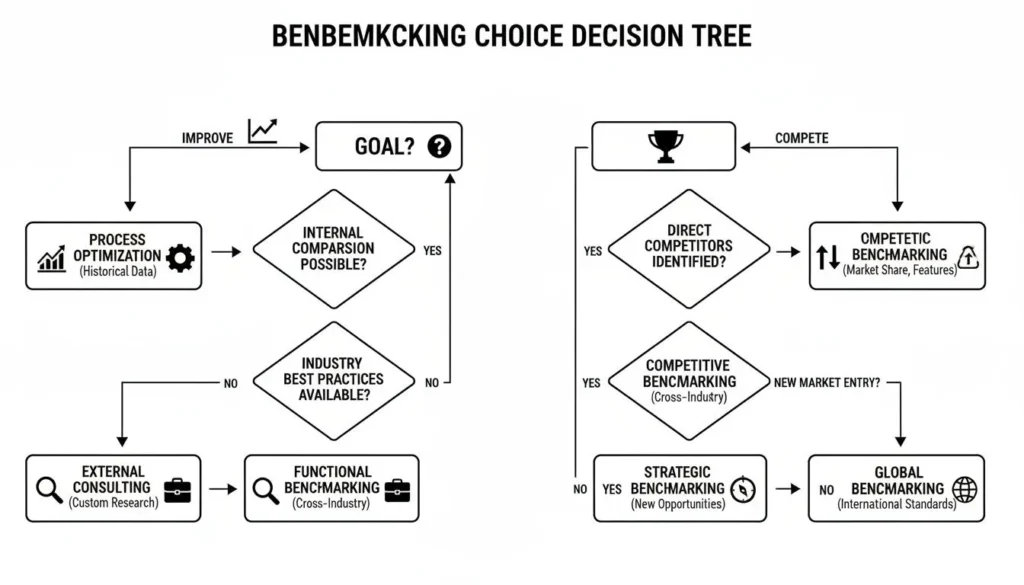
As you can see, figuring out if you’re trying to improve or compete is the first and most critical decision you’ll make on your benchmarking journey.
Selecting Your Key Performance Indicators
Once you’ve settled on a strategy, the next big task is picking your KPIs. These are the specific, measurable numbers you’ll use to see how you’re doing. Choose the wrong KPIs, and you could end up chasing metrics that look good on paper but don’t actually move the needle for your business.
The golden rule here is alignment. Your chosen KPIs have to connect directly to your most important strategic goals. If your goal is to boost customer loyalty, tracking social media “likes” is pointless. You should be looking at Customer Lifetime Value (CLV) or Net Promoter Score (NPS) instead.
To make sure you’re tracking what truly matters, just follow this simple framework.
Start with Your Business Objectives: What are the top one or two things your company or department is trying to achieve right now? Is it growing revenue, cutting costs, or grabbing more market share?
Link Objectives to Your Strategy: If your goal is to cut costs, an internal benchmarking strategy is a natural fit. If it’s to expand your market footprint, competitive benchmarking is probably the way to go.
Identify Relevant KPIs: Now, pick metrics that directly show progress toward that goal, using your chosen strategy. For example, if you’re using internal benchmarking to slash operational costs, good KPIs would be Cost Per Acquisition (CPA) or your support team’s Average Handle Time (AHT). To get more ideas on tracking your results, you might find our guide on how to measure content performance useful.
Let’s say a software company is using competitive benchmarking to win more market share. They might track these performance indicators:
- Sales Cycle Length: How long does it take us to close a deal compared to our top competitors?
- Customer Churn Rate: What percentage of customers are we losing each month versus our rivals?
- Feature Adoption Rate: Are customers using our new features faster than they’re using the new stuff our competition just launched?
By carefully picking KPIs tied directly to both your strategy and your business goals, you guarantee that your benchmarking performance indicators deliver real, actionable insights—not just a bunch of interesting data points. This focused approach is how you turn simple comparison into a serious competitive advantage.
How to Collect and Normalize Your Data
So, you’ve settled on your benchmarking strategy and picked your KPIs. The next logical step is gathering the right information, but this is often where the real work begins. The quality of your entire benchmarking effort depends on the quality of the data you collect.
Fortunately, there’s a wealth of information available. The trick is knowing where to find it and how to blend different sources together to paint a complete and accurate picture.
Sourcing Your Benchmark Data
A successful benchmarking project rarely relies on a single source of data. Doing so can give you a skewed, incomplete view of reality. The best approach is to combine your internal numbers with external context.
Here are the primary places you’ll want to look for data:
- Internal Systems: This is your treasure trove of primary data. Your CRM, ERP, web analytics platforms, and project management tools are sitting on years of performance history. This information is the bedrock for internal benchmarking and provides the baseline for every other comparison.
- Industry Reports: Consulting agencies, market research firms, and industry associations are constantly publishing reports filled with performance data. These are fantastic for competitive and functional benchmarking, giving you a broad look at the standards in your sector.
- Public Filings and Company Statements: For any publicly traded competitors, their annual reports and quarterly investor calls are a goldmine. You can often find key metrics like revenue growth, operational costs, and market share.
But gathering the raw numbers is only the first step. You’ll quickly find that data from different sources isn’t immediately comparable. A massive enterprise’s marketing budget can’t be fairly measured against a startup’s spend. It’s like comparing prices in different currencies without a conversion rate. This is where data normalization comes in.
Understanding Data Normalization
Data normalization is the critical process of adjusting and standardizing your raw data to make fair, apples-to-apples comparisons. It’s what removes the distortions created by differences in company size, market conditions, or operational scale. Skip this step, and your conclusions will be shaky at best.
Think of it this way: say one person runs a 5k on a flat, paved road, while another runs a 5k up a steep, muddy trail. Just comparing their finish times is totally misleading. Normalization is the act of adjusting for the difficulty of the terrain so you can see who is actually the stronger runner.
Normalization transforms raw, unequal data points into a common scale, revealing the true performance story that lies underneath. It ensures your insights are built on fairness and accuracy.
For instance, comparing the total number of support tickets handled by two teams is meaningless if one team supports a product with 10,000 users and the other supports a product with 1 million users. A normalized metric, like “tickets per 1,000 customers,” gives you a much clearer view of each team’s true efficiency.
How to Normalize Your Data
The normalization method you choose will depend on the metrics you’re comparing. The goal is always the same: create a common denominator that levels the playing field.
Common normalization techniques include:
- Using Ratios and Percentages: Instead of absolute numbers, turn them into ratios. For example, compare Marketing Spend as a Percentage of Revenue rather than the raw dollar amounts.
- Per-Unit Normalization: Break down your metrics into a single unit. This could be Cost Per Employee, Revenue Per Square Foot, or Defects Per 1,000 Units Produced.
- Adjusting for Time: When looking at data from different time periods, you have to account for factors like inflation or overall market growth. A 5% increase in sales might look good on paper, but if the market grew by 15% that same year, it’s actually an underperformance.
The recruiting industry provides a perfect example of why this matters. Gem’s 2026 Recruiting Benchmarks Report, which analyzed a staggering 165 million applications, revealed that hiring has become incredibly selective, with only 0.5% of applicants getting an offer. At the same time, recruiters are now handling 93% more applications and 40% more open roles than in 2021, even as their team sizes have shrunk by 14%.
Simply tracking “hires per recruiter” would be completely deceptive without normalizing for this massive increase in workload. To see how top-tier teams are adjusting for these variables, you can explore more insights from Gem’s recruiting benchmarks report.
By taking the time to properly collect and normalize your data, you’re setting yourself up for truly powerful analysis. This careful prep work ensures the benchmarking performance indicators you track are genuine reflections of performance that you can act on with confidence.
Turning Benchmark Data Into Actionable Insights
Collecting and normalizing your data is just the starting line. The real magic happens when you turn those numbers into an actual game plan. Raw data is just noise; you have to find the signal. This is the part where you stop looking at what your performance is and start digging into why.
The first step on this path is gap analysis. It’s a simple but incredibly powerful technique where you put your performance numbers right next to your chosen benchmark. The “gap” is nothing more than the space between where you are now and where you want to be—whether that’s hitting an internal target, matching a competitor, or reaching an industry average.
From Identification to Interpretation
Spotting a performance gap is the easy part. If your sales cycle takes 30 days and the industry benchmark is 20 days, you have a 10-day gap. Simple. The real work begins when you start asking questions about that gap. Is it a minor difference you can live with, or is it a major red flag that’s costing you business?
The answer always depends on context. A small gap might be fine if your average deal size is double the benchmark’s. On the other hand, a large gap could point to serious problems in your process. This is where you graduate from basic reporting to real strategic thinking.
Take email engagement, for example. The Dotdigital Global Benchmark Report 2026 points out a fascinating gap: while average email open rates sit at a respectable 55.4%, the global click-through rate (CTR) is a tiny 3.7%. A quick gap analysis shows that people are curious enough to open emails but not motivated enough to click.
That insight immediately changes the conversation. Instead of just celebrating high open rates, you start asking why clicks are so low. You might even explore channels with way better engagement, like SMS (25.7% CTR) or WhatsApp (51% CTR). Suddenly, a simple metric sparks a direct strategic question: “How do we make our email content more compelling?”
Uncovering the Root Cause
Once you’ve zeroed in on a meaningful gap, your next job is to find out where it’s coming from. This is called root cause analysis. It’s an investigative process that forces you to look past the symptoms and find the real operational or strategic problem. Think of it like a doctor who doesn’t just give you something for a fever—they find the infection that’s causing it.
Root cause analysis is the bridge between knowing you have a problem and knowing what to fix. It ensures your improvement efforts are targeted, efficient, and address the actual source of the performance gap.
A great tool for this is a simple framework called the “5 Whys.” By asking “Why?” over and over, you can peel back the layers of a problem until you hit its core.
Let’s go back to our sales cycle example with the 10-day gap.
Why is our sales cycle 10 days longer than the benchmark?
- Answer: Because our proposal and contract stage takes an average of 15 days, but competitors get it done in five.
Why does our proposal stage take so long?
- Answer: Our sales team has to create every single proposal manually from scratch. It’s a huge time sink.
Why are they creating them from scratch?
- Answer: We don’t have any standardized templates or a content library for them to pull from.
Why don’t we have templates?
- Answer: The project to create them got pushed back last quarter for other “urgent” tasks.
Why was it pushed back?
- Answer: We didn’t have any data that showed how much the manual process was slowing down deals and hurting revenue.
In just five questions, we went from a vague problem (“our sales cycle is too long”) to a specific, actionable root cause: the lack of standardized proposal templates is a major bottleneck. The fix isn’t some fuzzy goal like “sell faster” but a concrete task: “Create and roll out sales proposal templates.” This also shines a light on another issue—the need to better connect operational tasks to business outcomes, which you can read about in our guide to improving employee productivity.
By systematically analyzing gaps and digging for the root causes, you transform your benchmarking performance indicators from numbers on a dashboard into a data-driven plan for real improvement. This is how benchmarking becomes a powerful engine for change, not just an academic exercise.
Communicating Your Findings for Maximum Impact

You’ve done the heavy lifting and the analysis is complete. That’s a huge win, but the job’s not over. An insight that isn’t shared effectively is just data on a server—an opportunity completely lost.
The final, and arguably most important, step is to communicate what you’ve found. You need to do it in a way that gets people to understand, to believe, and most importantly, to act. This is less about dumping data and more about telling a compelling story that turns your benchmarking numbers into a clear case for change.
Crafting a Compelling Data Narrative
A great data presentation isn’t a collection of charts; it’s a story with a beginning, middle, and end. It sets the scene, introduces the conflict (the performance gap), and offers a clear path to a resolution (your proposed actions). Think of yourself as a guide walking your audience through the numbers.
Your story needs to answer three simple questions for anyone listening:
- “What did you find?” Don’t bury the lead. Start with your most critical finding.
- “So what?” This is the crucial part. Explain why it matters. Connect that data point to real-world business impacts like lost revenue, slipping efficiency, or a missed market opportunity.
- “Now what?” Give them a clear, actionable next step. This is the call to action your entire presentation should build toward.
Following this structure turns a dry report into a persuasive argument. It makes it far more likely your audience will stop just listening and start acting on your hard work.
Choosing the Right Visualizations
Numbers on a spreadsheet are easy to ignore. A sharp, clear chart? Not so much. The right visual can make a complex idea click in an instant, but the wrong one just adds to the confusion. Always choose a visualization that serves the story you’re trying to tell.
A great visualization doesn’t just show data; it reveals insights. It makes the gap you’ve identified impossible to ignore and clarifies the path forward.
Here are a few go-to chart types and how to use them to make your benchmark findings pop:
- Bar Charts: Perfect for straight-up comparisons. Use them to put your performance right next to a competitor’s or the industry standard.
- Line Graphs: The best way to show how things have changed over time. Track your performance against a benchmark across months or quarters.
- Scorecards or Dashboards: Great for a high-level snapshot of multiple KPIs. Use simple color-coding (red, yellow, green) to instantly signal performance status.
- Waterfall Charts: Incredibly useful for breaking down a performance gap into its root causes, showing exactly which factors are driving the difference.
No matter what you choose, keep your visuals clean and simple. Get rid of anything that doesn’t add to the core message. Strong presentation skills are essential for influencing decisions, and if you want to build more confidence, our guide on how to improve your public speaking is a great place to start.
For those looking to build out these reports, a number of excellent tools are available.
Popular Tools for Benchmarking and Visualization
Creating insightful dashboards and reports is much easier with the right software. Here’s an overview of some common tools that can help you bring your data to life.
| Tool Category | Examples | Best For | Key Feature |
|---|---|---|---|
| BI & Analytics Platforms | Tableau, Power BI | Creating interactive, in-depth dashboards from multiple data sources. | Drag-and-drop interface that makes complex visualizations accessible. |
| Spreadsheet Software | Microsoft Excel, Google Sheets | Quick, straightforward analysis and basic charting for smaller datasets. | Ubiquity and familiarity; powerful pivot tables and charting functions. |
| Programming Languages | Python (with Matplotlib, Seaborn), R (with ggplot2) | Highly customized and complex statistical visualizations for data scientists. | Ultimate flexibility to create any type of visualization imaginable. |
| Specialized Dashboards | Geckoboard, Databox | Building real-time, shareable KPI dashboards for team monitoring. | Pre-built integrations and templates for quick setup. |
Choosing the right tool often depends on your technical comfort level, the complexity of your data, and how you plan to share your findings.
Tailoring Your Message to the Audience
Not everyone in the room needs or wants the same level of detail. A huge part of getting your message across is framing it in a way that matters to the person you’re talking to.
An executive summary for leadership should be short, sharp, and strategic. They care about the bottom-line business impact: how this affects revenue, costs, and market position. They need the “so what” and the “now what,” not a deep dive into your methodology.
On the other hand, a detailed operational report for a department head needs to be tactical. This is where you include the root cause analysis, specific process-level data, and a concrete plan for what to do next. This audience needs the evidence and the “how-to” to make changes on the ground.
By translating your findings into a clear, visual, and relevant story, you ensure your hard-won insights don’t just die in a report. You give your organization the power to make smarter, data-driven decisions that lead to real, measurable growth.
Common Benchmarking Mistakes and How to Avoid Them
Even the most carefully planned benchmarking project can go off the rails if you stumble into a few common traps. I’ve seen it happen time and again. These mistakes can quickly turn a powerful growth tool into a source of misleading data and wasted effort. Knowing what these pitfalls are is the first step to building a benchmarking process that actually works.
One of the biggest blunders is getting obsessed with vanity metrics. These are the numbers that look great on a slide deck but don’t actually connect to your business goals. A sudden spike in social media followers or a jump in website traffic feels good, but it means very little if it isn’t leading to more sales, better leads, or happier customers.
The fix is simple: tie every single KPI you track back to a core business objective. Instead of just celebrating a 10% increase in pageviews, you need to be asking, “That’s great, but did our conversion rate also go up?” This one question forces you to shift your focus from empty stats to real, meaningful outcomes.
Relying on Unreliable or Incomparable Data
Another classic misstep is using bad data. This usually happens one of two ways: either your data source is flat-out wrong, or you’re not normalizing the data before comparing it. Pitting your raw marketing budget against a competitor’s is useless if they’re ten times your size. It’s the classic apples-to-oranges comparison, and it won’t teach you a thing.
To steer clear of this, you have to be relentless about data quality and normalization.
- Vet Your Sources: Always ask where external data is coming from. Is that industry report from a reputable firm? Is the sample size big enough to trust? Don’t take numbers at face value.
- Normalize Everything: Before you compare, you have to adjust for scale. Use ratios like Marketing Spend as a Percentage of Revenue or per-unit metrics like Cost Per Acquisition. This is how you level the playing field and make sure you’re getting a fair comparison.
A benchmark is only as strong as the data it’s built on. Rushing the data collection and normalization phase is like building a house on a shaky foundation—it’s bound to crumble.
Blindly Copying Competitors
This is probably the most tempting mistake of all. You see a competitor hit a home run, and the immediate reaction is to try and copy their exact playbook. If a rival launches a viral video campaign, the knee-jerk move is to call a meeting and start storyboarding your own. This completely misses the point of benchmarking, which is to understand the why behind the what.
Instead of just mimicking what you see, your job is to deconstruct their success. Pull apart the principles behind their strategy. Why did that video connect with their audience? What customer need were they tapping into that you might have missed?
The real win comes from adapting those core principles to fit your own unique brand, audience, and market position. Benchmarking should inspire strategic thinking, not just tactical copycatting. It’s about learning from others to forge your own path forward, not walking in their footsteps. By sidestepping these common errors, you can make sure your benchmarking efforts lead to genuine, lasting improvements.
Frequently Asked Questions About Benchmarking
Even after you’ve nailed down your strategy, a few practical questions always pop up once you start putting benchmarking into action. Let’s tackle some of the most common ones to help you move forward with confidence.
How Often Should I Benchmark My Performance?
There’s no single right answer here—it really depends on the metric and how fast your industry moves. A great rule of thumb is to align your benchmarking schedule with your decision-making cycle.
For fast-paced digital KPIs like website conversion rates or ad click-throughs, checking in monthly or even weekly is a smart move. For bigger-picture business metrics that shift more slowly, like customer churn or employee satisfaction, a quarterly or semi-annual review is usually plenty. The goal is to find a regular rhythm that lets you spot trends and make adjustments before you fall behind.
What if I Cannot Find Good Competitor Data?
This is a classic problem. Most companies aren’t exactly shouting their key performance numbers from the rooftops. When direct competitor data is hard to come by, you just need to get a little creative.
Don’t get stuck just because competitor data is out of reach. Pivot to internal and industry benchmarks to build a solid baseline and find plenty of ways to improve.
First, look inward with internal benchmarking. Start comparing performance across your own teams, regions, or even different time periods. Then, broaden your view with industry benchmarking. Tap into reports from market research firms, trade associations, and consulting groups. This data gives you a strong feel for what “good” looks like in your sector, even if you don’t know a specific rival’s exact numbers.
What Are the Best Benchmarking Tools for Beginners?
You don’t need a massive budget or complex software to get started. For most people just dipping their toes in, a powerful spreadsheet program is all you need to start gathering, organizing, and charting your data.
- Google Sheets and Microsoft Excel are perfect starting points. They have all the core functions you’ll need for basic analysis and creating simple charts.
- As your process gets more sophisticated, you can explore dedicated business intelligence (BI) tools. Platforms like Looker Studio, Power BI, or Tableau are designed to automate data collection and build interactive dashboards that can grow with you.
At maxijournal.com, we’re committed to publishing clear, insightful content that helps you stay informed. Explore our daily articles across business, technology, and more at https://maxijournal.com.
Discover more from Maxi Journal
Subscribe to get the latest posts sent to your email.