You’re probably standing in front of a shelf, or scrolling through a page, staring at labels that all promise some version of the same thing: clean pores, clearer skin, gentle formula, dermatologist recommended, glow, balance, reset.
That’s a common sticking point.
The hard part isn’t finding a face wash. It’s figuring out which one won’t leave your skin tight, greasy, irritated, or suddenly breaking out when you’re already using retinoids, benzoyl peroxide, or a strong acne routine. The best face washes aren’t “best” because they’re popular. They’re best when they match what your skin is dealing with right now.
Facial cleansing has always had the same basic job: remove dirt, oil, debris, germs, and other impurities from the skin’s surface. What changed is how we choose cleansers. Modern guidance treats cleansing as a skin-type and barrier-support decision rather than a one-soap-fits-all habit, a shift reflected even in broad category references like Wikipedia’s overview of face washing.
Beyond the Hype What “Best” Really Means for a Cleanser
A cleanser is a tool. If you use the wrong tool, your skin tells you fast.
The phrase best face washes makes it sound like there’s one winner for everyone. There isn’t. CeraVe, Cetaphil, Vanicream, Neutrogena, and Clinique can all make sense for different people because the main question is not Which brand wins? It’s What does your skin need a cleanser to do, without causing a second problem?
What a face wash is actually supposed to do
A good cleanser should do three things well:
- Remove buildup so sweat, oil, sunscreen, and daily grime don’t sit on the skin.
- Leave behind enough comfort that your face doesn’t feel squeaky, stingy, or hot.
- Fit your routine so you’ll use it consistently, especially if you’re also using treatment products.
That last point gets ignored. A technically good cleanser that feels awful won’t last in your routine.
Practical rule: If your skin feels “clean” but also tight, shiny in a stretched way, or slightly burny after rinsing, the cleanser may be doing too much.
Why product lists often fail
Most “best of” lists flatten everyone into the same category. But skin isn’t static. You might be oily in summer, drier in winter, reactive around your nose, and perfectly fine everywhere else. You might also have acne and a damaged barrier at the same time.
That’s why this guide uses a decision framework instead of a shopping roundup. When you know how to judge a cleanser by skin type, format, key ingredients, and barrier impact, you can walk into any store and narrow the options quickly.
Here’s the bigger context. The global face wash market was valued at USD 29.79 billion in 2024, is projected to reach USD 31.37 billion in 2025, and USD 47.42 billion by 2033, according to the market data cited in Reviewed’s face wash category coverage. That scale helps explain why the category feels crowded. There are more products, more positioning, and more claims competing for your attention.
The shift that matters most
Historically, cleansing was mostly about washing impurities away. Today, the smarter question is whether a cleanser supports or disrupts your skin while doing that job.
Think of your cleanser like dish soap for a delicate fabric instead of a greasy pan. Yes, it must clean. But if it strips too aggressively, the damage becomes part of the problem.
First Understand Your Skin’s Personality
Skin type sounds rigid, but it’s more like a personality pattern. Your skin keeps sending signals. You just need to read them.
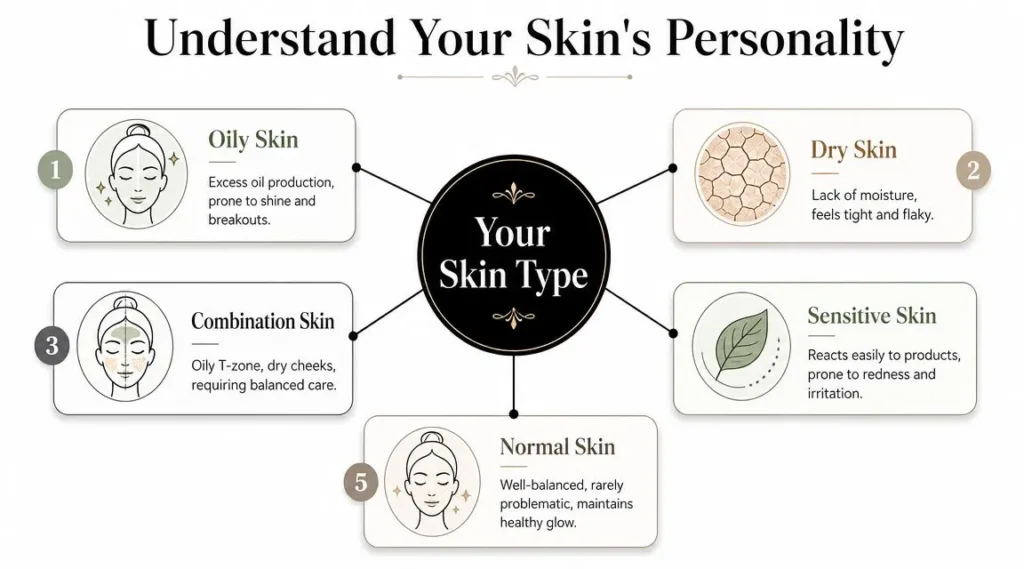
The biggest mistake people make is choosing a cleanser based on what they wish their skin were, not what it’s doing. If you pick a face wash for “oil control” because you get one shiny patch by noon, but the rest of your face feels dry and prickly, you’ll likely over-cleanse.
Read the signals your skin gives you
Your skin’s oil production works a bit like a thermostat. Some faces run warm and produce more oil all day. Others conserve and get dry fast. Some are uneven, with one zone acting oily and another acting dry.
A simple way to assess your baseline is to wash with a mild cleanser, apply nothing, and notice how your skin feels a few hours later.
- Oily skin often looks shiny across larger areas, especially forehead, nose, and chin. Pores may look more noticeable, and breakouts are common.
- Dry skin tends to feel tight after washing. It may look dull, flaky, or rough.
- Combination skin usually has an oily T-zone with cheeks that feel normal or dry.
- Sensitive skin reacts easily. That can mean stinging, redness, itching, or a tendency to flare with fragrance or harsh formulas.
- Normal or balanced skin usually feels comfortable after cleansing and doesn’t swing hard toward oiliness or dryness.
Your type can shift
Skin type isn’t a permanent identity card. Weather, stress, hormones, prescription topicals, and even over-cleansing can change how your face behaves.
That’s why “best face washes” should be matched to your current reality, not a label you picked years ago.
Skin type is your starting point, not your entire story.
If you’re pregnant or trying to simplify ingredient choices during that time, a practical companion read is this guide to the best facial cleanser for pregnant skin, which focuses on safety-minded product selection without making cleansing feel complicated.
A quick self-check
Ask yourself these questions:
- After washing, do you feel comfortable or tight?
- Where does shine show up first?
- Do new products often sting or redden your skin?
- Are breakouts your main issue, or is it dryness and irritation?
Your answer to question four matters most. The main problem should guide the cleanser.
If your skin feels both oily and sensitive, don’t force yourself into one box. That usually means you need oil removal with a gentler formula, not the harshest foam you can find.
Decoding Cleanser Ingredient Labels
Ingredient lists can look intimidating, but you don’t need to decode every botanical extract and stabilizer. You need to find the ingredients that match your skin’s problem.
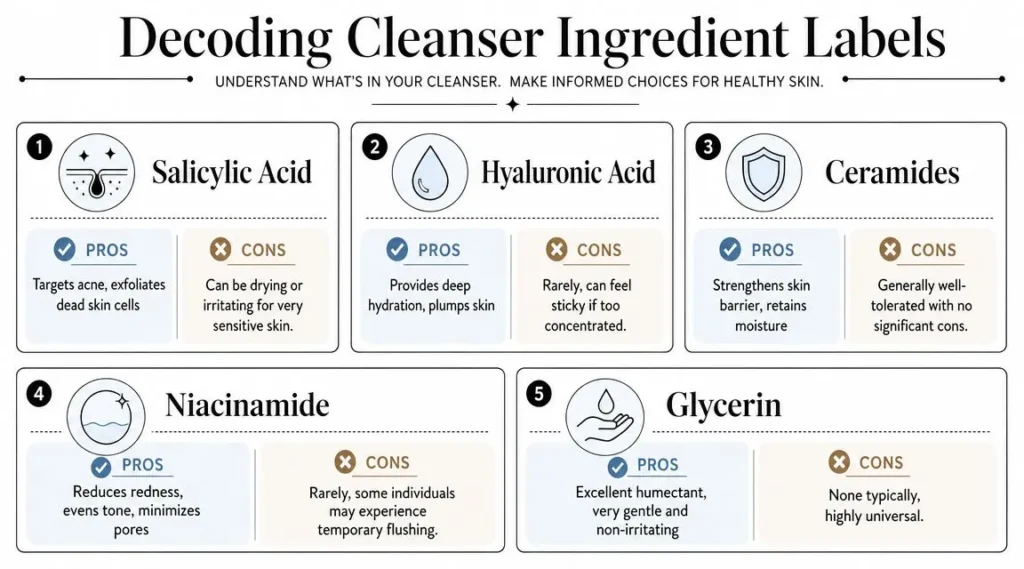
The best approach is problem first, ingredient second. That’s more reliable than trusting packaging words like “refreshing,” “purifying,” or “ultra clean.” As explained in Tru-Skin Dermatology’s cleanser ingredient guide, salicylic acid is especially relevant for oily or acne-prone skin because it’s lipid-soluble and can penetrate sebum-rich pores, while glycerin and ceramides are better fits when dryness and barrier support matter more.
Ingredients that earn your attention
Some ingredients matter because they support the cleanser’s main job without creating extra irritation.
- Salicylic acid makes the most sense when clogged pores and breakouts are a regular issue. Because it works well in oil-rich environments, it fits acne-prone skin better than very dry or easily irritated skin.
- Glycerin is one of the most useful hydration-support ingredients in a cleanser. It helps draw water toward the skin and usually plays well with almost every skin type.
- Ceramides help support the skin barrier. If your face feels fragile, reactive, or stripped after washing, this is the kind of ingredient worth spotting.
- Hyaluronic acid often shows up in cleansers marketed for hydration. It can be a nice extra, though the overall formula still matters more than one trendy ingredient.
- Niacinamide is often positioned for redness and oil balance. In a cleanser, think of it as supportive rather than the main event.
Ingredients that deserve caution
For sensitive or barrier-impaired skin, the issue often isn’t what’s missing. It’s what’s added.
Look more carefully at:
- Fragrance, especially if your skin stings, flushes, or reacts unpredictably.
- Exfoliating blends stacked into one cleanser when you’re already using retinoids or acne treatments.
- Very aggressive “deep clean” positioning, which often signals a harsher user experience even before you test it.
If you enjoy soothing ingredients in your routine, you might also like reading about the benefits of rose water as a follow-up step rather than relying on a cleanser to do every job at once.
How to scan a label fast
Use this quick filter in the store:
| What you need | What to look for | What to be careful with |
|---|---|---|
| Breakout support | Salicylic acid | Overly stripping acne washes |
| Dryness relief | Glycerin, ceramides | Heavy fragrance |
| Sensitive skin comfort | Fragrance-free, barrier-supportive ingredients | Multi-acid or “scrub” formulas |
| General maintenance | Simple, gentle formula | Cleansers making too many promises |
A rinse-off cleanser has limited contact time. The base formula often matters more than the flashiest active on the front label.
That’s why a plain, boring-looking cleanser can outperform a glamorous one. It may respect your skin better.
Choosing Your Cleanser Format and pH
Two cleansers can contain similar ingredients but feel completely different because the format changes how they behave on skin.
Gel, foam, cream, oil, and balm aren’t just textures for marketing. They usually signal how strongly the cleanser removes oil, how much slip it has, and whether it tends to feel fresh, cushioned, or stripping.
Format changes the experience
A useful way to think about cleanser format is to compare it to fabric care. Some formulas wash like a brisk machine cycle. Others act more like a gentle hand wash.
CeraVe’s dermatology-oriented guidance emphasizes minimizing surfactant damage during cleansing and preserving the barrier with fragrance-free, ceramide-containing formulas. That same guidance also supports a practical divide: foaming cleansers often fit oily or acne-prone skin better, while dry or sensitive skin usually does better with cream-based or non-foaming cleansers, as discussed in this CeraVe-focused cleansing explainer on YouTube.
What pH means in real life
pH sounds technical, but the practical idea is simple. It tells you whether something leans more acidic or more alkaline.
Your skin prefers a slightly acidic environment. Think of that preference like a well-set house thermostat. When a cleanser pushes too far away from that comfort zone, your skin can feel off afterward. Not always instantly dramatic, but enough to notice as tightness, dryness, or easier irritation.
You don’t need to become a chemist in the aisle. You just need to know that low-pH, gentle cleansers usually play more nicely with a stressed skin barrier than harsh, high-foam washes that leave your face feeling squeaky.
Cleanser Formats vs. Skin Types
| Cleanser Format | Best For | Key Characteristic |
|---|---|---|
| Gel | Oily or combination skin | Light feel, usually rinse-clean |
| Foam | Oily or acne-prone skin | Stronger oil and debris removal |
| Cream | Dry or sensitive skin | Softer cleansing, less stripped feel |
| Oil | Makeup or sunscreen removal | Dissolves stubborn residue well |
| Balm | Evening cleanse, heavy SPF or makeup | Rich texture that melts buildup |
If you’re curious how cleansing ingredients interact with the skin’s moisture balance, this primer on the benefits of glycerin soap adds useful context.
A few format trade-offs
- Foam feels satisfying, especially if you’re oily. But satisfying doesn’t always mean better.
- Cream cleansers can feel “less clean” if you’re used to suds, even when they’re doing their job well.
- Oil and balm cleansers are often best as the first cleanse at night, not necessarily your only cleanser if you prefer a fresher finish after.
Your preference matters. The best face washes are the ones your skin tolerates and you’ll keep using.
Building Your Daily Cleansing Routine
Many don’t need a complicated routine. They need a repeatable one that fits morning skin, evening buildup, and whatever treatments they use.
A good cleansing routine should feel boring in the best way. Predictable. Calm. Easy to stick to.
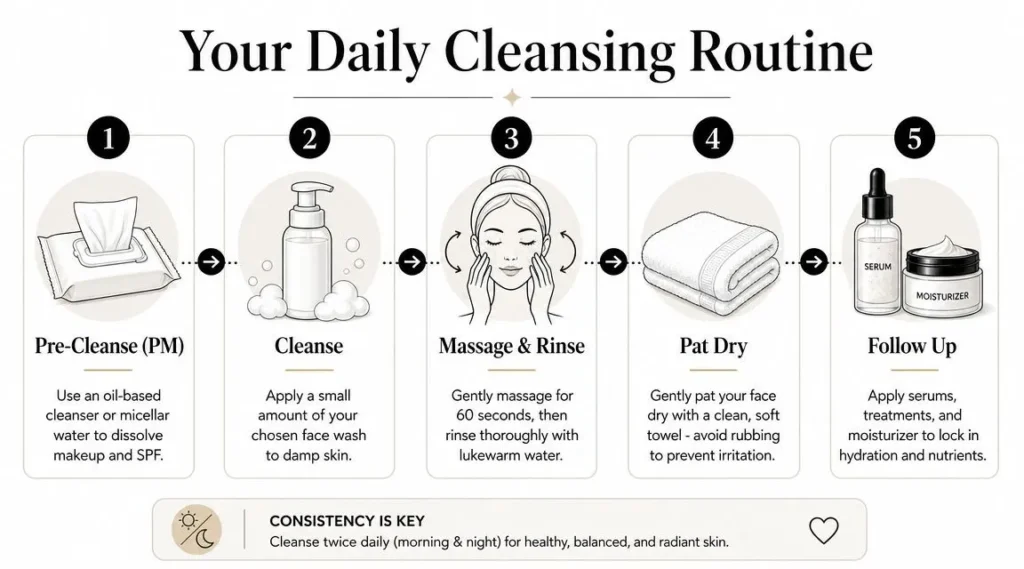
Early in the process, it helps to see the full flow at a glance.
Morning and evening don’t need the same approach
In the morning, many people do well with a gentle cleanse or even a very minimal rinse if their skin is dry and calm. The goal is not heavy-duty cleaning. It’s removing overnight sweat, leftover product, and oil without starting the day by stripping your face.
At night, cleansing matters more because the skin has collected sunscreen, pollution, oil, and makeup. Your cleanser then earns its place.
When double cleansing makes sense
Double cleansing sounds fancier than it is. It involves using an oil-based cleanser first, then a water-based cleanser second.
It’s especially useful if you wear:
- Water-resistant sunscreen
- Long-wear makeup
- Heavier complexion products
- Layers of skincare and city grime by the end of the day
The first cleanser loosens and dissolves the stubborn stuff. The second removes what’s left and leaves the skin feeling more complete, not filmy.
A visual walkthrough can help if you’re trying to refine your technique:
Technique matters more than people think
Small habits change how a cleanser feels.
- Use lukewarm water. Hot water often makes dry or sensitive skin angrier.
- Massage gently. You’re cleansing, not scrubbing a pan.
- Rinse thoroughly. Residue can create its own irritation.
- Pat dry. Rubbing with a towel adds friction your barrier doesn’t need.
- Follow quickly with moisturizer or treatment. Slightly damp skin often feels more comfortable with the next step.
If your cleanser only works when you scrub hard or use very hot water, it’s probably the wrong cleanser.
Consistency beats intensity here. The best face washes support a routine you can repeat every day without dreading it.
Troubleshooting Common Cleansing Problems
When a cleanser goes wrong, the skin usually gives a clear signal. The confusing part is interpreting it.

Many people assume any discomfort means they need a stronger cleanser, especially if they’re acne-prone. Often the opposite is true.
If your skin feels tight after washing
That stretched, papery, overly matte feeling usually points to a cleanser that’s too harsh for your current barrier. The formula may be too foamy, too aggressive, or just mismatched for skin that’s already dry or irritated.
Try these fixes:
- Switch formats from foam to cream or a low-foam gel.
- Reduce cleansing intensity by using less product and cooler water.
- Look for barrier-supportive features like fragrance-free formulas and a softer after-feel.
If you’re breaking out after changing cleansers
Not every post-cleanser breakout means purging. Cleansers are rinse-off products, so irritation is often the bigger issue than true purge-like behavior.
Ask what kind of breakout it is:
- Tiny, red, irritated bumps may mean the formula is too harsh or fragranced.
- Congested pores around makeup-heavy areas may mean the cleanser isn’t removing residue well enough.
- Sudden overall irritation may mean you changed too many things at once.
If your skin tends to calm down with simple soothing support, reading about aloe juice benefits may help you think more broadly about comfort-focused routines.
If you’re using acne treatments or prescription products
Often, people sabotage a good treatment plan here.
The best face wash for acne isn’t always the strongest one. For people using retinoids, benzoyl peroxide, salicylic acid, or prescription acne medications, a cleanser that strips too much can reduce tolerance and make the whole routine harder to maintain, a point emphasized in this consumer-facing dermatologist cleanser roundup at Walmart.
A mild, non-comedogenic cleanser can do more for long-term acne progress than an aggressive wash that makes you skip your treatment.
Quick symptom guide
| Symptom | Likely issue | Better direction |
|---|---|---|
| Tightness after rinsing | Over-cleansing | Lower-foam or cream cleanser |
| Stinging | Barrier stress or fragrance sensitivity | Fragrance-free, simpler formula |
| Greasy residue left behind | Cleanser too mild for your needs | Gel or second cleanse at night |
| More irritation on retinoids | Cleanser too stripping | Mild, non-comedogenic wash |
If the skin starts feeling calmer within a few days of simplifying, that’s useful feedback. Skin usually appreciates being handled more gently than we think.
Your Framework for Finding the Perfect Face Wash
Choosing among the best face washes gets easier when you stop looking for a universal winner and start using a short checklist.
You don’t need to memorize ingredient dictionaries or buy whatever is trending. You need a filter.
Guidance aimed at barrier support and sensitivity puts it well: a cleanser should remove impurities without stripping the skin barrier, and for irritated skin, low-pH, non-foaming, or cream cleansers are often better choices. It also helps to remember that “gentle” is a functional claim, not just a marketing word, as discussed in this barrier-focused cleanser explainer on YouTube.
The four-part test
Use this mental sequence whenever you shop.
1. Identify the main problem today
Not your ideal skin. Today’s skin.
Is it oily by noon? Dry and tight? Easily irritated? Congested because of sunscreen and makeup? Struggling because you’re on retinoids? The main issue should drive the purchase.
2. Match the ingredient story to the problem
For acne and oil, look harder at salicylic acid and overall oil-removal ability.
For dryness or sensitivity, scan for glycerin, ceramides, and fragrance-free positioning. Don’t let a flashy front label distract you from a formula that sounds harsh.
3. Pick the format your skin will tolerate
A cleanser can be “good” on paper but wrong in feel.
If your skin hates foam, stop forcing it. If heavy cream cleansers leave you feeling coated, choose a gel. If sunscreen is hard to remove, add an oil or balm step at night instead of upgrading to a harsher all-in-one wash.
For a useful comparison of texture preferences and formulation style across another major skincare category, you can compare top Japanese cleansers and notice how often the best options are matched by use case rather than crown one single winner.
4. Check for barrier respect
This is the final filter, and often the most important one.
Ask:
- Does this sound likely to sting my skin?
- Does it rely on “deep clean” language more than comfort cues?
- Will it work with my active treatments, or fight them?
The perfect face wash is the one that cleans enough, irritates little, and keeps the rest of your routine usable.
That’s the framework. Simple, but strong enough to work whether you’re buying from a drugstore shelf, a pharmacy, or a high-end beauty counter.
You don’t need a static list. You need judgment. Once you have that, the shelf gets much less confusing.
If you enjoy clear, practical writing like this, explore maxijournal.com for more approachable articles across health, science, lifestyle, technology, culture, and everyday questions that deserve straight answers.
Discover more from Maxi Journal
Subscribe to get the latest posts sent to your email.