If you’re reading about an endometriosis blood test, there’s a good chance you’re tired of uncertainty. Maybe you’ve had painful periods for years, bowel symptoms that seem to flare with your cycle, pain with sex, fertility worries, or scans that came back “normal” even though your body keeps telling you something isn’t right.
That frustration is understandable. Endometriosis has a long history of being hard to confirm, and many patients arrive at this topic hoping a blood test will finally provide a simple yes-or-no answer. It is more nuanced, but it’s also more hopeful than it used to be. New blood-based tests are more advanced than older markers, and some are showing strong performance in carefully studied groups. At the same time, access, cost, and insurance coverage are still catching up to the science.
The Diagnostic Maze of Endometriosis
You go to an appointment hoping for a clear answer. Instead, you leave with a stack of possibilities. IBS. A painful bladder. Fibroids. Stress. Maybe “just bad periods.” For many patients, that is what the early endometriosis workup feels like. Less like a straight road, more like walking through a hallway of doors that all partly fit the symptoms.
Endometriosis is difficult to diagnose because it does not show up the same way in every body. One person has severe period pain and exhaustion. Another mainly notices pain with sex, bowel symptoms, or trouble getting pregnant. Someone else has pelvic pain that is present all month, not only during a period. Those patterns can overlap with adenomyosis, ovarian cysts, fibroids, pelvic floor dysfunction, and gastrointestinal conditions, which is why symptoms alone rarely give a clean answer.
Patients are not imagining the delay. The condition is hard to pin down with symptoms alone.

Why symptoms and scans don’t always settle it
Part of the confusion comes from what each test can and cannot see. Imaging is useful, but it is not a universal detector. An ultrasound or MRI may spot an endometrioma, which is an ovarian cyst linked to endometriosis, or help map deeper disease in experienced hands. Smaller implants, more scattered lesions, or earlier disease may still be missed.
That gap can feel invalidating. A normal scan can mean “nothing visible on this test today.” It does not automatically mean “your pain has no medical explanation.”
For many years, the standard way to confirm endometriosis has been laparoscopy. This is a surgery that lets a clinician look inside the pelvis and often take tissue for pathology. It can answer important questions and, in some cases, treat disease during the same procedure. But it also asks a lot of the patient. There is anesthesia, recovery, time away from work or school, and financial planning if deductibles or coinsurance apply.
That practical burden is a big reason blood tests get so much attention. Patients are not only asking whether the science works. They are asking something more immediate. Can I get this test where I live? Will insurance cover it? Will it help me avoid surgery, or will I still need imaging, specialist visits, and possibly laparoscopy afterward?
A blood test, if it performs well and becomes widely available, could work like another clue in the puzzle rather than a magic final answer. That is the expectation to hold onto here. These tests are promising because they may shorten the path to diagnosis and help guide next steps. Right now, though, they are still part of a bigger decision-making process that includes symptoms, pelvic exam, imaging, fertility goals, treatment plans, cost, and access to specialists.
The CA-125 Test A Historical Snapshot
Before the newer multi-marker tests, the best-known blood marker in this area was CA-125. It’s a protein that can be increased in some people with endometriosis. For years, clinicians and researchers hoped it might become a practical non-invasive clue.
CA-125 did help push the field forward, but it also taught an important lesson. One biomarker by itself often can’t capture a condition as biologically messy as endometriosis.
Think of CA-125 as a general alarm
CA-125 is a bit like a smoke detector that tells you something may be happening in the building, but can’t tell you whether the source is the kitchen, the fireplace, or burnt toast. In medicine, that matters. A useful diagnostic test needs not only to pick up disease, but also to avoid falsely pointing toward it when something else is going on.
A large 2020 systematic review looked at 141 studies with 15,141 participants and assessed 122 blood biomarkers. The review found poor methodological quality across trials overall, and CA-125 showed only moderate performance rather than the level needed to replace surgery (systematic review on blood biomarkers for endometriosis).
What the numbers mean in everyday language
The same review reported that CA-125 had a mean sensitivity of 0.62 to 1.00 and specificity of 0.70 to 0.80 depending on the cutoff used. At cutoffs above 25 to 26 U/ml, sensitivity was 0.73 and specificity 0.70. At cutoffs above 30 to 33 U/ml, sensitivity was 0.62 and specificity 0.76. The review also concluded that no single biomarker, including CA-125, met the target needed to replace surgery, defined as at least 94% sensitivity and at least 79% specificity.
If those terms feel abstract, this is the practical point. A test with moderate sensitivity can miss people who have the disease. A test with moderate specificity can also flag people who don’t.
Practical rule: A CA-125 result can be one clue. It shouldn’t be treated as the final answer to whether you do or don’t have endometriosis.
There are more reasons CA-125 can confuse the picture:
- It isn’t specific to endometriosis. Other conditions can also raise it.
- Levels can vary. Menstrual timing and disease pattern can affect the result.
- It may perform differently in more advanced disease. That doesn’t make it dependable for broad screening.
Why CA-125 still matters historically
CA-125 showed that blood-based diagnosis wasn’t a fantasy. It proved there was a measurable signal worth studying. But it also made clear that endometriosis isn’t a one-marker disease. That realization pushed research toward combinations of markers rather than relying on a single protein.
The New Wave of Endometriosis Blood Tests
You have pelvic pain, your ultrasound is normal, and you are trying to decide what to do next. This is the moment many patients hear about newer blood tests and wonder if a blood draw could finally shorten a process that has already taken too long.
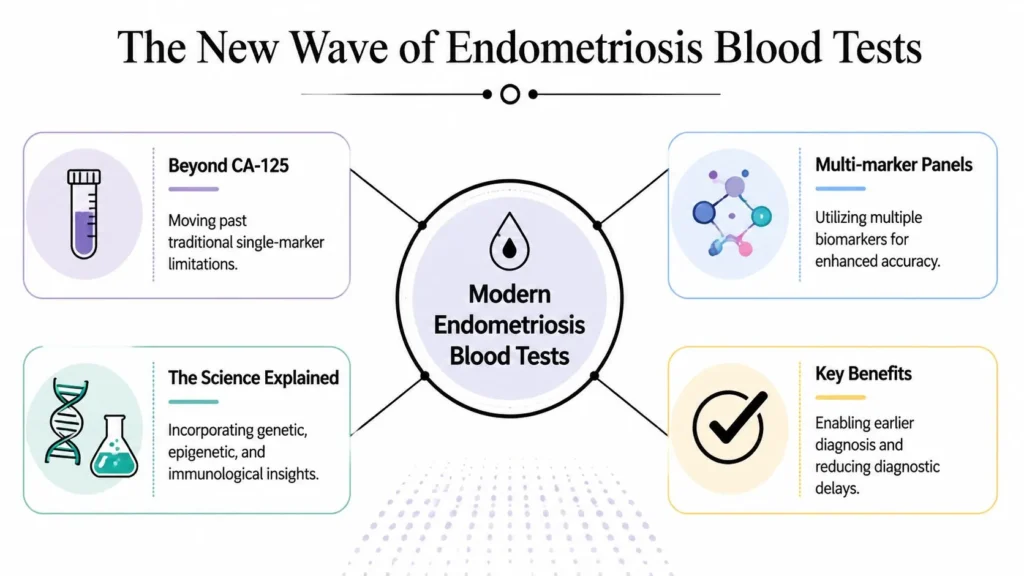
Modern endometriosis blood tests are built around patterns, not single markers. That shift matters. Endometriosis affects several body systems at once, including inflammation, hormone signaling, immune activity, and tissue remodeling, so researchers are now asking whether a combination of signals can identify a pattern that is more useful than any one lab value on its own.
From one clue to a fuller biological profile
One recent description of advanced testing reported an assay that combines seven circulating biomarkers, specifically three microRNAs, three proteins, and one steroid hormone, then adds age and BMI to a machine-learning classifier (report on multi-marker test design). A single-marker test works like checking one fingerprint. A multi-marker panel works more like reviewing fingerprints, shoe prints, and camera footage together before drawing a conclusion.
If terms like microRNA and machine learning sound distant from everyday care, that reaction is reasonable. They are tools for sorting complex biological information. This overview of biotechnology in everyday healthcare can make that process easier to follow.
That broader approach fits the reality of the disease. Endometriosis does not behave like a condition with one lab signature that is either present or absent in every patient.
Here’s a short explainer before the video below.
What early validation results mean in real life
One of the strongest early studies reported encouraging accuracy for a newer blood test, as noted earlier in the article. The practical takeaway is more important than memorizing the numbers. These newer panels may identify a meaningful share of people with endometriosis, including some whose imaging did not provide answers.
That does not make them a universal replacement for surgery or specialist evaluation.
A helpful way to frame expectations is this: these tests may function like a triage tool, not a final verdict. They can add weight to the picture your clinician is building from symptoms, pelvic exam findings, imaging, and your history. For a patient who has been told that a normal scan means everything is fine, that added biological evidence could become useful. For another patient, the result may still leave uncertainty.
Why the patient journey still matters more than the headline
The science is promising. Access is still uneven.
Some of these tests are available only in limited settings, through selected clinics, research pathways, or specific commercial rollouts. Insurance coverage can lag behind the evidence, especially when a test is new, billed out of network, or still gaining adoption. That means the practical questions often come quickly: Can I get it? Will my gynecologist know how to order it? What will it cost if my insurer says no?
Those questions are not secondary. They are part of the diagnostic experience.
A newer blood test may help shorten delays for some patients, but broad availability usually arrives later than the first wave of attention. That is why hope and caution belong together here. These tests suggest progress. They do not yet guarantee a quick, low-cost answer in every clinic.
How Blood Tests Compare to Imaging and Laparoscopy
You have pelvic pain, your ultrasound is “normal,” and you are still being told endometriosis is possible. That is the moment many patients feel lost. The confusion usually comes from expecting every test to answer the same question, when each one is looking through a different window.
An ultrasound or MRI looks for changes a radiologist can see, such as cysts, deep lesions, or organs that appear pulled out of place. A blood test looks for a biological signature, meaning patterns in proteins, inflammatory signals, or other markers linked to disease. Laparoscopy is different again. It allows a surgeon to look inside the pelvis directly and, in some cases, take tissue samples or treat visible disease during the same procedure.
A simple comparison helps here. Imaging is like taking a photograph of the pelvis. A blood test is closer to checking the smoke in the air when you cannot yet see the fire clearly. Surgery is the closest look because it puts eyes on the tissue itself.
Some newer blood tests use pattern recognition across many markers rather than relying on one lab value alone. That is part of why discussions about these tests often mention software, pattern matching, and lab models. If you want a plain-English explanation of how computers sort these medical patterns, this guide to bioinformatics and health data analysis can make the concept easier to follow.
Endometriosis Diagnostic Methods Compared
| Method | Invasiveness | Primary Purpose | Accuracy |
|---|---|---|---|
| CA-125 blood test | Low | Supportive clue, not a stand-alone diagnosis | Limited by lack of specificity and variable performance |
| New multi-marker blood tests | Low | Estimate the likelihood of endometriosis from a biological signature | Promising in validation studies, but interpretation depends on the specific test and clinical context |
| Ultrasound or MRI | Low to moderate | Look for visible structural disease, cysts, or deep lesions | Helpful for some patterns of disease, but can miss cases |
| Laparoscopy | High | Direct visualization and possible surgical confirmation or treatment | Still the historical reference standard for definitive confirmation |
The practical question is not which test is best in the abstract. It is which test helps most at your current step.
For example, if symptoms strongly suggest endometriosis and an ultrasound shows an ovarian endometrioma, imaging may already provide enough direction to guide treatment planning. If symptoms are strong but imaging is unrevealing, a blood test may add useful evidence that supports referral to a specialist rather than sending you back to “wait and see.” If the diagnosis remains uncertain, or if treatment decisions depend on seeing the disease directly, laparoscopy may still enter the conversation.
That distinction matters for expectations, cost, and insurance.
A blood test is less invasive than surgery, but “less invasive” does not always mean “simple to get.” Some patients can access imaging locally with standard insurance pathways, while a newer blood test may be available only through selected clinics or specialty labs. In other cases, the reverse is true. A clinician may be willing to order labs but may reserve MRI or surgery for specific situations. Coverage rules can shape the path as much as the science does.
Patients are often disappointed when a blood test does not replace every other step. A better expectation is that each test reduces uncertainty in a different way. One test may show a lesion. Another may strengthen suspicion. Surgery may still be the clearest route when symptoms are severe, fertility is part of the picture, or treatment and diagnosis need to happen together.
A normal scan does not rule out endometriosis. A blood test does not confirm every case. Used thoughtfully, these tools can still shorten the road to the right next decision.
Getting Tested The Process and What to Expect
When patients ask me about an endometriosis blood test, the first practical question isn’t “Which biomarker is in it?” It’s usually “How do I get one?” That’s the right question.
Availability depends on where you live, which clinicians are familiar with the test, and whether a specific lab panel is being offered in your region. The process also varies depending on whether the sample is traditional blood or menstrual blood.
What to say to your clinician
If you’re bringing this up at an appointment, keep it simple and concrete. Explain your main symptoms, how long they’ve been happening, and why you’re asking about non-invasive testing now.
A useful way to frame the conversation is:
- Your symptoms: painful periods, chronic pelvic pain, bowel symptoms with periods, pain with sex, or fertility concerns
- Your prior workup: any ultrasound, MRI, medications, or prior surgeries
- Your goal: whether you’re hoping for faster diagnosis, guidance on next steps, or help deciding about surgery
You don’t need to prove you’ve read every paper. You only need to make clear that you’re looking for a thoughtful diagnostic plan.

What sample collection may look like
For many tests, the process is a standard blood draw. In and of itself, that part is straightforward. The more important issue is what happens before and after the draw. Your clinician has to decide whether the result would change management.
A newer and fascinating option involves menstrual blood rather than blood from a vein. Research suggests menstrual blood may be a superior diagnostic sample because it directly contains cells and molecular markers from endometrial tissue. Using newer technology, researchers detected biomarkers with femtomolar-level sensitivity from just 2 ml of menstrual blood collected via a sterile cup (study on menstrual blood diagnostics and ddELISA).
How to read a result without overreading it
A common point of confusion is that a “positive” or “high-risk” result doesn’t automatically equal final diagnosis in the same way a pathology report from surgery can. It means the biological pattern is more consistent with endometriosis and should be interpreted with your symptoms, exam, and any imaging findings.
A “negative” result also needs context. It may lower suspicion. It doesn’t always erase it.
Bring one question to your follow-up visit: “How does this result change what we do next?” That’s the question that keeps testing connected to actual care.
Real-World Access Cost Availability and the Future
This is the part many articles skip. A test can be scientifically promising and still be hard for patients to get. Those are two separate issues.
The practical patient questions are usually blunt and fair. Can I order this now? Is it available near me? How much will it cost? Will insurance treat it as standard care or experimental?
The gap between validation and access
Some newer tests, including DotEndo and EndomTest, are part of the growing non-invasive sector. But real-world access remains limited. As of 2026, availability is often restricted to select providers in the United States, and there is still little transparency about pricing or insurance coverage. Reporting on this access gap notes estimated costs in the range of $300 to $800, while also emphasizing that reimbursement remains uncertain for many novel diagnostics (patient access information from DotLab).
That uncertainty matters as much as the science for many families. A strong test isn’t very helpful if a patient can’t find it locally, can’t afford it, or has no clear way to learn whether their insurer will reimburse any part of the cost.
Questions to ask before you commit
Before scheduling any endometriosis blood test, ask the ordering clinic or company these questions in writing if possible:
- Where is the test processed? This helps you understand logistics and turnaround expectations.
- What exactly am I paying for? Ask whether the quoted fee covers only the lab analysis or also consultation and reporting.
- Will you bill insurance directly? If not, ask whether you’ll receive documentation to submit yourself.
- How will results be explained? A test report without clinical interpretation can create more anxiety than clarity.
Why expectations need to stay grounded
There is a real risk that early access will be uneven. Patients in larger urban centers may hear about these tests sooner and have clinicians who know how to order them. Patients in rural areas or health systems with tighter coverage rules may still be steered toward older pathways.
That doesn’t mean progress is empty. It means the next challenge isn’t just inventing a better assay. It’s building the boring but essential infrastructure around it: clinician education, reimbursement pathways, regional access, and evidence that convinces payers the test is worth covering.
Your Questions Answered FAQ
Can a blood test diagnose endometriosis on its own?
Sometimes it can provide strong evidence, but it usually works best as part of a larger clinical picture. Your symptoms, pelvic exam, imaging, and treatment goals still matter. If surgery is being considered, your clinician may still recommend laparoscopy for confirmation or treatment.
If my blood test is negative, does that mean I definitely don’t have endometriosis?
No. A negative result lowers concern in some situations, but it doesn’t erase the possibility. Test results always have to be matched with your symptoms and history.
Can a blood test tell me what stage of endometriosis I have?
Not reliably in the same way surgery can classify visible disease. A blood test may suggest a biological pattern consistent with endometriosis, but staging has traditionally depended on surgical assessment.
Is a newer endometriosis blood test better than CA-125?
In general, the newer multi-marker panels are more biologically advanced because they don’t rely on one marker alone. That’s why many specialists see them as a more promising direction than CA-125. Better doesn’t mean perfect, and the exact usefulness depends on the specific test available to you.
Should I get a blood test if my ultrasound was normal?
Possibly. A normal ultrasound doesn’t rule out endometriosis. In some cases, a blood test may add useful information, especially if symptoms remain strongly suggestive.
What if I’ve already had surgery? Is there still a reason to ask about blood testing?
There can be. Some patients want additional non-invasive information if symptoms return, or they want help deciding whether more imaging or another specialist referral makes sense. The answer depends on your history and current symptoms.
Are menstrual blood tests something I can do at home?
Some research points in that direction, and the idea is appealing because sample collection may be more accessible for some patients. But practical availability depends on what companies or clinics are offering in your area right now.
How do I know whether information online about these tests is trustworthy?
Look for clear descriptions of what the test measures, how it was validated, and what it can and can’t do. If you want a good filter for evaluating medical claims online, this guide on finding credible sources for research is a smart place to start.
What’s the best next step if I think I have endometriosis?
Book an appointment with a gynecologist or an endometriosis-focused clinician and bring a symptom timeline. Include what hurts, when it happens, what you’ve already tried, and what your main priority is right now. Diagnosis moves faster when your story is organized.
A final thought from the clinic side. You do not need to wait until your symptoms become unbearable to ask better questions. If a blood test is available in your setting, it may be one useful piece of evidence. If it isn’t, that doesn’t mean you’re out of options. Good endometriosis care still starts with being heard, taken seriously, and guided through each diagnostic step with honesty.
If you enjoy clear, evidence-based health explainers like this one, visit maxijournal.com for approachable writing on science, health, technology, education, culture, and more.
Discover more from Maxi Journal
Subscribe to get the latest posts sent to your email.