The standard maximum break in snooker is 147, but the highest officially recorded competitive break is 153 and the theoretical ceiling is 155. That distinction matters because the common advice to call 147 the highest break in snooker is incomplete. You’ll hear commentators use maximum and highest as if they’re the same thing. They’re not, and once you separate the three numbers, every record, prize story and disputed early maximum becomes easier to judge.
The Highest Break in Snooker at a Glance
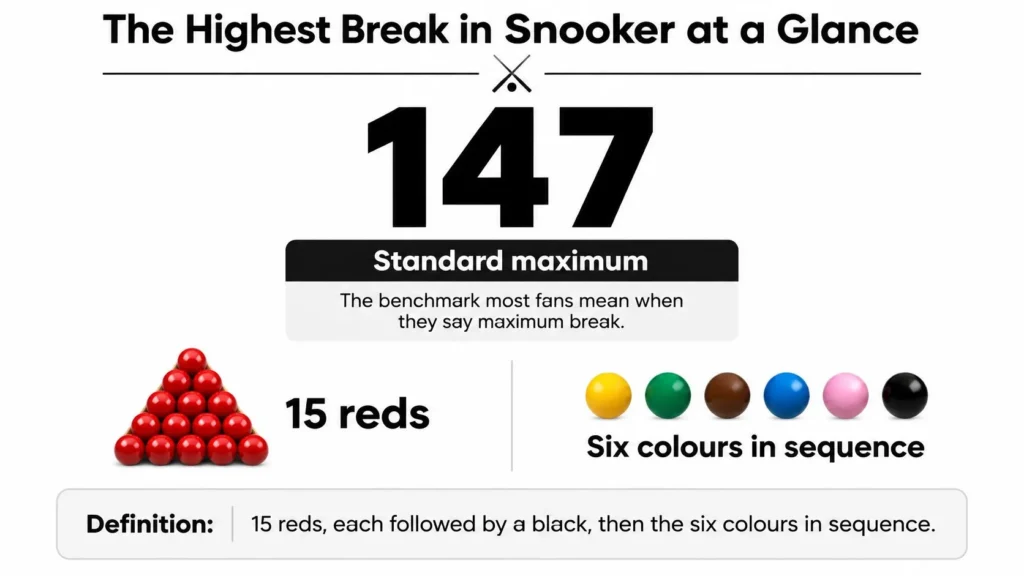
147 is the maximum break, but it is not automatically the answer to “What is the highest break in snooker?” The maximum describes a standard frame: 15 reds, each followed by a black, then the six colours in sequence. A player must make 36 scoring pots without replacing a post-red black with a lower-value colour.
That distinction causes the confusion because maximum and highest sound interchangeable. The first asks what the normal arrangement of balls can produce. The second asks what has been scored in competition, while a third question asks what the rules could allow after a free ball. Keep those categories separate and the three numbers stop competing for one title.
Three Numbers Readers Often Merge Into One
147 is the ordinary maximum and remains the benchmark most fans mean by that term. 153 is the highest officially recorded competitive break, reached through a free-ball situation rather than a normal sequence. 155 is the theoretical ceiling, calculated after a free ball creates an extra scoring opportunity at the start of a clearance.
| Break | Points | How it is made | Status |
|---|---|---|---|
| Standard maximum | 147 | 15 reds, 15 blacks, then the six colours | The benchmark for a normal frame |
| Highest officially recorded competitive break | 153 | Includes a free-ball situation | Competitive record, not a normal-frame total |
| Highest theoretical clearance | 155 | A free ball creates an extra red | Rules-based ceiling, not a recorded standard maximum |
If you need one practical answer, quote the category with the number. Say 153 for the highest officially recorded competitive break, 155 for the theoretical ceiling, and 147 for the standard maximum. That phrasing prevents one person answering a record question while another describes an ordinary maximum.
Quote the category, not just the number. A score on its own does not show whether you mean a standard maximum, a competitive record or a theoretical limit.
Without the free ball, the arithmetic of a standard frame always stops at 147.
How a 147 Is Built Ball by Ball
Start with a simple check you can do while watching any frame. Count the scoring pots and keep a running total. If a player takes a colour worth less than black after any red, the 147 is gone, even if the break becomes a very high century.
Stage One Reds and Blacks
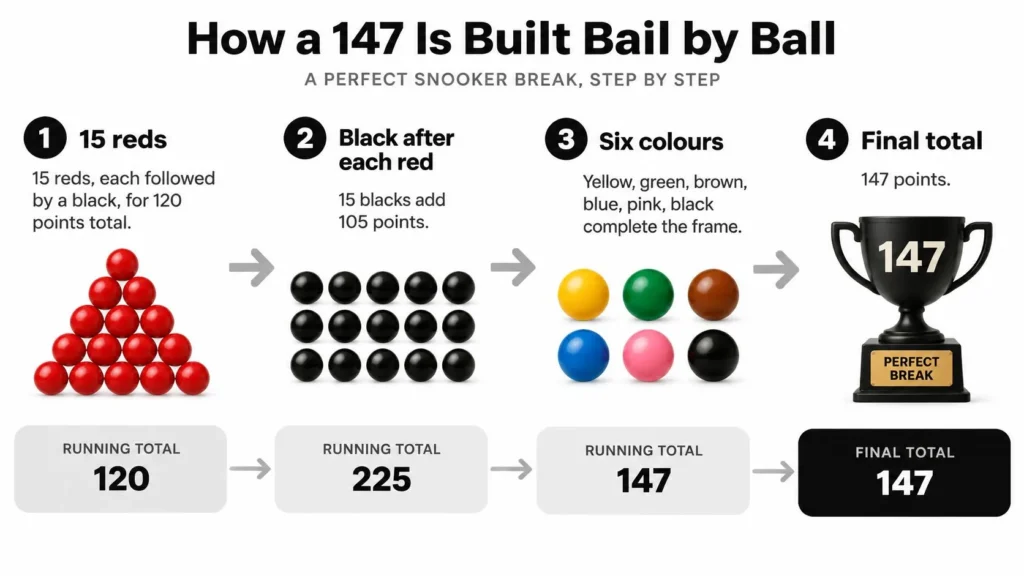
The first stage is 15 reds with 15 blacks, alternating red, black, red, black until no reds remain. Each red is worth 1 point and each black is worth 7 points. One red and black pair therefore adds 8 points, and fifteen pairs add 120 points from 30 pots.
That phase is where most maximum attempts fail. The player must keep finding a path from each red to the black, then back into position for another red. A good angle on one pot isn’t enough, because poor cue ball position two shots later can leave the black blocked or force a safer colour.
Say a player pots twelve reds with twelve blacks, then takes pink after the thirteenth red because the black is tied up. The break can still be excellent, but the maximum has already slipped away. That single choice costs one point compared with black, so the final ceiling for that visit drops below 147.
Stage Two Colours in Sequence
Once the reds are gone, the player clears the colours in ascending order. The sequence is yellow, green, brown, blue, pink and black. Those six pots add 27 points, taking the running total from 120 to exactly 147.
| Stage | Pots | Points |
|---|---|---|
| 15 reds with 15 blacks | 30 | 120 |
| Yellow | 1 | 2 |
| Green | 1 | 3 |
| Brown | 1 | 4 |
| Blue | 1 | 5 |
| Pink | 1 | 6 |
| Black | 1 | 7 |
The colours are often described as the easier part, but that’s only relative. The table’s more open and the order is fixed, yet a player still has to hold position from colour to colour while the crowd understands what’s at stake. A thin cut missed to a middle pocket at this stage hurts precisely because thirty perfect pots have already gone in.
- Count the pots: A standard maximum needs 36 scoring pots in total.
- Check the pairs: Every red must be followed by black during the first stage.
- Watch the final order: The colours must finish yellow through black, without a miss.
Speed highlights the challenge. Completing thirty-six pots in just over five minutes means roughly seven scoring pots per minute, including walking around the table, sighting each shot, and controlling the cue ball. Most club players would need far longer to decide the route between reds.
You can verify any claimed standard maximum with that arithmetic. Thirty pots for 120, six colours for 27, total 147. If the claimed score is higher, the break can’t have been a standard clearance alone.
How a Free Ball Lets a Break Pass 147
A standard frame contains fifteen reds. Once you’ve paired each one with a black and cleared the colours, there are no scoring balls left to add. That’s why readers reasonably ask how anyone can pass a total that’s already called the maximum.
What Changes With a Free Ball
A free ball arises after a foul leaves the incoming player snookered on the ball on. The player can nominate another ball to act as a red. Potting that nominated ball scores one point, just like a red, and the player then takes a colour as normal before continuing with the actual reds.
That nominated ball is the extra red in the arithmetic. It doesn’t mean officials add a sixteenth red to a standard frame, and it doesn’t break the scoring rules. It means the break begins with one additional red value pot and one additional colour before the normal sequence continues.
Practical rule: Any competitive break above 147 needs a free ball at the start of the scoring visit. Without that situation, the claim doesn’t fit the balls available in a standard frame.
The Arithmetic Behind 155 and 153
Take the extra red value pot at 1 point and follow it with a black at 7 points. That opening pair adds 8 points before the standard 147 sequence. Add eight to 147 and you reach 155, the theoretical ceiling.
A player doesn’t have to take black after the free ball, and later choices among colours can also reduce the final total. That’s how a recorded free ball break can finish between 148 and 155 rather than landing only on the ceiling. The Guinness recognised 153 sits in that range, above the ordinary maximum and below the theoretical limit.
Don’t try to reconstruct an exact ball by ball route for a record unless the official scoring record gives you one. The general mechanism is enough to explain why the total is valid, while inventing a precise sequence would turn a rules explanation into guesswork. Treat the score, event and recognition as the record, and the free ball as the reason it could exceed 147.
For your own judgement, use a blunt test. If someone claims a break above 147 in a normal frame with no free ball, treat it as an error or an unverified claim. If a free ball opened the visit and the break was officially scored in competition, a total above 147 is entirely possible.
How the 147 Became an Official Record
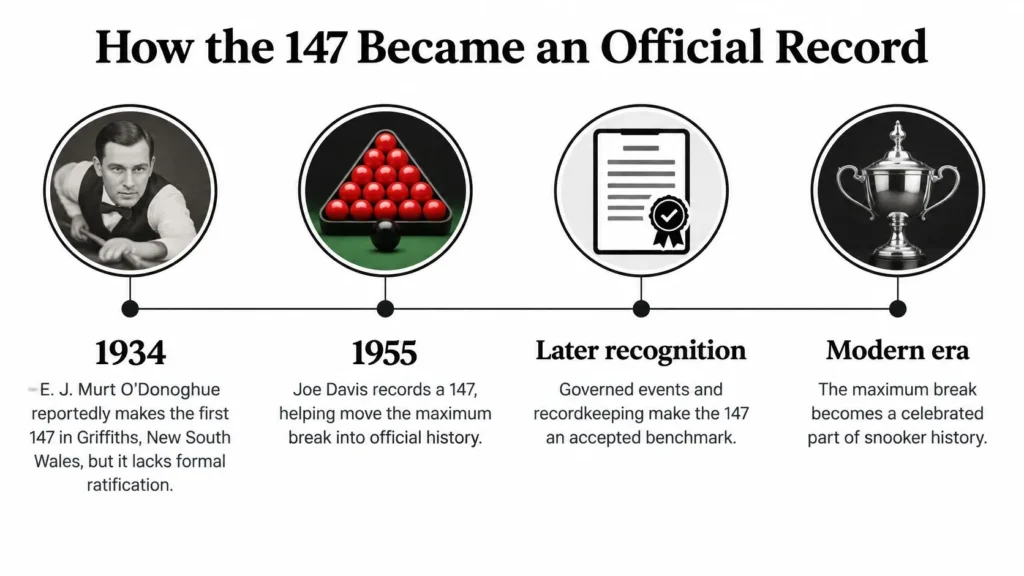
Reporting a score and ratifying a record are two different things, and the earliest maximum story proves it. According to the Snooker.org records page, New Zealand player E. J. Murt O’Donoghue reportedly made the first 147 in Griffiths, New South Wales, on 26 September 1934. The same records account describes Joe Davis compiling the first officially ratified maximum against Willie Smith at Leicester Square Hall in London on 22 January 1955.
Two decades separate those breaks, yet only the second one counts as a record. O’Donoghue played before the modern professional structure gave such claims a consistent route to formal recognition, while Davis’s maximum was officially ratified. That gap between reported and ratified still matters whenever you read old exhibition claims.
When Equipment Decided the Answer
John Spencer produced the awkward case. He made a maximum at the 1979 Holsten Lager International, but officials didn’t accept it because the table had oversized pockets. Players and fans could see the balls go in, yet the conditions didn’t match the standard required for a ratified tournament record. A perfect break on a non-standard table is still a perfect break, it just isn’t a record.
Steve Davis then supplied the accepted tournament first, making the first ratified tournament 147 at the 1982 Lada Classic in Oldham. He reportedly received a Lada car as the prize, and the car gave newspapers and broadcasters a simple symbol for the feat. A maximum had been possible since 1934; now it had become a milestone casual viewers could recognise.
| Year | Milestone | Player | Venue | Status |
|---|---|---|---|---|
| 1934 | First reported 147 | E. J. Murt O’Donoghue | Griffiths, New South Wales | Reported, not formally ratified |
| 1955 | First officially ratified maximum | Joe Davis | Leicester Square Hall, London | Ratified against Willie Smith |
| 1979 | Tournament maximum attempt | John Spencer | Holsten Lager International | Not accepted, oversized pockets |
| 1982 | First ratified tournament 147 | Steve Davis | Lada Classic, Oldham | Ratified tournament maximum |
| 1983 | First World Championship 147 | Cliff Thorburn | Crucible Theatre | Recorded at the Crucible |
| 1997 | Fastest officially recorded 147 | Ronnie O’Sullivan | World Championship | 5 minutes 8 seconds against Mick Price |
Cliff Thorburn carried the record onto snooker’s most familiar stage with the first Crucible maximum in 1983. After that, the question shifted from whether a 147 could count to how memorably it could be made. Speed records changed how fans judged style as well as accuracy, much as readers who follow records in other sports compare the world’s longest golf drive with the conditions under which it was set.
An exhibition achievement became a formal record only when governing body recognition and standard equipment supported it. A score starts the claim, but ratification decides whether history keeps it.
Players Who Set the Standard
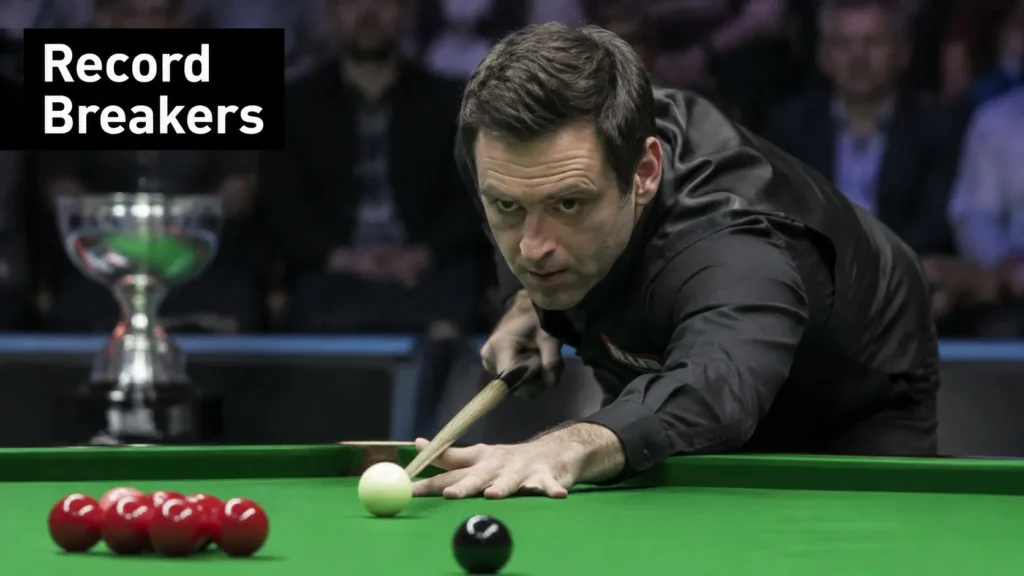
Ronnie O’Sullivan is the reference point for modern maximum break records. Guinness World Records credits O’Sullivan with 17 competitive 147 breaks by 2025, the record for the most by a player. Longevity matters here, because compiling that many maximums requires elite break building across very different eras of the professional game.
The image below captures the concentration behind that record, with O’Sullivan settled over a shot during competition.
Speed Volume and the Crucible Stage
The Sporting News account of Crucible maximums records O’Sullivan making 17 competitive 147s between 21 April 1997 and 15 August 2025, a span that began with a 5 minutes 8 seconds maximum against Mick Price at the 1997 World Championship when he was 21 years old, a break that remains the fastest officially recorded 147.
His later volume is just as striking. The tally was not front-loaded in his twenties. He was still adding maximums deep into his career, nearly three decades after the first, and that sustained output explains why O’Sullivan’s name anchors almost every comparison of career maximums.
Watch the clip below for the pace and cue ball control that make a timed maximum different from a careful clearance.
Recent Maximums Beyond One Player
Modern fields now produce maximums more often, although they still carry prize value. BBC Sport reported that Noppon Saengkham made a 147 in 2024 World Championship qualifying and won the £15,000 highest break prize. Snooker.org lists Mark Allen’s 147 as the highest break at the 2025 World Championship.
Frequency has risen at tour level too. Totally Snookered reported that the 2024/25 professional snooker season set a record with 14 maximum breaks. A busier record book does not make a 147 routine for an individual player, and its shot sequence is far less repeatable than a feat such as a hole in one on the PGA Tour. Thirty six consecutive scoring pots still leave no room for recovery after one miss.
O’Sullivan’s totals work as the comparison standard because they are tied to named record keepers, dates and events rather than reputation.
Verifying a Break Before You Call It a Record
Don’t call a break a record because a clip, headline or social post uses that word. Check the competition, the table, the scoring route and the recognising authority. Those four points separate history from a good story.
| Situation | Official record? | Reason |
|---|---|---|
| Standard frame at a ranked tournament | Yes | Ratified under standard conditions and officially scored |
| Exhibition or non-ranking match | Usually no | Early history shows exhibition maximums were often not ratified |
| Non-standard table, such as oversized pockets | No | The 1979 Holsten Lager International maximum was not accepted |
| Break above 147 through a free-ball sequence in competitive play | Yes, if officially recorded | Recognised breaks such as O’Sullivan’s 153 at the 2026 World Open |
| Claimed break without official scoring | Unverified | No official record exists until it is confirmed |
A Five Step Check You Can Apply
- Identify the competition. Ranking tournaments and major governed events carry official scoring and record keeping. Exhibition claims need stronger proof because they often sit outside that structure.
- Classify the scoring route. Count 36 pots and 147 points for a standard maximum. For anything higher, confirm a free ball opened the visit and make the arithmetic fit.
- Check the table specification. Pocket size isn’t a technical footnote. The rejected 1979 maximum shows that non-standard equipment can remove a break from the official record.
- Find the recognising authority. Look for the governing body or an established record keeper, not only a broadcaster’s graphic or a player’s recollection. A named event, opponent and date make the claim easier to cross check.
- State the category in your answer. Write standard maximum for 147, highest officially recorded competitive break for 153, and theoretical ceiling for 155. That wording answers the reader’s real question without forcing three different ideas into one number.
Use that sequence in order. Competition first tells you whether anyone with authority was scoring the frame. The route then tells you whether the total is mathematically possible. Equipment and recognition decide whether a possible score becomes a record.
A reliable record claim names the player, event, date, score and recognising authority. Missing several of those details is a reason to label the break unverified, not a reason to fill the gaps yourself.
Be careful with practice table stories. A player may clear every ball in a club or during an exhibition, but genuine and officially recorded aren’t synonyms. Without independent scoring under recognised conditions, you’ve got an anecdote, however impressive the break building was.
The clearest final wording is also the most accurate. The highest break in snooker in official competition is 153, the theoretical ceiling is 155, and 147 is the standard maximum. Give readers that category and source context, and you won’t mislead them with a single bare number.
For clear explainers that separate sporting records from the myths around them, plus daily writing across sports, science, technology, health, arts and entertainment, visit maxijournal.com. You’ll find approachable guides written for curious readers and opportunities for contributors who want to publish their own work.
Discover more from Maxi Journal
Subscribe to get the latest posts sent to your email.