If you want to get more out of what you read, the first step is to shift from being a passive consumer to an active participant. It’s about more than just seeing words; it’s about building a solid foundation in vocabulary and critical thinking. That’s what allows you to decode meaning, connect ideas, and actually remember what you read.
Why Reading Comprehension Matters More Than Ever
Have you ever finished a page, maybe even a whole chapter, only to realize you have zero clue what you just read? It’s a classic, and incredibly frustrating, experience. We’ve all been there.
Reading comprehension isn’t just about recognizing words. It’s the complex mental gymnastics of pulling real meaning from a text.
When you truly comprehend something, you’re actively building a mental map of the information. You stop being a spectator and start having a conversation with the author. You’re questioning their points, linking concepts to your own life, and sizing up their arguments. This skill is the absolute bedrock of learning and genuine critical thought.
The Four Pillars of Reading Comprehension
So, what does it actually take to build this skill? I’ve found it helpful to think of comprehension as a structure held up by four essential pillars. If one is shaky, the whole thing can feel unstable. These elements all work together, so strengthening one usually gives the others a boost, too.
Let’s quickly introduce the four core components you’ll be working on.
The Four Pillars of Reading Comprehension
| Pillar | What It Means | Why It’s Important |
|---|---|---|
| Vocabulary Knowledge | Your mental dictionary. It’s the collection of words you know and understand without having to stop and think. | A strong vocabulary lets you grasp the author’s precise meaning and nuance, keeping you in the flow of reading instead of constantly reaching for a dictionary. |
| Background Knowledge (Schema) | All the information and experiences you already have about a topic. Think of it as the mental filing cabinet you bring to the text. | When you know something about a subject, your brain has a framework to hang new details on, making them far easier to understand and remember. |
| Working Memory & Attention | Your ability to hold onto information while you process the next sentence or paragraph. It’s your mental RAM. | A sharp focus is crucial for tracking themes, character development, and complex arguments as they unfold from one page to the next. |
| Critical Thinking & Inference | The skill of “reading between the lines.” It involves making educated guesses and understanding what’s implied, not just what’s stated outright. | This is where you identify an author’s purpose or bias and uncover the hidden layers of meaning that make a text truly come alive. |
Mastering these areas is what turns reading from a chore into an act of discovery. You start to see the intricate web of ideas holding a text together, and that’s a game-changer.
Comprehension in a Global Context
The need for strong reading skills isn’t just a personal project; it’s a global issue that’s become much more urgent. A shocking 70% of children in low- and middle-income countries can’t read and understand a simple story. This crisis was made worse by recent educational disruptions.
The COVID-19 pandemic alone pushed over 100 million additional children below minimum reading proficiency, effectively wiping out two decades of progress. You can read the full report from the World Bank on the global literacy crisis to get the full picture.
This global reality highlights just how fundamental this skill is. It’s the key that unlocks everything else: education, economic opportunity, and the ability to be an informed citizen.
The ability to comprehend text is the foundation upon which all other academic learning is built. Without it, students are not just falling behind in one subject; they are cut off from the entire curriculum.
Keeping this bigger picture in mind gives our efforts real purpose. Every strategy you learn doesn’t just help you; it reinforces the value of a skill that is essential for everyone. Before we jump into the specific techniques, grasping why this matters so much sets the stage for real, lasting improvement.
Preparing Your Mind Before You Read
Most people think reading comprehension begins with the first sentence. But experienced readers know the real work starts before you even dive in. What you do in those few minutes beforehand can completely change how much you get out of a text.
Think of it as a mental warm-up. This isn’t about doing a ton of research. It’s about quickly building a mental roadmap so your brain isn’t working overtime just to figure out what’s going on. A little prep gives you a framework to hang new information on, making everything that follows click into place.
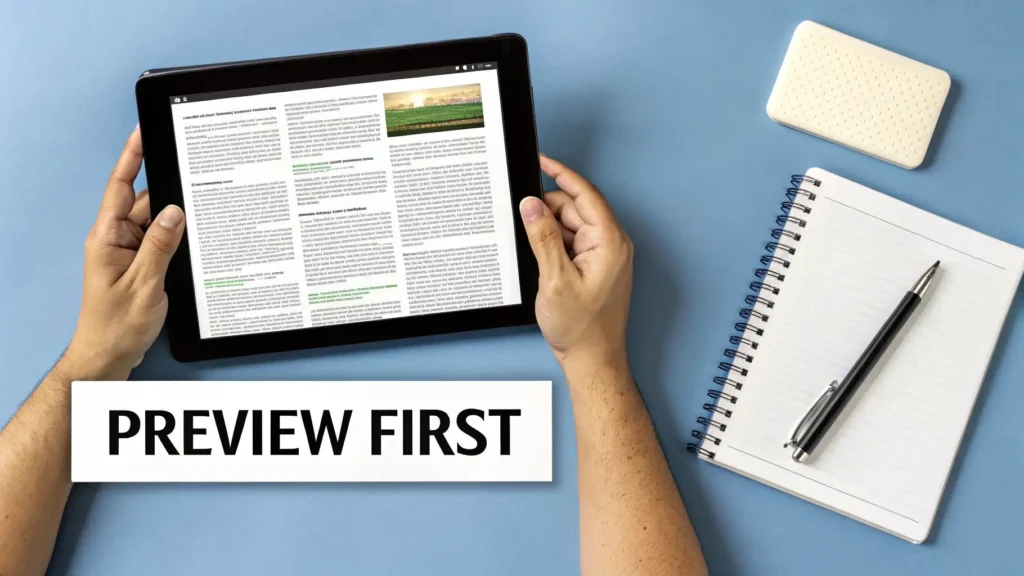
Create a Mental Blueprint with Previewing
Before you start reading word-for-word, give the material a quick two-minute tour. This scan is all about spotting clues that tell you where the author is headed.
Your goal isn’t to understand everything just yet—it’s to get the lay of the land. It’s a deceptively simple trick that pays off big time.
Here’s what to look for in your preview:
- Headings and Subheadings: These are the author’s signposts. They map out the main topics and show you the flow of the argument.
- Introduction and Conclusion: Always read the first and last paragraphs. This is where you’ll usually find the main point and the final summary.
- Visuals: Glance at any charts, graphs, or images. The captions alone often spell out the most important takeaways.
- Bolded Words: Pay attention to anything the author emphasized. These are usually the core concepts you absolutely need to grasp.
This process lets your brain sketch out a structure for the information. It’s way more efficient than trying to build that structure from scratch while you’re in the thick of reading.
Turn Passive Reading into an Active Search
Once you have a feel for the material, start asking questions. This simple shift turns you from a passive reader into an active detective. It gives you a mission.
For example, if you’re reading an article called “The Rise of Artificial Intelligence in Healthcare,” you can flip the headings into questions:
- Instead of just reading “AI’s Role in Diagnostics,” ask yourself, “How exactly is AI being used to diagnose illnesses?“
- When you see “Ethical Considerations,” frame it as, “What are the biggest ethical problems with using AI in medicine?“
This questioning primes your brain to hunt for answers, keeping you far more engaged. You’re not just reading words on a page; you’re on a quest for specific information.
Activating your curiosity before you read is like turning on a spotlight in a dark room. Instead of stumbling around, you can move directly toward the things you want to find, illuminating the most important information along the way.
Activate Your Existing Knowledge
The final step before you begin is to ask, “What do I already know about this?” This is called activating your prior knowledge, and it’s a game-changer. It forges a link between the new information and what’s already stored in your long-term memory.
This doesn’t need to be a formal ordeal. Just a quick mental check-in is enough. If the topic is the Roman Empire, think back to that history class or a documentary you saw. Even a hazy memory gives the new details something to “hook” onto.
Connecting new ideas to what you already know makes them stick. This foundation is essential, as reading achievement often builds on existing knowledge. For example, the 2021 Progress in International Reading Literacy Study (PIRLS) found massive performance gaps among fourth-graders in 43 countries. Top-performing nations scored 300 points higher than lower-performing ones, partly due to these foundational differences. You can explore the PIRLS 2021 international reading achievement results to see the data for yourself.
These pre-reading habits might feel like an extra step, but they make your reading time dramatically more focused and productive. It’s also a fantastic way to quiet a busy mind before you try to learn something new. If that’s something you struggle with, our guide on how to meditate for stress relief might be helpful.
Engaging Actively While You Read
Alright, you’ve warmed up your brain and previewed the text. Now for the main event. This is where we shift reading from a passive act—just letting your eyes scan the words—into an active, hands-on process of making sense of it all.
Let’s be honest, just highlighting a few sentences isn’t going to cut it. That rarely leads to deep understanding. To really get it, your brain needs to do more than just follow along. The goal is to create a constant dialogue with the material.
Let’s get into some powerful, practical ways to keep your mind locked in from the first sentence to the last.
Annotate with Purpose and Create a Dialogue
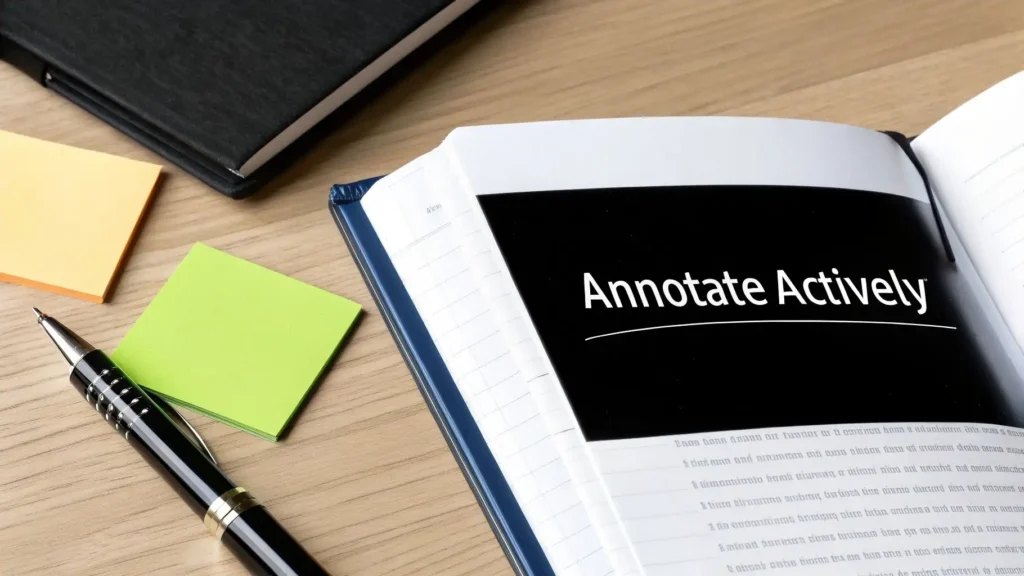
This is my single most important tip: make the text yours through annotation. I’m not talking about mindless highlighting. I’m talking about having a full-blown conversation with the author right there in the margins of the page.
Think of the margins as a scratchpad for your brain. This is where you connect dots, challenge ideas, and capture those fleeting “aha!” moments. When you annotate with real intention, you’re not just marking things; you’re interacting with them.
Here are a few simple but incredibly effective ways to do this:
- Ask questions in the margins whenever something feels confusing or sparks your curiosity. (“Why this specific example?” or “What’s the evidence for this claim?”)
- Summarize key paragraphs in your own words. This is a mini-test that forces you to process the core idea before moving on.
- Draw arrows to link related ideas, maybe from one page to another, showing how an argument builds.
- Use your own symbols. An exclamation mark for a surprising fact, a star for what seems to be the main thesis—whatever works for you.
This whole process keeps you from “zoning out,” that feeling where your eyes are moving but your brain checked out ten minutes ago. You’re physically and mentally in it.
Active annotation is the bridge between seeing words and understanding ideas. It forces you to slow down, think critically, and build a personal connection with the material, making it far more likely you’ll remember what you read.
For example, if you’re reading a chapter on the Industrial Revolution, don’t just highlight “steam engine.” Jot down a note like, “How did this impact family life?” or “Connects to the growth of cities.” This adds layers to your understanding. It’s a similar principle to active recall, which we touch on in our guide on how to learn a new language.
Break Down Complex Information with Chunking
Ever stared at a dense, 20-page chapter and just felt… tired? That’s where chunking comes in. It’s a simple but game-changing strategy for tackling overwhelming texts. The idea is to break down the beast into smaller, bite-sized pieces.
Instead of trying to absorb the entire thing in one go, just focus on understanding one section—or even one complicated paragraph—at a time. Read a chunk, then pause. Give yourself a moment to digest it before you move to the next part.
This little trick prevents your brain from getting overloaded. It gives your working memory a fighting chance to actually process the information in each segment. You’ll be surprised how much less intimidating a difficult text feels when you approach it piece by piece.
Turn Words into Mental Movies with Visualization
Here’s another powerful tool for your comprehension toolkit: visualization. It’s exactly what it sounds like—consciously creating mental images of what you’re reading. You’re basically directing a little movie in your head based on the author’s script.
This is a no-brainer for stories and novels, but it’s surprisingly effective for dry, abstract topics, too. Reading about photosynthesis? Picture the sunlight hitting a leaf and imagine the chemical reactions buzzing with activity. Going through a technical manual? Visualize yourself actually performing each step.
Visualization works on a few levels:
- It anchors abstract ideas to concrete images, which our brains find much easier to store and recall.
- It keeps you engaged because you’re actively co-creating the content.
- It highlights what you don’t understand. If you can’t picture it, you probably haven’t fully grasped it yet.
This practice makes any information feel more personal and, therefore, more memorable. It’s the difference between reading a recipe and actually imagining the smell and taste of the final dish. By building these mental models, you’re building a much deeper and more durable understanding.
What To Do After You Read to Make It Stick
The real work of comprehension doesn’t end when you close the book. What you do in the minutes, hours, and days afterward is what separates fleeting familiarity from genuine, lasting knowledge. These post-reading habits are all about pulling ideas out of your fragile short-term recall and locking them into long-term memory.
Think of it like this: reading is gathering the raw materials, but the after-work is where you actually build something with them. By actively engaging with what you just read, you forge stronger neural pathways, making that information easy to find and use later on.
The True Test: Summarize It in Your Own Words
One of the best ways I know to check if you really understand something is to summarize it from memory. It sounds simple, but it’s a real acid test. If you can’t explain the main points and how they all fit together without peeking back at the text, your grasp is probably still a bit shaky.
This isn’t just about regurgitating facts. The act of translating the author’s argument into your own language forces you to process it on a much deeper level. You have to decide what’s essential, toss out the fluff, and then rebuild the core message logically.
Here’s a practical way to tackle this:
- The One-Sentence Challenge: First, try to distill the entire piece down to a single, core sentence. What is the absolute heart of the message?
- The Elevator Pitch: Now, expand that sentence into a short paragraph. Lay out the main argument, the key evidence used to support it, and the final conclusion.
- Find Your Weak Spots: Pay close attention to the moments you pause or get stuck. Those are your red flags—the exact areas you need to go back and review.
This simple exercise immediately shines a spotlight on any fuzzy areas in your understanding. It’s an active recall workout that builds memory far more effectively than just passively re-reading a page.
Draw a Map: The Retrospective Outline
Another powerhouse technique is to create a “retrospective outline.” Instead of outlining before you read, you build one after you’re done, entirely from memory. This is like reverse-engineering the author’s logic, letting you see the structural skeleton that holds the entire piece together.
Your goal is to map out the main thesis, the big supporting points, and the smaller sub-points that flesh everything out. This gives you a bird’s-eye view of the argument, making it crystal clear how each part contributes to the whole.
Creating a retrospective outline is like drawing a map of a city after you’ve walked its streets. You solidify your mental layout, notice connections you missed the first time, and finally see how all the neighborhoods fit together.
For instance, if you just read an article about a historical battle, your outline might look something like this:
- Main Thesis: The battle’s outcome was decided by logistical failures, not battlefield tactics.
- Supporting Point A: Critical supply chain breakdowns.
- Sub-point: Troops ran out of food.
- Sub-point: Critical shortage of ammunition.
- Supporting Point B: Communication lines completely collapsed.
- Sub-point: Messengers were intercepted.
- Sub-point: Command sent conflicting orders.
Breaking it down this way makes the author’s logic transparent and incredibly easy to remember.
Teach It to Cement It
It’s one of the oldest truths in learning: the fastest way to truly master something is to teach it to someone else. When you’re forced to explain a concept, you find out what you really know.
This strategy, often called the Feynman Technique, is brilliant because it instantly exposes the holes in your knowledge. The moment you stumble, use vague language, or say “you know, that thingamajig,” you’ve found exactly where your comprehension is weak.
So grab a friend, a partner, or even just talk to the dog. Explain the core ideas from what you just read as if you were teaching a total beginner. Use simple language and relatable analogies. This act of simplification and verbalization demands a profound level of clarity and burns the information into your memory for good.
Building Your Personal Comprehension Toolkit
Let’s get practical. There’s no single magic bullet for better reading comprehension. What works for one person might not work for another, so the best approach is always a personal one, built around your specific reading habits and sticking points.
Think of yourself as a detective investigating your own learning process. Instead of just grabbing random techniques and hoping for the best, you’ll first figure out what’s actually tripping you up. From there, you can build a toolkit of strategies that directly address those challenges and create a realistic plan for making real, lasting progress.
Identify Your Primary Reading Hurdles
First things first: you can’t fix a problem until you know exactly what it is. Do you find yourself constantly stumbling over unfamiliar words? Or maybe you read every sentence but get to the end of a chapter with no clue what the main point was?
Take a second to think about your last few reading sessions. Pinpointing the main obstacle is the crucial first step toward picking the right tools to fix it.
Most comprehension problems fall into one of these buckets:
- Vocabulary Gaps: You hit words you don’t know so often that it breaks your flow and muddies the author’s message.
- Focus and Concentration: Your mind starts to wander, and you realize you’ve been “reading” for five minutes without absorbing a single thing.
- Grasping the Main Idea: You remember little facts and details but couldn’t summarize the overall argument if someone asked.
- Connecting Ideas: You struggle to see how one paragraph flows into the next or how different sections build on each other.
Once you know your main hurdle, you can get specific with your strategy. If focus is the issue, the “chunking” method we talked about earlier is a great fit. If it’s vocabulary, making an active word log a priority will pay off big time.
Choose the Right Strategy for the Right Text
Next, it’s time to accept that not all reading is the same. You wouldn’t tackle a dense legal contract the same way you’d read a novel for fun, and your comprehension strategies shouldn’t be one-size-fits-all either.
Matching your technique to the material is a game-changer. For example, detailed annotation is perfect for a heavy academic paper, but a quick mental summary is probably all you need for a straightforward news article. Making this choice deliberately saves you a ton of time and mental energy.
The art of skilled reading lies in knowing which tool to pull from your toolkit for the specific job at hand. By adapting your strategy to the text type, you work smarter, not harder, and get far more out of every page you read.
This decision-making process keeps you engaged and makes your reading far more efficient. The flowchart below gives you a simple way to choose the best post-reading task to really cement what you’ve learned.
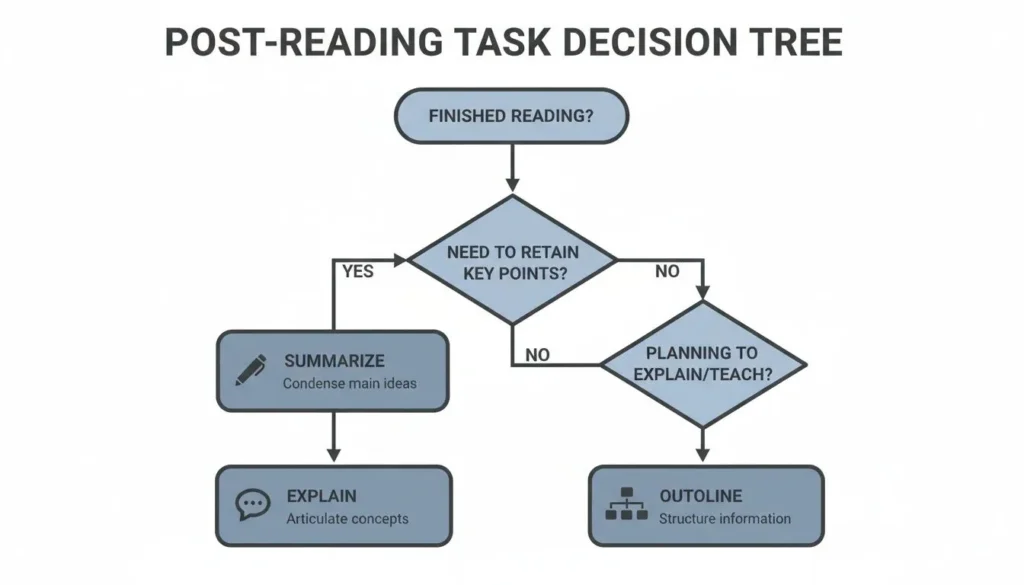
As the visual guide shows, whether you choose to summarize, outline, or teach the concept to someone else depends entirely on your goal—be it long-term memory or sharing that knowledge.
Matching Reading Strategies to Text Types
To make this even easier, here’s a quick guide to help you select the most effective comprehension technique based on what you’re reading.
| Text Type | Best Pre-Reading Strategy | Best During-Reading Strategy | Best Post-Reading Strategy |
|---|---|---|---|
| Academic Journal Article | Review abstract & headings. | Highlight key findings & annotate. | Write a one-paragraph summary. |
| Textbook Chapter | Scan for key terms & questions. | The KWL Method. | Answer end-of-chapter questions. |
| News Article/Blog Post | Skim the first & last paragraphs. | Identify the 5 Ws (Who, What, Where, When, Why). | Discuss it with a friend or colleague. |
| Fiction Novel | Read the back cover summary. | Visualize scenes & characters. | Reflect on themes and character arcs. |
| Technical Manual | Identify the specific problem to solve. | Follow steps & “chunk” the info. | Apply the steps to the real task. |
Using a table like this removes the guesswork. You simply find your text type and have a proven plan ready to go.
Setting Achievable Goals for Improvement
Now that you’ve identified your hurdles and have a few strategies in mind, the last step is to make a practical, low-pressure plan. The name of the game is consistency, not intensity.
Trying to master every technique at once is a surefire way to get overwhelmed and quit. Instead, set tiny, manageable goals. For this week, just commit to summarizing one article you read. Or maybe try annotating only the first chapter of that book on your nightstand.
These small wins are what build momentum and slowly turn these conscious practices into unconscious habits. To stay on track, you might want to check out some of the best productivity apps for students that can help you organize and track your goals.
Your personal toolkit isn’t set in stone; it will change and grow as your skills do. By checking in with yourself every so often and tweaking your approach, you create a powerful system for continuous improvement that delivers real, noticeable results over time.
Got Questions About Reading Comprehension?
As you start putting these reading strategies into practice, you’re bound to run into a few hurdles. It happens to everyone. Let’s walk through some of the most common questions and roadblocks people face—clearing these up now will help you stay on track.
One of the first things people ask is about speed. “Do I really need to slow down to understand more?” The short answer is yes, at least when you’re starting out. Trying to blaze through a text is one of the biggest reasons we forget what we just read.
Giving yourself permission to slow down allows your brain to actually do its job—processing the information, spotting connections, and forming mental pictures. You might eventually get faster without sacrificing understanding, but for now, comprehension should always be the priority over speed.
What Do I Do About Words I Don’t Know?
Hitting a wall of unfamiliar vocabulary is another classic challenge. Should you stop and look up every single word? Not necessarily. Breaking your flow every few seconds can make it nearly impossible to follow the author’s train of thought.
The best approach is to start with context clues. Can you get the gist of the word from the sentences around it? If a word seems absolutely critical to the main idea and the context isn’t helping, then go ahead and look it up. For less important words, just jot them down and look them up later. This way, you build your vocabulary without derailing your reading session.
Don’t let perfect be the enemy of good. The goal isn’t to master every single word on the first read. It’s about grasping the core message and building from there.
I’m Using the Techniques, but Still Forgetting Everything. What Gives?
This is incredibly frustrating, but you’re not alone. You read a chapter, you feel like you’ve understood it, but an hour later, it’s all a blur. When this happens, it’s usually a signal that your post-reading game needs some work.
Understanding something in the moment is one thing; locking it into your long-term memory is a totally different ballgame. If retention is your weak spot, you need to get more active after you finish reading.
- Talk It Out: Try explaining the key points to someone else. If no one’s around, just say it out loud to yourself. The act of verbalizing forces your brain to organize the information.
- Outline from Memory: Once you’ve closed the book, grab a notebook and sketch out the main arguments and structure. Don’t peek!
- The 24-Hour Test: A day after you read something, challenge yourself to write down the three most important takeaways. This simple act of “spaced repetition” is a powerful memory booster.
These active recall exercises are far more effective for building lasting memory than just passively rereading the material. Make them a consistent part of your routine, and you’ll find that information starts to stick.
At maxijournal.com, we publish daily content designed to be clear, engaging, and easy to understand, covering topics from technology and health to arts and entertainment. Explore our latest articles at https://maxijournal.com.
Discover more from Maxi Journal
Subscribe to get the latest posts sent to your email.