Starting to invest really boils down to three simple ideas: figure out what you’re saving for, pick the right kind of account for that goal, and then fill it with some solid, low-cost investments. That’s it. It’s the single most powerful thing you can do for your financial future.
Your First Steps Into the World of Investing

Jumping into the world of investing can feel a lot like learning a new language, filled with jargon and intimidating charts. But here’s the good news: you don’t need a finance degree or a mountain of cash to start. Your most valuable asset isn’t money—it’s time.
The magic behind building real wealth is compound growth, which is just a fancy way of saying your investment earnings start making their own earnings. Imagine a small snowball rolling down a hill. As it rolls, it picks up more snow, getting bigger and moving faster. The earlier you start, even with small amounts, the more time your money has to grow on its own.
Getting Your Financial House in Order
Before you even think about putting a single dollar into the market, you need to know why you’re doing it. A fuzzy goal like “I want to be rich” won’t get you anywhere because it’s not actionable. You need to get specific.
Your goals are the blueprint for your entire strategy. They’ll determine what kind of account you open, how much risk you should take, and what you invest in.
Think about it in real-world terms:
- Buying a house in 3 years? That’s a short-term goal. You’ll need that cash relatively soon, so you’d probably stick to safer, lower-risk investments to make sure the money is there when you need it.
- Saving for your kid’s college in 15 years? That’s a long-term goal. You have plenty of time to ride out the market’s ups and downs, so you can take on more risk for a shot at higher returns.
- Retiring in 30 years? This is the classic long-term goal. With decades ahead of you, you can let compounding do its heavy lifting.
The real secret to successful investing isn’t trying to perfectly time the market—it’s about having more time in the market. A steady, consistent approach almost always wins out over trying to guess the market’s next move.
Your Quick Start Investing Checklist for Beginners
To get started, you need to break the process down into small, manageable steps. This first phase has nothing to do with picking stocks. It’s all about building a solid foundation so you can invest with confidence and avoid rookie mistakes, like having to cash out your investments during a financial emergency.
Think of this checklist as the non-negotiable prep work. Knocking out these simple tasks puts you on the right track before you ever open an investment account, ensuring your journey starts on stable ground.
| Action Item | Why It’s Important | Your Simple First Step |
|---|---|---|
| Build an Emergency Fund | This is your financial safety net. It stops you from having to sell investments at a bad time to cover a surprise car repair or medical bill. | Open a separate high-yield savings account and set up automatic weekly or monthly transfers. Aim for 3-6 months of essential living expenses. |
| Pay Down High-Interest Debt | Credit card debt with a 20% APR will destroy your wealth faster than most investments can build it. Paying it off is a guaranteed return on your money. | Start throwing extra cash at your highest-interest debt first. Make minimum payments on everything else until that one is gone, then move to the next. |
| Define Your Financial Goals | Clear goals give you a roadmap. They tell you how long you have to invest, how much risk you can handle, and which account is best for you. | Grab a notebook and write down what you’re saving for and when you’ll need the money. This simple act makes it real. |
Once you’ve checked these boxes, you’re not just ready to invest—you’re ready to invest smart. You’ve built a buffer, eliminated financial drags, and given your money a clear purpose.
Building Your Financial Foundation Before You Invest
It’s tempting to jump right into picking stocks and funds, but doing that without a solid base is like building a house on sand. Trust me on this one. Before you put a single dollar into the market, a few key prep steps can mean the difference between long-term success and a costly mistake. Think of this as your pre-flight checklist.
This foundational work makes sure that when life inevitably throws a curveball—a surprise car repair, an unexpected job loss—you won’t be forced to sell your investments at the absolute worst time. It’s all about building a financial buffer that lets your investments do their thing and grow undisturbed.
Create Your Financial Safety Net
The single most important asset for a new investor isn’t a hot stock tip; it’s an emergency fund. This is just a stash of cash, typically 3 to 6 months’ worth of essential living expenses, parked in an easily accessible account.
Its purpose is simple: cover unexpected costs without wrecking your financial goals. Without it, a $1,500 transmission issue could force you to sell investments during a market downturn, locking in losses and setting you back in a big way.
Here’s how to get one set up:
- Calculate Your Number: Add up your non-negotiable monthly costs—rent or mortgage, utilities, groceries, insurance, car payments. Multiply that total by three to get your minimum target. Aim for six if you can.
- Choose the Right Home: This money needs to be liquid and safe, not invested. A high-yield savings account is perfect. It’s separate from your daily checking, earns a bit of interest, and is there when you need it.
- Automate It: The easiest way to build your fund is to “pay yourself first.” Set up an automatic transfer from your checking to your savings account every single payday. Even $50 a week adds up faster than you’d think.
An emergency fund isn’t just about the money; it’s about peace of mind. It gives you the confidence to invest for the long haul, knowing you have a cushion for short-term surprises.
Tackle High-Interest Debt First
Before you start funneling money into the market, take a hard look at any existing debt, especially the high-interest kind. Trying to out-invest a credit card with a 21% APR is a losing battle. It’s just not going to happen.
Think about it this way: paying off that credit card gives you a guaranteed, risk-free return of 21% on your money. You are extremely unlikely to find an investment that consistently and safely delivers that kind of return. Wiping out that debt is one of the most powerful “investments” you can make.
Define Your Why and When
Your financial goals are the GPS for your investment strategy. A vague goal like “I want to be rich” isn’t going to cut it. You need to get specific about what you’re investing for and when you’ll need the money. This timeline is what dictates your entire approach.
Your goals will usually fall into one of three buckets:
- Short-Term Goals (1-3 years): This is for something like a down payment on a car or a big vacation. Because the timeline is so short, you can’t afford to risk the principal. Money for these goals is much better off in a high-yield savings account or maybe short-term bonds, not the stock market.
- Mid-Term Goals (4-10 years): Saving for a house down payment or starting a business often falls into this category. Here, you can take on a bit more risk, maybe with a balanced portfolio of stocks and bonds.
- Long-Term Goals (10+ years): This is the classic stuff: retirement, a child’s college fund. With decades ahead of you, you can afford to embrace the market’s ups and downs for higher potential returns, leaning heavily into diversified stock funds.
Knowing your timeline directly shapes your risk tolerance—how comfortable you are with the market’s wild swings. A 30-year retirement goal can easily weather a market downturn, but a down payment you need in two years absolutely cannot.
By clarifying your goals and timelines now, you set yourself up to make smart, appropriate investment choices later on. You can also explore more in-depth strategies to learn more about aligning financial goals with your business plans.
Choosing The Right Accounts and Investments
Okay, with your financial foundation looking solid, we get to the fun part—actually deciding where to put your money so it can start working for you. This really comes down to two big decisions: picking the right type of investment account, and then choosing the investments to put inside that account.
Think of the account as the bucket and the investments as what you fill it with. Choosing the right bucket is a huge deal because different accounts come with some incredible tax advantages. Getting this right from day one is one of the smartest things you can do for your future wealth.
Select The Best Investment Account for Your Goals
Your investment account is the vehicle that will hold your assets and let them grow. For most people starting out, there are three main types to know, and each one serves a different purpose, especially when it comes to taxes.
- Your Workplace 401(k) or 403(b): If your company offers a retirement plan, especially one with a matching contribution, this is your absolute first stop. An employer match is free money. It’s that simple. If they match 100% of your contributions up to 5% of your salary, contributing that 5% gives you an immediate 100% return on your money. You can’t beat that, anywhere.
- An Individual Retirement Account (IRA): This is an account you open on your own, completely separate from your job. They come in two primary flavors—Roth and Traditional—and offer fantastic tax breaks to incentivize saving for retirement. You can open an IRA at pretty much any online brokerage in a matter of minutes.
- A Standard Taxable Brokerage Account: This is your all-purpose, flexible investment account. There are no contribution limits or rules about when you can take your money out. It’s the perfect spot for goals that aren’t retirement-related, like saving for a house down payment in five or ten years. You typically fund this after you’re taking full advantage of your tax-advantaged retirement accounts.
This simple flowchart is a great visual guide for prioritizing where your money should go.
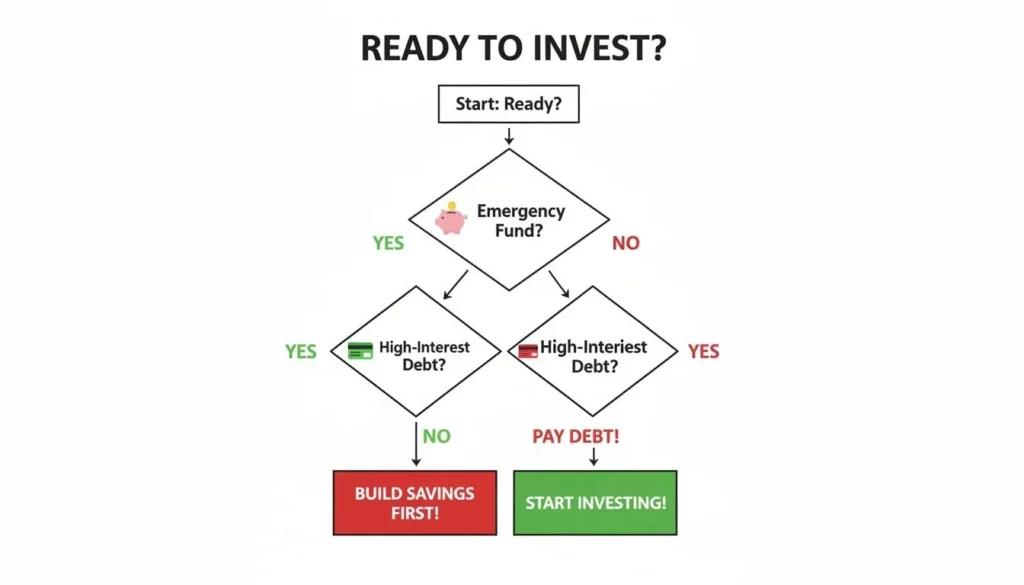
As you can see, tackling high-interest debt and building that emergency fund are the non-negotiable first steps. You have to secure your present before you can build for your future.
To make this even clearer, here’s a quick rundown of how these accounts stack up against each other.
Investment Account Comparison for Beginners
| Account Type | Best For | Key Tax Benefit |
|---|---|---|
| 401(k) / 403(b) | Retirement savings, especially for capturing an employer match. | Contributions are often tax-deductible, and growth is tax-deferred. |
| IRA (Roth or Traditional) | Long-term retirement savings with powerful tax advantages. | Roth: Tax-free growth and withdrawals. Traditional: Tax-deductible contributions. |
| Taxable Brokerage Account | Mid-term goals (5+ years) or investing beyond retirement limits. | Maximum flexibility with no withdrawal restrictions. |
Each account has a specific job to do. Using them correctly is the key to building wealth efficiently.
Demystify Your Investment Choices
Once your account is open, what do you actually buy? For a beginner, the goal isn’t to hit a home run by picking the next Amazon. The real goal is to build a diversified portfolio that grows steadily over the long haul without needing you to check it every day.
The most effective way to start investing money is to own a small piece of many great companies, not a large piece of one or two. This is the core principle of diversification, and it’s your best defense against risk.
Here are the most common investment types you’ll encounter.
ETFs and Index Funds
For new investors, these are your best friends. An Exchange-Traded Fund (ETF) or an index fund is a basket that holds hundreds or even thousands of different stocks or bonds, all bundled into a single investment. For example, buying a share of an S&P 500 index fund instantly makes you a part-owner of the 500 largest companies in the United States.
- Instant Diversification: One purchase spreads your money across an entire market segment, dramatically reducing your risk.
- Extremely Low Cost: They have rock-bottom fees (called expense ratios), so more of your money stays invested and works for you.
- Simplicity: This is the ultimate “set it and mostly forget it” strategy that has proven to be incredibly effective over time.
Individual Stocks
This is what most people think of when they hear “investing”—buying a share of ownership in a single company like Apple or Tesla. While the potential rewards can be high if you pick a winner, the risk is concentrated. If that one company hits a rough patch, so does your investment.
Most experienced investors recommend building a solid core portfolio with broad-market ETFs and index funds before ever dipping your toes into picking individual stocks. If you’re curious about the mechanics behind how stocks and other assets are traded, you might find it interesting to learn more about how blockchain technology works and its growing role in finance.
Bonds
Think of a bond as a loan you make to a government or a corporation. In exchange for your cash, they promise to pay you back with interest over a set period. Bonds are generally much safer than stocks, but they also offer lower long-term returns. Their main job in a portfolio is to provide stability and smooth out the ride when the stock market gets choppy.
The historical data is pretty clear on this. The Global Investment Returns Yearbook 2025 found that from 1900 to the present, stocks delivered an annualized real return of 5.5% globally. Bonds came in at just 2.0%. This massive difference is exactly why stocks are the primary engine for long-term wealth creation.
How to Select a Platform and Make Your First Investment
Alright, you’ve got your financial foundation built and your goals mapped out. Now for the exciting part—choosing where your money will live and grow, and actually making that first investment.
This moment can feel like a huge hurdle, but I promise it’s simpler than it sounds. The choice really comes down to one question: how hands-on do you want to be? Your answer will point you toward either a robo-advisor or an online brokerage.
Robo-Advisors: The Automated Approach
If your goal is to invest wisely without becoming a market analyst, a robo-advisor is a fantastic choice. Think of it as a digital money manager. You answer a few straightforward questions about your goals and how you feel about risk, and its algorithms build and manage a diversified portfolio for you.
It’s the ultimate “set it and forget it” option, perfect for anyone who feels a little overwhelmed by the idea of picking their own funds. Robo-advisors handle all the complicated stuff, making sure you’re properly diversified from day one.
Why people love them:
- Automatic Rebalancing: They keep your investments on track with your goals without you lifting a finger.
- Low Minimums: Many platforms let you get started with just a few dollars.
- Hands-Off Management: Ideal if you’re busy or simply not interested in the day-to-day management.
Online Brokers: The Hands-On Route
For those who want to be in the driver’s seat, an online brokerage firm is the way to go. These platforms give you direct market access to buy and sell whatever you want—ETFs, index funds, individual stocks, you name it.
Going this route means you’re making all the decisions, which brings more flexibility and can often mean lower fees. The best part is, you don’t have to be an expert from the start. Most top-tier brokers offer a treasure trove of research tools and educational content to help you learn as you go.
Pro Tip: Don’t get stuck with analysis paralysis here. The truth is, most of the big-name robo-advisors and online brokers are excellent. The “best” one is the one that fits your style—do you want automation or control? Pick one and move forward.
Walking Through Your First Investment Purchase
Once you’ve picked a platform and transferred some cash into your account, you’re ready to buy. Let’s imagine you’re starting with a classic: a broad-market ETF that tracks the S&P 500. It’s a solid first move many new investors make.
Here’s a simple breakdown of what that looks like:
- Find the Investment: Use the search bar on the platform and type in the fund’s ticker symbol—a unique code that identifies it on the market. For S&P 500 ETFs, popular tickers are VOO or IVV.
- Enter Your Order: Decide how much you want to invest. You can either type in a dollar amount or the number of shares. Thanks to fractional shares, a feature on most platforms now, you can invest as little as $1.
- Choose Your Order Type: You’ll see a few options, but for your first time, a market order is the simplest. This just tells the broker to buy the investment right away at the current market price. No fuss.
- Confirm and Submit: Give the details a quick final look and hit the “buy” button. And just like that, you’re an investor! You officially own a tiny slice of hundreds of the world’s biggest companies.
Diversifying from the get-go is key. A simple way to do this is by using ETFs that track major global indexes. For the first time in nearly 15 years, the U.S. S&P 500 recently underperformed some international markets. European and Asian markets delivered almost double the dollar returns, with Vanguard reporting that non-U.S. equities jumped 32%. It’s a powerful reminder of why thinking globally matters. You can dig into more of that data on global stock performance at Goldmansachs.com.
Managing Your Portfolio and Avoiding Common Pitfalls

Making that first investment feels like a huge accomplishment, and it is. But it’s just the starting line. Real wealth isn’t built in a day or with a single brilliant move; it’s the result of consistent, disciplined habits stacked up over years. Now, your job shifts from getting started to staying the course.
The goal is to create a simple, repeatable process that lets your money work for you without needing constant babysitting or emotional reactions to every news headline. Two incredibly powerful habits are the bedrock of this strategy: dollar-cost averaging and periodic rebalancing.
Automate Your Wealth with Dollar-Cost Averaging
One of the simplest and most effective things any new investor can do is set up dollar-cost averaging. All this means is investing a fixed amount of money at regular intervals—maybe $100 every single month—no matter what the market is doing.
This boring-sounding habit is a secret weapon for a few reasons:
- It takes emotion completely out of the picture. By automating your investments, you eliminate the fear and guesswork. You’re not trying to predict the “perfect” day to buy; you just buy.
- It averages out your purchase price. When the market dips, your $100 buys more shares than it did the month before. When the market is up, it buys fewer. Over many years, this smooths out what you pay per share.
- It builds an unbreakable habit. Consistency is everything in investing. Automating contributions ensures you’re always making progress, even when life gets hectic.
If you have a 401(k), you’re already doing this—money gets invested from every paycheck. You can easily apply this same powerful logic to your IRA or brokerage account by setting up recurring transfers and automatic investments.
Rebalancing Your Portfolio for Long-Term Success
Over time, some of your investments are going to grow faster than others. Your stocks might have a killer year and outpace your bonds, throwing your carefully planned asset allocation out of whack.
Portfolio rebalancing is just the simple act of bringing your portfolio back to its original targets. For example, if you started with a 70% stock and 30% bond mix, but a stock market rally pushed that to 80/20, you’d sell some stocks and buy more bonds to get back to your 70/30 goal.
It can feel a little strange to sell your best performers, but rebalancing forces you to follow the single most important rule of investing: buy low and sell high. It also keeps your portfolio aligned with your risk tolerance so you don’t accidentally end up taking on more risk than you’re comfortable with. You don’t need to obsess over this; checking in once a year is more than enough for most people.
Avoiding The Most Common Beginner Mistakes
The single biggest threat to your long-term success isn’t a stock market crash—it’s your own behavior. Reacting emotionally to market swings is where investors lose the most money. Knowing the common traps is the first step to sidestepping them entirely.
The most successful investors aren’t the ones who make the most brilliant moves, but the ones who make the fewest big mistakes. Patience and discipline will always outperform short-term speculation.
Here are the top mistakes to actively avoid:
- Trying to Time the Market: Guessing market bottoms and tops is a fool’s errand. Seriously, even the pros with all their fancy algorithms can’t do it consistently. The most proven path to success is simply time in the market, not timing the market.
- Panic-Selling During a Downturn: Market corrections are normal. They happen. When prices fall, it feels scary, but selling just locks in your losses. History has shown, time and again, that markets recover and go on to reach new highs. Staying grounded is key, and our guide on how to calm anxiety naturally has some practical tips that can help.
- Ignoring Fees: Tiny fees can take a massive bite out of your returns over decades. An investment with a 1% annual fee might not sound like much, but it can eat up nearly a third of your potential earnings over your lifetime compared to a low-cost alternative. Stick with low-cost index funds and ETFs whenever possible.
When you’re thinking about the long term, it helps to know where the smart money is headed. A recent PwC survey, for example, found that 61% of global investors plan to increase their exposure to the technology sector in the next few years. This doesn’t mean you should pile into tech stocks, but it does suggest that having solid exposure through a broad fund like an S&P 500 index is a sensible move.
Got Questions? Let’s Clear Things Up.
Diving into the world of investing is exciting, but it almost always comes with a few lingering questions. That’s completely normal. Getting these last few uncertainties sorted out is often the final push people need to actually get started.
Let’s tackle some of the most common questions I hear from people who are just beginning their investing journey.
How Much Money Do I Actually Need to Start Investing?
This is probably the biggest myth out there—the idea you need a pile of cash to even think about investing. The truth? You can start with whatever you’ve got. Seriously. Modern investing platforms have completely torn down the old barriers.
Most of the big-name online brokers and robo-advisors have $0 account minimums. Even better, the magic of fractional shares means you can buy a tiny slice of an expensive stock (think Amazon or Google) for as little as $1. You don’t need hundreds or thousands of dollars to buy a full share anymore.
Here’s the real secret: the amount you start with is way less important than the habit of starting. Kicking things off with just $25 or $50 a month is a huge win because it puts the incredible power of compounding on your side from day one.
What’s the Single Best Investment for a Complete Beginner?
Okay, while there’s no single “best” investment that fits every single person, there’s one approach that comes pretty darn close for most beginners. If you’re just starting out, a low-cost, broad-market index fund or ETF is almost always the right first step.
What does that actually mean? Think about funds that track a major market index, like:
- An S&P 500 Index Fund: This instantly makes you a part-owner in 500 of the biggest, most established companies in the U.S.
- A Total World Stock Market Index Fund: Want to go even bigger? This gives you a piece of companies from all over the globe, including both established and up-and-coming markets.
This strategy is so powerful because you stop trying to do the impossible: pick the next winning stock. Instead of betting on a single company to succeed, you’re placing a bet on the long-term growth of the entire market. Historically, that has been a very, very good bet.
It’s simple, it’s effective, and it lets you build a diversified portfolio with just one purchase.
Is It Safe to Invest My Money Through an App?
Yes, as long as you’re using a reputable platform, investing your money through an app is extremely safe. These companies operate in a heavily regulated industry with multiple layers of consumer protection built in.
In the United States, the key thing to look for is membership in the Securities Investor Protection Corporation (SIPC). SIPC is a non-profit that insures your investments up to $500,000 (which includes a $250,000 limit for cash) if your brokerage firm were to fail. It’s a critical safety net for your money.
Beyond that, just use the same common sense you would with your online bank. Set a strong, unique password and, most importantly, enable two-factor authentication (2FA). It’s an easy and essential extra layer of security.
How Often Should I Be Checking My Investments?
If you’re investing for the long haul, the answer is simple: as little as possible. Seriously. Checking your portfolio every day is one of the worst habits you can develop as an investor.
The day-to-day zigs and zags of the market are just noise. They’re driven by news headlines, algorithms, and a million other things that have nothing to do with your 20-year plan. Watching these swings will only crank up your anxiety and tempt you to make emotional mistakes, like panic-selling when the market takes a temporary dip.
A much healthier (and more profitable) rhythm is to check in periodically. A quick review once a quarter or even once every six months is plenty. It’s just enough to make sure you’re on track and see if you need to rebalance, but not so often that you get caught up in the daily drama. Let your strategy work for you over years, not days.
Discover more from Maxi Journal
Subscribe to get the latest posts sent to your email.