You’re probably feeling this already, even if you’ve never opened an economics textbook. Grocery prices seem to change faster than you expect. A car payment or mortgage quote looks different from what a friend got a while ago. Your savings account might finally pay more interest, yet things still don’t feel cheaper.
That confusing mix sits at the heart of interest rates and inflation. They sound like distant policy terms, but they shape what your paycheck buys, what debt costs, and how fast your savings grow. They also don’t hit everyone the same way. A rate change can feel mild in one town and painful in another, especially where housing plays a bigger role in family finances.
Understanding Inflation and Interest Rates
What inflation really means
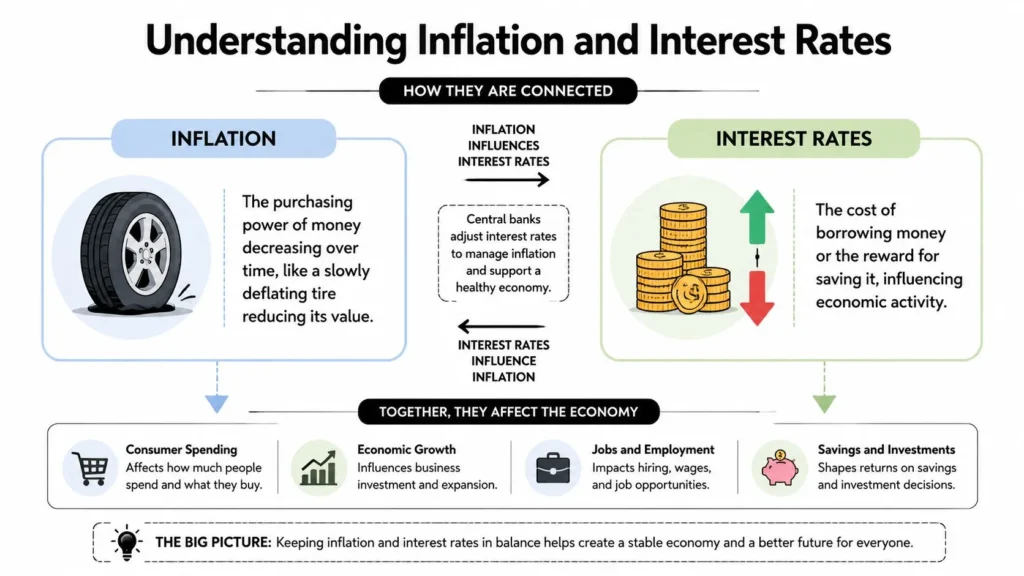
Inflation means the purchasing power of money falls over time. A simple way to think about it is a slowly leaking tire. The tire still works, but it doesn’t carry you as well as it did before. Money works the same way when prices rise. The same number of dollars buys fewer groceries, less gas, or less rent than it used to.
That’s why people notice inflation most in routine purchases. If your budget already feels tight, even small changes in everyday prices can force choices. You may put off buying shoes, eat out less, or skip replacing an old laptop.
What interest rates really mean
Interest rates are the price of renting money.
If you borrow money for a car, a house, or a credit card purchase, the interest rate is what you pay for the right to use that money now instead of later. If you save money in a bank account or buy a bond, the interest rate is what you earn for letting someone else use your money for a while.
A few everyday examples make this clearer:
- Borrowing: A higher interest rate usually means a higher monthly payment.
- Saving: A higher interest rate can mean your savings account grows faster.
- Investing: Interest rates affect bond prices, stock valuations, and how attractive cash looks.
Practical rule: Inflation tells you what money is losing in buying power. Interest rates tell you what borrowing costs and saving pays.
Why inflation isn’t always caused by the same thing
People often talk as if inflation has one simple cause. It doesn’t.
Sometimes inflation rises because people and businesses are spending strongly. Other times, prices rise because something disrupts supply, such as shipping problems or shortages in key sectors. Recent analysis argues that much of the 2022 to 2023 inflation spike reflected sectoral and supply-side shocks rather than broad excess demand, with CPI reaching 9.1% in June 2022, the highest in 40 years, according to Oliver Wyman’s discussion of post-pandemic inflation drivers.
That matters because interest rates are a powerful tool, but they can’t directly manufacture more goods, clear ports, or fix supply chains. They mainly work by changing how much people and businesses borrow, spend, and invest.
The Central Bank’s Balancing Act
A central bank, such as the Federal Reserve in the United States, acts like a driver trying to keep a car moving at a safe speed. If the economy is slowing too much, it may press the accelerator by lowering interest rates. If prices are rising too quickly, it may tap the brakes by raising them.
That’s the basic link between interest rates and inflation. Lower rates usually encourage borrowing and spending. Higher rates usually discourage them.
Pressing the accelerator
When rates are lower, people often feel more comfortable financing a car, buying a home, or expanding a business. That can lift demand across the economy.
For your wallet, lower rates can mean:
- Cheaper borrowing: Monthly payments may become easier to handle.
- More hiring confidence: Businesses may be more willing to expand.
- Higher spending: Families may feel freer to make big purchases.
That sounds good, but there’s a tradeoff. If spending grows faster than the economy’s ability to produce goods and services, prices can rise faster too.
Tapping the brakes
When rates go up, borrowing becomes more expensive. A mortgage payment looks larger. Credit card balances become more painful to carry. Businesses may delay opening a new location or buying equipment.
The central bank does this because slower spending can cool price pressure. But it’s a delicate move. If policymakers brake too gently, inflation may stay high. If they brake too hard, hiring can weaken and the economy can slip into recession.
The job isn’t to make life cheap overnight. The job is to slow the economy enough to reduce inflation without causing unnecessary damage.
Why this feels uneven in real life
The textbook story makes monetary policy look smooth and predictable. Real life is messier.
A rate increase doesn’t land on every household the same way. Someone with a fixed-rate mortgage might barely feel it right away. Someone carrying credit card debt or shopping for a first home may feel it immediately. A retiree living on savings may welcome higher deposit rates, while a small business owner seeking a loan may hate them.
So when people ask whether rate hikes are “working,” the honest answer is that they may work very differently depending on your debt, your income, your city, and the timing of your financial decisions.
How Rate Changes Ripple Through the Economy
A central bank doesn’t call your bank and tell it what to charge you for a car loan tomorrow morning. The process is more like a ripple moving across a pond. It starts at the policy level, then spreads through banks, loans, spending decisions, and finally the prices people see every day.

From central bank to household budget
Here’s the chain in plain language:
- The central bank changes a policy rate.
- Commercial banks face different funding conditions.
- Loan rates adjust across mortgages, auto loans, business loans, and credit cards.
- Households and businesses rethink what they can afford.
- Spending slows or speeds up.
- Price pressure changes over time.
This is why monetary policy often feels delayed. The decision happens first. The budget consequences show up gradually.
For a family, the first visible change is often borrowing cost. A higher mortgage rate can shrink what home buyers can afford. A higher credit card rate can turn a manageable balance into a stubborn one. A higher auto loan rate can push a buyer toward a cheaper car or delay the purchase entirely.
Businesses feel the ripple too
Businesses don’t just react to customer demand. They also react to financing costs.
If a company has to pay more to borrow, it may postpone buying machines, opening a store, or hiring workers. When enough firms make similar decisions, the whole economy cools. That can reduce inflation, but it can also reduce momentum.
Why one region can react differently from another
The practical aspects become more interesting. The link between interest rates and inflation isn’t uniform across regions.
In the UK, areas where house prices are less sensitive to interest rate changes see the impact on both borrowing and consumption cut by roughly half, according to NBER research on spending responses to interest rate movements. The same research notes that a 1 percentage-point rate cut raises house prices by about 6 percent in the average region, but the spending effect is much weaker where local house prices don’t react much.
That means two people can live in the same country and experience the same rate move very differently. In places where housing wealth responds strongly, people may borrow and spend more quickly when rates fall. In places where housing is less rate-sensitive, that boost is weaker.
A rate change is one policy. The lived experience depends on local housing markets, debt levels, and how exposed households are to borrowing costs.
A Historic Battle Against Inflation
The clearest historical lesson came during the Great Inflation in the United States. From 1965 to 1982, inflation changed how Americans thought about money, wages, prices, and the power of the central bank, according to the Federal Reserve’s history of the Great Inflation.
By 1980, U.S. inflation hit 14.6%, the highest on record in that period. People weren’t just annoyed by higher prices. They were living in an economy where price stability had broken down.
Volcker’s hard choice
Federal Reserve Chair Paul Volcker responded with a strategy that was painful and dramatic. He pushed the Federal Funds rate to a peak of 19 to 20%, the highest ever recorded by the Fed, as described in this overview of economic conditions and policy responses. The goal was clear. Break inflation, even if the short-term cost was severe.
That cost was real. The Fed’s aggressive tightening intentionally triggered a recession. Borrowing became brutally expensive. Unemployment rose. Many households and businesses suffered.
Why the episode still matters
The policy eventually restored price stability over time. Just as important, it restored credibility. People began to believe the Fed would act forcefully when inflation got out of hand.
That history still shapes modern central banking. Policymakers learned that if inflation expectations drift too far, bringing them back can require much harsher action later. For your future, that lesson matters because today’s interest-rate decisions are partly driven by what officials want to avoid repeating.
Distinguishing Between Nominal and Real Rates
A lot of people hear that savings rates are “up” and assume they’re coming out ahead. Sometimes they are. Sometimes they aren’t. The missing concept is the difference between nominal and real rates.
The headline number versus the useful number
The nominal rate is the number you see advertised. If a savings account pays 3%, that 3% is nominal.
The real rate adjusts for inflation. If your account pays 3% but prices rise 2% over the same period, your gain in actual purchasing power is only 1%. That’s the number that tells you whether your money is doing more work for future you.
Here’s a simple way to see it:
| Scenario | Nominal Interest Rate | Inflation Rate | Real Interest Rate | Ending Purchasing Power |
|---|---|---|---|---|
| Savings grows faster than prices | 3% | 2% | 1% | Higher |
| Savings only matches price growth | 3% | 3% | 0% | About unchanged |
| Savings lags inflation | 3% | 4% | -1% | Lower |
What current policy tells us
Historically, the Federal Funds rate has averaged 1.5 percentage points above GDP deflator inflation. As of Q1 2024, the spread was 2.2 percentage points, with the Federal Funds rate at 5.3% and GDP deflator inflation at 3.1%, showing tighter policy than the long-run average, according to Farmdoc Daily’s analysis of U.S. inflation and interest rates.
That doesn’t mean every saver is winning or every borrower is losing. It means policy, at that moment, was relatively restrictive compared with history.
Why investors watch TIPS
Treasury Inflation-Protected Securities, or TIPS, are designed to help with this problem. Their principal adjusts with the Consumer Price Index, so they aim to protect purchasing power more directly than a plain bond.
The key idea is simple. A normal bond pays based on a fixed principal amount. A TIPS bond adjusts that principal as inflation changes, so the investor’s return is tied more closely to real value rather than just the headline number.
What This Means for Your Household and Investments
Economic news matters most when it changes what you should do next. The practical effect of interest rates and inflation depends on whether you’re mainly a borrower, a saver, or an investor. Individuals are typically some mix of all three.
If you borrow money
Rising rates are hardest on people with variable or new debt. Credit cards, adjustable-rate loans, and fresh mortgage shopping become more expensive quickly.
A few practical habits matter here:
- Prioritize flexible debt first: Credit card balances can become heavier when rates stay high.
- Know your reset points: If a loan rate can change, check when and how.
- Value stability: Fixed-rate borrowing can provide peace of mind when rates are moving around.
If you’re trying to build a personal finance plan from scratch, a beginner-friendly guide to how to start investing money can also help you think about debt, cash reserves, and long-term goals together instead of treating them as separate problems.
If you save cash
Higher rates can be good news for savers, but only if you compare the return with inflation. A better savings rate doesn’t automatically mean your purchasing power is growing.
This is the question to ask: “After inflation, am I ahead?”
If your savings account earns more dollars but buys fewer groceries, the headline yield is flattering you.
That’s why comparing options matters. A checking account, high-yield savings account, certificate of deposit, money market fund, and short-term Treasury product can all behave differently in a changing rate environment.
If you invest for the long run
Investors have to think about both inflation risk and rate risk. Bonds can react strongly when rates change. Stocks can also struggle when borrowing gets expensive or when investors expect slower growth.
One tool designed specifically for inflation protection is TIPS. TreasuryDirect explains that a CPI-driven index ratio of 1.01165 would raise a $1,000 TIPS principal to $1,011.65, and interest is then calculated on that adjusted amount, as shown in TreasuryDirect’s explanation of TIPS CPI adjustments.
That doesn’t make TIPS perfect for every investor. It does show how some investments are built to protect your real return, not just your nominal one.
The uneven part people often miss
The same rate environment can create different winners and losers.
A homeowner with a locked fixed mortgage may feel protected. A first-time buyer may feel shut out. A retiree with cash savings may welcome better yields. A young family with credit card debt may feel squeezed. A region with rate-sensitive housing may react sharply, while another may barely move.
Understanding that uneven impact helps you avoid one of the biggest mistakes in personal finance. Don’t assume the national headline describes your exact situation.
Navigating a World of Changing Rates
You don’t need to predict every Fed meeting to make smarter decisions. You need a framework that keeps you grounded when headlines get loud.
Start with three habits.
First, look past the headline rate and ask about real purchasing power. That applies to your savings account, your paycheck, and any investment that promises income. The number that matters most is what your money can buy later.
Second, treat high-cost debt seriously when rates are high. Variable-rate balances can diminish future choices. Paying them down isn’t exciting, but it can be one of the clearest ways to improve your financial position.
Third, remember that monetary policy is uneven. National news gives you the broad weather map. Your own life depends on your shelter, your debt, your job, and your local housing market. The same storm feels different depending on where you stand.
If you’re building long-term financial habits, it helps to think in systems rather than headlines. The same mindset used in a guide on how to create a business plan applies here too. Define goals, understand risks, and make decisions that still make sense if conditions change.
The big lesson is simple. Interest rates and inflation are not abstract forces floating above your life. They show up in rent, loan payments, savings growth, and future opportunities. Once you understand that, economic news stops sounding like noise. It becomes something you can translate into action.
maxijournal.com publishes approachable writing across business, education, science, technology, health, arts, travel, entertainment, and more. If you enjoy clear explanations that connect big ideas to everyday life, visit the site for fresh articles, practical commentary, and opportunities to explore new topics as a reader or contributor.
Discover more from Maxi Journal
Subscribe to get the latest posts sent to your email.