An asteroid striking the ocean can create a tsunami from space far larger than an earthquake-generated wave. The Chicxulub impact, about 66 million years ago, shows the scale such an impact can reach. Solar storms, by contrast, do not directly generate tsunamis. Headlines can blur these distinct events, but a dramatic space story alone is no warning sign for the sea.
Three ideas often get squeezed into one phrase. A satellite image can show a tsunami without space causing it. A solar storm is not a splash that displaces ocean water. An asteroid impact, however, can move water physically, and the geological record preserves evidence of such events. Separating these cases makes claims about space and tsunamis easier to judge.
Which Space Scenarios Can Really Cause Tsunamis
A tsunami is a wave produced by a sudden, large displacement of water. Most come from undersea earthquakes, landslides, or volcanic collapse, because each of those events physically pushes or drops a volume of sea. Anything that can’t move water in that way can’t directly make a conventional tsunami.
That’s the test that separates a tsunami seen from space from a tsunami caused by something in space, a distinction Space.com’s explainer on solar storms and tsunamis makes when it notes that solar storms don’t directly produce conventional tsunamis because those waves require substantial displacement of the ocean. If you’re curious about exploration more broadly, fun facts about space exploration make a useful contrast, because human activity in orbit observes Earth far more often than it changes the oceans.
| Scenario | Mechanism | Scientific status | Verdict |
|---|---|---|---|
| Asteroid or comet impact into the ocean | Sudden displacement of water by the object’s energy | Confirmed in the geological record, for example the Chicxulub impact | Real, rare, and capable of very large waves |
| Solar storm | Charged particles and magnetic disturbance in near-Earth space | No known direct way to displace water; possible statistical links to earthquakes are not established as predictive | Does not directly create tsunamis |
| Satellite observation of an Earth-made tsunami | Sensors detect changes in the ocean surface or ionosphere after an earthquake or landslide | Established research and warning tool | Space observes the tsunami; space does not cause it |
Why Solar Storms Fail the Water Test
A solar storm disturbs charged particles and magnetic fields around Earth. It can interfere with satellites, radio signals, and power systems, but it doesn’t shove seawater aside. Researchers have examined possible statistical links between solar activity and earthquakes, yet nothing is established as a predictive mechanism you could use to forecast a wave.
Gravity causes a similar mix-up. The Moon and Sun raise regular ocean tides, which rise and fall on a predictable schedule. Tides aren’t tsunamis, and steady gravitational pull doesn’t create the sudden displacement a tsunami requires.
Reader test: When a headline says space caused a wave, ask which of the three scenarios it describes, what moved the water, and what evidence supports that claim.
Satellites belong in the third row, not the first. They can measure a passing wave, map damage afterward, and sometimes add warning time. They don’t start the wave.
Why Water Displacement Decides the Size of a Wave
Drop a pebble into a bathtub and the splash sloshes the whole tub. Drop the same pebble into a swimming pool and the ripple barely registers. The pebble didn’t change. The amount of water around it did, and that ratio is the heart of an impact tsunami.
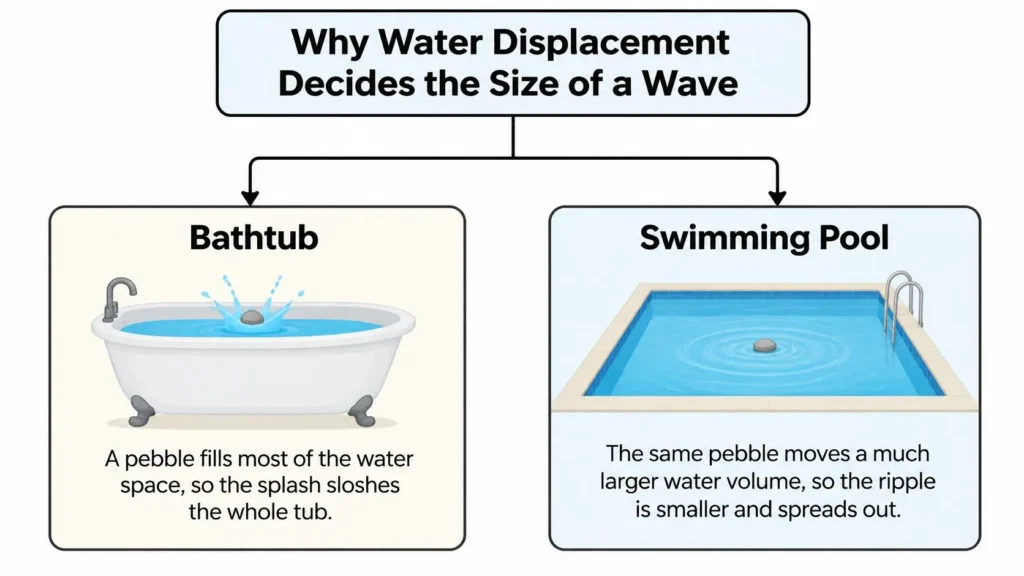
An ocean impact follows a simple chain. The object punches into the water, excavates a cavity, and forces water outward and upward. The cavity then collapses, and the displaced water radiates away as a series of waves.
The Factors That Set the Outcome
- Object diameter: A wider object displaces far more water, because volume grows quickly as size increases, so a modest increase in diameter can mean a much larger cavity.
- Impact velocity: A faster object carries far more energy, because kinetic energy rises with the square of speed. Double the speed and you quadruple the energy available to move water.
- Impact angle: A steep impact drives energy down into the water column, while a shallow angle spreads more energy along the surface and through the atmosphere.
- Water depth: Deep water can absorb and spread some of the disturbance, while a shallow sea gives the displaced water less room, so more of it piles into waves.
- Distance from the coast: Waves lose height as they spread across a basin, so an impact near populated shorelines leaves less room for that decay.
Shallow water matters twice. First, an impact in a shallow sea can displace a large share of the local water column. Second, as any tsunami reaches shallower water near land, it slows down and grows taller, which is why a wave that’s hard to notice in the open ocean can flood a harbor.
Why a Land Impact Tells a Different Story
Contrast that with an airburst over solid ground, such as the Tunguska event over Siberian forest. Energy released over trees can flatten vast areas, but without a body of water to displace, there’s no ocean wave. Medium matters as much as energy.
A tsunami is about how much water is moved and how fast, not how bright the impact looks.
So the scenario that produces the biggest waves isn’t mysterious. It’s a larger, faster object striking a shallow ocean near coastlines. Change any one of those ingredients and the wave changes with it.
The Chicxulub Impact and Its Giant Wave
About 66 million years ago, an asteroid struck shallow marine water near Mexico’s Yucatán Peninsula. The collision produced one of the most powerful tsunamis known from Earth’s history, with a wave that spread far beyond the impact site, according to the AGU account of the end-Cretaceous global tsunami. The asteroid was more than 6 miles (about 10 kilometers) wide, and its impact rapidly displaced enormous volumes of water. For a broader view of the planet’s much earlier history, Earth in the beginning traces an earlier chapter in the same long story.
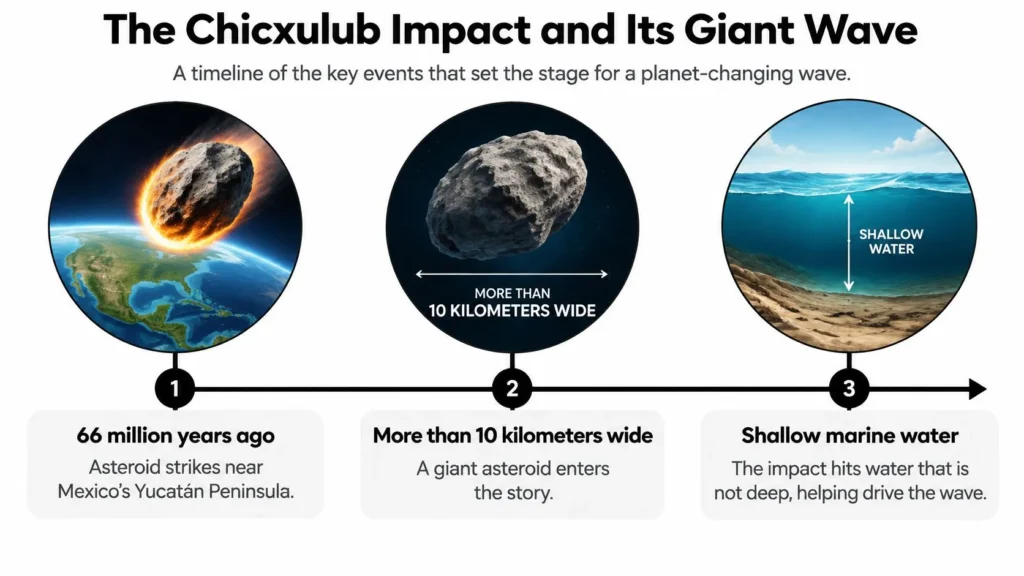
The First Minutes
Models put the initial wave at several kilometers high shortly after impact, an extreme peak near the source that fell rapidly as the disturbance spread outward. As the wave expanded, its energy was distributed across a widening area of water, reducing its height. The AGU report on the modeled end-Cretaceous tsunami describes a global event whose peak reached about a mile high.
Around 10 minutes after the collision, a ring-shaped wave approximately 1.5 kilometers (0.93 miles) high was modeled about 220 kilometers (137 miles) from the impact site. That ring was not a single wall of water. It was an expanding circle, growing wider while losing height as it moved away from the source.
The two measurements describe different stages of the same event. The first captures an extreme near the impact; the second shows how much the wave had spread within minutes. A headline that gives only the first can make it sound as though the whole ocean remained that tall.
Reading the Evidence in Rock
No one witnessed the event directly. Researchers instead identified tsunami evidence at 120 geological sites, including locations as distant as present-day New Zealand. Deposits across widely separated places point to an event much larger than a local flood.
Scientists examine sediment layers for signs of powerful water movement. Coarse material deposited where fine sediment normally settles, disrupted layers, and other unusual deposits can preserve evidence of a passing wave. Any single site may be difficult to interpret, but a pattern across many sites, considered alongside numerical models, supports the case for a far-reaching tsunami.
What the evidence proves: An asteroid striking an ocean or shallow sea can create a tsunami far larger than modern earthquake-generated tsunamis, with effects extending across ocean basins.
Chicxulub shows what can happen when a very large asteroid strikes water under these conditions. The impact transformed a regional collision into an event whose effects reached across the oceans. It does not mean every asteroid creates a giant wave. The evidence supports the mechanism at its extreme, for an object of this size striking water.
How an Impact Wave Travels and Hits Distant Coasts
The first splash is not the whole tsunami. What matters for distant shores is how the wave spreads through ocean basins, how high it remains, and how forcefully water moves when it reaches the coast. The Chicxulub impact tsunami was estimated to be up to 30,000 times more energetic than the Indian Ocean tsunami of 26 December 2004, according to the NOAA-hosted global simulation study. That comparison uses one of the largest tsunamis in the modern historical record as a measuring stick.
| Time or distance | Modeled behaviour | What it means for coasts |
|---|---|---|
| Within about 1 hour | Wave moves from the Gulf of Mexico into the Atlantic; open-ocean heights in the Gulf exceed 300 meters | Nearby shorelines face the largest waves |
| About 4 hours | Wave enters the Pacific through the Central American seaway | Distant ocean basins receive the wave with reduced height |
| At least 24 hours | Wave keeps circulating through the world’s oceans | Multi-day wave activity across basins |
| North Atlantic and South Pacific coastlines | Modeled wave heights above 10 meters | Major coastal flooding risk despite distance |
| Beyond 10,000 km | Velocities above 20 cm per second along shorelines | Seafloor scouring and disturbed marine sediments |
Height Falls, but the Hazard Doesn’t Vanish
The modeled wave spread from the Gulf of Mexico into the Atlantic within about 1 hour, then entered the Pacific through the Central American seaway after approximately 4 hours. In the Gulf, open-ocean heights exceeded 300 meters (984 feet) roughly an hour after impact. As the wave crossed ocean basins, its height fell, but the remaining waves could still threaten distant coasts.
In the North Atlantic and South Pacific, modeled waves reached coastlines at heights exceeding 10 meters (33 feet). At a low-lying coast, water arriving at that height could cause major flooding. Distance weakens a wave; it does not automatically make the coast safe.
Why Current Speed Matters as Much as Height
Height is only one part of a tsunami’s force. Simulated offshore flow velocities exceeded 1 meter per second in several regions, while velocities above 20 centimeters per second occurred along shorelines worldwide. More than 10,000 kilometers from the impact, those currents could scour the seafloor and disturb marine sediments.
Fast-moving water picks up and carries sediment, then deposits it elsewhere. Those changes can remain in the geological record, giving researchers evidence of how far powerful water traveled. The wave’s height describes one hazard; its currents help explain both coastal damage and the sediment left behind.
The 2004 Indian Ocean tsunami was among the deadliest in modern history. Chicxulub occurred long before humans existed and was linked to a major mass extinction through the impact’s wider effects, not the wave alone. These events differ in scale and context, but both show why a tsunami’s reach and force matter beyond the place where it begins.
How Often Space Impacts Could Trigger Ocean Waves
Geography loads the dice toward water. Oceans cover most of Earth’s surface, so by area alone, a random impact is more likely to hit water than land. That doesn’t make a giant ocean impact likely in your lifetime. It means that when a large object does arrive, water is the probable target.
Frequency and size work against each other. Small objects arrive often and usually do limited damage. Large objects arrive rarely and can affect whole ocean basins. The table below uses order-of-magnitude estimates from near-Earth object population models, which means the intervals are rough scales, not precise forecasts.
| Object size | Approximate impact interval | Ocean tsunami potential |
|---|---|---|
| About 140 m | Order of 10,000 years | Regional coastal waves if it strikes near shore |
| About 1 km | Order of hundreds of thousands of years | Waves that could affect an entire ocean region |
| About 10 km (Chicxulub class) | Order of 100 million years | Ocean-basin-scale waves, as the Chicxulub record shows |
Reading the Size Bands
At the smallest end of this table, an object of about 140 meters striking near a shore could produce damaging regional waves. Location decides much of the outcome. The same object landing in the middle of a deep ocean gives its waves far more distance over which to fade.
An object of about 1 kilometer moves the problem up a category. An ocean strike at that scale could generate waves affecting an entire ocean region, reaching multiple coastlines. Events in this band are the ones that shape serious planetary defense planning, because the consequences cross borders.
The 10 kilometer band is the Chicxulub class, arriving on timescales of roughly a hundred million years. You don’t plan your week around it. Scientists still study it because it defines what the mechanism can do at its extreme, and it anchors models used for smaller, more plausible objects.
Objects well below the table’s first row usually break apart in the atmosphere. They can still cause local damage from an airburst, but they rarely deliver a coherent punch to the ocean surface. That’s why size sorting matters before wave modeling begins.
The Detection Gap
Most large near-Earth objects are catalogued, which is good news, because they’re the ones capable of basin-scale waves. Many smaller objects aren’t catalogued, so they could arrive with little warning. Their saving grace is that their tsunami potential is more local.
Planning perspective: The risk is a low-probability, high-consequence tail, so effort concentrates on finding the large objects early enough to act.
How Satellites and Asteroid Surveys Spot the Danger
A satellite that sees a tsunami is not seeing one arrive from space. Space surveys look for asteroids before impact; Earth-observing satellites can detect or study waves that an earthquake or another event has already set in motion. These are separate jobs, and neither tool does both.
Ground telescopes scan the sky repeatedly, tracking near-Earth objects as they move. The image below shows an observatory of the kind used for this patient search.
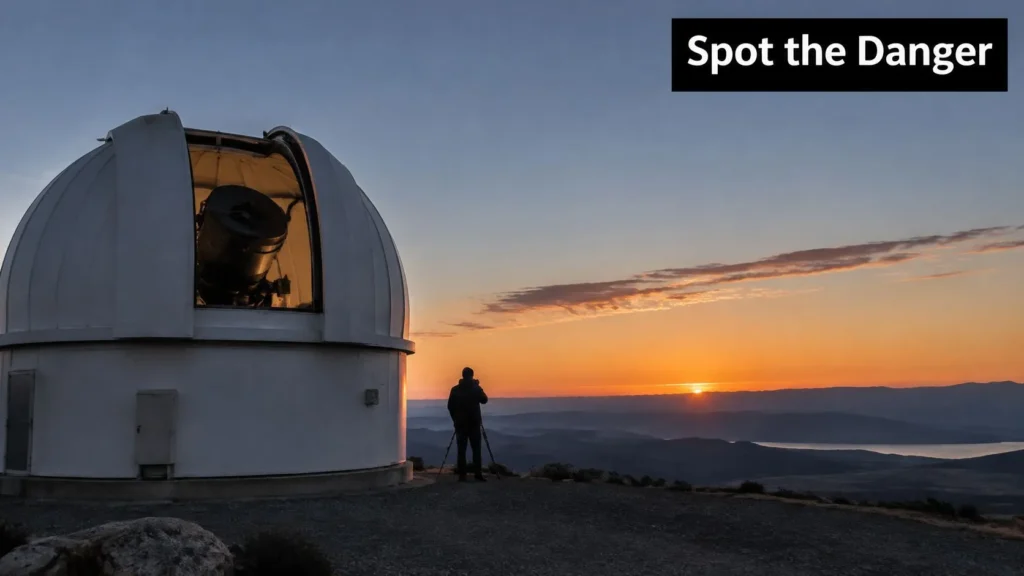
Large objects may be found years or decades ahead, leaving time to consider deflection or evacuation planning. Smaller objects can be detected only days or hours before reaching the atmosphere, or not detected beforehand. In general, warning time falls as object size decreases, while the danger from an individual object also tends to be smaller.
Detecting a Wave Already in Motion
Satellites can help detect a tsunami, but their signals do not mean that space weather caused the wave. NASA’s experimental GUARDIAN system identified ionospheric disturbances associated with a tsunami and flagged an incoming wave near Kauai about 32 minutes before coastal tide gauges detected it, according to NASA’s account of GUARDIAN catching a tsunami. The ionosphere can carry clues about a wave below; it is not the source of the tsunami.
This video shows how satellite-based detection fits into the broader warning process.
The SWOT satellite serves a different purpose. It imaged a tsunami shortly after the earthquake, capturing its leading crest and shorter waves behind it. Those observations helped researchers infer details about shallow earthquake slip near the trench. That is useful for understanding how a tsunami forms, but it is not the same as a real-time alert system. A satellite can observe a wave only when its path and timing bring it over the right place.
Coverage and interpretation also have limits. False alarms must be controlled, and small or landslide-generated tsunamis may not be captured. Satellite observations therefore work alongside buoys, tide gauges, and evacuation authorities. Available lead time depends on the event, satellite passes, processing speed, and distance to the coast.
Asteroid surveys assess a possible impact before it happens. Satellites help detect or observe a tsunami after an Earth event has created it. Neither role makes space weather a direct cause of ocean waves.
What to Do When a Tsunami Warning Sounds
The best defense against an impact tsunami is preventing the impact, but that only works when an object is detected early enough. NASA’s DART mission deliberately struck the moonlet Dimorphos and shortened its orbit, demonstrating that a kinetic impactor can shift an object’s path. For a short-notice threat, there may be no time to intervene. Warning and evacuation are the protection people can act on.
Coastal venues, schools, and workplaces can prepare routes and assembly points through emergency evacuation planning for venues. At home, the same principle applies: choose your route in advance, so you can move without debating when an alert arrives.
Steps to Take
- Learn your route first: Before a warning, find your coast’s evacuation route and a location on high ground. You may not have time to look them up once danger is near.
- Move on shaking: If strong shaking occurs near the coast, go inland or uphill without waiting for an official message. An earthquake-generated tsunami can arrive within minutes.
- Treat warnings as instructions: Leave the hazard zone when authorities issue an official warning, including one informed by satellite detection. Confirmation may come too late to leave safely if you wait.
- Don’t watch the water: Do not wait for the sea to recede. That change can signal an approaching wave, and the water may then surge inland.
- Stay away until cleared: Remain away from the coast until authorities give the all-clear. Tsunamis arrive in a series over hours, and later waves can be larger.
An impact tsunami has an important difference: there would be no shaking warning, because no earthquake ruptured beneath you. You would depend on official alerts, so knowing your route before a headline appears matters.
If you enjoy science stories that separate evidence from dramatic headlines, maxijournal.com publishes daily writing across science, technology, and other topics for curious readers. Visit maxijournal.com to keep exploring questions like this one, from asteroid impacts to the satellites watching our oceans, and find fresh articles whenever you want your next good read.
Discover more from Maxi Journal
Subscribe to get the latest posts sent to your email.