In our fast-paced world, stress has become a constant companion for many. It silently chips away at our well-being, manifesting as tight shoulders, racing thoughts, and sleepless nights. While the sources of stress are endless, a powerful antidote exists that requires nothing more than a small space and your own body: yoga. This isn’t about achieving pretzel-like flexibility; it’s about intentional movement and breath.
This article explores 8 specific yoga poses for stress relief, each a scientifically-backed tool to shift your nervous system from a state of ‘fight-or-flight’ to ‘rest-and-digest’. We will delve into how these poses work on a physiological level to lower cortisol, slow your heart rate, and bring profound calm. Each entry is designed to be a mini-masterclass, complete with detailed instructions, modifications for every body type, and tips for integrating them into your busiest days. Prepare to transform your relationship with stress, one pose at a time.
1. Child’s Pose (Balasana): The Instant Grounding Pose
Child’s Pose, or Balasana, is a cornerstone of many yoga practices for good reason. It’s a gentle, restorative posture that offers an immediate sense of safety and calm, making it one of the most effective yoga poses for stress relief. By folding the body forward and bringing your head toward the earth, you create a cocoon-like space that encourages introspection and quiets the mind. This position naturally soothes the central nervous system, helping to dial down your body’s “fight or flight” response.
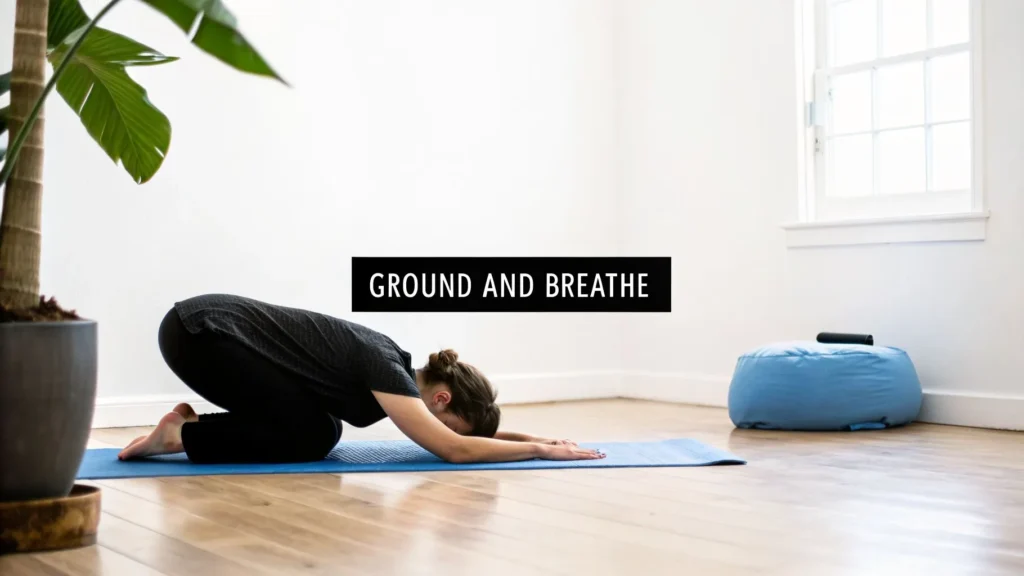
The pose works by physically compressing the front of the body, which encourages deep, diaphragmatic breathing into the back and sides of the ribs. This type of breath is scientifically linked to activating the parasympathetic nervous system, responsible for the “rest and digest” state.
Why It Works for Stress: When you rest your forehead on the mat, you apply gentle pressure to the area between your eyebrows, sometimes called the “third eye.” This point is associated with soothing the mind and relieving tension in the forehead and scalp.
How to Practice Balasana
- Start on all fours: Begin on your hands and knees in a tabletop position.
- Bring your toes together: Touch your big toes together and spread your knees wide, about as wide as your yoga mat. For a more restorative version, you can keep your knees together.
- Fold forward: Exhale and slowly lower your torso between your thighs. Rest your forehead on the mat.
- Position your arms: You can either stretch your arms forward with palms down for a gentle shoulder stretch or rest them alongside your body with palms facing up.
- Breathe and hold: Stay in the pose for at least five deep breaths, feeling your back expand with each inhale and softening with each exhale.
Modifications and Tips
- For Tight Hips: Place a rolled-up blanket or bolster between your thighs and calves to reduce the deep knee flexion.
- Forehead Support: If your forehead doesn’t comfortably reach the floor, rest it on a yoga block or a stack of books to keep your neck long.
- Quick Reset: Use this pose for a 60-second mental reset during a stressful workday. The forward fold can help lower cortisol and bring you back to a state of calm.
2. Legs-Up-The-Wall Pose (Viparita Karani): The Ultimate Passive Rest
Legs-Up-The-Wall, or Viparita Karani, is a deeply restorative inversion that offers profound stress relief with minimal effort. This passive pose is celebrated for its ability to calm the nervous system and promote a state of deep relaxation. By elevating the legs above the heart, you gently reverse the effects of gravity on the body, encouraging venous drainage from the legs and facilitating a decrease in heart rate, which signals to your brain that it’s safe to rest.
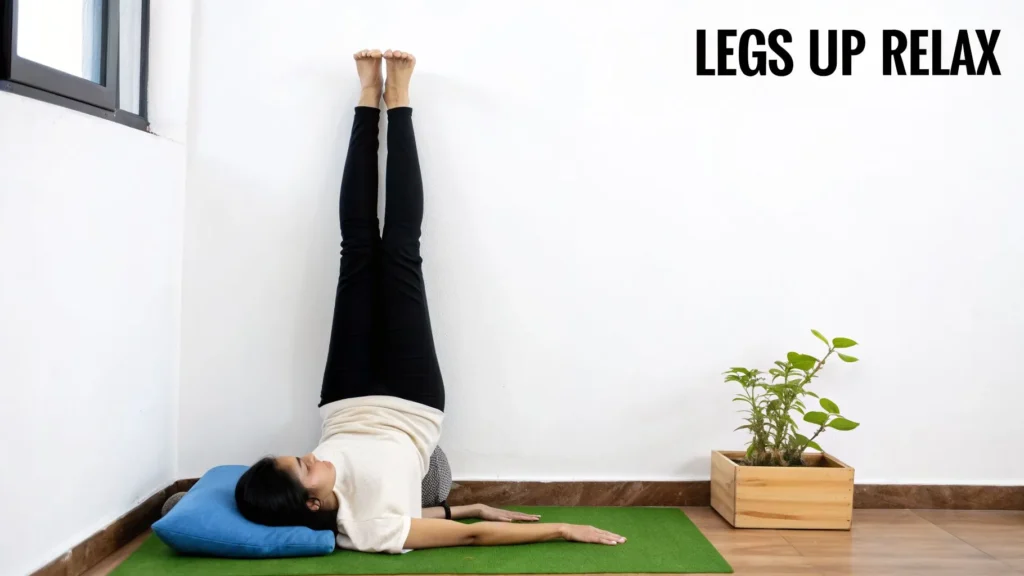
The pose is so effective it is often recommended by sleep clinics as a natural aid for insomnia and used in corporate wellness programs for a midday mental reset. It effectively quiets the mind, relieves tired legs and feet, and is one of the most accessible yoga poses for stress relief available to all levels.
Why It Works for Stress: This gentle inversion helps trigger the parasympathetic nervous system, responsible for the body’s “rest and digest” mode. By calming the nervous system, it can help lower cortisol levels and reduce the physiological symptoms of stress, like a racing heart or shallow breathing.
How to Practice Viparita Karani
- Set up near a wall: Place a folded blanket or bolster on the floor about 5-6 inches away from a clear wall.
- Sit beside the wall: Sit on one end of your support, with your side against the wall.
- Swing your legs up: In one fluid motion, lie back onto your support and swing your legs up the wall. Your sitting bones should be as close to the wall as is comfortable.
- Settle into the pose: Rest your head and shoulders on the floor. Let your arms rest open to the sides with palms facing up, allowing your chest to broaden.
- Breathe and hold: Close your eyes and breathe deeply. Remain in the pose for 5 to 15 minutes. To come out, gently bend your knees and roll to one side.
Modifications and Tips
- For Tight Hamstrings: Move your hips further away from the wall to decrease the intensity of the stretch.
- Lower Back Support: Place a folded blanket or pillow under your hips to elevate them slightly, which can feel more comfortable and increase the restorative benefits.
- Secure Your Legs: If your legs tend to splay apart, loosely loop a yoga strap around your mid-thighs to hold them together without effort.
- Bedtime Routine: Practice this pose in bed with your legs up the headboard for a few minutes before sleep to help calm your mind and body.
3. Downward-Facing Dog (Adho Mukha Svanasana): The Full-Body Reset
Downward-Facing Dog, or Adho Mukha Svanasana, is one of yoga’s most recognizable poses, celebrated for its dual ability to invigorate the body and soothe the mind. As a mild inversion, it gently reverses blood flow, bringing fresh oxygen to the brain, which can help calm anxiety and relieve mild depression. This foundational pose is a cornerstone of many yoga practices and stands out as one of the most effective yoga poses for stress relief by releasing accumulated tension in the neck, shoulders, and back.
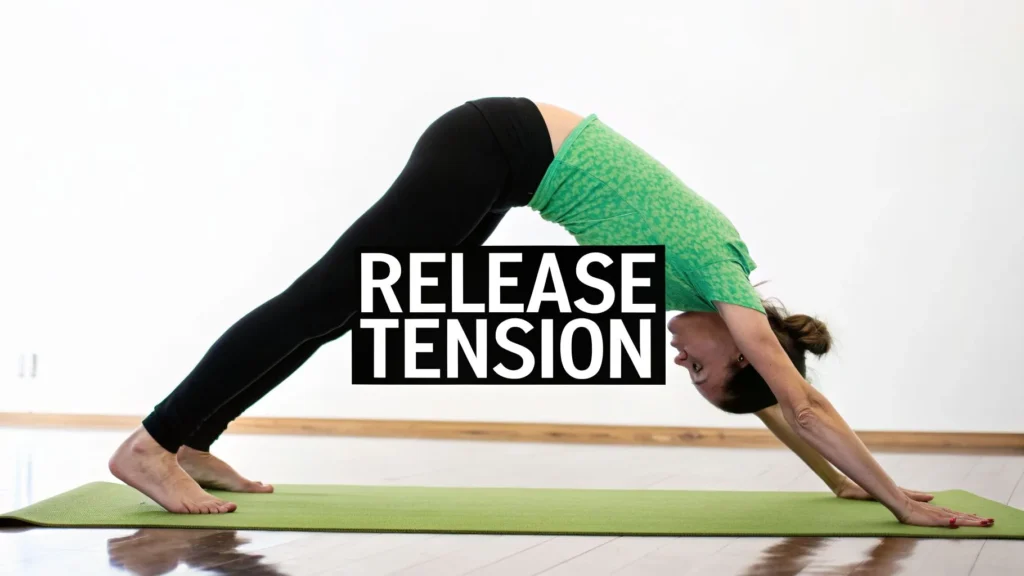
The pose creates a long line of energy from your hands to your hips, stretching the entire backside of the body, including the hamstrings, calves, and spine. This full-body lengthening helps counteract the effects of prolonged sitting, making it a favorite in office yoga classes for midday relief.
Why It Works for Stress: By positioning your head below your heart, Downward-Facing Dog encourages a calming effect on the nervous system. The physical effort required also draws your focus inward, creating a moving meditation that interrupts cycles of stressful thoughts.
How to Practice Adho Mukha Svanasana
- Start on all fours: Begin in a tabletop position with your wrists under your shoulders and knees under your hips.
- Lift your hips: Tuck your toes, press firmly into your hands, and lift your hips up and back, forming an inverted ‘V’ shape with your body.
- Ground and lengthen: Spread your fingers wide and press the mat away from you. Keep your head between your upper arms, looking toward your thighs.
- Engage your body: Actively draw your navel toward your spine and continue to lift your hips high, lengthening your torso.
- Breathe and hold: Stay in the pose for five to ten deep breaths. Feel the stretch in your hamstrings and the strength in your arms and shoulders.
Modifications and Tips
- For Tight Hamstrings: Generously bend your knees. The priority is a long, straight spine, not straight legs. “Pedal” your feet by bending one knee and then the other to gently open your hamstrings.
- Wrist Support: If you feel strain in your wrists, place yoga blocks under your hands to reduce the angle of extension.
- Immediate Grounding: Use this pose as a quick reset during a stressful moment. Holding it for even 30 seconds can help you feel more centered and clear-headed. For those new to movement, exploring some fitness tips for beginners can help build the foundational strength needed for this pose.
4. Corpse Pose (Savasana): The Art of Conscious Relaxation
Corpse Pose, or Savasana, is the essential conclusion to nearly every yoga practice and is arguably the most important of all yoga poses for stress relief. While it appears to be just lying down, Savasana is an active state of conscious relaxation where the body and mind fully absorb the benefits of the preceding postures. It allows your nervous system to downshift from an active state to one of deep rest, facilitating a profound release of accumulated physical and mental tension.
This pose is so effective that it’s used beyond the yoga mat. For instance, adapted versions are incorporated by the military to help with PTSD recovery, and hospitals integrate guided Savasana into patient care protocols to promote healing and reduce anxiety.
Why It Works for Stress: Savasana teaches the body to let go completely. By systematically relaxing every muscle, you send a powerful signal to your brain to exit the “fight or flight” mode and enter the parasympathetic “rest and digest” state. This lowers cortisol levels, slows the heart rate, and calms the mind.
How to Practice Savasana
- Lie down comfortably: Gently lie on your back. If you need to, use your hands to support your descent to the floor.
- Position your body: Let your feet fall open naturally, about hip-width apart or wider. Allow your arms to rest alongside your body, a few inches away from your torso, with your palms facing up as a gesture of receptivity.
- Find alignment: Make small adjustments to ensure your body is symmetrical and comfortable. Your head should be centered and your spine long.
- Close your eyes and release: Gently close your eyes and let go of controlling your breath. Allow your body to feel heavy and completely supported by the floor beneath you.
- Rest and hold: Stay here for at least 5-10 minutes. The goal is to remain still and aware without drifting into sleep.
Modifications and Tips
- For Spinal Support: Place a rolled blanket or bolster under your knees to release any tension in your lower back. A small, flat pillow under your head can also support the natural curve of your neck.
- Deepen Relaxation: Use an eye pillow or a light scarf over your eyes to block out light and encourage your facial muscles to soften.
- Stay Warm: Your body temperature can drop during deep relaxation, so cover yourself with a light blanket to stay comfortable.
- Commit to the Pose: Don’t skip Savasana, even if you are short on time. A few minutes of intentional rest is more restorative than none. As part of a larger wellness routine, integrating such practices is one of many powerful mental health self-care tips.
- Practice Gratitude: While resting, you can bring to mind things you are grateful for or repeat a positive affirmation to enhance the emotional benefits.
5. Cat-Cow Stretch (Marjaryasana-Bitilasana): The Rhythmic Stress Melter
Cat-Cow Stretch, a dynamic flow between two poses, is a foundational element in yoga recognized for its ability to create a moving meditation. The gentle, fluid transition between Marjaryasana (Cat Pose) and Bitilasana (Cow Pose) synchronizes movement with breath, making it one of the most accessible yet profound yoga poses for stress relief. This sequence gently massages the spine and abdominal organs, releasing tension stored in the back, neck, and shoulders.
The rhythmic nature of the movement has a powerful calming effect on the mind. By linking each inhale to an arch (Cow) and each exhale to a round (Cat), you establish a steady pace that helps regulate the nervous system. This mindful repetition draws your focus inward, away from external stressors, and encourages a state of relaxed awareness. It’s often recommended in physical therapy for improving spinal mobility and alleviating back pain.
Why It Works for Stress: The synchronized movement and breath in Cat-Cow directly stimulate the vagus nerve. Flexing and extending the spine creates a gentle “pumping” action that activates the parasympathetic nervous system, guiding your body out of a high-alert state and into a condition of rest and calm.
How to Practice Marjaryasana-Bitilasana
- Start on all fours: Begin in a tabletop position with your wrists directly under your shoulders and your knees under your hips.
- Inhale into Cow Pose: As you inhale, drop your belly toward the mat. Lift your chest and chin, and gaze gently upward, creating a gentle arch in your spine.
- Exhale into Cat Pose: As you exhale, press firmly into your hands and round your spine toward the ceiling. Tuck your chin to your chest and release your neck.
- Create a flow: Continue flowing between Cow Pose on the inhales and Cat Pose on the exhales, moving with your own breath.
- Breathe and hold: Repeat the sequence for 5-10 breath cycles, focusing on the sensation of your spine moving and lengthening.
Modifications and Tips
- Protect Your Wrists: If you have sensitive wrists, place your hands on fists with your knuckles on the mat or use yoga wedges.
- Knee Comfort: Place a folded blanket or towel under your knees for extra cushioning and support.
- Morning Ritual: Practice this sequence for a few minutes right after waking up to gently awaken the spine and set a calm tone for the day.
- Office Break: Use a sturdy chair to perform a seated version of Cat-Cow during your workday to quickly release tension from your back and shoulders.
6. Seated Forward Fold (Paschimottanasana): The Surrender Pose
Seated Forward Fold, or Paschimottanasana, is a fundamental pose that encourages introspection and physical release. This deep stretch for the entire back of the body, from the heels to the neck, is one of the most effective yoga poses for stress relief because it calms the mind as it lengthens the muscles. By folding your torso over your legs, you create a quiet, contained space that helps turn your focus inward and away from external stressors. This action gently stimulates the internal organs and soothes the nervous system.
The pose works by lowering the head below the level of the heart, an inversion that can trigger the parasympathetic nervous system’s “rest and digest” response. This helps slow your heart rate and encourages deep, restorative breathing into your back body, releasing tension held in the spine and shoulders. Many yoga classes end with this pose to promote a feeling of surrender and peace.
Why It Works for Stress: Paschimottanasana physically releases tension in the hamstrings and lower back, areas where many people hold stress. This physical release sends a signal to the brain to let go of mental and emotional tension, making it a powerful tool for processing anxiety.
How to Practice Paschimottanasana
- Start in a seated position: Sit on the floor or your mat with your legs extended straight out in front of you. Sit tall on your sitting bones, lengthening your spine.
- Engage your legs: Flex your feet, pressing your heels away from you and drawing your toes back toward your shins.
- Hinge and fold: Inhale to lengthen your spine, and as you exhale, hinge forward from your hips, not your waist. Keep your back as straight as possible initially.
- Reach and soften: Reach for your feet, shins, or ankles. Once you’ve gone as far as you can with a straight back, allow your spine to round and your head to hang heavy.
- Breathe and hold: Stay in the pose for at least five deep breaths. With each inhale, imagine creating length in your spine; with each exhale, allow yourself to soften deeper into the fold.
Modifications and Tips
- For Tight Hamstrings: Bend your knees generously. The goal is to release the lower back, not to force straight legs. You can rest your belly on your thighs.
- Use Props for Support: Place a folded blanket or bolster under your sitting bones to help you tilt your pelvis forward. You can also place a yoga strap around the balls of your feet to gently guide yourself into the fold without straining.
- Warm-Up First: This pose is best practiced when your muscles are warm, such as after a few rounds of Sun Salutations or at the end of your yoga practice.
- Focus on Breath: Never force the stretch. Instead, use your breath to ease into the pose. Imagine your inhales creating space in your back body and your exhales releasing you further into the fold.
7. Supported Reclining Butterfly Pose (Supta Baddha Konasana): The Ultimate Surrender
Supported Reclining Butterfly Pose, or Supta Baddha Konasana, is a deeply restorative posture that offers a profound sense of release and openness. By using props to fully support the body, it allows you to completely surrender to gravity, eliminating muscular effort and signaling to your nervous system that it is safe to rest. This makes it an incredibly powerful yoga pose for stress relief, especially when dealing with accumulated tension in the hips and chest.
The pose gently opens the groin, inner thighs, and front of the pelvis, areas where we often store emotional stress. Supporting the spine allows the chest and heart to expand, encouraging deeper, more relaxed breathing and creating a feeling of emotional and physical spaciousness. This passive opening is key to its calming effect.
Why It Works for Stress: This pose physically unwinds tension from the hips and opens the heart center. This combination can facilitate emotional release in a safe, supported environment, making it a cornerstone of trauma-informed yoga and programs for anxiety.
How to Practice Supta Baddha Konasana
- Set up your props: Place a yoga bolster or a stack of firm pillows lengthwise behind you. Sit on the floor with your lower back touching the end of the bolster.
- Create the butterfly shape: Bring the soles of your feet together and let your knees fall out to the sides, creating a diamond shape with your legs.
- Recline slowly: Gently lower your back down onto the bolster, ensuring your spine and head are fully supported. You may want a small pillow under your head for extra comfort.
- Position your arms: Let your arms rest comfortably out to your sides with your palms facing up, allowing your shoulders to relax.
- Breathe and hold: Close your eyes and stay here for 5 to 15 minutes. Focus on the sensation of your belly rising and falling with each breath, allowing your body to feel heavy and relaxed.
Modifications and Tips
- For Tight Hips: If the stretch in your inner thighs is too intense, place yoga blocks or rolled blankets under your outer knees for support.
- Emotional Release: This pose can sometimes bring emotions to the surface. Allow them to arise without judgment. Consider having a journal nearby to write down any feelings or thoughts that come up afterward.
- Evening Ritual: Practice this pose in the evening to help your body and mind transition from the day’s activities into a state of rest before sleep.
8. Breath Awareness in Mountain Pose (Pranayama in Tadasana)
While not a complex contortion, the simple act of standing with intention and breathing deeply in Tadasana, or Mountain Pose, is one of the most accessible and profound yoga poses for stress relief. This practice combines the grounding stability of a strong standing posture with the nervous system regulation of pranayama (conscious breathing). It teaches you to find stillness and calm amidst the chaos of daily life, making it a powerful tool you can use anywhere, anytime.
The genius of this practice lies in its portability and subtlety. It can be done in a corporate boardroom before a major presentation or in a hospital to manage patient anxiety. By focusing on the breath while standing tall, you interrupt the body’s stress response cycle, activating the parasympathetic nervous system and bringing a sense of immediate focus and peace.
Why It Works for Stress: Consciously slowing your exhale sends a direct signal to your brain to calm down. When you extend your exhalation to be longer than your inhalation, you stimulate the vagus nerve, which helps regulate heart rate, digestion, and mood, effectively switching your body from a state of stress to one of rest.
How to Practice Pranayama in Tadasana
- Find your stance: Stand with your feet either together or hip-width apart. Distribute your weight evenly across both feet, feeling all four corners of each foot rooting into the ground.
- Align your body: Gently engage your thigh muscles and tuck your tailbone slightly. Lengthen your spine, roll your shoulders back and down, and let your arms rest by your sides with palms facing forward.
- Begin the breath: Close your eyes or soften your gaze. Start by simply noticing your natural breath.
- Introduce the pattern: Begin a 4-4-6 breath. Inhale through your nose for a count of four, hold the breath gently for a count of four, and then exhale slowly through your nose or mouth for a count of six.
- Breathe and hold: Continue this breathing pattern for at least one to three minutes, focusing on the sensation of the breath moving through your body and the feeling of the ground beneath your feet.
Modifications and Tips
- Set the Tone: Practice for a few minutes each morning to establish a calm foundation for your day.
- Comforting Gesture: Place a hand on your heart or belly to feel the rise and fall with each breath, which can be a comforting physical anchor.
- Add a Mantra: Pair your breath with a positive affirmation, such as inhaling “I am calm” and exhaling “I release tension.”
- Stressful Moments: Use this technique for an instant reset during a difficult meeting or a stressful commute. No one will even know you’re doing it. For more ways to integrate mindfulness, you can learn how to meditate for stress relief.
Stress-Relief Yoga: 8-Pose Comparison
| Pose | Implementation Complexity | Resource Requirements | Expected Outcomes | Ideal Use Cases | Key Advantages |
|---|---|---|---|---|---|
| Child’s Pose (Balasana) | Low — simple alignment, minimal guidance | Yoga mat; block or pillow optional | Activates parasympathetic system, lowers cortisol, calms anxiety; gentle lower‑back/hip stretch | Quick office or home stress relief; beginners; pregnancy (modified) | Extremely accessible, deeply calming, easily modified |
| Legs‑Up‑The‑Wall (Viparita Karani) | Very low — passive inversion | Wall space; mat; pillow/head support optional | Reverses fight‑or‑flight, reduces cortisol, improves circulation and lymphatic drainage | Evening wind‑down, recovery after workouts, insomnia relief | Passive, restorative, circulation and swelling reduction |
| Downward‑Facing Dog (Adho Mukha Svanasana) | Moderate — requires basic strength and alignment | Mat; blocks optional for modifications | Increases circulation and endorphins, relieves neck/shoulder tension, grounds anxiety | Flow classes, midday tension relief, grounding during stress | Full‑body stretch + strength, improves focus and mobility |
| Corpse Pose (Savasana) | Low (mentally demanding to relax fully) | Mat; bolster/eye pillow optional for comfort | Deepest parasympathetic activation; lowers heart rate/BP; emotional integration | End of practice, sleep preparation, clinical relaxation protocols | Minimal effort, strong physiological relaxation, widely accessible |
| Cat‑Cow (Marjaryasana‑Bitilasana) | Very low — rhythmic movement with breath | Mat | Synchronizes breath and movement, mobilizes spine, reduces accumulated tension | Warm‑ups, office breaks, spinal mobility routines | Breath‑awareness builder; gentle, safe for most bodies |
| Seated Forward Fold (Paschimottanasana) | Low–Moderate — needs hip/hamstring care | Mat; bolster or strap optional | Calming inversion effect, stretches posterior chain, promotes introspection | Cool‑down, flexibility work, anxiety processing | Meditative, deep posterior stretch, easily modified |
| Supported Reclining Butterfly (Supta Baddha Konasana) | Low — requires careful prop setup | Bolster, pillows, blankets | Deep parasympathetic activation; opens hips/chest; emotional release and safety | Restorative classes, trauma‑informed therapy, deep relaxation | Extremely restorative, supports emotional healing and surrender |
| Breath Awareness in Mountain Pose (Tadasana Pranayama) | Low — requires mental focus and timing | None; can use chair if needed | Immediate heart‑rate and BP reduction; interrupts anxious thought cycles | Anywhere: before meetings, during commutes, acute anxiety moments | Portable, no equipment, fast, scalable with practice |
Integrating Calm: Your Path Forward with Yoga
You now possess a practical toolkit of eight distinct yoga poses for stress relief, each one a unique invitation to reconnect with your body and quiet your mind. We’ve explored the grounding comfort of Child’s Pose (Balasana), the restorative reset of Legs-Up-The-Wall (Viparita Karani), and the full-body release found in Downward-Facing Dog (Adho Mukha Svanasana). Each pose serves a purpose, from the complete surrender of Corpse Pose (Savasana) to the gentle spinal mobilization of Cat-Cow (Marjaryasana-Bitilasana).
The journey from chronic stress to a state of calm is not about adding another complicated task to your to-do list. Instead, it’s about strategic subtraction and mindful integration. You don’t need to perform every pose daily. The real power lies in consistency and intentionality.
Making It Your Own: A Practical Approach
The key takeaway is that you are in control. The goal isn’t to achieve a picture-perfect pose but to experience the mental and physical release it offers. These poses are adaptable tools, not rigid rules.
- Identify Your Stress Signature: Do you feel stress as tension in your shoulders and neck? A few rounds of Cat-Cow or a gentle Downward-Facing Dog could be your go-to. Is your stress more mental, with racing thoughts keeping you awake? Legs-Up-The-Wall before bed might be the perfect antidote.
- Create “Micro-Sanctuaries” in Your Day: You don’t need a full hour. Find small pockets of time. Can you take three minutes for a Seated Forward Fold at your desk? Can you start your morning with five deep breaths in Mountain Pose instead of immediately checking your phone? These small acts accumulate, creating a significant impact on your nervous system’s baseline.
- Listen, Don’t Force: As we discussed, every body is different. The modifications provided for poses like Supported Reclining Butterfly Pose are crucial. Your practice should feel supportive and nurturing. If you feel sharp pain, ease off. True progress in using yoga poses for stress relief is measured by how you feel, not how you look.
Your yoga mat can be more than just a piece of equipment; it can be a designated space where you consciously choose to let go of external pressures and turn your attention inward.
By making space for these simple movements, you are actively retraining your body’s response to pressure. You are teaching your nervous system that it can return to a state of calm more efficiently. This isn’t just about feeling good for five minutes; it’s about building long-term resilience. The connection between your breath, your body, and your mental state is profound. With each conscious inhale in Tadasana or gentle exhale in Balasana, you strengthen that connection, building a reliable internal refuge from life’s inevitable storms. Your path forward is one of small, consistent steps toward a more centered and peaceful you.
For more actionable guides and in-depth articles on integrating mindfulness and wellness into your daily life, explore the resources at maxijournal.com. We are dedicated to providing clear, science-backed content that helps you build a healthier, more balanced lifestyle. Discover your next step at maxijournal.com.
Discover more from Maxi Journal
Subscribe to get the latest posts sent to your email.