The popular advice is simple: if an item is free, take the deal. That shortcut can cost you money. Buy 2 get 1 free is a threshold-based promotion, not a gift. You must pay for two units before the third creates any value, so the offer only works when the product, quantity, and timing fit your actual needs.
The promotion belongs to the long-established BOGO family, commonly associated with Josiah Wedgwood, an eighteenth-century retail entrepreneur credited with devising the tactic. The format later became widely known as BOGOF or BOGO, and research has found that shoppers often prefer free-item framing over mathematically equivalent price reductions because the offer attracts more attention. The Journal of Business Research study used eye-tracking experiments to examine that response.
The useful question isn’t “How much is free?” It’s “Would I buy all three items anyway, and can I use them before they lose value?”
Why Free Does Not Always Mean the Best Deal
The word free changes how shoppers evaluate an offer. A customer may compare “buy two, get one free” with the regular shelf price instead of comparing it with every available alternative. That framing can make the promotion feel urgent and unusually generous, even when a direct percentage discount would be more practical.
The catch sits in the threshold. You don’t receive any benefit after buying one item. You must commit to two paid units, then accept a third unit, often selected from a qualifying group. If you only needed one item, the promotion can increase your spending rather than reduce it.
Practical rule: A free item saves money only when its useful value exceeds the money and risk required to obtain it.
The arithmetic can also hide the cost. In the standard structure, the first two units remain at their regular price, while the third carries no additional charge. That means you may pay more at checkout, store more at home, and accept a product you wouldn’t have chosen without the promotion.
The household test
Household size matters. Three people who regularly use the product may divide the purchase naturally. A single shopper buying three fresh dairy products, seasonal garments, or trend-sensitive accessories faces a different decision. The unused item can spoil, become outdated, or occupy money that could have stayed available for another need.
Product type matters just as much. Shelf-stable goods, cleaning products, and repeat-use toiletries are generally easier to plan around than products with short shelf lives or uncertain demand. A promotion on an item you consume regularly can lower your effective cost. A promotion on something you’re trying for the first time can encourage wasteful experimentation.
The psychological appeal is real, not imaginary. Research linked through the Journal of Business Research promotion study found that consumers preferred buy-one-get-one-free framing over equivalent price reductions, with that preference becoming stronger when the discount was relatively high. The emotional force of “free” can therefore overpower a calmer comparison of unit price, quantity, and likely use.
Before celebrating, ask three questions:
- Need: Was buying three units already part of your plan?
- Capacity: Can your household use or store them safely?
- Alternative: Would a percentage discount on one unit leave you better off?
If the answer to any of these is no, the promotion deserves scrutiny rather than automatic approval.
How Buy 2 Get 1 Free Pricing Works
The word free does not determine the value. Start with three identical items priced at $30 each. Without a promotion, they cost $90. Under buy 2 get 1 free, you pay for two items, or $60, and receive three units. Your effective unit price is $20, found by dividing the amount paid by the number of units received.
The calculation is:
- Regular total: $30 + $30 + $30 = $90
- Promotional total: $30 + $30 = $60
- Savings: $30
- Effective unit price: $60 ÷ 3 = $20
- Effective discount: $30 ÷ $90 = 33.3%
When all three qualifying units have the same regular price, the offer is economically equivalent to 33.3% off when buying three units. The framing still changes how the deal feels. “One free” puts a visible reward in front of the shopper, while a percentage discount requires a little calculation. The research abstract on equivalent promotions describes eye-tracking evidence that helps explain why the free-item frame can attract attention and influence choice even when the underlying value matches a price reduction.
Uneven prices change the result
Retailers commonly apply the free item to the lowest-priced qualifying unit. That rule becomes important when you mix products with different prices. Suppose the three items cost $30, $30, and $10. You pay $60, the $10 item is free, and the regular combined value is $70. Your savings are $10, or 14.3% of the regular total.
| Item Prices | Total Before Discount | Free Item Value | You Pay | Effective Discount |
|---|---|---|---|---|
| $30, $30, $30 | $90 | $30 | $60 | 33.3% |
| $30, $30, $10 | $70 | $10 | $60 | 14.3% |
The quickest shopping check is total paid divided by total units received. Compare that result with the ordinary shelf price and with other promotions. Store terms decide whether items can be combined and which unit becomes free, so check them before assuming the highest-priced product will be discounted.
Retailers also place conditional offers in digital shopping journeys, where promotion design can influence whether customers complete a purchase. A broader guide to promotions for abandoned cart recovery explains that role in ecommerce. The same principle applies in a store: attractive framing can change what enters the basket, but the final cost still depends on how many units your household can use.
Comparing Buy 2 Get 1 Free to Other Promotions
A promotion becomes easier to judge when every option uses the same regular price. Assume each item costs $30.
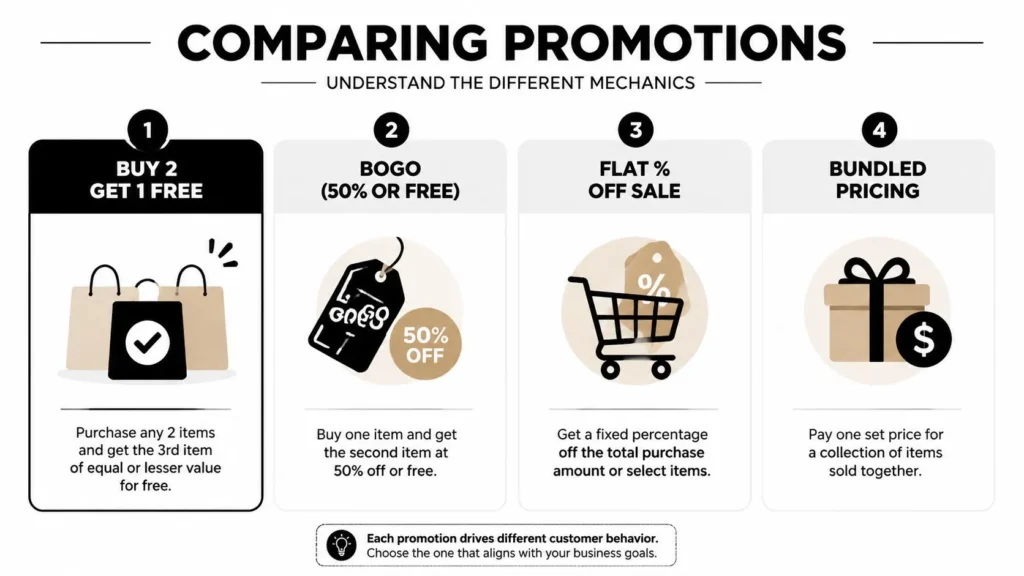
With buy 2 get 1 free, three items have a regular value of $90, but you pay $60. Your effective cost is $20 per item, and your effective discount is 33.3%, provided all three items qualify at the same price.
A BOGO free offer on two $30 items gives you two units for $30. That produces an effective unit price of $15 and a 50% effective discount. It also requires a smaller quantity commitment, which can make it more useful for a small household or a product you’re testing.
A flat 30% discount on one $30 item reduces the price to $21. You spend less at checkout and don’t need to buy additional units. If you need three items, however, three discounted units cost $63, compared with $60 under buy 2 get 1 free. In that specific scenario, the multi-buy offer has the lower total cost.
A three-for-$10 bundle works differently because the advertised bundle price replaces the normal item pricing. You must calculate its unit price, then compare it with both the regular price and competing promotions. Bundle pricing can be attractive when the combined total is clear, but the low headline price doesn’t matter if the products don’t match your needs.
The right comparison depends on usage
| Promotion | Quantity in example | Total paid | Effective unit price | Best fit |
|---|---|---|---|---|
| Buy 2 get 1 free | 3 | $60 | $20 | You already need three |
| BOGO free | 2 | $30 | $15 | You need two and both qualify |
| 30% off | 1 | $21 | $21 | You need only one |
| Three-for-$10 bundle | 3 | $10 | $3.33 | The bundle price and contents fit |
The final tiebreaker is cost per use, not cost per item. A $20 item used repeatedly may be a better purchase than a $15 item used once, but three unused items have no practical savings. Shoppers comparing store layouts and product pairings may also benefit from understanding cross merchandising examples for retail, since adjacent products can encourage add-on purchases that weren’t part of the original plan.
Smart Strategies to Maximize Your Savings
Treat the promotion like a small purchasing decision, not a prize. A reliable process helps you separate genuine value from a larger basket.
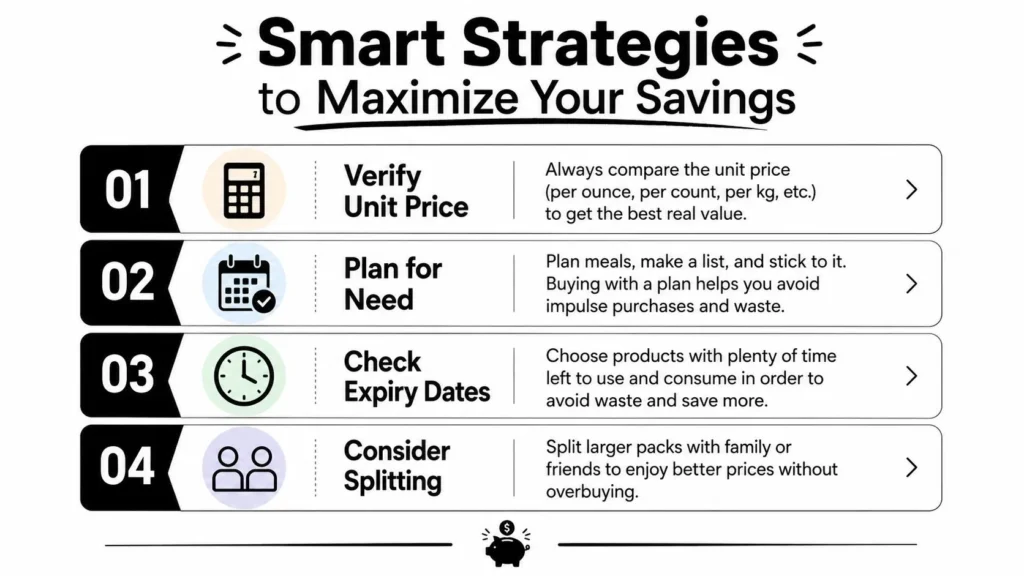
Verify the unit price first
Add the prices of the paid units, then divide by the number of units you take home. For identical $30 items, $60 divided by three equals $20 each. For mixed-price products, confirm which item receives the discount and calculate from the actual receipt total.
Compare that result with the ordinary price and with current alternatives. A store may advertise a dramatic free-item message while another retailer offers a lower everyday price or a direct discount without a quantity threshold.
Plan around consumption
Write down who will use the products and roughly when. For pantry staples, the question may be whether your storage space can accommodate the purchase. For clothing or games, ask whether each item has a specific role rather than treating the third unit as an abstract saving.
Mix-and-match rules can improve the fit. Some retailers allow shoppers to combine eligible flavors, sizes, colors, or product lines, while others require identical items. Read the offer terms and test the cart before paying. A qualifying combination can prevent you from buying three versions of something nobody wants.
Before checkout: Decide what will happen to each unit, including the free one.
Check coupon and return conditions
Manufacturer coupons, store coupons, and cashback applications may sometimes work with multi-buy pricing, but retailer policies differ. Some stores allow particular forms of stacking, while others block coupons on promotional items or calculate the discount before applying another offer. Confirm the exact terms in the retailer’s app, circular, or checkout policy instead of assuming that every discount layers.
Returns can be less generous than the display suggests. Retailers may divide the promotional savings across the transaction, so the “free” item can carry a prorated value on the receipt. Returning one paid item may also cause the system to recalculate the offer, reducing the refund or removing the promotion entirely.
Time the purchase carefully
Seasonal resets and loyalty-member early access can affect availability, especially when popular sizes, colors, or flavors sell quickly. Timing doesn’t make an unsuitable deal good, but it can help you secure qualifying items when you’ve already decided the quantity makes sense.
Real Examples Across Fashion Books Games and Groceries
The same promotion can be excellent in one category and wasteful in another. The deciding factors are the regular price, the competing offer, the product’s useful life, and whether the shopper can use every unit.
Consider a clearance event for jeans priced at $60 per pair. Buying two and receiving a third free gives three pairs for $120, an effective price of $40 per pair and an effective discount of 33.3%. If the same retailer offers a flat 40% discount, each pair costs $36, so three pairs cost $108. The clearance promotion looks generous because one pair is free, but the straight discount wins when the shopper wants three pairs.
Books show why the lowest-priced-item rule matters. Suppose a store applies buy 2 get 1 free to hardcovers priced at $30, $25, and $20. The $20 book becomes free, so you pay $55 for books with a $75 regular value. The effective discount is 26.7%, below the equal-price result, and the saving depends on choosing titles you want rather than adding a cheaper book to trigger the offer.
Digital video-game bundles create a different risk. A storefront might let you select three qualifying indie games, but the third game has no value if you won’t play it. The absence of physical storage and spoilage doesn’t eliminate the opportunity cost of spending on an unwanted title.
Groceries divide sharply between durable and perishable goods. Three shelf-stable pantry items can be easy to schedule and store. Three dairy products with uncertain use can lose their value through spoilage before the household consumes them.
| Category | Example Scenario | Effective Savings | Key Pitfall | Verdict |
|---|---|---|---|---|
| Fashion | Three $60 jeans, third free | 33.3% | A simultaneous 40% sale is cheaper | Compare both offers |
| Books | $30, $25, and $20 hardcovers | 26.7% | Lowest-priced book is free | Works only if all titles fit |
| Games | Three qualifying digital titles | Depends on prices | Unplayed games create no useful value | Buy only titles you want |
| Groceries | Three qualifying pantry items | Depends on prices | Storage and consumption capacity | Stronger for shelf-stable goods |
For broader shopping context, readers can explore the best places to shop before committing to a retailer’s promotion. Shoppers tracking fashion offers can also find Debenhams sales and compare the promotion with direct markdowns rather than evaluating the free-item message in isolation.
Why Retailers Love This Promotion Format
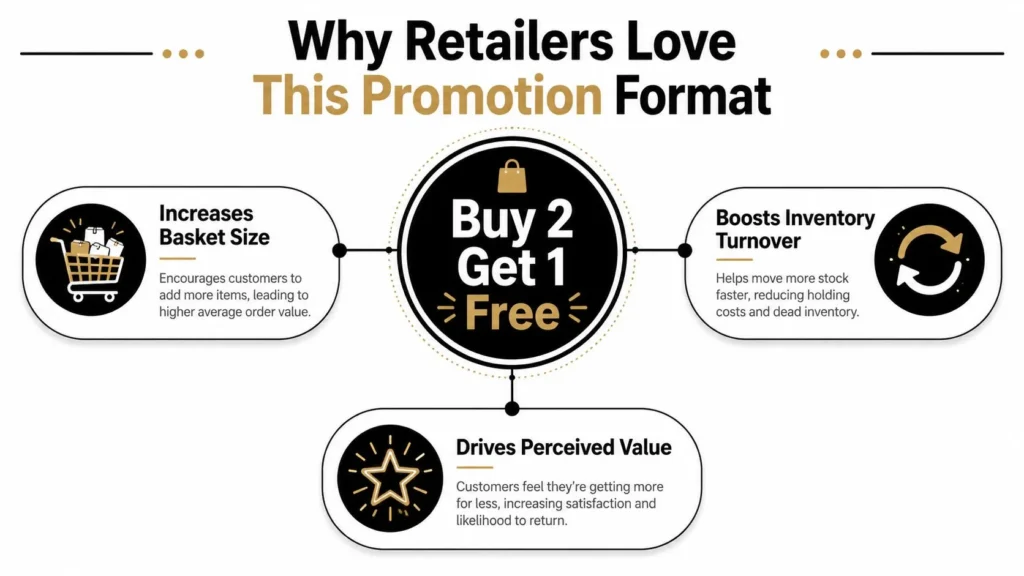
Retailers favor buy 2 get 1 free because one threshold serves several commercial goals. The customer must reach three units, so the offer can raise the transaction value while helping products leave the store faster. The promotion works like a quantity gate: the discount appears only after the shopper crosses it.
That speed matters for seasonal goods, slow-moving stock, and products occupying valuable shelf space. A percentage markdown reduces the price of each unit, while a multi-buy structure encourages a larger basket. Retailers can therefore improve inventory flow without placing every item in a blanket sale.
The free-item frame protects attention and margin
The word “free” gives the offer an emotional anchor. Research on BOGO-style promotions found that shoppers preferred the free-item frame over equivalent price reductions, and eye-tracking evidence showed that the framing changed attention and selection. As noted in the published research record, the presentation of the free unit helps explain why retailers give it prominent space.
Retailers also commonly make the lowest-priced qualifying item free. In a mixed basket, this can preserve more revenue than applying the same percentage reduction to every product. The customer experiences a visible reward, while the retailer limits the discount to the least expensive eligible item.
The offer also reveals how shoppers build baskets. A store can see which flavors, colors, sizes, or product lines customers combine, then apply that information to merchandising, product placement, and future promotions. Cross-category combinations may expose selling opportunities that a single-item markdown would not show.
Conditions still need clear disclosure
A conditional “free” claim needs readable terms. Retailers should identify the qualifying products, required quantity, price restrictions, exclusions, and return treatment. Guidance from the Federal Trade Commission on “free” claims reflects the broader compliance rule: promotional wording should not hide the conditions attached to the offer.
These mechanics also fit within a retailer’s wider ecommerce plan, alongside essential ecommerce best practices to boost growth in 2026. Shoppers can use the same information to judge the threshold before assuming the free item represents real value.
Does Buy 2 Get 1 Free Create More Household Waste
The claim that every multi-buy promotion creates more waste goes too far. A 2021 literature review found no scientific consensus, with 12 studies linking price promotions to greater food waste and 8 studies finding the opposite or no clear effect. The review is available in this Sustainability literature review.
The outcome depends on the household and the product. Later household-level research discussed in the review found no increase in waste and, in some cases, lower waste for discounted purchases. That finding doesn’t make every multi-buy offer responsible. It means the purchase context matters.
A large household with reliable storage may use a buy 2 get 1 free pantry offer efficiently. A single-person household may struggle with the same quantity, particularly when the product is perishable or the shopper has uncertain plans. Food skills, storage habits, environment-minded behavior, and the ability to freeze products can change the result.
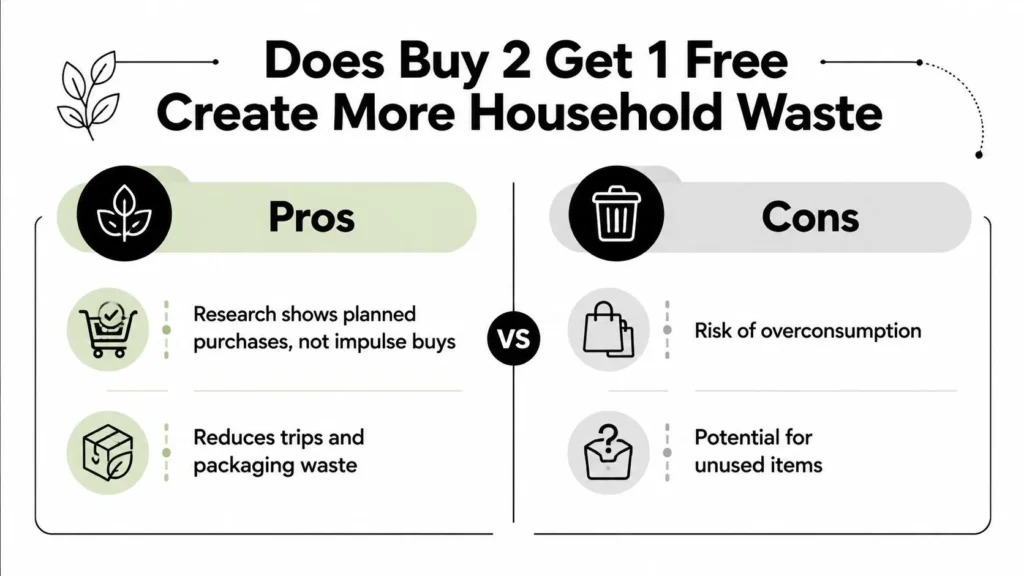
A practical waste check asks whether the household can consume, preserve, share, or store every unit. If not, the “saving” may transfer cost from the checkout to the rubbish bin. For readers developing a broader zero-waste lifestyle, the best approach is to treat multi-buy shopping as a planning decision, not an automatic virtue or automatic problem.
Maxijournal.com offers approachable writing across shopping, business, science, technology, health, fashion, games, and everyday education. Visit maxijournal.com for practical articles that help you evaluate offers, habits, and decisions with greater clarity.
Discover more from Maxi Journal
Subscribe to get the latest posts sent to your email.