Before you even think about swimming full laps, the real starting point is getting comfortable in the water. Your first goal isn’t to be fast; it’s to feel confident and in control. This means mastering three foundational skills: calm breathing, relaxed floating, and a solid kick.
Think of these as the building blocks for everything that comes next. Once you have these down, learning strokes like freestyle and backstroke becomes so much easier.
Building Your Confidence in the Water
That initial feeling of getting into the pool can be a little unnerving. The key is to reframe your thinking—the water is there to support you, not fight you. We’ll start with the absolute basics to build that trust.
Modern swim coaching has shifted away from the old “sink or swim” mentality of throwing beginners into complex strokes. Instead, the focus is now on mastering a few core competencies first: floating, kicking, and getting a feel for moving your arms through the water. You can actually read more about this evolution in teaching methods over on Britannica.com.
Let’s break down the skills you’ll work on.
Get Comfortable with Your Face in the Water
The instinct for most new swimmers is to hold their breath the second their face touches the water. This creates immediate tension and makes everything harder. So, the very first thing to practice is simply breathing out.
Stand in the shallow end where you feel secure. Take a normal breath through your mouth, then slowly lower your face into the water while humming or gently blowing bubbles. It’s a surprisingly simple drill, but it works wonders.
The goal is to teach your brain that having water on your face is no big deal. Keep doing this until it feels completely natural. This single exercise is your best weapon against the panic reflex.
Master the Art of Floating
Floating isn’t about strength; it’s about trust and relaxation. Your lungs are basically built-in life jackets, but if your body is tense and rigid, you’ll sink like a rock.
To practice, find some waist-deep water. Take a nice, deep breath and gently lean back. Let your head rest on the surface like it’s a pillow and extend your arms out to the sides to help with balance.
Another great way to practice is the “dead man’s float.” Start by facing down, grab your knees and tuck them into your chest, and then slowly let your arms and legs drift out. The trick is to let go of every bit of tension in your muscles. Your hips might dip a bit, and that’s perfectly fine. As long as you stay relaxed, you’ll stay up.
The secret to a stable float is relaxation. If you fight the water, you’ll sink. If you trust it to hold you up, it will. Think of the water as a supportive cushion, not an obstacle to overcome.
Develop an Effective Flutter Kick
A good flutter kick is the engine that will power your freestyle and backstroke. The most common mistake beginners make is kicking from their knees, almost like they’re riding a bicycle. This is exhausting and doesn’t get you very far.
A proper flutter kick starts from your hips. Your legs should stay mostly straight, but not locked, and your ankles should be relaxed and floppy.
- Practice with a Kickboard: Grab a kickboard, hold it out in front of you, and just focus on your kick. Try to feel the movement originating from your hips and core, not your knees.
- Keep Kicks Small and Fast: You’re not trying to make a huge splash. Your feet should just barely break the surface of the water, creating a nice, steady “boil” behind you.
A strong kick not only moves you forward but also helps keep your body aligned and horizontal in the water. Remember, your mental state is just as important as your physical technique. For some great strategies on staying calm and focused, check out our guide on mental health and self-care tips.
Before we move on, let’s quickly recap the foundational skills we’ve just covered. Getting these right will set you up for success and make the entire learning process much smoother and more enjoyable.
Your Foundational Skills for Learning to Swim
| Core Skill | Primary Goal | Why It’s Important |
|---|---|---|
| Calm Breathing | To exhale comfortably underwater. | Prevents panic, reduces tension, and is the first step to rhythmic breathing for strokes. |
| Relaxed Floating | To trust the water to support you. | Teaches body position, balance, and how to work with the water instead of against it. |
| Effective Kicking | To generate propulsion from your hips. | Provides forward movement, helps maintain a streamlined body line, and builds endurance. |
Mastering these skills gives you a solid base to build upon. Once you feel at ease with breathing, floating, and kicking, you’ll be ready to start putting them all together into your first strokes.
Deconstructing the Freestyle Stroke
Freestyle, or front crawl as it’s often called, is the stroke most people picture when they think of swimming. It’s also usually the first one swimmers learn. From the deck, it can look like a blur of chaotic splashing, but it’s really just a few key movements working in harmony.
The best way to get the hang of it is to break it down, piece by piece, so you can build it back up into a smooth, efficient stroke.
Interestingly, this stroke has been the king of speed for over a century. It really took off after Australian swimmer Richmond Cavill blew away a world record in 1902, swimming 100 yards in a blistering 58.4 seconds. That performance pretty much cemented front crawl as the go-to for speed and efficiency, which is why we still start with it today. If you’re a history buff, you can find more tidbits about swimming’s evolution on Wikipedia.
Let’s dive in and take this stroke apart.
The Arm Cycle: Catch, Pull, and Recovery
Your arms are the engine of your freestyle stroke. Instead of just windmilling them through the water, think of the motion in three distinct phases: the catch, the pull, and the recovery. This mental framework helps give every part of your stroke a purpose.
- The Catch: As your hand enters the water, reach forward, but don’t just let it plunge down. You want to keep your elbow higher than your hand. This position creates a huge surface area to “catch” the water—almost like you’re reaching your arm over a big barrel.
- The Pull: With your hand set, you’ll pull straight back toward your feet, maintaining that high-elbow position. This is your power phase, where you really propel yourself forward. Your entire forearm, from fingertips to elbow, should act like a big paddle.
- The Recovery: Once your hand zips past your hip, lift your arm out of the water. This part should feel relaxed. Let your elbow lead the way, and keep your hand and wrist loose as your arm swings forward to start the cycle all over again.
A classic rookie mistake is dropping the elbow during the pull. It feels easier, but it kills your power. Really focus on that high elbow—it’s the secret to pulling yourself through the water instead of just pushing water down.
Key Takeaway: Think of your arms working in a continuous loop. As one arm is pulling back through the water generating power, the other is cruising forward above the water, ready for the next catch. This creates a seamless, constant source of propulsion.
Connecting Your Kick and Body Roll
While your arms are doing the heavy lifting, your kick and how your body moves are crucial for stability and a little extra push. Your kick should be a steady flutter kick, and the power needs to come from your hips, not your knees. Keep your legs mostly straight and let your ankles stay relaxed and floppy.
This is where the foundational skills you’ve been working on—breathing, floating, and kicking—all start to come together to support the full stroke.
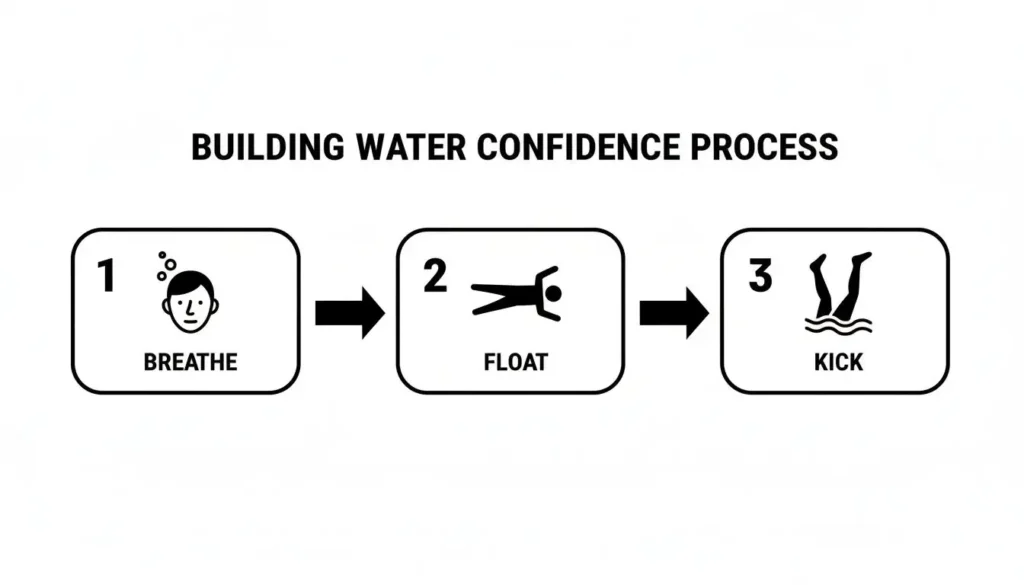
As you can see, a solid kick, built on the confidence from floating and breathing, is what keeps your body aligned and moving forward.
Now for the body roll. As your arms rotate, your body should naturally roll from side to side along its central axis. This isn’t some dramatic, jerky twist. It’s a smooth rotation that helps you reach farther with your arms and, most importantly, makes it much easier to breathe. Picture a skewer running from the top of your head down to your toes—you’re just rotating around it.
Mastering Rhythmic Side Breathing
Breathing is, without a doubt, the biggest challenge for most beginners. The secret is to turn your head to the side for a breath, not lift it straight up. Lifting your head is an anchor; it makes your hips and legs sink, creating a ton of drag that just slows you down.
The perfect time to breathe is right as one arm is recovering over the water. As that arm comes up, your body roll creates a little pocket of air next to your head. Use that moment to turn your face to the side and grab a quick breath. Just one ear should come out of the water.
Then, as your face goes back in, start exhaling slowly and steadily through your nose or mouth. This stops you from holding your breath, which is what leads to that panicked, out-of-air feeling.
A fantastic drill for this is the single-arm pull. Grab a kickboard with one hand, extend it out front, and swim using only the other arm. Focus on turning your head to breathe with every single stroke. This isolates the movement and helps lock in the timing until it becomes second nature.
Learning Backstroke and Basic Breaststroke
Alright, you’ve gotten the hang of moving through the water on your front. Now it’s time to flip over and add a couple more strokes to your arsenal.
Backstroke is a fantastic next step. Why? Because your face is always out of the water, which takes the whole tricky breathing coordination thing out of the equation for a bit. It lets you focus purely on your body position and movement. We’ll start there, then dip our toes into the basics of breaststroke.
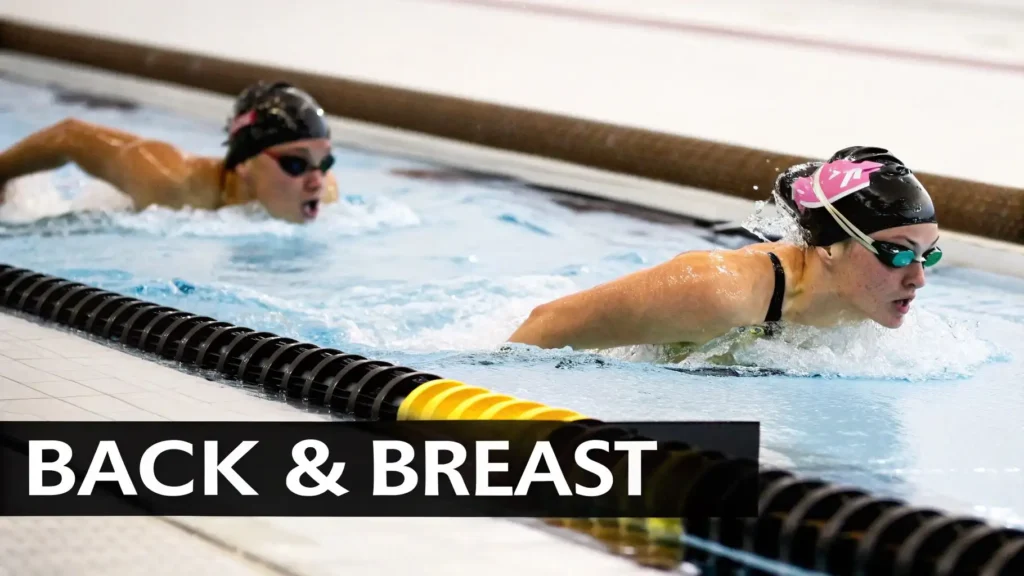
Mastering the Backstroke
The secret to a good backstroke is a solid, flat body position. Think of yourself as a plank floating on the water. Your ears should be just under the surface, and you absolutely have to keep your hips high, almost brushing the top of the water.
If you let your hips sag—and it’s the most common mistake—you’ll create an anchor’s worth of drag. It feels like you’re swimming uphill. Squeeze your core to keep that straight line from head to toe.
The kick is the same flutter kick you learned for freestyle. Keep it small, quick, and initiated from your hips. Your ankles should be relaxed and floppy, creating a steady “boil” on the surface rather than giant, energy-wasting splashes. This kick is your engine and your rudder, providing both power and stability.
Your arms move one at a time in a big, circular motion. As one arm leaves the water, lead with your thumb. As it comes over your head, rotate your hand so your pinky finger slices into the water first. This simple rotation sets up a much more powerful pull under the water.
Backstroke Pro Tip: It’s ridiculously hard to swim in a straight line when you can’t see where you’re going. Look up at the ceiling and pick a landmark—a light fixture, a beam, anything. Use that as your North Star to keep from zigzagging into the lane line.
Introducing the Basic Breaststroke
Breaststroke is a different beast entirely. It’s a much more relaxed, chilled-out stroke, and once you nail the timing, you can go for ages. The heart and soul of this stroke is its unique kick, often called the “frog kick.”
Unlike the flutter kick, both legs move together in a very specific sequence. It looks simple, but every part matters.
- Heels Up: Start by pulling your heels up toward your butt.
- Feet Out: Flex your feet and turn your toes out to the sides, like a frog.
- Whip and Squeeze: Now for the power—whip your legs around in a circle, pushing the water back, and then squeeze them together forcefully to finish.
All your propulsion comes from that “whip” as you catch the water with the inside of your feet and lower legs.
The arms are a synchronized sweep. Begin with your arms stretched out in front of you. Sweep them out to the sides (don’t go wider than your shoulders!), then scoop your hands together under your chin and shoot them forward again into a glide. Your head comes up for a quick breath as your hands sweep out and back.
The rhythm is the key. Everyone chants the same mantra: “pull, breathe, kick, glide.” This timing is non-negotiable. You do each part one after the other, with a distinct pause for the glide. Don’t rush it! That glide is free speed, so enjoy it.
Common Beginner Mistakes and How to Fix Them
Every new swimmer I’ve ever worked with hits a few roadblocks. It’s a completely normal part of the learning curve. Instead of getting frustrated, it’s better to think of these hurdles as chances to really dial in your technique.
This isn’t about muscling through the water; it’s about moving smarter. You might be surprised to learn just how much technique matters. Between the 1940s and 1970s, researchers found that swimming economy—how efficiently swimmers move—improved by a staggering 40% to 50% just from technique changes alone. You can dive deeper into the evolution of swimming economy on Swimming Science if you’re curious.
Let’s get into the most frequent mistakes I see and, more importantly, how to fix them with simple, actionable adjustments.
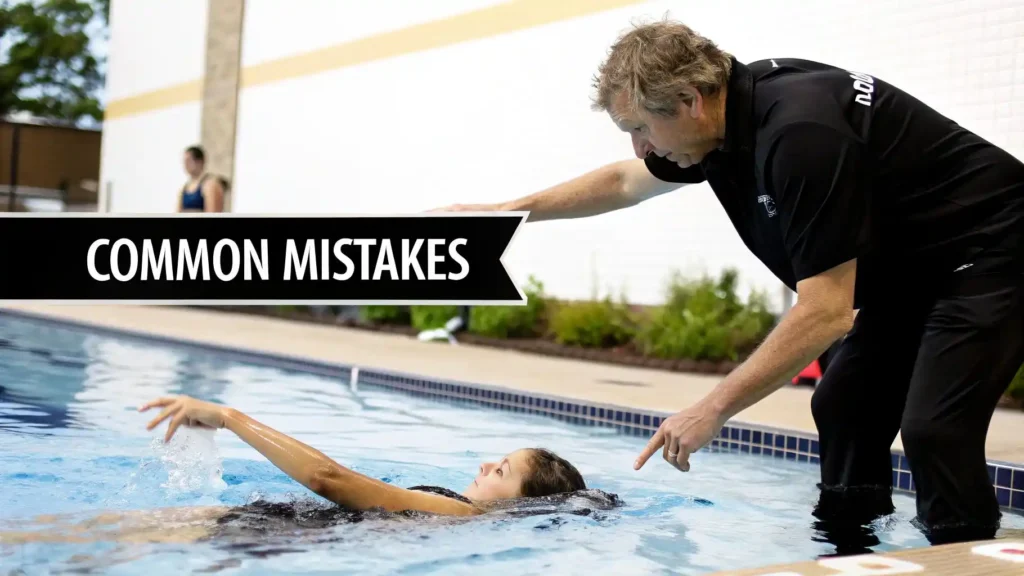
Sinking Legs or Hips
This is the number one issue, hands down. You feel like your upper body is doing all the work, but your legs are just dragging behind you like an anchor. This creates a ton of drag and makes every single stroke feel like an uphill battle.
Almost every time, the root cause is your head position. The second you lift your head to peek forward, your body acts like a seesaw—your head goes up, and your hips and legs immediately sink. Keeping your body flat and horizontal is the foundation of all efficient swimming techniques for beginners.
How to Fix It:
- Look Down, Not Forward: When swimming freestyle, your gaze should be aimed directly at the bottom of the pool. Think about keeping your head perfectly aligned with your spine.
- Press Your Buoy: Imagine your chest is a buoy. Gently press it down into the water. This one small move will help pop your hips up toward the surface, instantly improving your body line.
A simple rule I always teach is: where your head goes, your body follows. Keep that head neutral and facing down, and your hips and legs will stay high in the water.
Lifting Your Head to Breathe
This mistake is a close cousin to the sinking-legs problem. It’s that natural instinct to lift your entire head out of the water to gasp for air. This completely breaks your streamline, kills all your forward momentum, and leaves you feeling way more tired and out of breath than you should be.
Breathing in swimming should be a smooth rotation, not a panicked lift. The idea is to turn your head just enough so your mouth clears the water, breathing into the little air pocket your body creates as it moves.
Crossing Your Arms Over
Another classic freestyle error is letting your hands cross over the centerline of your body when they enter the water. Picture a straight line running down your middle from head to toe. Your right hand should always stay on the right side of that line, and your left hand on the left.
When your arms cross that line, it throws your whole body off balance. Your hips will start swaying side-to-side in a “snaking” motion. Not only does this slow you down, but it’s also a common cause of shoulder strain over time.
How to Fix It:
Focus on having your hand enter the water directly in line with your shoulder. A great mental trick is to imagine you’re swimming on a set of train tracks—your arms should never cross over to the other track. Nailing this alignment is a huge step forward. For more tips on improving your overall fitness and form, check out our other guides in the sports category.
Your Simple 4-Week Progression Plan
Let’s put all this theory into practice. A structured plan is your best friend when you’re just starting out because it takes the guesswork out of your pool sessions and builds skills in a logical order.
Here’s the key: consistency over intensity. You’ll see amazing progress with just two or three short sessions in the pool each week. This isn’t about becoming a world-class athlete overnight; it’s about building a solid foundation, brick by brick.
This plan will guide you from tentatively stepping into the shallow end to swimming your first real laps with a growing sense of confidence. Each week’s skills stack right on top of the last, so you’re always building on what you’ve already mastered.
Week 1: Getting Comfortable
Your only job this week is to make friends with the water. Seriously, that’s it. Forget about swimming across the pool—just focus on how the water supports you and how you can control your body and breath within it. This is, without a doubt, the most important week of the whole process.
- Main Goal: Master calm, rhythmic breathing and feel totally relaxed while floating.
- Key Drills: Spend your time doing rhythmic bobs, gently blowing bubbles with your face in the water, and practicing a completely limp back float and “dead man’s float.” The aim here is to feel completely at ease.
Week 2: Adding Propulsion
Okay, now that you and the water are on good terms, it’s time to start moving. This week is all about building a kick you can count on—the engine that will eventually power your strokes. Grab a kickboard; it’s going to be your most valuable tool.
The secret to a good progression plan is focusing on one major element at a time. Don’t try to learn everything at once. Isolate the kick this week, and you’ll see how much faster you progress later on.
- Main Goal: Develop a steady, consistent flutter kick that starts from your hips, not your knees.
- Key Drills: Use a kickboard to push yourself through the water. Concentrate on keeping your legs long but not stiff, letting your ankles stay floppy like fins, and making your kicks small and quick.
Week 3: Integrating Arm Movements
With a solid kick giving you stability and forward momentum, we can now start layering in the basic arm movements. We’re not aiming for perfect form just yet. The goal is simply to get a feel for the rhythm and motion of the freestyle arm cycle.
- Main Goal: Introduce the fundamental freestyle arm stroke.
- Key Drills: Try single-arm freestyle drills while holding a kickboard with your other hand. Go one length using only your right arm, then come back using only your left. This isolates the motion and helps you focus on the “catch, pull, recovery” sequence without having to think about everything else.
Week 4: Putting It All Together
This is the week it all starts to connect. You’ll bring together your breathing, your kick, and your arm movements to swim your very first complete freestyle laps. Don’t even think about speed. Your entire focus should be on maintaining a smooth, continuous rhythm from one end of the pool to the other.
The physical and mental benefits of swimming are huge, and once you get going, you might want to learn more about overall wellness. You can check out some great articles in our health category.
- Main Goal: Swim short, continuous freestyle laps without stopping.
- Key Drills: Start small. Try to swim just four strokes in a row, then take a breather. When that feels good, build up to six, then eight, and keep adding a few more until you make it all the way across the pool.
Your 4-Week Beginner Swim Progression
To make it even simpler, here’s the entire plan laid out in a table. Pin this up or save it to your phone so you know exactly what to work on each time you head to the pool.
| Week | Main Focus | Key Drills To Practice |
|---|---|---|
| Week 1 | Comfort & Breathing | Rhythmic bobbing, blowing bubbles, back float, dead man’s float. |
| Week 2 | Kicking & Propulsion | Kickboard drills focusing on a hip-driven flutter kick with floppy ankles. |
| Week 3 | Basic Arm Strokes | Single-arm freestyle drills (with kickboard) to learn the arm cycle. |
| Week 4 | Full Stroke Coordination | Swimming short sets (4, 6, 8 strokes) and building up to a full lap. |
This four-week roadmap provides a clear path forward, removing the intimidation factor and letting you focus on one small victory at a time. Trust the process, be patient with yourself, and you’ll be swimming laps before you know it.
Of course, here is the rewritten section with a more natural, human-written tone, following all the provided guidelines and examples.
Your Top Questions About Learning to Swim, Answered
If you’re just starting out, you’ve probably got a million questions swirling around in your head. That’s totally normal. Everyone wonders about things like how long it’ll take, why we teach certain strokes first, and especially how to deal with that pit-in-your-stomach feeling in deep water. Let’s clear the air on some of the most common things new swimmers ask.
One of the first things people want to know is, “So, how long until I can actually swim?” While there’s no single answer for everyone, you can expect to master the absolute basics—like floating and getting yourself safely to the side—in about 20-25 hours of solid practice. If your goal is to be swimming laps with a decent freestyle, you’re probably looking at closer to 40-50 hours. It really just depends on how comfortable you are starting out and how often you can get in the pool.
You might also wonder why almost every swim program starts with freestyle. It’s all about efficiency and building a solid foundation. The flutter kick and the way you roll your body in freestyle are the exact same core movements you’ll use for backstroke, which makes it the perfect next step. Freestyle teaches you the fundamental principles of staying balanced and moving through the water that you’ll use in every other stroke.
What About That Fear of Deep Water?
A fear of the deep end is incredibly common, and for many people, it’s the biggest hurdle. It usually comes down to that feeling of losing control when your feet can’t touch the bottom. The trick is to tackle it slowly with gradual, controlled exposure—not all at once.
Start in the shallow end, in water where you can easily stand but you feel a little bit of that lightness. This is your new home base. Just hang out here, practice your bobbing and breathing, and get used to the feeling. The next step? Try floating on your back. The moment you realize the water can—and will—hold you up is a game-changer for your confidence.
Your mission isn’t to conquer the deep end on day one. It’s to slowly nudge the edges of your comfort zone. Celebrate moving one foot further from the wall. Cheer for yourself when you float for two seconds longer than you did yesterday.
Once you’re feeling good about floating, grab a kickboard and cruise along the edge of the pool, just past where you can stand. Kick yourself along, knowing the wall is right there if you need it. This lets you experience being in deeper water without the pressure. Over time, you start building real trust—in yourself and in the water. As your skills grow, you’ll find that fear starts to shrink.
Discover more from Maxi Journal
Subscribe to get the latest posts sent to your email.