The most popular advice about quantum computing is also the most misleading: learn what a qubit is, count how many a machine has, and assume the biggest number wins. That approach misses the true story. Quantum computers do not try every answer at once, and a processor with more fragile qubits can be less useful than a smaller system with better control, stronger error correction, and a more effective connection to classical computing.
To understand how quantum computing works, follow the information rather than the headline. A classical computer prepares data, runs instructions, and returns a result. A quantum computer does something more delicate: it prepares quantum states, manipulates their probability amplitudes with gates, uses interference to favor useful outcomes, and measures the result. In practical systems, a classical processor manages much of that workflow, while a quantum processing unit handles a specialized subproblem.
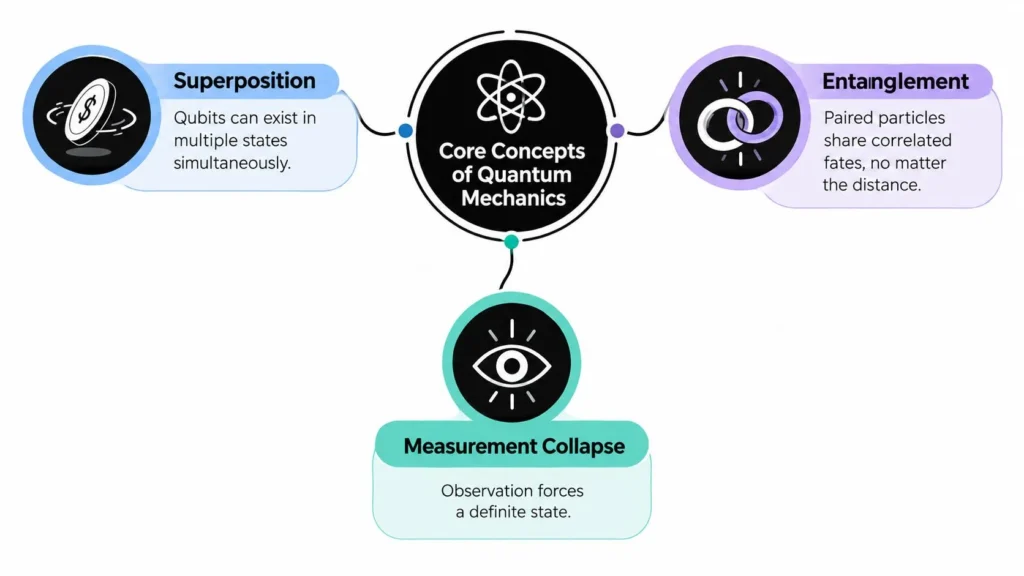
Understanding the Core Concepts of Quantum Mechanics
A quantum computer isn’t a faster classical computer with unusual hardware. It uses a different information unit and different rules for manipulating that information. A classical bit is either 0 or 1, like a light switch that rests in one position. A qubit can occupy a combination of the states 0 and 1 before measurement.
A spinning coin offers a useful, though imperfect, analogy. A coin lying flat shows heads or tails, while a spinning coin has a physical state that contains motion associated with both possibilities. A qubit’s superposition is not merely an unknown classical value. Its state includes probability amplitudes, which can reinforce or cancel one another when quantum gates act on them.
Superposition is not parallel answers
People often say that a quantum computer evaluates every possible answer simultaneously. That phrasing creates the wrong expectation. A measurement still produces one classical result, not a list of all answers. The advantage comes from designing a circuit so that incorrect paths interfere destructively and useful paths become more likely to appear when the system is measured.
Quantum gates perform controlled transformations on these amplitudes. Some gates change the balance between states, while others create relationships between qubits. The circuit’s sequence matters because each operation changes the conditions under which later amplitudes combine.
Entanglement adds another layer. When qubits become entangled, their measurement outcomes can be correlated in ways that can’t be described by treating each qubit as an independent object. You shouldn’t picture entanglement as a hidden telephone between particles. It is better understood as a shared quantum state whose parts must be described together, even when the physical systems are separated.
Measurement changes what you can observe
Before measurement, a qubit can carry quantum information in a superposition. Measurement converts that information into a classical outcome, such as 0 or 1, according to the state prepared by the circuit. Once measured, the original superposition isn’t available for another inspection of the same run.
That limitation explains why quantum algorithms need careful probability engineering. The machine doesn’t hand you a magical answer. It gives you samples from a distribution, and a useful algorithm makes the desired result appear often enough to identify.
For readers comparing technical explanations across unfamiliar topics, compare vs Matter can help separate a simple analogy from a claim about the underlying technology. The important distinction remains this: superposition supplies the state space, entanglement links qubits, gates shape amplitudes, and measurement produces the usable output.
Exploring Quantum Algorithms and Computational Power
Quantum algorithms matter because they turn physical effects into a repeatable computational procedure. The algorithm doesn’t gain value merely because qubits can occupy several states. It gains value when the circuit uses interference to make a particular structure easier to detect than it would be with a comparable classical method.
Grover’s search as probability amplification
Suppose you have an unstructured collection of possible entries and want to find one that satisfies a condition. A classical search checks candidates according to its search strategy. Grover’s algorithm begins by spreading amplitude across possibilities, uses an oracle to mark the desired candidates, and applies an operation that increases their amplitude.
The machine still needs measurement at the end. The algorithm’s contribution is that repeated circuit operations reshape the probability distribution so the marked answer is more likely to be observed. This is a form of amplitude amplification, not a promise that every database lookup becomes instant.
The benefit also depends on the problem’s structure and the cost of loading data into the quantum system. If preparing the input or correcting errors consumes more resources than the search saves, the theoretical advantage may not translate into a practical one.
Shor’s algorithm looks for periodic structure
Shor’s algorithm addresses a different kind of problem. Integer factorization appears difficult for known classical methods at relevant scales, but the quantum procedure turns factorization into a period-finding task. A quantum circuit evaluates a function over many inputs, uses interference to reveal information about its repeating structure, and then applies classical mathematical processing to recover factors.
That division of labor is important. Quantum algorithms often don’t replace every step. A classical computer may prepare parameters, control the experiment, transform the measured data, and verify the result.
Practical rule: Don’t ask whether a quantum computer is faster in general. Ask which mathematical structure the algorithm can expose, how much data preparation costs, and whether the hardware can execute the circuit accurately enough.
The same reasoning applies to chemistry and materials simulation. Quantum systems naturally represent quantum states, so researchers investigate whether a controlled quantum processor can model molecular behavior more directly than a classical approximation. That possibility is promising, but the useful question isn’t whether a circuit looks impressive. It’s whether the complete workflow produces a result with an advantage over the classical alternatives.
Comparing Major Hardware Platforms and Engineering Challenges
Quantum hardware platforms make different compromises because they encode and control qubits through different physical systems. No single architecture has won every engineering contest. A platform may offer excellent fidelity but slower operations, or fast gates but demanding environmental controls.
| Hardware Platform | Qubit Representation | Operating Environment | Primary Engineering Challenge |
|---|---|---|---|
| Superconducting circuits | Electrical states in superconducting circuits | Cryogenic refrigeration and microwave control | Maintaining coherence while scaling wiring, control, connectivity, and fabrication |
| Trapped ions | Internal states of individual ions | Trapped charged atoms controlled by lasers | Increasing operation speed and system scale while preserving precise control |
| Photonic systems | Properties of individual photons, such as path or polarization | Optical components, photon sources, detectors, and photonic circuits | Producing, routing, detecting, and entangling photons reliably at scale |
Superconducting systems use fabricated circuits that behave quantum mechanically when cooled to extremely low temperatures. Their engineering ecosystem resembles advanced electronic hardware, but the operating environment is far more demanding. Control lines, readout systems, calibration, and chip connectivity all become part of the computational problem.
Trapped-ion systems hold ions in electromagnetic fields and manipulate them with laser or microwave pulses. Their qubits can interact through shared motion, giving the architecture flexible connectivity. The trade-off is that operations and control sequences can be slower, and scaling a carefully controlled ion chain creates substantial engineering pressure.
Photonic approaches encode information in light. Photons can travel through optical networks and avoid some of the cooling requirements associated with other platforms, but reliable computation requires excellent sources, detectors, routing, interference, and methods for handling photon loss.
The hardware choice changes the algorithmic reality
Connectivity determines how easily a circuit can place two-qubit gates between the qubits it needs. Coherence determines how long quantum information survives before environmental interaction damages it. Operating speed affects how many useful operations can fit into that window.
These features can’t be reduced to a single qubit-count ranking. A processor with many poorly connected or noisy physical qubits may struggle to run a circuit that a smaller, better-controlled system can complete. Readers tracking commercial announcements can use this overview of Google’s quantum computing work as a starting point, but they should inspect the underlying engineering metrics rather than treating processor size as a complete score.
The comparison also explains why quantum computing isn’t a single product category. Hardware teams are solving different versions of the same broad problem, namely how to prepare, control, connect, read, and protect fragile quantum states well enough to execute a useful algorithm.
Overcoming Noise with Quantum Error Correction
Quantum states are sensitive to unwanted interactions with their surroundings. Thermal effects, control imperfections, stray fields, measurement errors, and other disturbances can alter the information before a circuit finishes. This loss of usable quantum information is commonly discussed as decoherence, but error correction must handle more than one kind of fault.
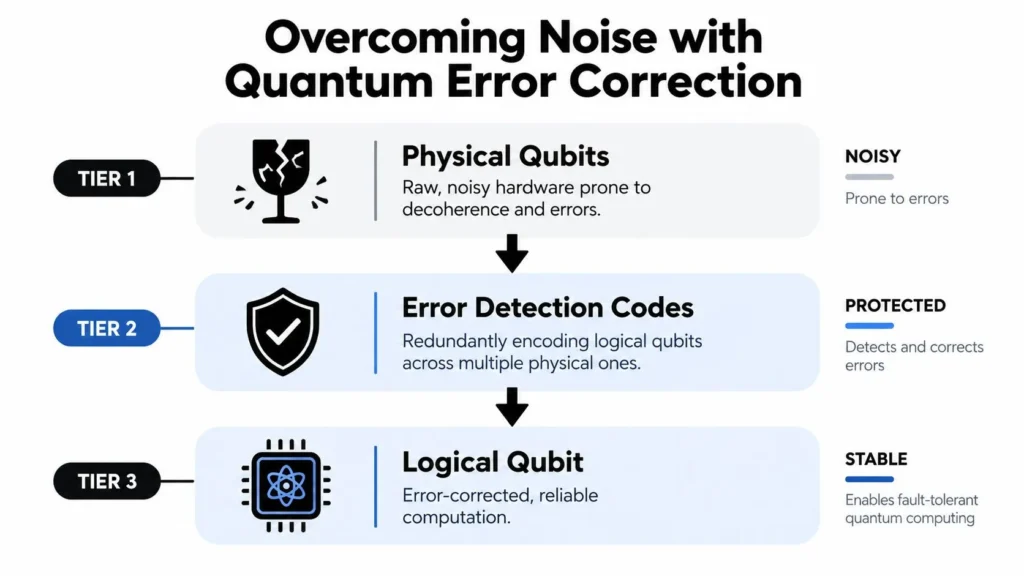
A raw physical qubit is therefore not the same thing as a dependable computational unit. Quantum error correction encodes information across multiple entangled physical qubits, measures carefully chosen error signals, and uses a decoder to infer what went wrong without directly measuring away the encoded quantum state.
Physical qubits and logical qubits serve different purposes
A logical qubit is a protected information unit assembled from many physical qubits. The redundancy doesn’t create extra copies that can be read independently. Instead, it distributes the quantum information across an encoded state and creates measurable patterns, called syndromes, that reveal errors without revealing the logical value itself.
The key condition is the physical error rate. If it falls below a threshold determined by the error-correction code and noise model, increasing the code distance can reduce the logical error rate sharply. The commonly discussed surface code has a physical error threshold of around 1%, while one recent fault-tolerance result reported a 0.7% threshold for a standard circuit-based noise model. That result also reported preserving 12 logical qubits for nearly 1 million syndrome cycles with 288 physical qubits at 0.1% physical error, compared with nearly 3,000 physical qubits for similar performance using the surface code, as described in the reported fault-tolerance result.
The exact overhead depends on the code, hardware, connectivity, decoder, and target computation. That is why raw qubit count tells you little about the number of reliable operations a machine can perform.
Fidelity determines whether protection helps
Gate fidelity measures how closely an operation matches its intended transformation. Two-qubit gates deserve particular attention because they create entanglement and usually introduce more opportunities for error than single-qubit operations. In neutral-atom systems, the highest demonstrated two-qubit gate fidelity reported in the cited review is about 0.995, while expert surveys identify targets above 99.9% for single-qubit gates and 99% for two-qubit gates for scalable error correction. These figures and the engineering context are discussed in this review of quantum error correction and neutral-atom systems.
When physical operations are too noisy, adding more qubits can add more faults faster than the code can remove them. Once operations cross the relevant threshold, additional qubits, better decoders, and improved scheduling can make protection increasingly effective. Commercial viability depends on useful logical operations, not on an impressive inventory of uncorrected physical qubits.
Integrating Quantum Systems into Hybrid Architectures
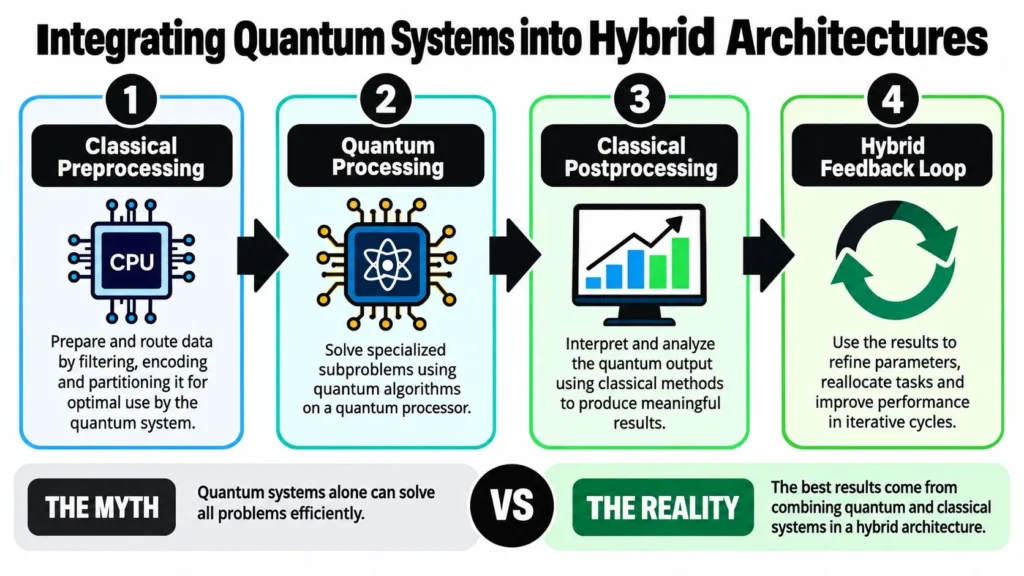
The standalone quantum computer is mostly a storytelling device. In a practical workflow, a quantum processing unit, or QPU, acts more like a specialized accelerator attached to classical infrastructure. Classical processors prepare data and instructions, the QPU runs a selected quantum circuit, and classical systems interpret the output and decide what to do next.
A molecular workflow shows the division of labor
Consider a molecular simulation. A classical system can select a representation of the molecule, reduce the problem, prepare circuit parameters, and manage the experiment. The QPU can then execute a subroutine intended to represent a difficult quantum-mechanical part of the calculation. Classical software receives measurements, estimates an objective, updates parameters, and submits another circuit.
This repeated process is often called a hybrid feedback loop. It resembles training or optimization workflows in which one system proposes a candidate and another evaluates it. The quantum processor isn’t expected to store and process an entire enterprise dataset by itself. It receives a carefully prepared task and returns measurements that a classical controller can use.
A 2026 report described IBM systems paired with two classical supercomputers to model a 12,635-atom protein complex, illustrating how quantum processors can sit inside a much larger computational arrangement rather than operating alone. The same source also highlighted benchmark frameworks that measure end-to-end performance across QPUs, GPUs, and controllers. These examples appear in this quantum computing industry report.
End-to-end measurement changes the scoreboard
A quantum circuit may be fast in isolation but unhelpful if data loading, calibration, queueing, error mitigation, result interpretation, and classical optimization dominate the workflow. Teams therefore need benchmarks that include the full path from input preparation to verified output.
That approach shifts the question from “How many qubits does the machine have?” to a more useful set of questions:
- Task fit: Does the QPU address a subproblem with a meaningful quantum structure?
- Control quality: Can the system execute the required gates with adequate fidelity?
- Workflow cost: How much classical processing and data movement surround each quantum call?
- Verification: Can researchers compare the output with a trusted classical method or physical measurement?
The practical future is likely to involve coordination among CPUs, GPUs, specialized controllers, and QPUs. Quantum computing won’t replace classical computing as a general-purpose system. It will need classical systems to make the quantum component usable.
Debunking Common Misconceptions and Realistic Timelines
Quantum computing has a serious communication problem: a real technical milestone can sit beside an exaggerated business promise. The best defense is to separate capability, reliability, and economic usefulness. A processor may demonstrate a difficult operation without yet supporting a dependable customer workflow.
Enterprise interest illustrates this gap. Industry data reports that 53% of enterprise IT leaders have high intent to invest in quantum, while 35.8% expect material business value within 1–3 years and 27.5% within 3–5 years, according to the industry reporting collected by ScienceDaily. Investment intent and near-term value aren’t contradictory, but they describe different decisions. Organizations can prepare, experiment, and build expertise before a reliable commercial advantage exists.
Four claims that need more careful wording
“Quantum computers try every answer at once.” They create superpositions and manipulate amplitudes, but measurement returns a limited classical result. An algorithm must use interference to make useful answers more likely.
“More qubits automatically means more power.” Physical qubits can be noisy, poorly connected, or difficult to control. Logical-qubit count, gate fidelity, circuit depth, decoding, and full workflow performance provide a better picture.
“Quantum computers will replace classical machines.” Classical processors handle data preparation, optimization, control, and interpretation in hybrid architectures. The QPU is a specialist, not a universal replacement.
“A laboratory demonstration proves immediate business value.” A demonstration can validate a physical principle or an error-correction technique. A business application also needs repeatability, scale, integration, verification, acceptable cost, and a problem where the quantum method beats available classical options.
Read road maps as engineering hypotheses
Road maps can still be useful, but readers should examine what each milestone measures. Recent reporting says IBM’s road map targets a larger Nighthawk processor with 7,500-gate circuits and a complete quantum module before year-end, a projection described in the ScienceDaily quantum computing coverage. The meaningful question isn’t just whether that gate count appears. It’s whether the gates run with sufficient fidelity, whether logical information survives, and whether the module supports a valuable end-to-end workload.
A grounded timeline therefore has milestones rather than a single promised arrival date. Researchers need to improve physical operations, demonstrate useful logical qubits, scale decoding and control, integrate classical infrastructure, and validate applications against strong classical baselines. Until those pieces align, quantum computing remains a field with substantial technical progress and uncertain commercial timing.
Navigating the Future of Quantum Technology
The next phase of quantum computing will be easier to follow if you track the right signals in the right order. Start with the physical layer, then examine the logical layer, and finally ask whether the complete system performs useful work.
A practical reading sequence
Check gate fidelity first. A circuit cannot deliver reliable results if its operations introduce errors faster than the code can correct them. Pay special attention to two-qubit operations because entanglement makes them central to many useful circuits.
Look for logical-qubit evidence. A logical qubit demonstration should describe the encoding, error model, syndrome cycles, decoder, and observed logical error behavior. A raw physical-qubit total doesn’t answer those questions.
Inspect the benchmark boundary. Find out whether a result measures only the QPU or includes compilation, control, data transfer, classical optimization, and verification. End-to-end benchmarks make comparisons more meaningful.
Match the algorithm to the problem. Shor’s algorithm depends on periodic structure, while Grover’s algorithm addresses a particular search setting. A press release that says “quantum advantage” without naming the task, baseline, and resource assumptions deserves careful scrutiny.
Follow the hybrid workflow. Look for evidence that researchers can prepare inputs, execute circuits, interpret measurements, and repeat the process reliably with classical systems. Integration is part of the technology, not an afterthought.
Accessible explainers can provide the vocabulary needed to read technical announcements, while hardware papers and benchmark reports supply the detail behind them. For application-oriented examples, Maxi Journal’s guide to quantum computing use cases offers a beginner-friendly place to connect the underlying concepts with areas such as chemistry, optimization, and computing workflows.
The most important transition is from noisy physical experimentation to error-aware programming with useful logical qubits. That transition won’t be captured by qubit count alone. It will appear in lower logical error rates, deeper reliable circuits, better decoders, stronger integration with classical processors, and demonstrations that survive comparison with practical classical methods.
Understanding how quantum computing works therefore means holding two ideas together. Quantum mechanics gives the field a distinctive way to represent and transform information. Engineering determines whether that possibility survives noise, scales through error correction, and earns a place in a real hybrid system.
Maxi Journal publishes accessible science and technology writing, including beginner-focused explanations and coverage of quantum error correction. Visit maxijournal.com to follow approachable articles that connect complex technical developments with the questions readers actually ask.
Discover more from Maxi Journal
Subscribe to get the latest posts sent to your email.