Augmented reality, or AR, adds a layer of digital information directly onto your view of the real world. It doesn’t replace what you see; it enhances it. Think of it as a see-through digital overlay that blends computer-generated images, sounds, and data with your actual surroundings.
What Is Augmented Reality in Simple Terms
Let’s say you’re standing in front of an ancient ruin while on vacation. If you point your phone’s camera at it, an AR app could instantly show you a 3D reconstruction of what it looked like in its prime, perfectly aligned with the crumbling stones you see in front of you. That’s the magic of AR: it adds context and interactive digital elements to the physical world.
This is fundamentally different from virtual reality (VR), which pulls you into an entirely new, computer-generated world using a headset. With AR, you stay put. Your phone or a pair of smart glasses simply acts as a window, mixing digital content into your physical space in real time. What once felt like pure science fiction is now a very real, fast-growing technology.
And it’s growing fast. The global AR market was valued at USD 31.97 billion in 2022 and is projected to hit USD 88.4 billion by 2026. According to market analysis from Grand View Research, that’s a compound annual growth rate of 31.5% as more and more industries find practical uses for it.
Augmented Reality at a Glance
To make this crystal clear, let’s simplify the core ideas. AR technology might seem complex, but it boils down to a few key concepts working together to create that seamless blend of digital and physical.
| Concept | Simple Explanation | Everyday Example |
|---|---|---|
| Real-World Environment | This is just your normal, physical surroundings. | Your living room, a city street, a park. |
| Digital Overlay | Computer-generated content like 3D models, text, or animations. | A virtual sofa appearing in your living room. |
| Real-Time Interaction | The ability for the digital content to react to you and your environment. | Walking around the virtual sofa to see it from all angles. |
Ultimately, AR is about combining these three elements—the real world, digital information, and interactivity—to create a single, unified experience.
Breaking Down the Basics
So, how does it all come together? At its heart, AR is a combination of three pieces that work in harmony to interpret your environment and place digital objects within it convincingly.
- The Real World: This is your actual, physical space, captured through a device like a smartphone camera or the sensors in a pair of smart glasses.
- Digital Information: This is the computer-generated content—the 3D models, text, videos, or animations created by software that will be added to your view.
- An Interactive Overlay: This is the final result, where the digital information is projected onto the real world, allowing you to see and interact with both at the same time.
The magic of AR isn’t just seeing digital objects; it’s seeing them in the right place at the right time, making them feel like a natural part of your world.
How Augmented Reality Technology Works
So, how does AR pull off the trick of placing a virtual sofa in your very real living room? It’s not magic, but it’s a brilliant, fast-paced dance between hardware and software. The whole process is about perceiving, understanding, and then adding to your surroundings.
At the heart of it all are your device’s sensors—mostly the camera, but also the accelerometer and gyroscope. These are the system’s eyes and ears. They’re constantly grabbing data from the real world, everything from what your camera sees to how you’re tilting and moving your phone.
All that raw information gets funneled into the device’s processor, which is where the real heavy lifting begins.
The Brains Behind the Overlay
For AR to feel real, your device has to know exactly where it is in relation to everything around it. This is handled by a clever process called Simultaneous Localization and Mapping (SLAM). You can think of SLAM as a tiny digital map-maker living inside your phone.
As you move your device, SLAM technology builds a 3D map of the space in real-time. It latches onto unique features—like the corner of a table or the pattern on your rug—and uses them as anchor points. By tracking these points, the device understands its own position and orientation, which keeps digital objects from floating around weirdly when you move.
This idea has been around for a while. Way back in 1968, Ivan Sutherland built the first head-mounted display, a see-through headset that laid graphics over reality. It was a clunky start, but it paved the way for everything we have today.
The infographic below breaks down this simple, three-step flow: see the world, process it, and show the augmented view.
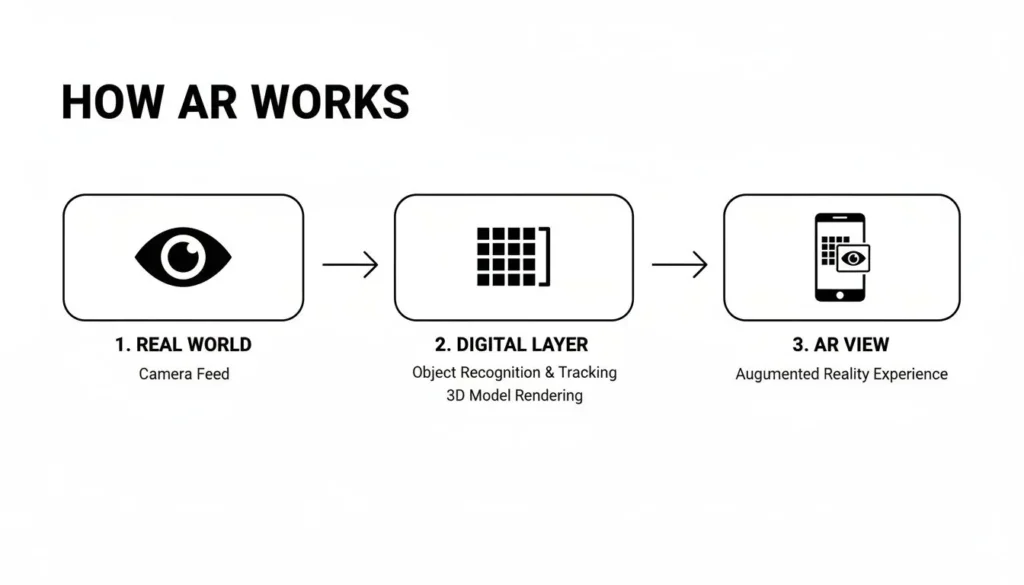
This loop—capturing reality, adding a digital layer, and presenting the final mix—is the core of how AR works.
Projecting the Digital World
Once the device has a solid map of the room, the final step is projection. This is when the digital stuff—3D models, text, or little animations—gets rendered onto your screen.
The system is smart enough to factor in perspective, scale, and even the lighting in the room to make the digital object look like it actually belongs there. It’s all about making the illusion seamless.
An AR system runs through this entire cycle—sensing, processing, and projecting—dozens of times every second. This constant, rapid repetition is what makes the experience feel smooth and interactive, turning digital additions into a natural part of your world.
This tight coordination between hardware and software is what makes AR possible. Knowing these basics helps demystify how digital information can blend so convincingly with our physical reality. For a deeper dive into how complex data fuels experiences like this, check out our guide on what data science is and how it works.
Exploring the Main Types of Augmented Reality
Augmented reality isn’t a one-size-fits-all technology. It’s really a family of different approaches, each built for a specific job. Getting to know these types helps you see just how broad AR’s potential is, moving way beyond simple selfie filters and games.
The real difference between them comes down to how an AR experience gets started and where the digital stuff shows up.
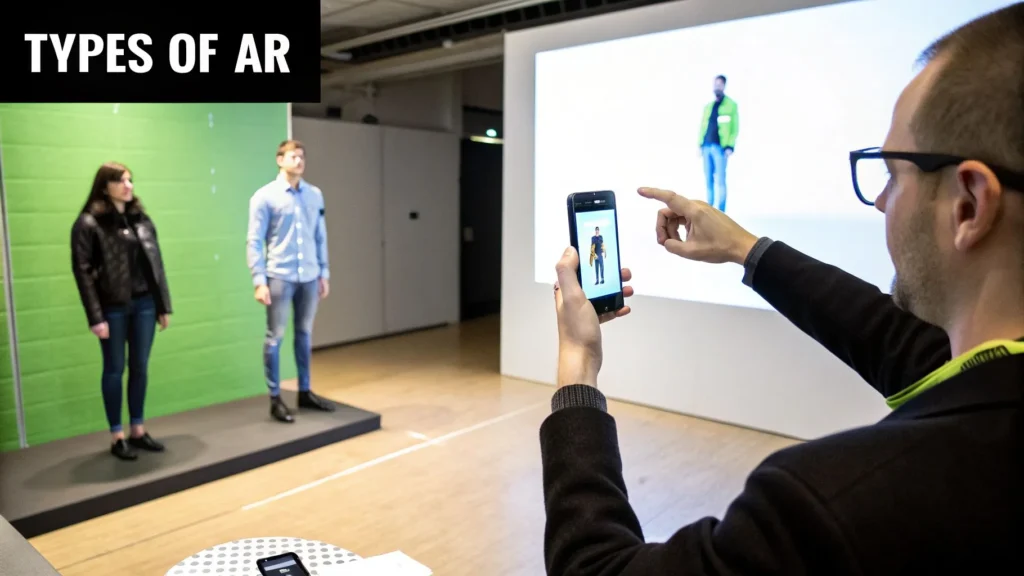
Some AR needs a specific visual cue in the real world to kick things off, almost like a secret password. Others can drop digital objects anywhere you point your device. This single distinction shapes how just about every AR app is designed and used.
Marker-Based AR
You’ve almost certainly run into Marker-based AR. This type uses a specific, easy-to-recognize image—like a QR code, a brand logo, or a custom pattern—to trigger a digital overlay. When your device’s camera spots the marker, it knows precisely where to anchor the 3D model or animation.
Think of it as a stage cue for a play. The marker essentially tells the AR app, “Right here. This is where the magic happens.”
- How it works: The app has a pre-defined image it’s looking for. The camera scans its surroundings, and as soon as it gets a match, it instantly calculates the object’s position and orientation to lock the digital content in place.
- Real-world example: Pointing your phone at a special wine bottle label and watching an animated story about the vineyard pop up on the screen.
Markerless AR
Flipping the script, markerless AR doesn’t need any special trigger image. Instead, it leans on that clever SLAM technology we covered earlier to map out the environment on the fly. It identifies flat surfaces like floors and walls, letting you place digital objects convincingly within a real space.
This approach gives you a ton more freedom and is the powerhouse behind many of the most popular mobile AR apps today.
The real beauty of markerless AR is that it works almost anywhere. By understanding the geometry of a room, it lets people place and interact with virtual content in a much more natural, spontaneous way.
The famous game Pokémon GO, for instance, uses markerless AR to make it look like a Pikachu is standing right there on the sidewalk in front of you.
Other Important AR Types
Beyond these two main categories, a few other specialized forms of AR have carved out their own niches, often in professional or industrial fields.
- Projection-Based AR: Just like it sounds, this type projects digital light directly onto physical surfaces, turning almost any object or wall into an interactive display. A great example is an interactive sandbox where a projector colors the sand to create live topographical maps as you move it around.
- Superimposition-Based AR: This powerful form swaps the real view of an object with an enhanced, augmented one. In the medical world, a surgeon might use this to overlay a patient’s CT scan directly onto their body during an operation, giving them a crucial real-time view of what’s underneath.
With all the talk about immersive tech, it’s easy to get augmented reality (AR), virtual reality (VR), and mixed reality (MR) all jumbled up. They sound similar, and they’re definitely related, but each one creates a fundamentally different experience.
Getting a handle on the core distinction is the first step. Let’s try a simple analogy. Picture yourself driving a car. Everything you see through the windshield is your normal, physical reality.
- Augmented Reality (AR) is like having a heads-up display that projects navigation arrows and your current speed right onto the glass. You still see the real road ahead, but now it’s enhanced with a handy digital layer of information.
- Virtual Reality (VR) is like replacing your entire windshield with a massive, high-res screen that teleports you somewhere else. You’re no longer seeing the road at all; you’re completely immersed in a new, fully digital place, like a racetrack or a fantasy world.
- Mixed Reality (MR) is the most sophisticated of the bunch. Imagine a holographic co-pilot sitting right there on your dashboard. It looks real, and you can even interact with it as if it were a solid object, but it’s pure data.
The key difference really boils down to one simple question: Does the technology add to your world, or does it replace it? AR adds to it, VR replaces it, and MR blends the two so digital objects can actually interact with your physical space.
AR vs. VR vs. MR: A Simple Comparison
Each of these technologies requires different gear and delivers a unique level of immersion, which is why they’re suited for completely different jobs. A quick side-by-side comparison makes these differences pop, showing you why a simple smartphone is perfect for AR, but you’ll need a dedicated headset for a true VR experience.
| Technology | What It Does | Device Example | Level of Immersion |
|---|---|---|---|
| Augmented Reality (AR) | Overlays digital information onto the real world. | Smartphones, Smart Glasses | Partial |
| Virtual Reality (VR) | Creates a fully immersive, completely digital environment. | Oculus Quest, PlayStation VR | Total |
| Mixed Reality (MR) | Blends digital and physical worlds where virtual objects can interact with real ones. | Microsoft HoloLens | High (Interactive) |
At the end of the day, AR uses the world as its canvas, while VR creates a brand new one from scratch. Mixed reality pushes that even further by making its digital creations smart enough to recognize and react to the physical environment around them. Each approach opens a totally different door—one enhances reality, another lets you escape it, and the last one merges them together.
How Augmented Reality Is Changing Our World
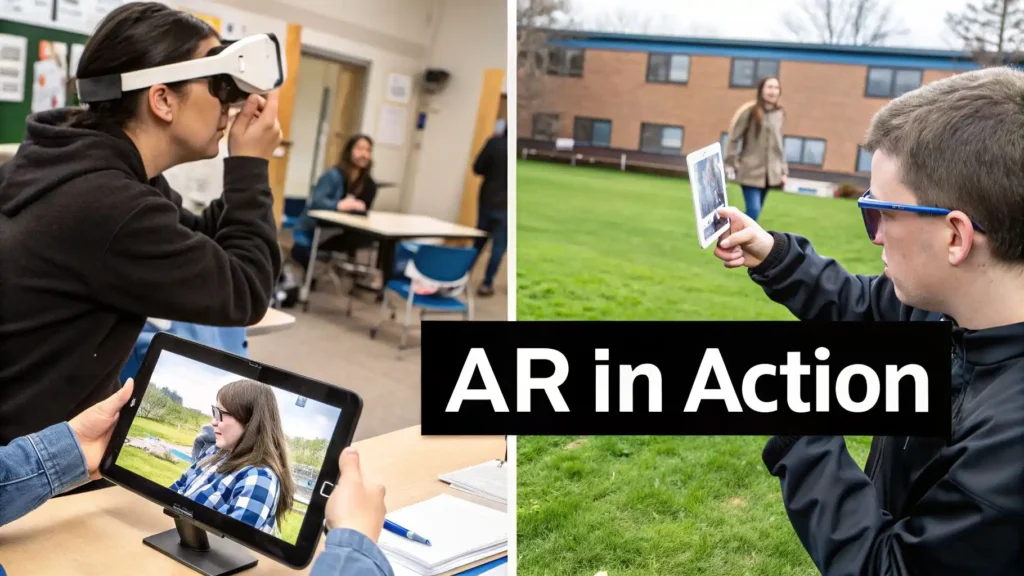
It’s easy to think of augmented reality as a far-off, futuristic idea, but the truth is it’s already here, actively solving real problems and opening up new possibilities. The real impact of AR isn’t found in sci-fi concepts; it’s in the practical tools being used every day in retail, healthcare, manufacturing, and so much more.
Take retail, for example. The age-old frustration of buying a sofa online, only to find it doesn’t fit your space, is quickly becoming a thing of the past. AR apps let you use your phone’s camera to place a true-to-scale 3D model of that sofa right in your living room. It’s more than just a cool gimmick—it solves a genuine problem for shoppers and cuts down on expensive returns for businesses.
Travel is another area getting a major upgrade. Imagine standing in front of the Roman Colosseum, pointing your phone at the ruins, and instantly seeing it rebuilt to its former glory, gladiators and all. This is what AR does. It adds a dynamic, interactive layer of history and context that a static guidebook could never hope to match.
Driving Efficiency in Technical Fields
In more technical industries like manufacturing and healthcare, AR’s practical benefits are even clearer. It’s all about getting workers the right information, right when they need it, without them ever having to look away from their task.
Think of an aircraft mechanic wearing a pair of AR glasses. Instead of juggling a clunky manual, they see step-by-step instructions projected directly onto the engine they’re fixing. This simple overlay dramatically speeds up complex repairs and, more importantly, slashes the risk of human error.
The numbers don’t lie. In manufacturing settings, AR guidance has been shown to boost worker productivity by 30-50% while simultaneously reducing mistakes and training time. In the medical world, surgeons are using AR overlays to guide their instruments with incredible precision during complex operations, improving outcomes and safety. You can dive deeper into these trends with the full market analysis from Grand View Research.
AR is becoming a powerful tool for knowledge transfer, empowering less experienced workers with the insights of a seasoned expert by overlaying critical data directly onto their field of view.
Transforming Education and Entertainment
The classroom is also being completely reimagined with AR. Instead of just reading about the solar system, students can now use a tablet to bring a 3D model of it to life, watching the planets orbit right on their desk. This kind of hands-on, visual learning makes abstract topics more exciting and far easier to grasp.
It’s a perfect example of how AR can bridge the gap between abstract ideas and real-world understanding, leading to better engagement and knowledge that actually sticks.
Of course, for many of us, our first taste of AR comes from gaming and entertainment. From catching virtual monsters in your local park to playing interactive board games that spill out onto your coffee table, these apps are built for pure fun. As the tech gets better, the experiences become more realistic and seamlessly woven into our surroundings, making entertainment feel more personal than ever. For the best sound to go with these immersive worlds, check out our guide to the best wireless headphones available now.
What to Expect from the Future of AR
While today’s augmented reality is already impressive, what’s coming next promises a much deeper, more natural blend with our daily lives. The next huge leap is about getting AR off our phone screens and directly into our line of sight through lightweight smart glasses that look and feel completely normal.
Imagine this: instead of pulling out your phone for walking directions, the arrows just appear in front of you, guiding you down the street. That kind of constant, hands-free access is what will turn AR from a neat party trick into an essential tool. The real goal is to make the technology itself invisible, leaving only the useful information behind.
The Rise of Smarter AR Experiences
The true game-changer for AR’s future will be its marriage with artificial intelligence. When you combine AR and AI, the experiences stop being passive displays and start becoming context-aware and deeply personal. An AI-powered AR system won’t just throw data at you; it will understand what you’re doing and give you exactly what you need, right when you need it.
For instance, picture yourself pointing your AR glasses at a houseplant. An AI-driven app could instantly identify it, tell you if it’s thirsty, and even spot early signs of disease. This fusion elevates AR from a simple visual layer into an intelligent partner that helps you make sense of the world.
A core idea powering this future is the AR Cloud. Think of it as a shared, persistent digital copy of the real world—an invisible data layer that allows AR experiences to be collaborative and permanent.
This is a powerful concept. It means you could leave a virtual note for a friend on a specific park bench for them to find later. It also unlocks the door for massive, multiplayer AR games where everyone sees and interacts with the same digital objects in the same physical spaces. If you’re curious about how these kinds of interconnected data systems work, you might find our guide on what blockchain technology is interesting.
Of course, a few major hurdles are still in the way. Engineers are working hard to crack some tough nuts before AR glasses become something we all wear:
- Battery Life: All that constant processing and displaying information is a massive power drain.
- Social Acceptance: Let’s be honest, designing glasses that don’t look weird is a huge challenge.
- Privacy Concerns: An always-on camera that’s constantly mapping the world raises some serious questions about data and security.
Once these issues are solved, we’ll be heading into a future where the line between our physical and digital worlds becomes wonderfully, and usefully, blurred.
Still Have Questions About Augmented Reality?
Let’s clear up a few common questions that pop up when people are first getting their heads around AR. Think of this as a quick-fire round to solidify what we’ve talked about.
What’s a Simple Example of AR I Can Try Right Now?
One of the best is Google Maps Live View. When you’re walking, just hold up your phone. The app overlays giant digital arrows and street signs directly onto your camera’s feed, literally pointing the way.
Another fantastic one is the IKEA Place app. It lets you drop true-to-scale 3D models of furniture right into your living room. You can see exactly how that new couch will fit before spending a dime.
Do I Need Special Glasses to Use AR?
Nope, not for most of the AR you’ll encounter today. While dedicated AR headsets and smart glasses are definitely part of the picture, the powerful smartphone you already own is the most common way to experience augmented reality.
The real magic of AR’s growth is its accessibility. Billions of phones are already AR-ready, using their built-in cameras and sensors to blend digital and physical worlds without any extra gear.
This incredibly low barrier to entry is exactly why AR has exploded in popularity across so many different fields.
What’s the Main Difference Between AR and VR?
Here’s the simplest way to remember it: Augmented Reality (AR) adds to your world, while Virtual Reality (VR) replaces it.
With AR, you’re always grounded in your physical space, just with digital information layered on top. In VR, you put on a headset that completely blocks out your surroundings, immersing you in a 100% computer-generated environment. It’s the difference between enhancing reality and escaping it entirely.
At maxijournal.com, we love digging into the tech that’s shaping our lives. For more deep dives into the tools of tomorrow, check out our latest articles at https://maxijournal.com.
Discover more from Maxi Journal
Subscribe to get the latest posts sent to your email.