So, you’re thinking about getting your dog professionally trained. That’s a fantastic decision! It’s one of the best things you can do for your relationship, building a common language that leads to a safer, happier life together. But let’s be honest, the first question on everyone’s mind is usually: “How much is this going to cost?”
On average, you can expect to pay anywhere from $50 for a single group class to over $2,500 for a comprehensive board-and-train program. The final bill really comes down to the type of training you choose, your dog’s unique personality and challenges, and even where you live.
What to Expect From This Guide
Think of budgeting for dog training like planning for your own fitness goals. You could join a budget-friendly group class at the local gym, hire a personal trainer for one-on-one attention at a higher price, or go all-in on an immersive wellness retreat. Each path has a different price and serves a different purpose.
This guide is here to break it all down for you, making sense of the costs so you can find the perfect fit for your wallet and your pup. We’ll walk through:
- The Different Ways to Train: From group classes to private sessions and everything in between.
- What Drives the Price: We’ll look at why a trainer in a big city might charge more than one in a small town.
- The Gear You’ll Need: A quick look at the essential equipment you might need to buy.
- How to Save Money: Tips and tricks for finding top-notch training that doesn’t break the bank.
A well-trained dog isn’t just an expense—it’s an investment. You’re investing in a more peaceful home, fewer chewed-up shoes, and a stronger bond with your four-legged best friend.
Our goal is simple: to give you a clear, no-nonsense look at the costs so you can confidently choose the right training for you and your dog.
Comparing Different Dog Training Programs
Figuring out the right training program for your dog can feel a lot like picking a school. There are different formats for different personalities, learning styles, and, of course, budgets. The best fit really comes down to your dog’s specific needs, your own lifestyle, and what you’re looking to achieve together.
Let’s walk through the most common options and what you can expect to pay for each.
Group Obedience Classes
For many dog owners, especially those with puppies who need to learn how to be around other dogs, group classes are the perfect starting point. Think of them as the community classroom of dog training—they’re social, affordable, and fantastic for nailing the basics while your dog learns to focus with distractions around.
- Average Cost: You’ll typically find multi-week courses (usually 4 to 8 weeks) for $100 to $250.
- Best For: Fundamental commands like sit, stay, and come, practicing good leash manners, and socializing your dog in a safe, structured way.
- Keep in Mind: The trainer’s attention is split among the whole class. This setup isn’t built for tackling serious or deep-rooted behavioral issues like aggression or severe anxiety.
Private One-on-One Training
If group classes are the classroom, private training is like getting a personal tutor. These sessions are built entirely around you and your dog, giving you an expert’s undivided focus to work through your unique challenges. It’s hands-down the best path for complex behavior problems.
The real magic of private training is that the expert can see your dog in your home—their turf—and spot the subtle triggers and patterns you might miss. This personalized strategy means you often see faster, more meaningful results, but that focused attention comes with a higher price tag.
This infographic breaks down the typical cost differences you’ll see.
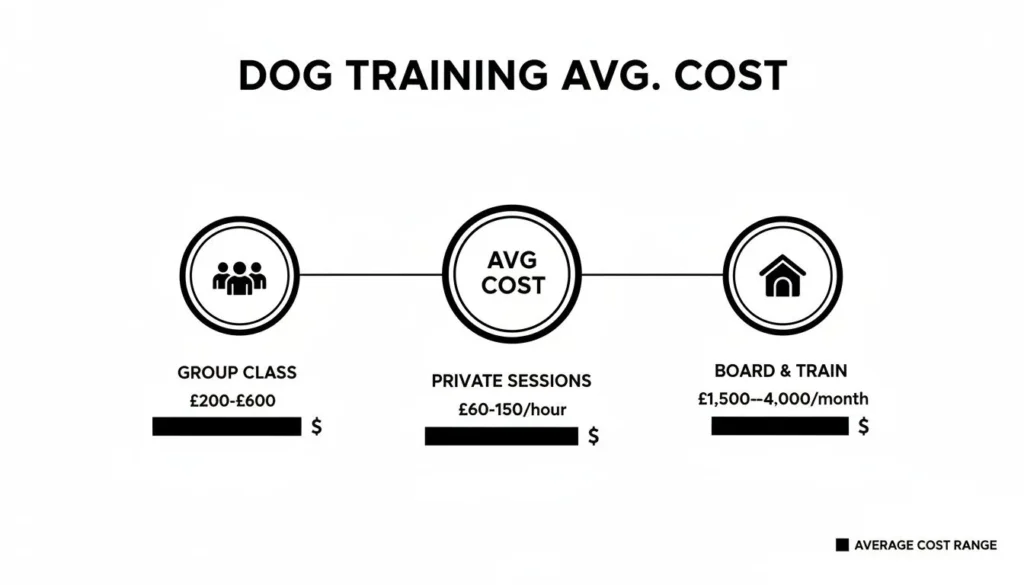
As you can see, there’s a pretty big leap in cost from group classes to something like a board-and-train program. That jump directly reflects the amount of intensive, one-on-one time and expertise involved.
Board-and-Train Programs
Often called “doggy boot camps,” board-and-train programs are the most immersive—and most expensive—option out there. Your dog goes to live with a professional trainer for a few weeks, getting daily, focused training sessions.
This is a great option for owners facing significant behavioral hurdles or those whose schedules just don’t allow for daily training reinforcement. But remember, a huge piece of the puzzle is teaching you how to maintain the training. Any good program will include handler sessions to make sure you know how to lead your dog when they get home.
A trainer’s job isn’t just to train the dog; it’s to train the person at the other end of the leash. Without owner involvement, even the best-trained dog may revert to old behaviors once they return home.
Online Dog Training Courses
In recent years, online courses have become a really popular and wallet-friendly choice. They offer amazing flexibility, letting you learn and practice from home on your own schedule. If you’re a self-starter who wants to master basic obedience and work through minor issues, this can be an excellent resource.
The dog training industry itself is a huge slice of the pet care world. In the U.S., it’s projected to be a $287.5 million industry by 2026. That number covers everything from hourly private sessions, which average $50-$150 an hour, to highly specialized programs for service dogs that can cost over $20,000. You can dig deeper into data on the dog training services market.
Here’s a quick rundown of how the options stack up:
| Training Type | Typical Cost | Key Benefit |
|---|---|---|
| Group Classes | $100 – $250 (package) | Socialization & affordability |
| Private Training | $75 – $200 (per hour) | Customized & targeted |
| Board-and-Train | $1,500 – $5,000+ (package) | Intensive & immersive |
| Online Courses | $50 – $300 (one-time fee) | Flexible & convenient |
Getting familiar with these different models is the first step in making a smart investment in your dog’s behavior and your shared future. And speaking of smart financial decisions, you might also find our guide on the best travel insurance for international trips helpful.
So, What Goes Into the Final Price Tag?
Ever get a quote from a dog trainer and wonder why it’s so different from the last one you saw? It’s not arbitrary. The total cost of dog training is a lot like a recipe—several key ingredients mix together to determine the final price. Knowing what these are helps you understand exactly what you’re paying for.
Think of it this way: when you hire a plumber, you’re not just paying for the hour they’re at your house. You’re paying for their experience, their specialized tools, and the complexity of the problem. Dog training works the same way. A trainer’s background, your zip code, and your dog’s unique personality and challenges all weigh heavily on the cost.
The Trainer’s Expertise and Credentials
One of the biggest factors is, without a doubt, the trainer’s background. A professional who just earned their first basic certification is going to be more affordable than a Certified Applied Animal Behaviorist (CAAB) who has a master’s degree and a decade of experience with complex cases.
- Certifications: Trainers who invest in top-tier certifications from respected organizations like the CCPDT or IAABC often have higher rates. This isn’t just a piece of paper; it reflects a serious commitment to ethical practices and staying current on the science of animal behavior.
- Specialization: Is your dog struggling with severe aggression or separation anxiety? A trainer who specializes in these tough cases has a very specific, high-demand skill set, and their pricing will reflect that. The same goes for those who train service dogs.
- Experience: A seasoned pro with a long list of success stories simply has a proven track record. You’re paying a premium for their ability to read a situation, adapt their methods, and get results efficiently.
Your Geographic Location
Where you live plays a huge role. A trainer running a business in a major city like New York or San Francisco has sky-high overhead—facility rent, insurance, gas—and their prices have to cover those costs. In contrast, a trainer in a smaller, more rural town will likely have lower expenses, which can translate into more budget-friendly rates for you.
A higher price doesn’t automatically guarantee a better trainer, and a low price doesn’t mean they’re a bad one. It’s on you to vet their credentials, methods, and reviews alongside the cost.
Your Dog’s Specific Needs
Finally, the biggest variable is your dog. A group class teaching basic puppy manners is a world away from a one-on-one program designed to tackle deep-seated fear or reactivity. The more complex the issue, the more time, skill, and customization are required from the trainer.
The demand for good training is massive. North America alone accounts for over 35% of the global revenue in the dog training market, a figure driven by high pet adoption rates and a growing desire to give our dogs the best life possible. Prices reflect this demand. A multi-week group class for basic obedience might cost between $100 and $250, but a private package for serious behavioral issues could easily range from $500 to over $1,500. You can learn more about the scale of the dog training market and see just how big the industry is.
Here’s a quick breakdown of how your dog’s situation affects the price:
- Age and History: A fresh-faced puppy learning “sit” is a different project than a newly adopted adult dog with a mysterious past and a boatload of trust issues.
- Behavioral Issues: Tackling problems like resource guarding, leash reactivity, or dog-to-dog aggression requires a much more intensive and specialized plan.
- Breed Traits: Some breeds have powerful instincts, like a Border Collie’s need to herd or a Great Pyrenees’ drive to guard. Working with (not against) these traits often requires a more nuanced approach, which can add to the cost.
Budgeting for Essential Training Equipment
The trainer’s fee is a big piece of the puzzle, but it’s not the whole picture. When you’re figuring out your total dog training cost, don’t forget to factor in the gear you’ll need to make the lessons stick. It’s like signing up for a new class—the tuition is just the first step. You still need the right tools to actually do the work.

This equipment isn’t just a bunch of “nice-to-haves.” These are the tools that help you reinforce what your trainer teaches, creating consistency between your sessions and the practice you do at home.
Core Training Supplies
Every dog and owner needs a basic kit to get started. You might already have some of these things, but training often calls for specific gear that’s safer and more effective for teaching new skills.
Here are the essentials you can’t skip:
- A well-fitting collar or harness ($20 – $60): Your trainer will almost certainly have an opinion on this. Many recommend a front-clip harness to gently discourage pulling without putting any pressure on your dog’s neck.
- A sturdy leash ($15 – $40): A standard 6-foot leash is the classic choice for a reason—it gives you control while giving your dog a little freedom. You’ll probably be told to ditch the retractable leash, as they can teach bad habits and be a safety risk.
- High-value treats ($10 – $30 per month): We’re not talking about your dog’s everyday kibble. Think tiny, soft, smelly treats that get your dog genuinely excited to learn.
This spending isn’t trivial. The global market for dog training equipment was valued at USD 2.5 billion in 2025 and is on track to nearly double. That’s a clear sign of how much owners are investing in these tools. For many people, this can easily add up to an annual equipment budget of several hundred dollars. You can find more details on the growing market for dog training gear if you’re curious.
Helpful Training Aids and Tech
Once you have the basics covered, a few extra tools can really help accelerate your dog’s progress. These are the kinds of items often recommended by trainers who lean on positive reinforcement to build good behavior.
Key Takeaway: Pay close attention to the tools a trainer recommends—it’s a huge clue about their training philosophy. A list full of treat pouches, clickers, and puzzle toys points to a positive, rewards-based approach. A focus on prong collars, e-collars, or choke chains suggests a more old-school, punishment-based mindset.
Consider making room in your budget for these:
- Clicker ($3 – $10): A simple but powerful tool. It makes a distinct “click” to mark the exact moment your dog does the right thing, making communication crystal clear.
- Treat pouch ($10 – $25): Keeps those high-value rewards within easy reach, so you can reinforce good behavior instantly, whether you’re at home or on a walk.
- Puzzle toys or mats ($15 – $50): These are fantastic for giving your dog’s brain a workout. A mentally tired dog is a happy (and less destructive) dog.
- Pet camera ($50 – $200+): If you’re tackling issues like separation anxiety, a camera is invaluable for seeing what’s really happening when you’re not there.
Finding Affordable and High-Quality Training
Let’s be honest, seeing the price tag on some dog training programs can be a real shock. But that high dog training cost doesn’t mean you have to choose between your budget and a well-behaved dog. It’s absolutely possible to find fantastic, effective training without breaking the bank—you just have to know what you’re looking for.

Think of it less like bargain hunting and more like smart investing. You want the best return—a happy, well-adjusted dog—for your money. A little bit of research up front can save you a ton of cash and ensure your dog is getting the quality instruction they deserve.
Creative Ways to Reduce Training Costs
Saving money doesn’t mean you have to settle for a subpar experience. In fact, many professional trainers and organizations offer excellent ways to make their services more accessible. The trick is to get proactive and explore your options.
Here are a few proven ways to lower your costs:
- Check Local Non-Profits: Your local animal shelter or rescue group often runs low-cost group classes for the community. They’re usually taught by great trainers and are a perfect way to support a good cause while you train.
- Ask About Package Deals: Almost every trainer will offer a discount if you buy a bundle of sessions instead of paying one by one. This is one of the easiest ways to drop the per-session cost.
- Leverage Free Resources: Supplement paid classes with top-notch free content. Look up videos from trusted sources like the American Kennel Club (AKC) or reputable trainers on YouTube to brush up on basic commands.
- Practice Consistently at Home: The real magic happens between your official lessons. Just 10-15 minutes of practice each day cements what your dog is learning, which means you get way more value out of every single professional session.
It’s a lot like how savvy travelers find great deals. For more tips on that, you might find our guide on how to find cheap flights useful.
Red Flags of a “Too Good to Be True” Price
While a good deal is always welcome, an unbelievably low price can sometimes be a major warning sign. Here’s a critical thing to remember: dog training is a largely unregulated field. That means anyone, regardless of their experience or education, can hang out a shingle and call themselves a “trainer.”
A rock-bottom price might signal a lack of experience, no real certification, or worse, a reliance on outdated and harmful training methods.
Be wary of any trainer who offers a “guaranteed fix” for a low price. Behavior is complex, and ethical trainers focus on management and improvement, not unrealistic promises.
Keep an eye out for these red flags:
- Vague credentials or a background that boils down to “I grew up with dogs.”
- Use of punitive tools like prong collars, shock collars (e-collars), or choke chains as a first resort.
- Language centered on “dominance,” being the “alpha,” or forcing your dog to submit.
Your dog’s safety and well-being come first. It’s always a better value to invest a little more in a qualified, positive reinforcement trainer than to save a few bucks with someone who could do more harm than good.
Is Professional Dog Training a Smart Investment?
When you see the final bill for a training package, it’s natural to hesitate. That number can feel big. But try to reframe the dog training cost as an investment, not just another expense. Doing so completely changes the perspective. You aren’t just paying someone to teach “sit” and “stay”; you’re investing in a safer, happier, and less stressful life with your dog.
Think about it this way: proactive training is your best defense against much bigger costs down the road. A dog who learns what’s okay to chew and what isn’t can save you hundreds, maybe even thousands, in replacing furniture, shoes, or drywall. A dog who is properly socialized is far less likely to get into a scuffle that results in steep vet bills or, even worse, legal trouble.
Beyond the Price Tag
The real return on your investment goes way beyond money. It’s about building a strong, healthy relationship based on clear communication and trust. That bond is the bedrock of a wonderful life together.
The goal isn’t just to stop bad behaviors; it’s to give your dog the confidence and skills to be a happy, well-adjusted member of your family. This prevents small issues from escalating into serious problems that are far more expensive and difficult to solve later on.
Good training dramatically lowers the stress level for everyone in the house. Imagine not having to worry about how your dog will act when guests come over, or dreading every walk because of pulling and lunging. You get to simply enjoy your dog’s company. That kind of peace of mind is priceless.
The best training isn’t always the most expensive program. It’s the one that correctly identifies your dog’s specific needs and is taught by a qualified professional using modern, positive methods. Making the right choice here is about empowering yourself to build a fantastic life with your canine companion.
Many principles of clear communication and positive reinforcement are universal. For a different perspective on ensuring quality interactions, you might find our article on customer service best practices surprisingly relevant. At the end of the day, you’re not just buying lessons; you are investing in a lifetime of better behavior and a stronger bond.
Your Top Questions About Dog Training Costs, Answered
Even after breaking down the numbers, you probably still have a few questions. That’s completely normal. Let’s tackle some of the most common ones that pop up when people are planning their dog training budget.
How Much Should I Actually Budget for a New Puppy?
If you’re bringing home a new puppy, a realistic starting budget for training is somewhere between $300 and $800.
This initial investment usually gets you a multi-week group puppy class (around $150-$250) to nail down socialization and basic cues. It also leaves room for a couple of private sessions (another $150-$400) to work on those specific at-home headaches like house soiling or crate training meltdowns.
And don’t forget the gear! Set aside another $50 to $100 for the essentials: a good-fitting harness, a solid leash, and, of course, a ton of high-value treats to keep them motivated.
Are Online Dog Training Courses Actually Worth It?
Absolutely, as long as you’re using them for the right reasons. Online courses can be a fantastic, budget-friendly way to learn foundational obedience skills or work through minor issues like jumping on guests. They give you the freedom to learn at your own pace and are perfect if you’re a hands-on, self-motivated owner.
Where they fall short is with serious behavioral problems. Things like aggression, resource guarding, or severe separation anxiety really need the expert eye of a professional who can be there in person. Those situations are too complex and high-stakes for a pre-recorded video to solve.
Think of it this way: An online course is like a great cookbook. It gives you all the ingredients and instructions, but if your kitchen is on fire, you need to call the fire department, not just re-read the recipe.
Will My Pet Insurance Help Pay for Behavioral Training?
This is a fantastic question, and the answer is a solid “maybe.” Your standard pet insurance plan almost certainly won’t cover general obedience training or puppy classes.
However, some of the more comprehensive plans, or special wellness add-ons, might offer reimbursement for behavioral modification. The key is that it usually has to be prescribed by your veterinarian to treat a diagnosed behavioral condition.
- What might get covered: Working with a certified behaviorist to treat diagnosed issues like severe anxiety, compulsive disorders, or certain types of aggression.
- What probably isn’t covered: Standard puppy kindergarten, basic manners classes, or training for fun dog sports.
The only way to know for sure is to read the fine print of your specific policy. Call your insurance provider and ask them directly what they cover—the rules vary wildly from one company to the next.
At maxijournal.com, we publish clear guides to help you navigate life’s complexities. Explore more articles on pets, travel, and technology at https://maxijournal.com.
Discover more from Maxi Journal
Subscribe to get the latest posts sent to your email.