Welcome, parents and aspiring young athletes! Before the flashy dunks and three-point swishes, every great basketball journey begins with a fundamental skill: dribbling. A player’s ability to control the ball with confidence is the bedrock upon which all other skills are built. It’s the difference between controlling the game and the game controlling you. A strong handle allows a young player to see the court, make smart passes, and attack the basket without fear of losing the ball.
This guide cuts through the noise to deliver a curated list of the most effective basketball dribbling drills for kids. We’ll move beyond simple bouncing and dive into specific exercises designed to build hand-eye coordination, finger-pad control, and court awareness. Forget generic advice; you will find actionable instructions and clear goals for every drill, making practice sessions productive and engaging.
We’ve designed this resource for both the beginner picking up a ball for the first time and the intermediate player looking to gain a competitive edge. Inside, you’ll discover:
- Step-by-step breakdowns of 8 essential drills.
- Coaching cues to correct common mistakes.
- Skill progressions to challenge players as they improve.
- Fun, game-based drills to keep kids motivated.
Our goal is to provide a clear roadmap for developing a skilled and confident ball-handler. Let’s start building that foundation.
1. Stationary Dribbling (Figure-8 Pattern)
The stationary figure-8 drill is a cornerstone of fundamental basketball training and one of the most effective basketball dribbling drills for kids to master ball control. It teaches young players how to feel the basketball without looking at it, developing essential hand-eye coordination and spatial awareness. Because it requires no court space, it’s an ideal drill for practice at home, in a garage, or during physical education class.
This drill involves standing with feet shoulder-width apart and knees bent in an athletic stance. The player then dribbles the ball in a figure-8 pattern around and through their legs. This continuous motion forces them to use both hands, build fingertip control, and keep the dribble low and protected. USA Basketball’s youth coaching guidelines and the foundational methods of legendary coach John Wooden frequently feature this drill for its pure focus on ball handling.
How to Implement the Figure-8 Drill
Setup:
- Stance: Start in a low, athletic stance with feet wide and knees bent. This position lowers the center of gravity, making it easier to control the ball.
- Ball Position: Begin by dribbling with one hand on one side of your body.
Execution:
- Dribble the ball from the front of your body, through your legs, to the back.
- Receive the ball with your other hand behind your legs.
- Continue the dribble with the new hand, bringing it around the outside of that leg to the front.
- Repeat the motion, passing it through your legs to the original hand, completing the figure-8 shape.
Coaching Cue: “Pound the ball! Don’t be afraid to dribble it hard. A strong, low dribble is harder for a defender to steal.”
Tips for Success & Progression
To get the most out of this drill, focus on proper technique first and speed later. Encourage kids to keep their eyes up instead of watching the ball. This builds a critical habit of surveying the court while handling the ball.
- Beginner: Start very slowly, even without dribbling. Just pass the ball around the legs to get the motion down.
- Intermediate: Focus on keeping the dribble low (below the knees) and maintaining a consistent rhythm. Try alternating directions from clockwise to counter-clockwise.
- Advanced: Increase the speed of the dribble. Challenge the player to complete as many figure-8s as possible in 30 seconds.
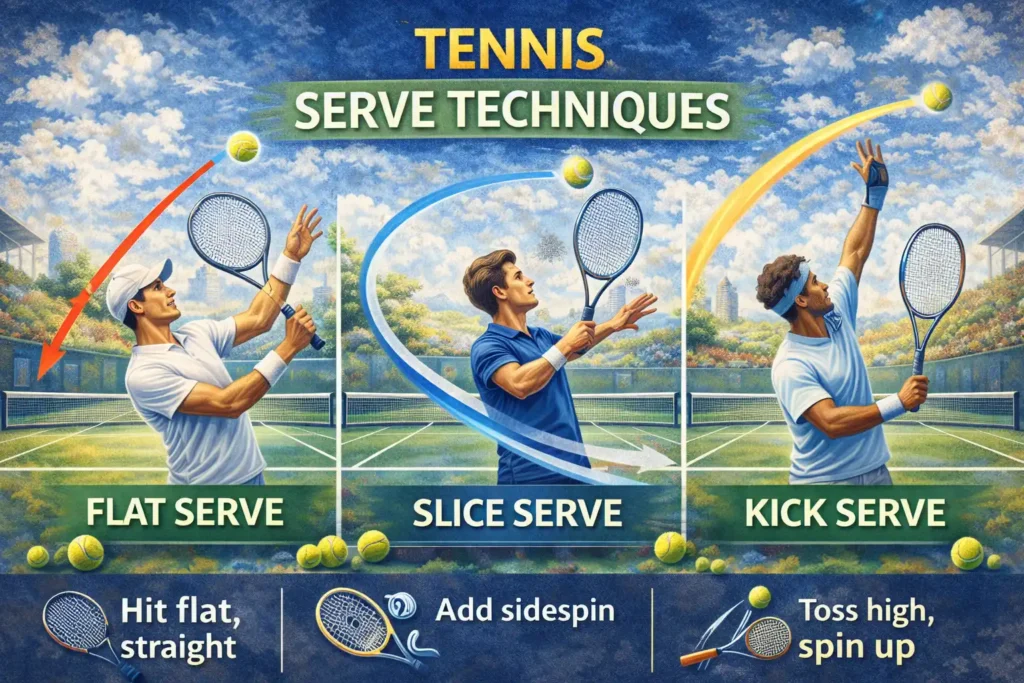
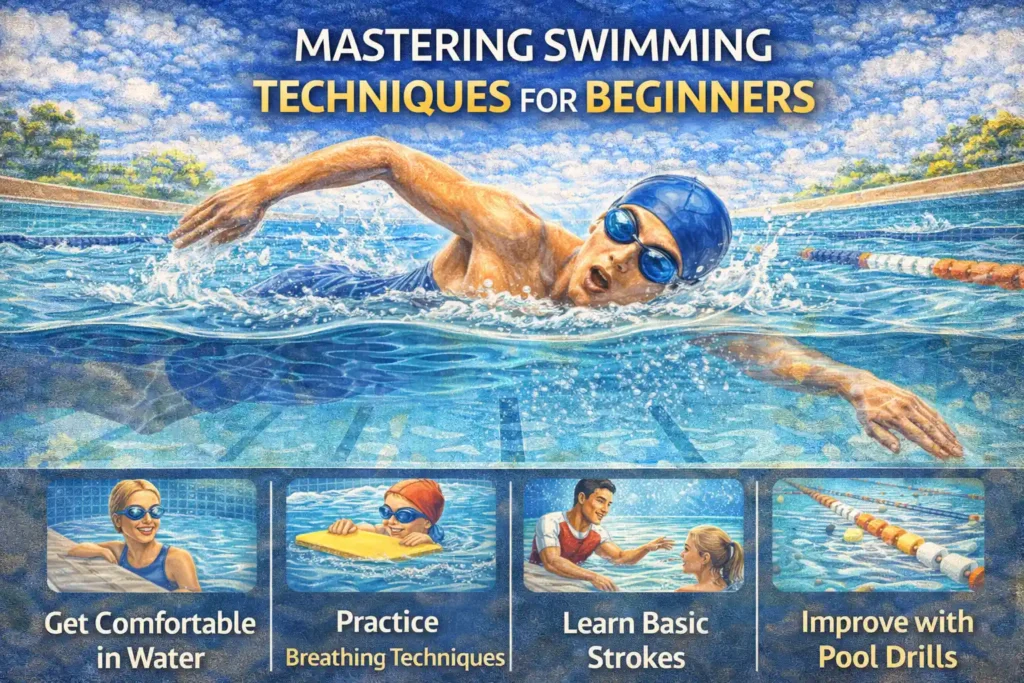
Just as swimmers develop a feel for the water, this drill helps players develop a feel for the basketball. If you’re looking for ways to improve overall body coordination, you might find valuable insights in articles about different athletic disciplines, such as these swimming techniques for beginners. Building a broad athletic base can support skill development in any sport.
2. Cone Weaving Drill
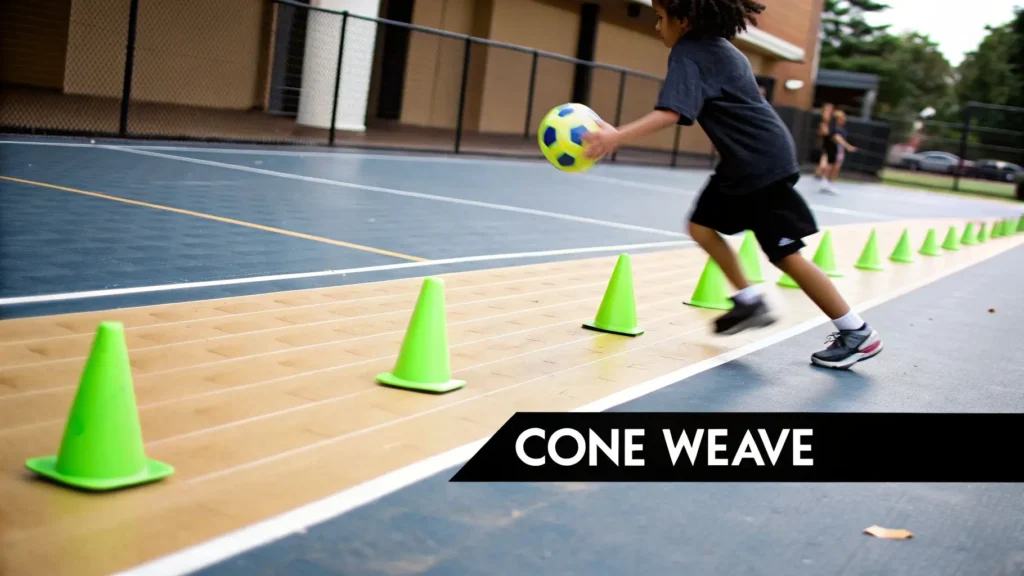
The cone weaving drill is a dynamic and engaging exercise that bridges the gap between stationary control and in-game movement. It stands as one of the most practical basketball dribbling drills for kids because it simulates navigating through defenders on the court. This drill forces players to combine footwork, speed, and ball handling, teaching them to keep the ball close while changing direction.
This drill is a staple in youth basketball programs everywhere, from local leagues to elite training camps run by Nike and Adidas. Its effectiveness lies in its direct application to game situations, where players rarely dribble in a straight line. By weaving through cones, kids learn to protect the ball with their body, use crossover dribbles effectively, and keep their head up to see the path ahead.
How to Implement the Cone Weaving Drill
Setup:
- Cones: Place 5 to 8 cones in a straight line, spaced approximately 3-4 feet apart.
- Player Position: The player starts at one end of the line of cones.
Execution:
- Begin dribbling with the right hand on the right side of the first cone.
- As you approach the space between the first and second cone, perform a crossover dribble, switching the ball to your left hand.
- Weave around the second cone with your left hand.
- Continue this pattern, executing a crossover in between each cone and using the outside hand to dribble around the next cone.
- Once at the end, turn around and repeat the drill coming back.
Coaching Cue: “Stay low! A low center of gravity gives you the balance to change directions quickly without losing control of the ball.”
Tips for Success & Progression
The primary goal is maintaining control while in motion. Speed will come naturally as comfort and skill improve. A key point of emphasis is to encourage players to keep their eyes forward and anticipate the next cone, just as they would anticipate a defender’s move.
- Beginner: Start by walking through the cones slowly. Focus on making a clean crossover dribble between each cone without fumbling the ball.
- Intermediate: Increase the pace to a jog. Challenge the player to complete the drill using only their non-dominant hand to build confidence and ambidexterity.
- Advanced: Decrease the spacing between the cones to force quicker, tighter dribbles. Time each run and encourage the player to beat their previous best time.
This drill is excellent for building agility and coordination, skills that are transferable across many sports. To learn more about how different training methods can support overall athletic development, exploring resources on varied sports like this guide to tennis serves can provide a broader understanding of kinetic chains and body mechanics.
3. Two-Hand Dribbling Switch
The two-hand dribbling switch is an essential building block for developing ambidextrous ball handlers and stands as one of the most practical basketball dribbling drills for kids. This drill focuses on moving with the ball and smoothly transferring it from one hand to the other, a foundational skill for evading defenders and creating offensive opportunities. It simulates game-like movement, teaching young players to be comfortable handling the ball with either hand while in motion.
This drill is a core component of youth development programs worldwide, from Coach Mike Krzyzewski’s Duke basketball program to the International Basketball Federation (FIBA) youth guidelines. Its value lies in building confidence in a player’s non-dominant hand, turning a potential weakness into a strength. By mastering the simple crossover motion, kids learn to protect the ball and navigate the court effectively.
How to Implement the Two-Hand Dribbling Switch
Setup:
- Space: Find an open area, such as a driveway or half-court, with enough room to take several steps forward.
- Ball Position: Start with the basketball in one hand, ready to dribble forward.
Execution:
- Begin walking forward while dribbling the ball with your right hand.
- After two or three dribbles, push the ball across your body in front of you to your left hand. The dribble should be low and quick.
- Catch the dribble with your left hand and continue moving forward, now dribbling with your non-dominant hand.
- After another two or three dribbles, switch the ball back to your right hand.
- Continue this alternating pattern as you move down the court.
Coaching Cue: “Keep your hand on top of the ball. Push it across your body, don’t slap at it. Control the crossover.”
Tips for Success & Progression
The primary goal is control, not speed. A smooth, controlled crossover is far more effective than a fast, sloppy one. Young players should focus on making the switch seamless, keeping the ball at waist height or lower.
- Beginner: Start by practicing the crossover while standing still. Dribble three times with the right hand, then cross over. Three times with the left, then cross back. Once comfortable, progress to a slow walk.
- Intermediate: Increase the pace from a walk to a jog. Focus on keeping the eyes up to see the court, not the ball. Use audible counting (“one, two, cross!”) to maintain a steady rhythm.
- Advanced: Perform the drill at a running speed. Decrease the number of dribbles between each switch, eventually moving to a quick 1-to-1 crossover with every step.
4. Mirror Dribbling (Partner Drill)
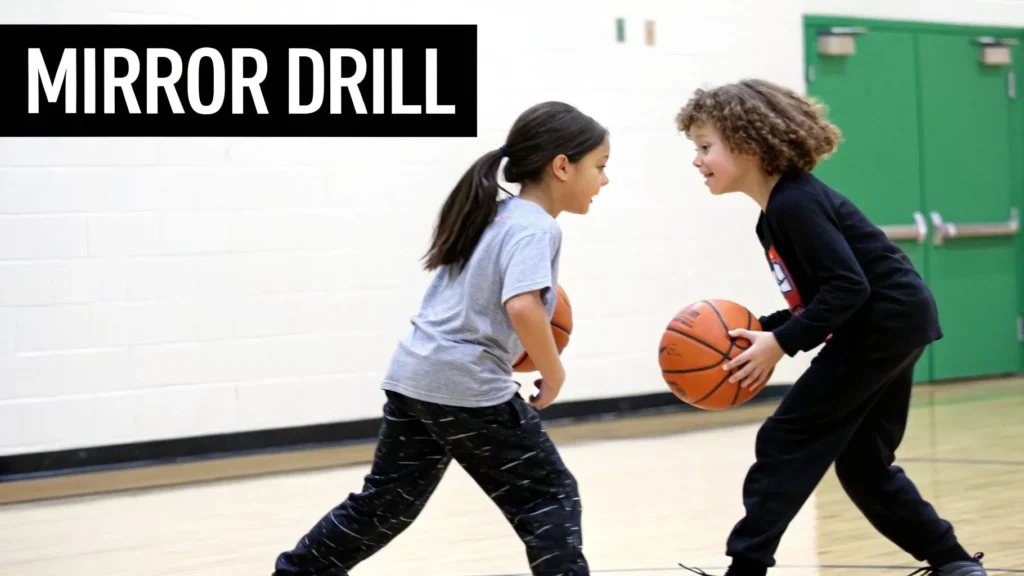
Mirror Dribbling is an engaging and interactive partner drill that turns fundamental skill-building into a fun game. It is one of the most effective basketball dribbling drills for kids because it develops reactive abilities alongside ball control. The drill requires two players: a “leader” and a “mirror,” with the mirror’s job being to copy the leader’s every dribble and movement. This dynamic interaction helps improve hand-eye coordination, reaction time, and peripheral vision.
Because it mimics the unpredictability of a real game scenario, Mirror Dribbling is a staple in youth basketball leagues and elementary school physical education programs. Sport England’s youth basketball guidelines often recommend this activity for its ability to teach players how to watch an opponent’s body instead of just the ball, a critical defensive and offensive skill. It builds concentration and the ability to adapt quickly to changing situations on the court.
How to Implement the Mirror Drill
Setup:
- Partners: Two players face each other, standing approximately 6 to 8 feet apart. Each player has a basketball.
- Roles: Designate one player as the “leader” and the other as the “mirror.”
Execution:
- Both players begin dribbling in a stationary position.
- The leader starts performing various dribbling moves, such as crossovers, between-the-legs dribbles, or simply changing dribble height and speed.
- The mirror must react and copy the leader’s movements as quickly and accurately as possible.
- After a set time (e.g., 30-60 seconds), the players switch roles.
Coaching Cue: “Mirror the leader’s shoulders and hips, not just the ball! That’s how you learn to anticipate their next move.”
Tips for Success & Progression
The primary goal is to foster quick reactions and court awareness, so the focus should be on observation and imitation rather than complex moves. Encourage players to keep their eyes up to see their partner fully.
- Beginner: The leader should use slow, simple, and exaggerated movements, like high dribbles, low dribbles, and stationary crossovers.
- Intermediate: The leader can add lateral movements (dribbling side to side), forward and backward steps, and quicker combinations.
- Advanced: Introduce more game-like moves, such as hesitation dribbles or behind-the-back moves. Challenge the mirror to maintain perfect timing with the leader for an entire minute without a mistake.
5. Speed and Control Dribbling
Speed and control dribbling is a fundamental drill that teaches young athletes how to maintain possession of the basketball while changing pace, a critical skill for in-game situations. It effectively bridges the gap between stationary ball-handling and applying those skills at game speed. By practicing dribbling at various speeds, kids learn to protect the ball, keep their eyes up, and react to the flow of the game, whether they’re pushing the ball on a fast break or navigating a crowded half-court set.
This progressive drill is a staple in high school conditioning programs and professional player development camps because it directly translates to on-court performance. It simulates the dynamic nature of basketball, requiring players to transition from a slow, controlled dribble to an all-out sprint without losing the ball. The ability to change speed on demand is what separates good ball handlers from great ones.
How to Implement the Speed and Control Drill
Setup:
- Space: Use the full length of a basketball court, or a clear, long space (like a driveway or park path) of at least 50-60 feet.
- Markers: Use the court’s existing lines (baseline, free-throw line, half-court) or place cones at different intervals.
Execution:
- Start at the baseline in an athletic stance.
- Dribble to the first mark (e.g., the free-throw line) at a slow, controlled pace (about 50% speed). Focus on keeping the ball low and your head up.
- From the first mark to the second (e.g., half-court), increase your pace to a medium speed or a light jog (about 75%).
- From the second mark to the opposite baseline, accelerate to a fast sprint (about 90-100% speed), pushing the ball out in front while maintaining control.
- Repeat the drill coming back down the court, alternating hands.
Coaching Cue: “Head up, eyes forward! See the court, not the ball. Push the ball out in front of you when you sprint.”
Tips for Success & Progression
The primary goal is to maintain control at every speed; speed itself is secondary. As players become more comfortable, they can focus on increasing their pace without sacrificing ball security. It’s crucial that players warm up properly before sprinting to avoid strains.
- Beginner: Start by walking the drill. Focus solely on the mechanics of dribbling while moving, without worrying about speed.
- Intermediate: Introduce the three distinct speeds (slow, medium, fast). Use verbal cues like “Walk,” “Jog,” and “Run” to guide the child. Practice with both the dominant and non-dominant hand.
- Advanced: Add a defensive element, such as having a coach or parent apply light pressure. Incorporate a crossover or behind-the-back move at each change-of-speed marker.
Proper technique during acceleration and deceleration is important for performance and safety. To better understand how to move efficiently and avoid common issues, you can learn more about how to prevent sports injuries through foundational athletic principles. This knowledge helps create a more durable and confident young player.
6. Wall Dribble and Catch
The Wall Dribble and Catch is a dynamic and engaging drill that teaches children to anticipate ball movement and improve their reaction time. Unlike static drills, this exercise introduces an element of unpredictability, forcing young players to adjust their hands and body to receive a rebound. It is one of the most effective basketball dribbling drills for kids to build hand-eye coordination and an understanding of how the ball behaves after contacting a surface.
This drill is excellent for solo practice and can be done in a basement, garage, or against any suitable wall in a gymnasium. It simulates receiving a quick pass or reacting to a loose ball, training reflexes that are crucial during a live game. Recommended by USA Basketball for individual skill work, this activity helps players learn to track the basketball off a bounce, a fundamental skill for both offense and defense.
How to Implement the Wall Dribble and Catch Drill
Setup:
- Space: Find a flat, smooth wall with enough clear space around it to move.
- Stance: Stand about 6 to 8 feet away from the wall in an athletic stance, with knees bent and ready to move.
Execution:
- Start by dribbling the ball with one hand.
- Perform a strong “push” dribble, directing the ball towards the wall so it bounces off the ground first, then hits the wall.
- As the ball rebounds off the wall, move your feet to get into position to catch it.
- Catch the ball with both hands, secure it, and then repeat the process.
Coaching Cue: “Attack the ball! Don’t wait for it to come to you. Move your feet to meet the ball as it comes off the wall.”
Tips for Success & Progression
The key is to start at a manageable distance and focus on making a clean catch before adding complexity. Encourage kids to keep their eyes on the ball all the way from the wall into their hands. This constant tracking builds superior focus and coordination.
- Beginner: Stand closer to the wall and focus on a consistent dribble angle. Catch the ball with two hands every time.
- Intermediate: Vary the angles and power of the dribble to create different rebound patterns. Try catching the ball with only the left hand, then only the right hand.
- Advanced: Increase the distance from the wall and the speed of the dribble. Challenge the player to take a quick shuffle step left or right immediately after dribbling to make the catch more difficult.
7. Dribble Tag (Competitive Game Drill)
Dribble Tag transforms a fundamental skill into an exciting game, making it one of the most engaging basketball dribbling drills for kids. This drill disguises repetitive practice as a fun competition, teaching players to handle the ball while reacting to their surroundings. It effectively combines ball control with agility, evasive movements, and court awareness, all within a game-like environment that kids naturally enjoy.
This dynamic activity is a staple in youth basketball leagues and camps because it teaches players to dribble with their heads up instinctively. Instead of focusing solely on the ball, a player must track the person who is ‘it’ while simultaneously avoiding other players. This multi-tasking challenge directly translates to real-game situations where players need to see the court, identify teammates, and avoid defenders.
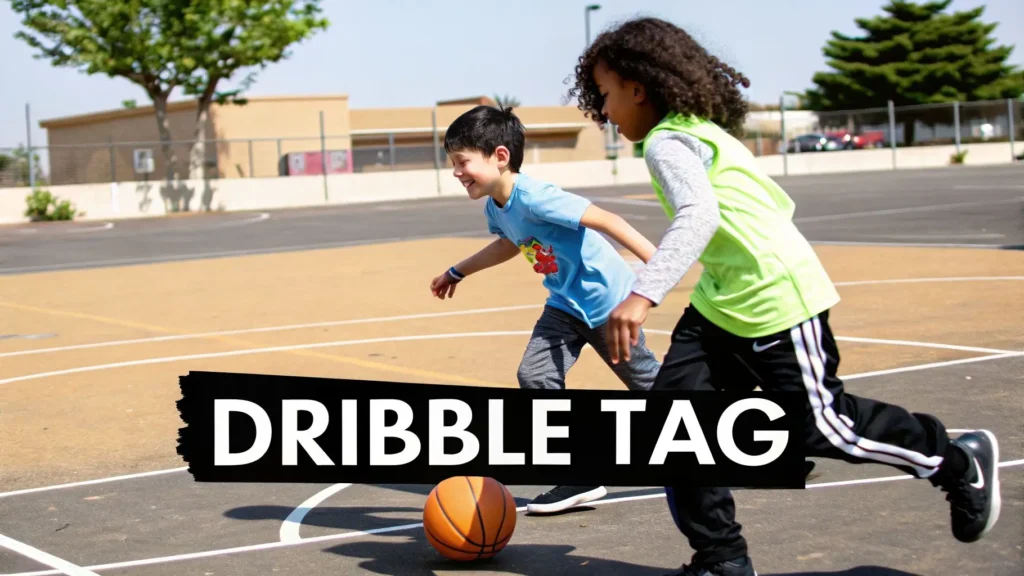
How to Implement Dribble Tag
Setup:
- Space: Define a clear playing area, such as the half-court circle or the area inside the three-point line.
- Players: Each player needs a basketball. Designate one player to be ‘it’. For larger groups, use multiple ‘it’ players (one for every 3-4 kids).
Execution:
- All players begin dribbling within the designated boundaries.
- The player who is ‘it’ attempts to tag another player while maintaining their own dribble.
- Other players must use their dribbling skills to evade the tagger without losing control of their ball or going out of bounds.
- If a player is tagged, loses control of their dribble, or dribbles out of bounds, they become the new ‘it’.
Coaching Cue: “Keep your head on a swivel! You need to see the tagger and the open space at the same time. Use your body to protect the ball.”
Tips for Success & Progression
The primary goal is to encourage continuous movement and ball control under pressure. Start by emphasizing fun and participation over strict rules, especially with younger children. Ensure the playing area is safe and free of obstacles.
- Beginner: Use a larger playing area to give players more space to maneuver. The goal is simply to keep the dribble alive while moving.
- Intermediate: Shrink the playing area to increase the difficulty. Introduce a rule where the ‘it’ player can also try to knock other players’ basketballs away.
- Advanced: Add a second ‘it’ player to increase the pressure. Another variation is “last one dribbling,” where players are eliminated if they lose control, and the final player remaining is the winner.
8. Dribble and Pass Progression Drill
The Dribble and Pass Progression Drill bridges the gap between individual ball handling and team play, making it one of the most practical basketball dribbling drills for kids. This drill teaches young athletes how to transition from dribbling on the move to making a precise pass, a sequence that occurs countless times in a real game. By combining these two fundamental skills, it helps players develop court awareness, decision-making, and the ability to contribute to team offense.
This drill is a core component in many competitive youth basketball programs and high school practice routines because it simulates game-like scenarios. A player dribbles to a specific spot on the floor, comes to a controlled stop, and executes a pass to a partner or a target. It reinforces the idea that dribbling has a purpose: to create a passing or scoring opportunity. This multi-skill exercise is praised by coaching clinics for building well-rounded players who can both handle the ball and distribute it effectively.
How to Implement the Dribble and Pass Progression Drill
Setup:
- Players: Two players are ideal, one dribbler and one receiver. A wall or rebounder can be used for solo practice.
- Spacing: Place a cone or marker about 10-15 feet away from the receiver.
Execution:
- The first player starts at a designated line and dribbles toward the cone.
- Upon reaching the cone, the player performs a jump stop, securing the ball with two hands and establishing a pivot foot.
- Without hesitation, the player executes a pass (chest pass or bounce pass) to their partner.
- The players can switch roles, or the receiver can pass back for continuous reps.
Coaching Cue: “Dribble with a purpose! Look for your target before you stop dribbling so you’re ready to make a quick, accurate pass.”
Tips for Success & Progression
Proper footwork is the key to mastering this drill. Teach kids to stop on balance, ready to pass without traveling. Emphasize keeping their head up during the dribble to see the receiver.
- Beginner: Start without the dribble. Have the player take a few steps, practice the jump stop, and make a stationary pass.
- Intermediate: Introduce dribbling with the dominant hand. Focus on making a crisp chest pass and a strong bounce pass.
- Advanced: Require players to use their non-dominant hand for the dribble. Increase the distance and vary the pass types, adding overhead passes. Make it a timed drill to see how many successful pass-and-catch sequences can be completed in one minute.
The coordination of footwork, dribbling, and passing in this drill builds a foundation applicable to many sports. Similarly, developing precise motion is key in other activities, as seen in these tennis serve techniques. Mastering coordinated movements in one area can improve a child’s overall athleticism.
Kids Basketball Dribbling: 8-Drill Comparison
| Drill | Implementation complexity | Resource requirements | Expected outcomes | Ideal use cases | Key advantages |
|---|---|---|---|---|---|
| Stationary Dribbling (Figure-8 Pattern) | Low — simple, easy to teach | Basketball, flat surface, minimal space | Fundamental ball-handling, ambidexterity, hand-eye coordination | Beginners, home practice, PE warm-ups | Fast fundamentals, low injury risk, minimal setup |
| Cone Weaving Drill | Moderate — requires setup and spacing | 5–8 cones or markers, court space, basketball | Change-of-direction, agility, directional control, measurable timing | Agility training, competitive youth sessions, skill testing | Game-like movement, measurable progress, engaging |
| Two-Hand Dribbling Switch | Low–Moderate — focus on coordination | Basketball, small space (stationary or moving) | Weak-hand skill, balanced dribbling, improved timing | Weak-hand development, warm-ups, skill clinics | Prevents dominant-hand reliance, quick visible progress |
| Mirror Dribbling (Partner Drill) | Low — partner coordination needed | Two players, basketballs, small space | Reactive skills, peripheral vision, teamwork | Partner practice, PE classes, social drills | Engaging, builds anticipation and communication |
| Speed and Control Dribbling | Moderate — requires pacing and coaching | Court space, basketball, court markings | Speed-to-control balance, decision-making at pace | Conditioning, game-speed progression, advanced practice | Scalable intensity, builds confidence at higher speeds |
| Wall Dribble and Catch | Low — simple individual drill | Basketball and a wall (indoor/outdoor) | Reactive catching, tracking, rebound prediction | Individual skill work, reflex training, supplemental drills | Independent practice, fun, improves reaction timing |
| Dribble Tag (Competitive Game Drill) | Moderate — needs rules and supervision | Basketballs, defined play area, coach supervision | Agility, evasion, court awareness, cardiovascular fitness | Warm-ups, end-of-practice games, engagement sessions | Highly engaging, practices skills under pressure |
| Dribble and Pass Progression Drill | Moderate–High — multi-step, partner coordination | Partners/targets, court space, basketballs | Integrated dribbling + passing, footwork, decision-making | Team drills, game-situation training, advanced practice | Teaches transitions, improves passing under movement |
Putting it All Together: Building a Better Ball-Handler
The journey from a hesitant first dribble to a confident, controlled handle is built one practice at a time. We’ve explored a dynamic range of drills, from the foundational control of Stationary Figure-8s and the agility-focused Cone Weaving, to the reactive fun of Mirror Dribbling and Dribble Tag. Each of these exercises is more than just a repetitive motion; it’s a building block for on-court success. The goal isn’t simply to bounce the ball, but to make the basketball an extension of the player’s body, freeing their mind to see the court, anticipate plays, and become a true threat.
Mastering these basketball dribbling drills for kids requires a shift in perspective. Instead of viewing practice as a chore, it should be framed as a game of personal improvement. The real progress happens when a young player moves beyond the basic mechanics and starts internalizing the core principles we’ve discussed. Are they keeping their eyes up to survey the floor? Are they developing a feel for the ball with their fingertips? Are they actively working on their weaker hand until it’s nearly as strong as their dominant one? These are the questions that separate good practice from great practice.
Key Takeaways for Lasting Improvement
To ensure the skills learned from these drills translate into real game performance, focus on these central ideas:
- Consistency Over Intensity: A focused 15-minute dribbling session four times a week will yield far better results than one grueling, two-hour session on a Saturday. Building muscle memory and intuitive control is a gradual process that rewards regular effort.
- Purposeful Practice: Don’t just go through the motions. Encourage players to set a small goal for each session. This could be completing the Cone Weaving drill without losing the ball, successfully executing five consecutive two-hand switches, or keeping their eyes completely forward during the Wall Dribble drill. Purpose adds focus and makes practice more effective.
- Embrace Mistakes: Losing the ball is not a failure; it’s a sign of pushing boundaries. If a child never fumbles, they are likely not dribbling hard enough or fast enough to truly improve. Frame mistakes as valuable feedback that shows them exactly where their current limit is, creating a new benchmark to surpass.
- Make it Fun: The inclusion of drills like Dribble Tag and the Mirror Drill is intentional. When practice feels like play, kids are more engaged, try harder, and retain skills more effectively. Mix the technical drills with competitive, game-like scenarios to keep motivation high.
From Drills to Dominance
Ultimately, the value of these basketball dribbling drills for kids extends beyond the court. They teach discipline, the importance of process, and the satisfaction of seeing hard work pay off. A player who can confidently handle the ball under pressure is a player who can lead a fast break, break down a defense, and create opportunities for their teammates. They become more than just a participant; they become a playmaker.
Encourage your young athlete to start small. Pick two or three drills from this list and incorporate them into a regular routine. As they build confidence, they can add more complex variations and increase the speed. Celebrate their progress, from their first successful figure-eight to the moment they confidently use a crossover in a game. This foundation in ball-handling is the key that unlocks their full potential and deepens their love for the sport. The path to becoming a skilled ball-handler is right at their fingertips.
Want to help your young athlete track their progress and set new goals? A dedicated journal is a great tool for logging practice sessions, noting areas for improvement, and celebrating achievements. Check out maxijournal.com for customizable journals perfect for aspiring basketball stars. You can create sections for different drills, stats, and personal bests, turning practice into a documented journey of growth at maxijournal.com.
Discover more from Maxi Journal
Subscribe to get the latest posts sent to your email.