Watercolor painting can seem both magical and intimidating. Its transparent, luminous quality offers a unique way to capture light and emotion, but its unpredictable nature often frustrates newcomers. Many aspiring artists buy a set of paints, only to feel discouraged by muddy colors and buckled paper.
This guide is designed to change that. We’ve gathered 10 foundational watercolor painting tips for beginners that move beyond generic advice. Instead of just telling you to ‘practice,’ we’ll show you what to practice. You will learn specific, actionable strategies to build a solid foundation and find genuine joy in the painting process.
Inside this listicle, you will discover how to:
- Master water control, the true heart of the medium.
- Understand basic color theory and mixing.
- Plan compositions with light and shadow.
- Work progressively from light to dark values.
By focusing on these essential techniques, you’ll gain the confidence to avoid common pitfalls and learn to embrace the fluid beauty of watercolor. Let’s transform that blank page into your first masterpiece.
1. Start With Quality Basic Supplies
The quality of your materials directly influences your learning experience and the final appearance of your artwork. While it’s tempting to grab the cheapest set available, low-grade supplies often lead to frustration, making it difficult to practice essential watercolor painting tips for beginners. Poor quality paper buckles under water, student-grade paints can look chalky and weak, and cheap brushes won’t hold their shape or a sufficient amount of water.
Investing wisely from the start gives you a more accurate feel for how watercolors are supposed to behave. You don’t need the most expensive professional gear, but choosing reputable, mid-range brands will make a significant difference in your progress and enjoyment.
How to Choose Your Starter Kit
Focus your budget on the three most important components: paper, paint, and brushes.
- Paper is Priority: If you can only splurge on one item, make it the paper. Look for 100% cotton, cold-press paper with a weight of at least 140 lb (300 gsm). Brands like Arches or Fabriano Artistico are excellent choices that prevent buckling and allow colors to blend smoothly.
- Smart Paint Selection: Instead of a large set with 36+ colors, opt for a smaller, curated palette of 12-16 high-quality tube paints. This encourages you to learn color mixing. Mid-range brands like Winsor & Newton Cotman or Grumbacher Academy offer great performance without the professional price tag.
- Essential Brushes: Begin with two or three versatile brushes. A round brush (size 6 or 8) is perfect for details and lines, while a flat brush (1-inch) is great for broad washes.
By prioritizing quality paper and a select palette, you build a solid foundation. This approach ensures your materials support your efforts rather than creating unnecessary obstacles. You can always expand your collection of paints and brushes as your skills develop.
2. Master the Fundamentals of Water Control
Water is the most critical element in this medium; it’s what gives watercolor its name and its unique, flowing personality. Understanding how to manage water saturation, wetness levels, and water-to-pigment ratios is the foundation of successful painting. Proper water control determines everything from color intensity and smooth gradients to crisp edges and soft blooms. It’s the one skill that truly separates frustrating attempts from competent, beautiful work.
Learning this balance is a core part of the journey, and mastering it is one of the most rewarding watercolor painting tips for beginners. The goal is to move from fighting the water to collaborating with it, letting it do the beautiful work it’s meant to do. Greats like Winslow Homer showcased this mastery in his dynamic seascapes, where water feels both controlled and wild.
How to Practice Water Management
Achieving consistent results comes from intentional practice. Focus on understanding how water and pigment interact under different conditions before you even start a formal painting.
- Use Two Water Jars: Keep one jar for rinsing pigment from your brushes and a second jar for clean water. This prevents your colors from becoming muddy and gives you precise control over your water’s clarity.
- Test Your Ratios: Before applying a color to your artwork, test the pigment-to-water ratio on a scrap piece of paper. This helps you see exactly how vibrant or transparent the color will be.
- Learn the Stages of Wetness: Observe how paint behaves on paper that is soaking wet, damp, or completely dry. Each stage produces a different effect. For instance, applying wet paint to damp paper (wet-on-damp) gives you soft edges without the uncontrolled spreading of wet-on-wet.
By treating water as an active partner rather than just a solvent, you begin to understand its behavior. Consistent practice with these fundamental controls will build the intuition needed to create predictable, stunning effects.
3. Learn Color Theory and Mixing Fundamentals
Understanding how colors interact is foundational to creating vibrant, harmonious paintings rather than dull, muddy messes. Watercolor’s transparency makes color mixing unique; you are layering light, not just pigment. This means learning the basics of primary, secondary, and complementary colors is one of the most essential watercolor painting tips for beginners to create luminous, intentional results instead of accidental brown splotches.
Grasping color theory allows you to set a mood, create depth, and guide the viewer’s eye. Artists like Alvaro Castagnet use bold, harmonious color choices to create atmospheric cityscapes, demonstrating how a deliberate palette can define an entire piece. This knowledge gives you control over your artwork’s final emotional impact and visual appeal.
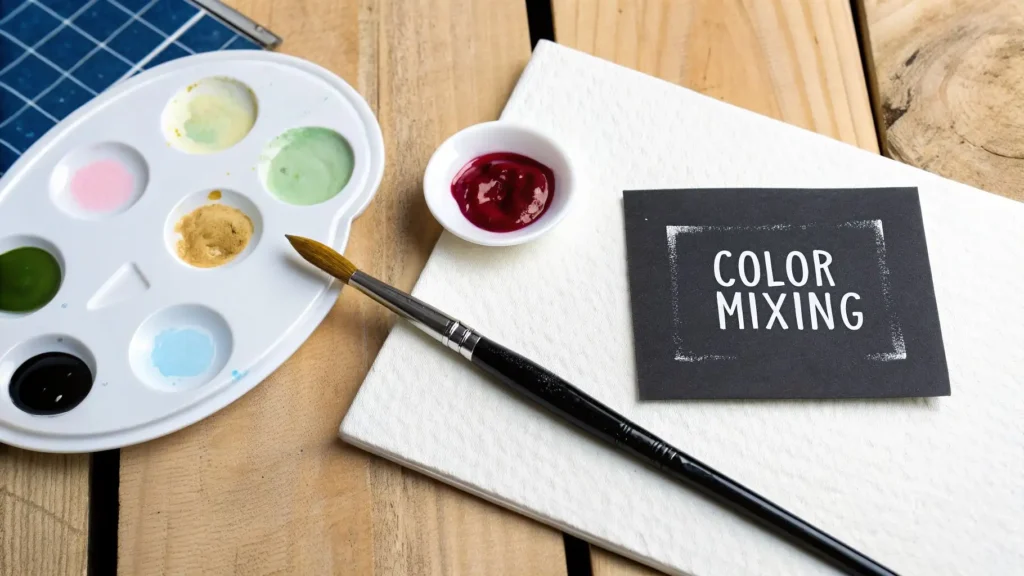
How to Practice Color Mixing
Effective color mixing is a skill built through consistent, hands-on practice. Start with simple exercises to build your confidence and understanding of your specific paints.
- Create a Mixing Chart: Your first step should be to create a color chart. Mix each color on your palette with every other color to see the exact hues they produce. This becomes your personal reference guide.
- Limit Your Palette: Begin projects with just three primary colors (a red, a yellow, and a blue). This forces you to learn how to mix a wide range of secondary and tertiary colors from a limited base.
- Master Water Control: Unlike acrylics or oils, you lighten watercolors by adding more water, not white paint. Practice creating gradients of a single color from its most saturated state to a nearly transparent tint.
- Avoid Over-Mixing: Mix complementary colors (like red and green or blue and orange) sparingly. Combining them directly on the palette will create grays and browns, which is useful for shadows but can lead to mud if done unintentionally.
By dedicating time to understand your palette, you move from guessing to making intentional color decisions. This simple practice elevates your work from looking amateurish to appearing thoughtful and cohesive, giving you the power to mix any color you can imagine.
4. Practice Wet-on-Wet Technique for Soft Effects
The wet-on-wet technique is fundamental to achieving the soft, ethereal look that makes watercolor so unique. It involves applying wet paint onto paper that has already been dampened with clear water. This method allows pigments to blend and diffuse organically, creating soft edges and beautiful, atmospheric gradients that are difficult to replicate with any other medium.
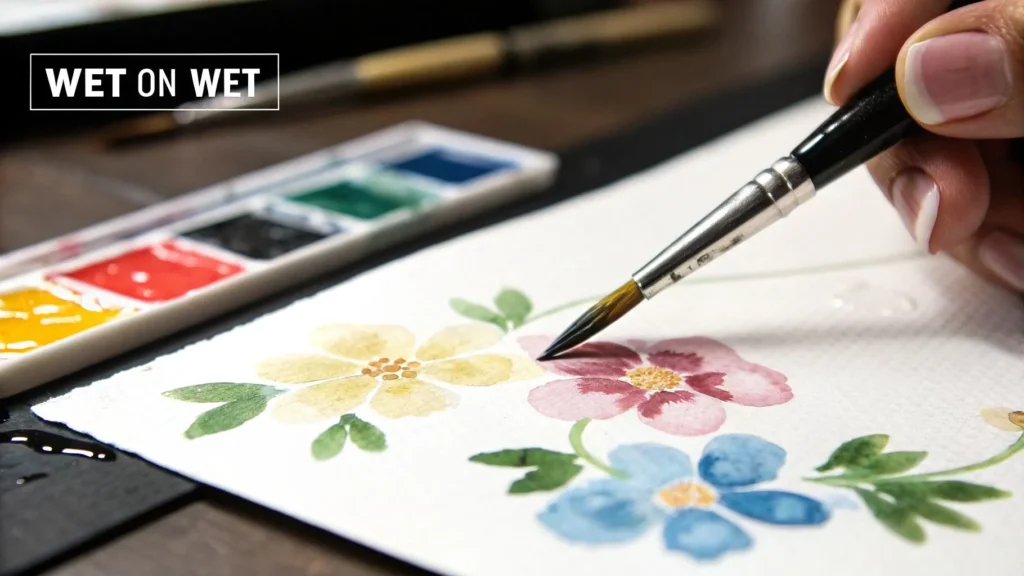
Mastering wet-on-wet is one of the most important watercolor painting tips for beginners because it teaches you to work with the water, not against it. It is perfect for painting backgrounds, skies, and loose floral elements. For more information on foundational methods, you can explore various painting techniques for beginners to build your skills.
How to Master Wet-on-Wet
Timing and water control are the keys to success with this technique. The goal is a gentle sheen on the paper, not puddles of standing water.
- Prepare Your Paper: Using a large, soft brush or a clean sponge, apply an even layer of water to the area you intend to paint. Wait for the initial shine to recede slightly before adding color.
- Control the Pigment: Touch your pigment-loaded brush to the damp paper and watch the color spread. The more water on the paper, the further the pigment will travel.
- Work Quickly: This technique has a limited working window before the paper begins to dry. Have your colors mixed and ready to go.
- Use Gravity: Gently tilt your paper to guide the flow of the colors, creating natural-looking blends and transitions.
The secret to wet-on-wet is observing the water’s behavior on the paper. Practice on scrap sheets to get a feel for how long the paper stays damp and how different amounts of pigment interact with the wet surface. This intuition is invaluable.
5. Develop Value and Contrast Understanding
Value, which is the lightness or darkness of a color, is arguably more important than color itself for creating a compelling painting. Beginners often use colors that are too similar in value, leading to compositions that appear flat and lack visual impact. Learning to manage contrast by using a full range of light, medium, and dark values is one of the most effective watercolor painting tips for beginners to create depth and drama.
A strong understanding of value ensures your artwork has structure and dimension. Paintings with well-planned value contrast guide the viewer’s eye and work effectively even when viewed in black and white. This fundamental skill is the key to transforming simple color applications into dynamic, three-dimensional scenes.
How to Practice and Plan Values
Before you even touch your colors, planning your values can set you up for success. This preparatory step helps you make intentional decisions about light and shadow.
- Create Monochrome Value Studies: Paint a small version of your composition using only one color (like Payne’s Gray or a neutral tint) diluted with varying amounts of water. This exercise forces you to see and replicate light, mid, and dark tones without the distraction of color.
- Squint at Your Reference: Squinting at your subject or photo blurs the details and simplifies the scene into basic value shapes. This helps you identify the darkest darks and lightest lights more easily.
- Plan Your Darks: In watercolor, it’s easy to make a light area darker, but almost impossible to do the reverse. Identify your darkest value areas in a preliminary sketch and apply them with confidence. This concept is just as important in drawing, as you can learn in this guide to drawing portraits.
- Use a Limited Value Palette: Start by simplifying your composition into just three or four distinct values: white (the paper), light gray, mid-gray, and black. This limitation will strengthen your final painting.
By focusing on value before color, you build a powerful structural foundation for your painting. A strong value sketch almost guarantees a successful outcome, as it solves major compositional problems before you commit to the final piece.
6. Plan Compositions Using Light and Shadow
Composition, or the arrangement of elements in your artwork, is a critical factor that can make or break a painting. For beginners, planning where light and shadow will fall before you even touch your brush to the paper is a powerful technique. This strategic thinking establishes a clear visual path, guiding the viewer’s eye through your work and creating mood, depth, and a professional finish.
Thoughtful planning prevents a composition from feeling disorganized or haphazard. By deciding on a dominant light source and mapping out your shadows, you build a strong foundation for your painting. This is one of the most effective watercolor painting tips for beginners because it forces you to think about the final image as a whole, rather than just isolated objects.
How to Plan Your Composition
Before starting your final piece, explore your ideas with quick, simple sketches. This preparatory step is where you can solve potential problems and strengthen your design.
- Create Thumbnail Sketches: Draw several small, simplified versions of your composition. In these thumbnails, experiment with the placement of your main subject and establish the patterns of light and shadow.
- Apply the Rule of Thirds: Mentally divide your paper into a 3×3 grid. Position your focal point at one of the intersections rather than directly in the center to create a more dynamic and interesting image. This principle is also fundamental in photography, and you can learn more about creating balanced images here.
- Define a Light Source: Choose one primary light source and stick with it. This creates consistent, believable shadows that give your subjects form and volume. Using diagonal lines in your shadows can also effectively guide the viewer’s attention.
Planning with light and shadow is not about rigid rules, but about making intentional choices. By simplifying your composition and focusing on a strong value structure, you give your watercolors clarity and dramatic impact, turning a simple scene into a compelling piece of art.
7. Preserve White Paper as Your Lightest Value
Unlike opaque media like oils or acrylics, watercolor painting’s brilliance comes from its transparency. Pigment sits on the paper, allowing light to reflect off the surface underneath. This means the white of the paper is your brightest white and most powerful tool for creating highlights and luminosity. Beginners must learn to plan their compositions around preserving these unpainted areas from the very start.
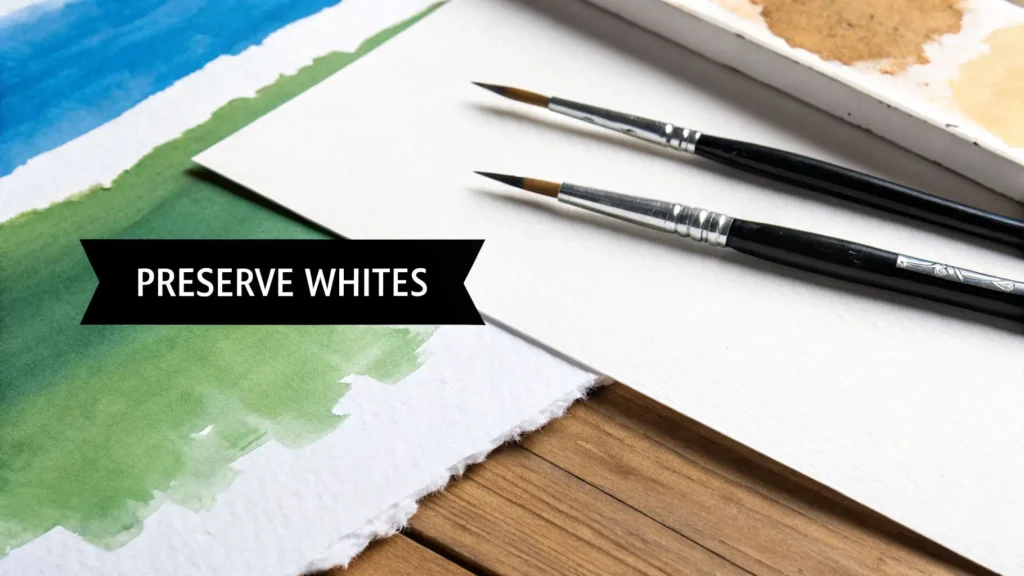
This technique requires forward-thinking and discipline. The traditional English watercolor masters and contemporary artists like Winslow Homer perfected this by leaving paper bare to depict sea foam or bright sunlight. Forgetting to save your whites is one of the most common mistakes, so making it a conscious part of your process is a crucial step in your journey with watercolor painting tips for beginners.
How to Preserve Your Whites
Planning is essential. Before you even dip your brush in paint, identify the brightest parts of your subject and decide how you will protect them.
- Plan Ahead: Lightly sketch your composition and circle the areas you intend to keep white. This visual reminder helps you avoid accidentally painting over highlights, light sources, or reflections.
- Use Masking Fluid: For intricate or small white areas, apply masking fluid (also called liquid frisket) with an old brush or a silicone tool. Let it dry completely before painting over it. Once your paint is dry, gently rub the mask off to reveal the crisp white paper underneath.
- Employ Masking Tape: For straight lines and geometric shapes, such as window panes or hard-edged reflections, masking tape is an excellent tool. Ensure it’s pressed down firmly to prevent paint from seeping underneath.
The core principle is restraint. Learning to leave areas of the paper untouched is just as important as learning how to apply paint. This practice will give your paintings a natural, sparkling light that is the hallmark of beautiful watercolor art.
8. Work from Light to Dark Progressively
Unlike opaque mediums like acrylic or oil, watercolor’s beauty lies in its transparency. This quality dictates a fundamental rule: you must build your colors from light to dark. Beginners often make the mistake of adding dark tones too early, which muddies the painting and kills the natural luminosity of the paper shining through. The correct method involves layering washes, allowing each to dry, to gradually build depth and value.
This progressive layering is one of the most crucial watercolor painting tips for beginners because it preserves the freshness and vibrancy unique to the medium. By reserving the white of the paper for your lightest lights and slowly adding color, you maintain control and create a painting with dimension and glow. This approach ensures your darks remain rich and your lights stay crisp and clean.
How to Build Your Values
Follow a structured layering process to control your painting’s value structure from the very beginning.
- Establish the Lightest Tones: Start by applying very diluted washes for the lightest areas, such as the sky in a landscape or the initial skin tone in a portrait. Think of this layer as a map of your lightest colors.
- Introduce Mid-Tones: Once the first layer is completely dry, mix a slightly more concentrated wash to paint the middle values. Apply these over the initial washes, carefully shaping your subject and adding form.
- Add Dark Accents Last: The final step is to add your darkest darks. Use a thick, pigment-rich mixture for shadows, fine details, and focal points. These final touches will make the entire painting pop.
Remember, you can always make an area darker, but you cannot easily make it lighter again. Step back from your work frequently to assess the overall value balance, and stop before you feel it’s completely finished to avoid overworking the piece.
9. Embrace Imperfection and Learn From Happy Accidents
One of the biggest mental hurdles for new painters is the desire for perfect control. Watercolor, however, is a fluid and often unpredictable medium. Its beauty lies in its spontaneity, and fighting this inherent nature leads to stiff, overworked paintings and a lot of frustration. Shifting your mindset from rigid precision to creative acceptance is a crucial step in your artistic journey.
Learning to see unexpected blooms, drips, or color mixes not as mistakes but as opportunities is a game-changer. This approach, famously championed by Bob Ross with his “happy accidents,” allows you to work with the paint rather than against it. Embracing these moments helps you develop a more intuitive and expressive style, making the painting process more enjoyable and your artwork more dynamic.
How to Turn Mistakes into Opportunities
Instead of immediately trying to “fix” something you didn’t plan, pause and consider how it can be incorporated into the piece.
- Work on Multiple Pieces: Start two or three simple paintings at once. This reduces the pressure to make any single piece perfect, freeing you to experiment without fear of “ruining” your one masterpiece.
- Keep a “Failure” File: Don’t throw away paintings you dislike. Keep them in a sketchbook or folder to analyze later. You can learn just as much from what went wrong as you can from what went right.
- Challenge Yourself: If a dark color accidentally drips onto a light area, challenge yourself to turn it into a shadow, a distant tree, or a textured rock. This builds creative problem-solving skills.
- Let It Rest: Before deciding a painting is a lost cause, set it aside for a day. Viewing it with fresh eyes often reveals that the “mistake” isn’t as bad as you thought or gives you new ideas on how to proceed.
Your goal isn’t to eliminate all accidents but to learn how to react to them creatively. Viewing every painting session as a learning experience, rather than a test of perfection, is one of the most valuable watercolor painting tips for beginners.
10. Paint Regularly and Build Consistent Practice Habits
Mastery in watercolor painting comes from consistent effort, not sporadic, intense sessions. Like learning an instrument, regular practice builds muscle memory, an intuitive feel for water control, and a natural instinct for color mixing. Committing to a steady routine is one of the most effective watercolor painting tips for beginners because it turns intimidating techniques into familiar skills over time.
Aiming for shorter, more frequent painting sessions is far more beneficial than one long session per month. This approach keeps the concepts fresh in your mind and steadily builds your confidence. The goal is to make painting a normal part of your week, transforming it from a daunting task into a rewarding and natural habit.
How to Build a Practice Routine
A sustainable routine is built on realistic goals and accountability. Focus on creating a schedule you can stick to, even on busy days.
- Schedule Your Sessions: Treat painting like any other important appointment. Block out specific times in your calendar, such as 20-30 minutes every Tuesday and Thursday evening. Starting small makes the habit easier to form.
- Use a Dedicated Sketchbook: Keep a sketchbook just for daily or regular practice. Use it for quick studies, testing color mixes, or practicing a single technique, like a flat wash or a simple gradient. This removes the pressure of creating a finished masterpiece every time.
- Join a Community or Challenge: Participating in something like a “100 Days of Watercolor” challenge or joining an online art community on Instagram or Reddit provides encouragement and accountability. Seeing others’ progress can be a powerful motivator.
The secret to progress is not perfection, but persistence. By dedicating even 15-20 minutes a few times a week to focused practice, you are actively wiring your brain and hands to understand the unique language of watercolor.
Top 10 Beginner Watercolor Tips Comparison
| Item | Implementation Complexity | Resource Requirements | Expected Outcomes | Ideal Use Cases | Key Advantages |
|---|---|---|---|---|---|
| Start With Quality Basic Supplies | Low — purchase and selection task | Moderate–High — professional paints, good paper, brushes ($50–150) | Better color vibrancy, handling, and longevity | Beginners starting out; those seeking quality results | Improved mixing; easier techniques; more enjoyable learning |
| Master the Fundamentals of Water Control | High — technical skill with steep learning curve | Low — basic supplies, lots of practice time (two water buckets recommended) | Predictable blooms, controlled edges, consistent tonal intensity | Technique-focused practice; all watercolor styles | Core competency; enables varied effects; increases control |
| Learn Color Theory and Mixing Fundamentals | Moderate — study plus experimentation | Low — limited palette, swatches, color charts | Harmonious palettes, fewer muddy mixes, predictable outcomes | Color-centric compositions, glazing, palette planning | Consistent color harmony; intentional color choices |
| Practice Wet-on-Wet Technique for Soft Effects | High — timing and environmental sensitivity | Low — paper, brushes, water; humidity awareness | Soft blends, luminous washes, organic transitions | Skies, water, atmospheric or impressionistic work | Smooth gradients; expressive, loose effects |
| Develop Value and Contrast Understanding | Moderate — visual assessment and planning | Low — monochrome studies, value sketches | Stronger depth, focal points, three-dimensional feel | Portraits, landscapes, compositions needing drama | Clear hierarchy; improved composition and readability |
| Plan Compositions Using Light and Shadow | Moderate–High — requires compositional skill | Low — thumbnail sketches, planning time | Intentional layouts, guided viewer attention, mood control | Narrative scenes, complex layouts, professional work | Strong visual flow; fewer mid-process fixes |
| Preserve White Paper as Your Lightest Value | Moderate — forward planning and masking skills | Low–Moderate — masking fluid, tape, careful technique | Bright highlights and preserved luminosity | Works needing crisp highlights or luminous whites | Natural luminosity; simplified highlight creation |
| Work from Light to Dark Progressively | Low–Moderate — patience and sequencing | Low — time for drying and layering | Maintained transparency, controlled depth, less muddiness | Layered glazing, detailed portraits/landscapes | Preserves clarity; systematic approach to values |
| Embrace Imperfection and Learn From Happy Accidents | Low conceptually; moderate mindset shift | Minimal — practice, reflection, multiple studies | More experimentation, creative discoveries, personal style | Creative exploration, loosening technique, risk-taking | Reduces perfectionism; fosters innovation and resilience |
| Paint Regularly and Build Consistent Practice Habits | Moderate — habit formation and scheduling | Moderate — time commitment, sketchbook, community support | Steady skill improvement, larger portfolio, confidence | Long-term skill development, habit-based progress | Accelerated learning; sustainable improvement and retention |
Your Creative Journey Starts Now
You’ve just explored ten foundational watercolor painting tips for beginners, each a vital step on your artistic path. From selecting quality paper that can handle generous washes to mastering the delicate dance between water and pigment, these guidelines provide a solid framework for your creative exploration. Think of them not as rigid rules, but as reliable signposts pointing you toward greater confidence and control.
The journey into watercolor is one of discovery. The insights on working from light to dark and preserving the white of the paper aren’t just technical advice; they are fundamental principles that define the medium’s luminous quality. Similarly, understanding color theory and value contrast moves you beyond simply copying what you see, allowing you to interpret scenes with emotion and depth. Each time you mix a new hue or lay down a transparent glaze, you are building an intuitive understanding of how colors interact.
Embracing the Process Over Perfection
Perhaps the most important takeaway is to embrace the process itself. Watercolor is known for its spontaneity, and those “happy accidents” you were warned about will often become your greatest teachers. Every unexpected bloom or unintentional bleed is a lesson in letting go of rigid control and collaborating with the medium.
Remember these key action points as you move forward:
- Invest in good paper first. It is the single most impactful supply you can buy.
- Practice water control daily. Simple drills with a wet brush will build muscle memory.
- Build your paintings in layers. This light-to-dark approach is central to achieving depth and brilliance.
- Paint regularly. Consistency is far more valuable than occasional, marathon sessions.
By committing to regular practice, you are not just learning to paint; you are developing patience, honing your observational skills, and cultivating a unique artistic voice. The beauty of watercolor lies in its transparency, and the same can be said for the learning process. Your progress will be visible in every new piece you create. Don’t aim for a masterpiece with every attempt. Instead, aim for discovery. Pick up your brush, dip it in water, and let the colors flow. Your creative journey truly starts now.
Ready for more inspiration and creative guidance? Explore the vibrant community and diverse artistic content at maxijournal.com. From artist spotlights to in-depth tutorials across various creative fields, maxijournal.com is your go-to resource for continuing your artistic education and connecting with fellow creators.
Discover more from Maxi Journal
Subscribe to get the latest posts sent to your email.