You’re standing in the health aisle, holding a bottle of aloe vera juice and reading words like “soothing,” “detox,” and “natural support.” It sounds promising. It also sounds a little like marketing copy wearing a lab coat.
That skepticism is healthy.
Aloe vera has been used for a very long time, and it still has a strong wellness halo. But old use does not automatically equal proven benefit, and “natural” does not automatically mean safe. The useful question is simpler: what can aloe juice realistically do, what is still uncertain, and what should make you put the bottle back on the shelf?
Often, people get stuck here. They hear that aloe helps digestion, skin, hydration, maybe blood sugar, maybe inflammation, maybe everything. The claims blur together. A practical answer has to separate three buckets: benefits supported by human research, ideas that make biological sense but need better evidence, and myths that survive mostly because they sound good.
Aloe juice can fit into a health routine. It is not a miracle drink. Think of it more like a niche tool than a universal fix. For the right person, using the right kind, in the right amount, it may be useful. For the wrong person, or the wrong product, it can be a fast route to stomach trouble.
Is Aloe Juice a Health Hack or Just Hype
You pick up a bottle because the label promises calm digestion, better skin, cleaner hydration, maybe even a full-body reset. That is a lot to ask from one plant drink.
The honest way to judge aloe juice is to separate what has been tested in people from what only sounds plausible. Aloe has a long history and a strong wellness reputation, but history is not proof. A claim belongs on firmer ground only when human studies show a useful effect, with a product and dose that resemble what people buy.

That is where aloe gets tricky. One small promising result can turn into a shelf full of oversized promises. A study on one narrow outcome, such as a skin-related measure or mild digestive comfort, does not automatically support claims about detox, immunity, metabolism, and energy. Marketing often treats those as if they are interchangeable. They are not.
A more useful approach is to ask three practical questions:
- What kind of aloe is in the bottle? Different aloe preparations can behave very differently.
- What specific benefit is being claimed? Relief for occasional stomach irritation is a narrower and more testable idea than a vague “cleanse.”
- What kind of evidence supports it? Human research is more reliable than tradition, lab theory, or label language.
Aloe juice works less like a universal tonic and more like a tool with a narrow job description. If you use a screwdriver, it can help with screws. It does not become a hammer just because the package makes bigger promises. Aloe may offer real value in certain situations, but that does not make every claim attached to it trustworthy.
Key takeaway: Aloe juice has some evidence behind a few targeted uses, weaker support for others, and plenty of marketing claims that outrun the research.
What Exactly Is in a Bottle of Aloe Vera Juice
Reading an aloe juice label can feel a bit like buying olive oil. Two bottles may sit side by side, look nearly identical, and produce very different results once you get them home. With aloe, the difference often starts with which part of the leaf ended up in the bottle.
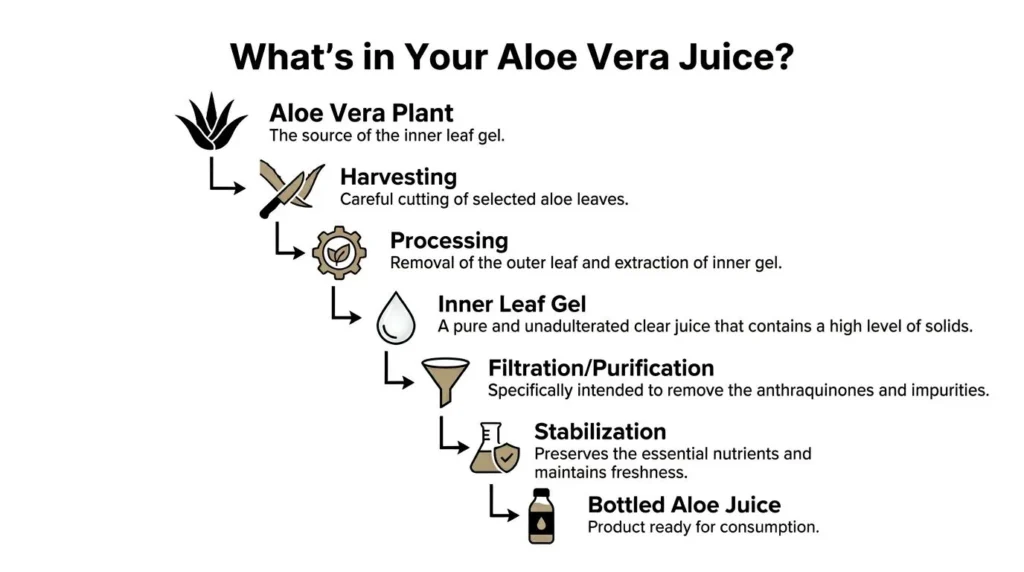
The aloe leaf is not one uniform material. The clear inner gel is the part usually associated with drinkable aloe products. Closer to the outer leaf sits a yellow latex-like layer that contains compounds known for strong laxative effects and a higher chance of stomach irritation. If you are trying to judge possible aloe juice benefits, that split matters more than the front label’s wellness language.
Inner gel versus the harsher outer portion
Aloe works more like a plant with separate zones than a single, uniform food. The center is the mild, slippery gel. The outer area is where the harsher compounds are more likely to come from. Manufacturers can process these parts differently, which helps explain why one aloe drink may seem gentle while another sends someone to the bathroom in a hurry.
That is why labels such as “inner leaf,” “purified,” or “decolorized” are worth paying attention to. They usually indicate that the product has been treated to reduce or remove the bitter latex components many people do not want in a daily drink.
What aloe juice contains
Aloe juice is often marketed as if it were a dense package of miracle compounds. A more grounded way to look at it is this. Aloe contains a mix of plant substances, but a long ingredient list is not the same as a proven health effect.
Broadly, aloe juice may contain:
- Polysaccharides: Long sugar molecules naturally present in the gel. These help give aloe its slick, viscous texture and are often discussed in relation to soothing effects.
- Small amounts of vitamins and minerals: Present in some products, but not in amounts that make aloe juice a substitute for nutrient-rich foods.
- Antioxidant plant compounds: Common in many plant foods and potentially helpful, though that alone does not confirm a meaningful clinical benefit.
- Laxative compounds from latex: These are the compounds careful processing aims to lower, especially in products meant for regular drinking.
This distinction is important for a simple reason. Supplements and wellness drinks can seem harmless when the label focuses on “natural plant actives,” but the source and amount of those compounds still shape how the product feels in the body.
Why the texture gets so much attention
Aloe’s texture gives people a clue, and sometimes the wrong one. Because the gel feels slick and cooling on skin, it is easy to assume drinking it will coat the digestive tract in the same straightforward way.
The body does not work like that. Your stomach and intestines are active systems with acid, enzymes, muscular movement, and constant turnover. Aloe is not lining the gut like paint on a wall. A better comparison is a temporary guest in a fast-moving stream. Its texture and plant compounds may interact with that environment, but not in the simple, one-layer way many ads imply.
That is also why aloe should not be lumped together with every other gut-friendly product. It plays a different role than fiber, fermented foods, or supplements aimed at changing the gut microbiome, such as the best time to take probiotics for digestive support.
Why two bottles can feel completely different
Processing changes the end product. One bottle may contain mostly purified inner gel and taste mild. Another may include more whole leaf material, extra acids, sweeteners, or preservatives. Those choices can affect taste, texture, and the chance of side effects.
So the practical takeaway is simple.
Shopping rule: If an aloe juice label does not clearly say whether it uses inner leaf or whole leaf, treat that as missing product information.
Aloe juice is not one standardized substance. It is a category of products made from the same plant in different ways. That helps explain why people can report completely different experiences and why the smartest question is not “Is aloe juice good?” but “What kind of aloe juice is this?”
The Science-Backed Aloe Juice Benefits
Aloe juice sits in an awkward middle ground. Some claims have a decent scientific basis. Others sound convincing mainly because the marketing is louder than the evidence.
The practical way to judge aloe is to sort benefits into three buckets: supported, plausible, and overstated.

Skin health has the clearest human evidence
The strongest human research on oral aloe points to skin, not digestion.
A few studies suggest that specific aloe compounds taken by mouth may help with skin elasticity, collagen-related changes, and visible signs of aging in some adults. That is more concrete than the usual wellness claim that aloe “supports beauty from within.”
The key phrase is specific aloe compounds. A study on a defined aloe extract is not the same thing as proof that any bottle labeled aloe juice will improve your skin. That gap is where a lot of supplement marketing gets slippery.
A simple comparison helps here. Skin works less like a surface you polish and more like a house maintained from the inside. Blood flow, hydration, inflammation, and structural proteins all affect how that house holds up. If oral aloe influences any of those systems, skin changes are at least biologically believable.
So the evidence-based version is modest. Oral aloe may help skin in certain forms and in certain people. It is not a guaranteed glow drink.
Hydration support is real, but ordinary
This benefit is easy to understand and easy to oversell.
If aloe juice helps someone drink more fluids, especially in place of sugary beverages, that can support hydration. Better hydration can help skin comfort, digestion, and general well-being. But the heavy lifting still comes from total fluid intake, not from aloe being uniquely hydrating.
In other words, aloe juice can join the hydration team. It is not the star player.
Some products also contain vitamins and plant pigments that sound impressive on a label. That does not automatically translate into a meaningful health effect in everyday use, especially if the amount is small or the product is heavily processed.
Digestive soothing is plausible, not settled
This is the reason many people buy aloe in the first place. They hope it will calm heartburn, stomach irritation, or a sensitive gut.
The theory makes sense on the surface. Aloe gel has a slippery texture and contains plant compounds that may interact with the digestive tract. But your gut is not a scraped knee, and drinking aloe is not the same as applying aloe to skin. The digestive system is more like a moving conveyor belt than a still surface. Anything you drink has to pass through acid, enzymes, muscle contractions, and constant turnover.
That helps explain the mixed real-world results. Some people report that purified aloe feels soothing. Others notice no difference. Some feel worse, especially with less refined products.
So the practical takeaway is narrower than the ads suggest:
- Reasonable expectation: purified aloe juice may feel soothing for some people with mild digestive discomfort
- Unreasonable expectation: aloe juice will fix chronic reflux, replace medical treatment, or solve every “gut health” problem
It also helps to keep aloe in context. Digestive symptoms can be shaped by meal size, stress, sleep, medications, and the rest of your routine. If you are also comparing aloe with microbiome-focused options, this guide to the best time to take probiotics for digestive support gives useful context on a very different approach.
Blood sugar claims need more caution than confidence
Blood sugar support is one of the most common aloe claims online. It is also one of the easiest areas for readers to misread.
There is interest here, but interest is not the same as a clear recommendation. Early findings and broad plant-based health claims often get turned into a simple message like “good for blood sugar,” even when the evidence is still limited, mixed, or product-specific.
That distinction is important because supplements can interact unpredictably with medicines. Anyone taking glucose-lowering medication should treat casual aloe experimentation carefully and involve a clinician, not a wellness influencer.
A short video can help if you want a broad visual overview before deciding whether aloe fits your routine.
Stronger evidence versus softer claims
Here is the clearest way to read the current benefit claims:
| Claim area | Evidence strength | Practical takeaway |
|---|---|---|
| Skin elasticity and wrinkle-related outcomes | Moderate human evidence | Most credible benefit, but still tied to specific oral aloe forms |
| Hydration-related support | Plausible and practical | Useful if it helps you drink fluids consistently |
| Digestive soothing | Common use, mixed evidence | May help some people, especially with purified products |
| Blood sugar support | Preliminary and cautious | Not a reason to self-treat a medical condition |
Where aloe marketing gets ahead of the science
A familiar pattern shows up with supplements.
A small study finds a narrow effect in a specific group. A brand turns that into a broad promise. Shoppers end up hearing that promise as if it applies to nearly everyone.
That is how a limited finding becomes a myth with a nice label.
Bottom line: The most credible aloe juice benefit is skin support from certain oral aloe preparations. Hydration and digestive comfort are more practical than dramatic. Blood sugar claims deserve the most skepticism.
How to Use Aloe Juice Safely and Effectively
The safest way to start aloe juice is boring. That is a good thing.
Do not start with a large glass because the label sounds enthusiastic. Start small, pay attention, and treat aloe like a supplement your body may or may not appreciate.
Start with the gentlest version
If you are trying aloe for the first time, choose a purified inner leaf product rather than a more aggressive whole leaf option.
That matters because the outer latex-related portion of the plant is the part most associated with cramping and laxative effects. A person might think “aloe is not for me” when the issue was “this was the wrong type of aloe.”
What a cautious first trial looks like
A practical beginner approach looks like this:
- Use a small amount first: Mix a little into water or a smoothie rather than drinking a large serving straight.
- Take it with awareness: Try it on a day when you are home and can notice how your stomach responds.
- Keep the rest of your routine stable: If you change five things at once, you will not know what caused the result.
If your body tolerates it and you like how it fits, you can keep it in rotation. If you notice urgency, cramping, or discomfort, that is useful feedback. Stop and reassess the product.
More is not better
Supplement logic often breaks down at this point. People assume that if a little may help, a lot should help more.
With aloe, that can backfire. The goal is not to flood the system. The goal is to see whether a modest amount of a well-made product agrees with you. If it does not, pushing the dose upward usually does not fix the problem.
Tip: Aloe is better approached like testing a new tea than like chugging a sports drink.
Who should be extra cautious
Certain groups should not treat aloe casually.
- Pregnant people: Avoid self-prescribing aloe juice, especially products that may contain irritating compounds from the outer leaf.
- People with digestive sensitivity: If your gut reacts strongly to many foods or supplements, aloe may not be the first thing to try.
- Anyone on regular medication: This matters especially if the medicine affects fluid balance or blood sugar.
- People with kidney concerns or significant medical conditions: A clinician should weigh in before use.
Even with a purified product, caution is not overkill. Supplements sit in a gray zone where “available” can be mistaken for “appropriate.”
Signs a product is not working for you
The most common red flags are practical, not mysterious:
- cramping
- loose stools
- stomach discomfort
- a “detox” feeling that is really just irritation
- worsening symptoms rather than steady comfort
A lot of wellness marketing teaches people to reinterpret side effects as proof something is “working.” That is not a reliable rule. If aloe makes you feel worse, your body is not failing the cleanse. The product may be a poor fit.
When aloe makes sense
Aloe juice may be worth trying if you want a small, low-drama addition to a routine focused on hydration or mild digestive comfort, and you are using a quality purified product.
It makes less sense if you are hoping for a cure-all. It also makes less sense if you already know your stomach hates unfamiliar supplements.
In practical use, aloe works best when expectations are narrow. “This may help me feel a bit better” is a realistic goal. “This will reset my whole system” is not.
Choosing a Quality Aloe Juice Product
Many aloe purchases go wrong here. The bottle design looks clean, the claims sound gentle, and the label still leaves out the detail that matters most.
A quality aloe product should tell you what part of the plant it uses and how it was processed. If the label is vague, assume you do not have enough information yet.
What to look for first
Start with the clearest screening questions:
Does it say inner leaf or inner fillet
That usually points toward the gentler portion of the plant.Does it mention purified or decolorized
Those words suggest processing intended to remove undesirable compounds.Does the ingredient list stay simple
If aloe is buried under sugar, flavors, or a long additives list, the product becomes harder to judge.Is there third-party quality language such as IASC certification
This can be a useful sign that the company is trying to verify aloe content and quality.
Aloe Juice Types Compared
| Feature | Decolorized (Inner Leaf) Juice | Whole Leaf Juice |
|---|---|---|
| Main source | Mostly inner gel | More of the full leaf |
| Taste | Usually milder | Often more bitter |
| Digestive feel | Often gentler | More likely to feel harsh for some people |
| Laxative risk | Lower when well purified | Higher concern if irritating compounds remain |
| Best fit | People seeking a cautious first try | People who know the product and tolerate it well |
Label language that helps and label language that distracts
Useful label terms tend to be concrete. Distracting label terms tend to be emotional.
Helpful terms include product form, purification details, and whether the bottle is flavored. Less helpful terms include “cleanse,” “detox,” “glow,” and “ancient secret.” Those words may sell a mood, but they do not tell you what is in the bottle.
A smart comparison takes less than a minute:
- Check whether it is inner leaf or whole leaf.
- Scan for purified or decolorized.
- Read the ingredient list from top to bottom.
- Ignore the front-label poetry until the basics are clear.
Buyer rule: If a company spends more space selling a lifestyle than describing the aloe itself, be cautious.
A note on purity claims
Some brands emphasize very high purity. That can be useful, but purity language still needs context. A bottle can be “pure” and still not be the kind of aloe you want. Product type comes first. Added sugar, flavors, and unclear processing can still matter even when the front says “pure.”
For many, the safest buy is the least dramatic one. Choose the product that is easiest to understand, not the one making the biggest promises.
Practical Ways to Add Aloe Juice to Your Diet
Aloe juice is not famous for tasting amazing. Many describe it as mildly bitter, grassy, or medicinal. The easiest fix is not forcing yourself to love it straight. It is mixing it with flavors that do it favors.

Four easy ways to use it
Citrus water blend
Mix a small amount of aloe juice into cold water with lemon or lime. Citrus cuts the grassy note better than plain water does.
Green smoothie
Blend aloe juice with spinach, cucumber, frozen mango, and a little ginger. Ginger helps cover bitterness. If you already enjoy bold wellness flavors, you might also like these ideas on benefits of ginger shots.
Coconut water refresher
Use aloe with chilled coconut water and a squeeze of lime. This works best if you want something light instead of a thick smoothie.
Berry blend
Mix aloe juice into a smoothie with blueberries or strawberries. Tart fruit tends to hide the flavor more effectively than mild fruit.
A simple rule for taste
Aloe does better with bright, sharp flavors than with bland ones.
Banana alone will not hide it well. Lemon, ginger, pineapple, berries, and mint usually do a better job. If you dislike the taste in water, that does not mean aloe is impossible for you. It usually means the pairing is wrong.
When to take it
There is no single perfect time for everyone.
Some people prefer aloe earlier in the day because they want to notice how their stomach responds. Others use it as part of a smoothie or light afternoon drink. The practical answer is to take it when you can be consistent and attentive, not when a trend says your body clock becomes magical.
Practical tip: Keep your first few tries simple. One small serving, one recipe, one variable at a time.
Keep the recipe boring at first
The first week is not the time for “superfood chaos.”
If you combine aloe with five new powders and three adaptogens, you will not know what helped or what caused trouble. Test aloe in one clean recipe. Once you know it suits you, then get creative.
A Balanced Verdict on Aloe Vera Juice
Aloe vera juice sits in the middle ground where many useful supplements live. It is not nonsense, and it is not a miracle.
The strongest verified case for oral aloe is skin support. Human research summarized by Healthline points to improvements in skin elasticity and wrinkle-related outcomes in specific groups using oral aloe intake. Hydration support is sensible. Digestive comfort is a common reason people try it, though that benefit is easier to oversell than to prove broadly.
The make-or-break factor is the product itself. A purified inner leaf juice is a very different experience from a harsh whole leaf product. A lot of the bad stories around aloe are really stories about poor product choice, too much too fast, or unrealistic expectations.
If you are healthy, curious, and using a cautious approach, aloe juice may be worth trying. If you are pregnant, take regular medication, have kidney issues, or have significant digestive symptoms, get personalized advice before adding it.
For many readers, the best outcome is not becoming an aloe evangelist. It is becoming a better filter of wellness claims. That kind of practical skepticism applies to aloe and to almost everything else in health media. If you enjoy thoughtful health reading in that spirit, this health and wellness journal is a useful place to keep exploring.
Frequently Asked Questions About Aloe Juice
What does aloe vera juice taste like
Usually mild, slightly bitter, and a little green.
Some bottles taste almost neutral. Others have a medicinal edge. Flavor depends on processing, whether the product is inner leaf or whole leaf, and what else the company adds. Many who stick with aloe do not drink it plain. They mix it with citrus, berries, ginger, or coconut water.
Can I drink aloe juice every day
Some people do, but “daily” only makes sense if the product is appropriate for you and your body tolerates it well.
A better question is whether it improves anything meaningful for you. If you are taking it daily and noticing no benefit, there is no prize for loyalty. If it causes discomfort, daily use is the wrong goal.
How long does it take to notice aloe juice benefits
That depends on what you mean by benefit.
Hydration-related effects are immediate in the ordinary sense that drinking fluids helps support hydration that day. Skin-related changes are slower and depend on consistent intake, product quality, and the specific outcome you care about. In general, aloe is not the kind of supplement where one serving should produce a dramatic visible result.
Can I make aloe vera juice at home
You can, but this is one area where homemade is not automatically safer.
The main issue is properly separating the useful inner gel from the more irritating outer components. That is harder than it sounds if you are inexperienced. Many people are better off buying a reputable purified product than experimenting with a fresh leaf and guessing they prepared it correctly.
Is aloe juice the same as aloe gel sold for skin
No.
Topical aloe gel and drinkable aloe juice are not interchangeable products. A bottle made for skin may contain ingredients that are not meant to be swallowed. Drinkable aloe should clearly say so on the label.
If you like clear, grounded writing that separates evidence from hype, visit maxijournal.com for more approachable articles across health, science, technology, culture, travel, sports, and everyday questions readers frequently ask.
Discover more from Maxi Journal
Subscribe to get the latest posts sent to your email.