Growth gets messy after the stage where hustle still works.
You know the pattern. Sales come in, but not predictably. Marketing happens in bursts. Cash feels tighter during the exact months you want to invest. You spend mornings fixing delivery issues, afternoons replying to customers, and evenings reading growth advice that sounds good but is impractical for a small team.
That is where most owners start asking how to grow small business without turning the company into a daily fire drill.
The problem is rarely effort. It is usually lack of an operating system. One campaign lives in one tool. Pricing decisions happen in your head. Hiring happens because you are overwhelmed, not because the numbers support it. Nothing connects.
Small businesses make up 99.9% of all U.S. businesses and employ nearly half of the private workforce, according to Salesgenie’s small business statistics roundup. The same source notes that only 50% of businesses make it past the 5-year mark. That gap matters. Plenty of owners work hard. Fewer build a business that can absorb growth.
A growth playbook is not a pile of tactics. It is a linked system. You validate demand before expanding offers. You build a marketing engine that can be measured. You protect cash before chasing scale. You tighten operations so more customers do not create more chaos.
That is the version of growth that lasts.
Beyond the Hustle Your Playbook Introduction
Most plateaus do not look dramatic from the outside.
A shop, agency, clinic, contractor, online store, or local service business can look busy and still be stuck. Revenue comes in. The phone rings. Customers know the name. But growth feels accidental. One strong month gets followed by a weak one. A new idea gets launched before the previous one was fully tested. Owners start mistaking motion for progress.
I see the same pattern in small teams that have reached their first ceiling. They are no longer trying to prove the business exists. They are trying to make it work reliably. That requires a different skill set.
What a real playbook looks like
A playbook connects four things that owners often manage separately:
- Demand: Are you solving a problem people actively want solved?
- Acquisition: Can strangers find you and become customers without constant manual effort?
- Cash discipline: Can the business fund its own next move?
- Operations: Can the company handle more volume without quality dropping?
If one of those breaks, growth turns expensive.
A business can have good marketing and still stall because the offer is weak. It can have strong demand and still struggle because invoicing is slow. It can have customers and still stay fragile because every process depends on the owner.
Growth is not adding more activity. Growth is removing the points where your business leaks money, time, trust, and attention.
Why this matters now
The market is crowded. Buyers have options. Most owners do not need more ideas. They need a way to decide what to do next, what to ignore, and what to fix before scaling exposes it.
That is the point of this playbook. Not motivation. Not hacks. A working model you can apply whether you run a product business, service company, or digital brand.
Build Your Unshakeable Growth Foundation
Growth usually fails before marketing ever gets a fair chance.
The biggest early mistake is trying to scale an offer that has not been properly validated. According to Founder Facts startup statistics, 42% of small businesses fail because of no market need, and the same source says rigorous validation can improve a founder’s success rate from 18% to 30%.

That statistic should change how you spend your next month. Before ads, before rebranding, before another social push, test whether the market wants the thing you plan to sell.
Start with a narrow problem, not a broad audience
Owners often describe their market too loosely. “Small businesses.” “Busy parents.” “People who want to get healthier.” None of that is specific enough to shape an offer.
A better starting point sounds like this:
- accounting support for solo consultants who hate monthly bookkeeping
- meal prep for shift workers who cannot follow normal delivery schedules
- content strategy for B2B founders who have traffic but no lead flow
Specific pain sells better than broad relevance.
Use simple tools first. Google Trends can help you compare topic interest. Ahrefs and SEMrush can help you spot phrases people search for, how competitive they are, and whether the intent is informational or transactional. You are not looking for vanity keywords. You are looking for evidence that people are already trying to solve the problem.
Audit the market before you build anything bigger
Open a spreadsheet. List your closest competitors. Then document:
| What to check | What to look for |
|---|---|
| Offer mix | What they sell, how they package it, what they leave out |
| Positioning | Who they target, what promise they lead with |
| Pricing style | Flat fee, monthly retainer, tiered plans, custom quote |
| Proof | Testimonials, case examples, before-and-after outcomes |
| Friction points | Slow websites, weak messaging, unclear next step |
This exercise does two things. It shows where demand already exists, and it reveals where buyers may still be underserved.
Do not copy the market leader. Find the gap they ignore. Sometimes that is speed. Sometimes it is clarity. Sometimes it is a tighter niche.
If you need a simple planning structure before testing ideas, this guide on how to create a business plan is a practical way to map the offer, customer, and revenue model.
Build a cheap test before you build a full business line
A lot of owners overbuild. They create the full course, full product line, full service menu, or full website before they have enough evidence.
A smarter move is an MVP test.
That can be:
- A landing page with one offer, one audience, and one call to action.
- A short paid traffic test on Facebook, Instagram, Reddit, or Google to see whether the message gets attention.
- A waitlist or lead form to measure actual interest.
- A pilot offer sold manually to a small group.
Carrd, Unbounce, and Webflow are fine for this. Keep the page simple. One problem. One promise. One clear next step.
The point is not to look polished. The point is to learn quickly.
If buyers cannot understand the offer in a few seconds, your test is measuring confusion, not demand.
Run customer interviews that reveal the truth
Survey tools are useful, but direct conversations are better early on.
Talk to people who fit the customer profile. Ask what they are doing today, what frustrates them, what they have tried, and what made them hesitate. Listen for repeated wording. That wording should shape your landing page and sales copy.
Good interview questions include:
- Current behavior: What are you using now to solve this?
- Pain intensity: What part of the process is most frustrating?
- Buying trigger: What would make you change now instead of later?
- Decision barrier: What would stop you from paying for a better solution?
Bad interviews sound like fishing for praise. Good interviews uncover why people delay, doubt, and compare.
Decide with evidence, not attachment
Founders get attached to ideas because they have already spent time on them. The market does not care.
When you finish your validation round, make one of three decisions:
- Double down if people understand the offer and move toward it.
- Refine if interest exists but the message or packaging is weak.
- Kill it if people are polite but noncommittal.
That discipline matters. The businesses that grow fastest are not always the ones with the most ideas. They are the ones that stop doing the wrong things sooner.
Engineer Your Marketing and Sales Engine
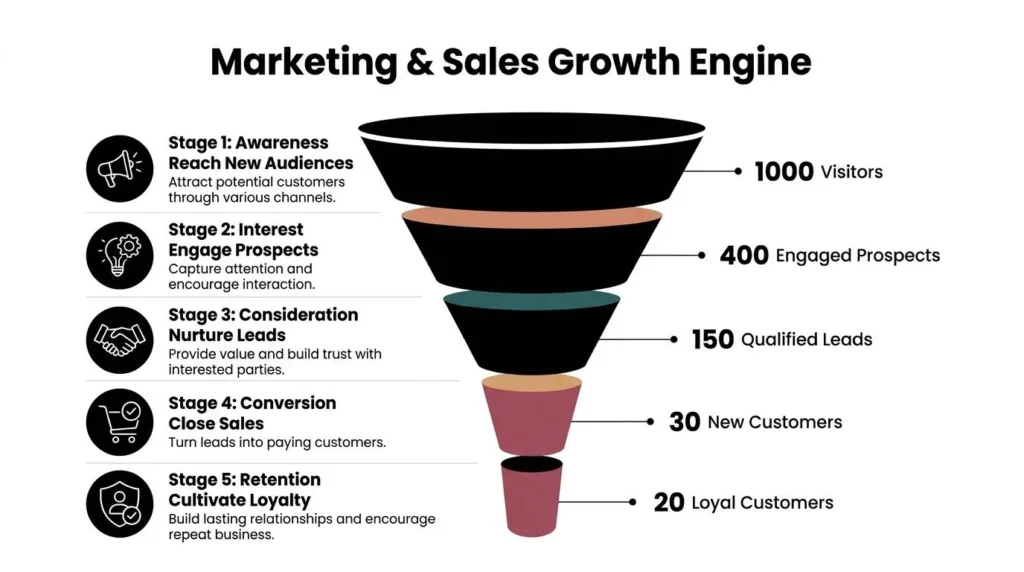
Once demand is validated, marketing stops being guesswork and starts becoming a system.
That distinction matters because many owners do “marketing” in fragments. They post when they remember. They boost a few posts. They run an ad, stop it, restart it, and then conclude nothing works. The issue is rarely one channel. The issue is that there is no engine.
According to The Zebra’s small business statistics, 50% of small businesses prioritize marketing, 72% boosted their online presence, and businesses using social media effectively generate 60% more leads. Those numbers make one point very clear. Buyers are already online. Your job is to meet them with a repeatable path from attention to trust to action.
Build one simple content flywheel
A good marketing engine starts with content that answers buyer questions before the sales conversation begins.
For most small businesses, the basic flywheel looks like this:
- Search-based content: Website pages and articles that target customer questions.
- Social distribution: Short posts, clips, carousels, or images that pull people back to the main offer.
- Email capture: A reason to subscribe, request a quote, book a consult, or join a list.
- Lead nurture: Helpful emails, case examples, FAQs, and reminders.
- Sales conversion: A booking page, checkout, inquiry form, or direct close.
This works because each asset feeds the next one. A single article can become a LinkedIn post, an Instagram carousel, a short email, a FAQ answer for your sales team, and a video script. That is how small teams stay consistent without creating from scratch every day.
For practical channel ideas, digital marketing tips for small business covers useful ways to align content and publishing.
Match channels to buying behavior
Not every business needs the same mix.
A local service business may get better traction from Google Business Profile, reviews, local SEO, and email follow-up than from spending hours on short-form video. A B2B consultant may get more from LinkedIn thought pieces and webinars than from broad consumer channels. An e-commerce brand may rely on product pages, creator partnerships, and cart recovery emails.
Use this filter before committing to a channel:
| Channel | Best when it works | Common mistake |
| SEO | Buyers actively search for your solution | Publishing broad content with no buying intent |
| Social media | You can show proof, personality, or outcomes regularly | Chasing trends unrelated to the offer |
| You have a clear reason for prospects to subscribe | Sending promotions before building trust | |
| Paid ads | You already know the offer converts | Paying to amplify weak messaging |
| Partnerships | Complementary businesses serve the same buyer | Choosing partners with mismatched audiences |
The winning move is usually depth, not breadth. Choose a few channels you can maintain well.
Your funnel needs handoffs, not just traffic
Traffic is not the goal. Qualified movement is.
A lot of small businesses create awareness but do little with the attention they earn. A prospect visits the site, sees generic copy, and leaves. Or they download something and never hear back in a useful way.
Fix the handoffs:
- Top of funnel: Use educational content, review-friendly pages, and clear service pages.
- Middle of funnel: Add FAQs, comparisons, testimonials, pricing guidance, and email sequences.
- Bottom of funnel: Make the next step obvious. Book. Buy. Request. Start.
If your site tries to do everything at once, buyers hesitate. Every important page should answer four questions: What is this? Who is it for? Why should I trust you? What do I do next?
Marketing becomes efficient when each piece has a job. One page should not try to educate, entertain, qualify, and close all at once.
Track the numbers that change decisions
Most small businesses either track nothing or drown in metrics they never use. You need a short dashboard that helps you make weekly decisions.
Here is a practical version.
| Metric | What It Measures | Good Benchmark for a Small Business |
| Website inquiries | How many visitors take a meaningful next step | Trending upward month to month |
| Lead-to-customer conversion | How many qualified leads become paying customers | Stable or improving over time |
| Cost per lead | What you spend to generate a lead | Low enough to preserve margin |
| Sales cycle length | How long it takes to close a deal | Shortening as messaging improves |
| Email engagement | Whether your follow-up earns attention | Consistent opens, clicks, and replies |
| Repeat purchase rate | How often customers come back | Rising as service and retention improve |
| Customer source mix | Which channels bring actual buyers | Diverse enough that one channel failure does not hurt badly |
Notice what is missing. Vanity metrics. A post can get attention and still produce no business value. Track what leads to revenue, not what flatters the team.
Make sales easier for the customer
Most owners think they have a lead problem when they have a friction problem.
Common friction points include:
- Slow response times
- Confusing pricing
- Weak proof
- Too many options
- No clear next step
If you sell services, create a tighter proposal process. If you sell products, improve product page clarity and follow-up emails. If you sell expertise, publish sharper case examples and stronger FAQs.
One practical note for content-led businesses. Platforms such as maxijournal.com publish daily writing across business, technology, health, arts, travel, and other categories, which can make them a useful outlet for content distribution or guest contribution when your strategy includes audience-building through editorial channels.
Growth marketing works best when sales is not treated as a separate department. Every article, ad, page, and email should make the eventual buying decision easier.
Master Your Finances for Sustainable Growth
A lot of owners talk about growth as if revenue alone makes a business stronger.
It does not. Some businesses grow into cash problems faster than they grow into stability.
According to Entrepreneurs HQ small business statistics, 82% of small business failures are tied to poor cash flow management, and nearly a third run out of money before reaching profit. The same source says maintaining a 3 to 6 month cash runway is essential.

That is why “grow at all costs” is dangerous advice for a small business. If the back end is weak, more sales can create more stress. You buy inventory too early. You hire too soon. You spend on ads before collections improve. The business looks active while cash gets tighter.
Build a cash view you can use weekly
You do not need a complex finance stack to get control. A simple spreadsheet or QuickBooks export can do the job if you keep it current.
At minimum, your cash forecast should include:
- Starting cash
- Expected incoming cash by week or month
- Fixed costs such as rent, software, payroll, insurance, debt payments
- Variable costs such as contractors, shipping, materials, ad spend
- Owner draws
- Tax set-asides
Make the forecast visible. Hidden numbers create bad decisions.
A practical method is to project the next 12 months and then review the next 8 weeks in more detail. The annual view helps with timing. The short-term view helps with survival.
Stress-test before you commit to spending
Most budgets assume things will go as planned. Growth budgets should assume disruption.
Model a few scenarios:
| Scenario | What changes | What you do |
|---|---|---|
| Best case | Sales land earlier than expected | Preserve part of the upside instead of spending all of it |
| Base case | Normal close rate and normal collections | Operate as planned, watch margins closely |
| Slow case | Delayed payments or weaker demand | Cut discretionary spend fast |
| Shock case | A major client leaves or ad costs rise | Protect runway and pause expansion bets |
Here, disciplined owners separate themselves. They do not budget for hope. They budget for reality with a margin of safety.
Revenue is theory until cash hits the account. Forecast around cash timing, not just booked sales.
Know your burn rate and your runway
If your business is investing ahead of revenue, you need to know how quickly cash is leaving.
Burn rate is simple. Track how much cash the business uses over a given period. Runway is how long current cash can support operations at that pace.
Those numbers matter most when you are hiring, increasing inventory, or stepping up marketing. The wrong move is not always spending money. The wrong move is spending without knowing how long you can afford the experiment.
A healthy runway gives you room to fix mistakes. A thin runway turns every mistake into a crisis.
Here is a useful explainer to watch before you update your own forecast:
Diversify how the business gets paid
One fragile revenue stream can make a growing company feel unstable.
Depending on your model, diversification may mean:
- adding recurring retainers to one-off project work
- pairing product sales with services or support
- improving upsells, bundles, or maintenance plans
- creating partnerships that send steady referral business
- reducing concentration in one big customer
This is not about adding random offers. It is about reducing dependency.
Tighten collections and payment terms
Many “growth” problems are collections problems.
If clients pay late, your forecast lies. If deposits are too small, you finance the work. If invoices go out late, you train customers to pay late.
Fix the basics:
- Invoice immediately.
- Use deposits where appropriate.
- Set due dates clearly.
- Follow up automatically through Stripe, QuickBooks, or your accounting workflow.
- Escalate politely but quickly when accounts age.
Financial discipline does not make a business less ambitious. It makes ambition survivable.
Create Raving Fans and Repeat Business
The easiest customer to grow from is often the one who already bought.
Too many owners spend all their energy on lead generation and almost none on what happens after the sale. That is backwards. Existing customers are the fastest source of repeat revenue, referrals, stronger reviews, and better messaging. They tell you what matters. They show you what to improve. They also lower the pressure on constant acquisition.
Stop treating the sale as the finish line
A lot of businesses deliver the product or complete the service, then go quiet. That leaves value on the table.
A stronger approach is to design the first 30 days after purchase with the same care you put into marketing. The customer should know what happens next, who to contact, what to expect, and how to get the best result.
For a service business, that may mean a kickoff email, a short onboarding form, a timeline, and a check-in. For a product business, it may mean setup guidance, product care tips, and a message that anticipates common questions.
Silence creates uncertainty. Follow-through builds trust.
Build a feedback loop you can maintain
You do not need a complicated customer experience program. You need a repeatable way to hear what customers say when they are happy, confused, disappointed, or ready to buy again.
Use a simple loop:
- Ask soon after delivery: A short survey with a few clear questions.
- Follow up personally on useful responses: Especially when someone is enthusiastic or frustrated.
- Look for patterns: Repeated objections, repeated praise, repeated confusion.
- Change something small each month: A script, a page, a handoff, an onboarding email.
Typeform, Google Forms, or even direct email replies work fine. The important part is that someone reviews the feedback and acts on it.
If customers keep asking the same question, that is not a customer problem. Your process failed to answer it early enough.
Turn satisfaction into advocacy
Loyalty does not require a complicated app or expensive rewards program. Small businesses often do better with personal, concrete gestures.
Try a few of these:
- Referral prompts: Ask for introductions right after a positive outcome, not months later.
- Simple loyalty perks: Early access, bonus support, preferred scheduling, or small add-ons.
- Milestone recognition: Thank repeat buyers and long-term clients in a way that feels human.
- Review requests: Make it easy. Send the request while the value is still fresh.
The key is timing. Most businesses ask too late or too vaguely. A happy customer needs a specific next action.
Fix service friction before adding perks
Owners sometimes jump to loyalty programs when the issue is inconsistent service.
If you want repeat business, first audit the experience:
| Experience area | What to check |
|---|---|
| Response speed | How long people wait for answers |
| Onboarding clarity | Whether customers know what happens next |
| Delivery consistency | Whether quality changes from order to order |
| Recovery process | How you respond when something goes wrong |
| Follow-up | Whether anyone checks in after the transaction |
A customer who feels seen and supported is easier to retain than one who receives a discount but no confidence.
Use customers to sharpen the offer
Retention is not only about keeping revenue. It is one of the best tools for improving the business itself.
Listen to how your best customers describe your value. Their wording is often better than your brand copy. Notice what they buy together. That can inform bundles. Notice where they stall. That may reveal unnecessary friction, weak pricing structure, or a missing offer tier.
Owners who learn from current customers usually market better to future ones.
Scale Your Operations Without Breaking Them
Growth exposes weak operations fast.
The business that handles ten orders or ten clients smoothly can start dropping balls at a higher volume. Emails get missed. Work gets redone. Customer updates slow down. The owner becomes the bottleneck because every decision still runs through one person.
That is why scaling is not about doing more. It is about building a business that can do more without needing more chaos.
For resource-constrained companies, the smarter path is often digital scale first. The University of Houston SBDC notes that small businesses with limited resources can grow through low-cost digital strategies and community partnerships, including content syndication and cross-promotions. That is the right instinct operationally too. Expand operational reach before expanding overhead.

Find the bottleneck before hiring around it
Most operational fixes start with one question. Where does work slow down or fail?
Look at the weekly flow of work and mark where delays happen:
- lead response
- quoting
- project kickoff
- production
- approvals
- invoicing
- fulfillment
- customer support
Do not guess. Watch the workflow for two weeks. Talk to the people doing the work. Review where errors repeat and where customers wait the longest.
A bottleneck is not always the busiest part of the business. It is the point that limits throughput.
Automate the routine, not the relationship
Automation works best on repetitive admin, reminders, routing, and reporting. It works poorly when you use it to avoid judgment-heavy work or customer empathy.
Good candidates for low-cost automation include:
- Lead capture and routing: Use forms that send inquiries to the right person automatically.
- Appointment scheduling: Calendly or similar tools cut back-and-forth email.
- Invoice reminders: Stripe and accounting tools reduce manual follow-up.
- Task creation: Zapier or Make can trigger internal tasks when a form is submitted or a payment is received.
- Basic email sequences: Onboarding, reminders, and follow-up can be templated.
Poor candidates include difficult customer recovery conversations, strategic pricing calls, and nuanced sales conversations. Technology should remove friction so your team can spend more time where human judgment matters.
Decide when to hire and when to buy capacity another way
Owners often hire because they feel overloaded. That is understandable, but it is not always the best move.
Use this filter:
| Need | Better first move |
|---|---|
| Short-term specialized work | Freelancer or contractor |
| Repetitive admin work | Automation or virtual assistant |
| Ongoing revenue-generating work | Employee if demand is stable |
| Channel testing | Fractional specialist before full-time hire |
| One-off creative or technical project | Agency or vetted freelancer |
If the work is core, recurring, and tied closely to quality or revenue, hiring may make sense. If the work is intermittent, technical, or still experimental, buy flexibility first.
That is one reason digital-first growth is so useful. A business can test adjacent channels, partnerships, and systems without taking on fixed overhead too early.
For teams trying to tighten workflows before adding headcount, how to improve operational efficiency offers a practical lens on process cleanup.
A first hire should remove a recurring constraint, not absorb your stress for a few weeks.
Write the SOPs you keep avoiding
If the business depends on memory, it will struggle to scale.
Standard Operating Procedures sound corporate, but for a small business they can be simple. A short Loom video, a checklist, a one-page doc, or a shared Notion page is enough if it helps another person complete the task correctly.
Start with the workflows that matter most:
- How a lead gets handled
- How a customer gets onboarded
- How work gets delivered
- How issues get escalated
- How invoices get sent and chased
- How recurring marketing gets published
Do not document everything at once. Document the tasks you repeat, delegate, or fix most often.
Use partnerships as operational advantage
Community partnerships are not only a marketing tactic. They can reduce operational strain too.
Examples include complementary businesses that share audiences, local organizations that host joint events, creators who repurpose your content, and distribution partners who extend reach without requiring another employee or location.
Cross-promotions and syndication can help you expand visibility while keeping execution lean. That matters when growth capital is limited and every fixed cost raises the risk of overextension.
The strongest small businesses I have seen do not scale by becoming bigger versions of their messy early stage. They scale by becoming simpler, clearer, and more repeatable.
If you want practical, approachable business guidance alongside coverage across technology, health, arts, travel, education, pets, entertainment, and more, visit maxijournal.com. It is an independent web-based magazine and blog that publishes daily commentary and welcomes readers who prefer clear, useful writing over hype.
Discover more from Maxi Journal
Subscribe to get the latest posts sent to your email.