You want to get stronger. You may have a pair of dumbbells at home, a gym membership you barely use, or a note in your phone that says “start lifting” followed by weeks of avoidance.
That hesitation makes sense. Beginner advice is often a mess. One person says you need barbells right away. Another says bodyweight is enough forever. Social media makes every workout look either painfully complicated or absurdly easy.
The good news is how to start strength training is much simpler than it looks. You do not need a perfect plan, expensive gear, or a “fitness personality.” You need a safe starting point, a few basic movement patterns, and a clear answer to the question that stops many people after week two: what do I do next?
That is what this guide solves. You will start with simple movements you can do at home, build a weekly schedule that fits real life, and then progress into a structured beginner program you can keep using once you feel ready for the gym.
Why Strength Training Is Your Best Health Investment
A lot of people think strength training is mainly about appearance. Bigger arms. Tighter legs. Visible muscle. Those can happen, but that framing is too small.
Strength training is really about keeping your body useful, capable, and resilient.
Around age 30, people begin losing lean muscle mass every 10 years, and resistance training is the most effective intervention to slow and even reverse that decline. In older adults, even one weekly session has been associated with up to a 37% increase in muscle strength according to this weightlifting statistics summary.
That matters long before old age. Muscle helps you stand up from the floor, carry luggage, pick up your kids, climb stairs, protect your joints, and tolerate everyday physical stress without feeling wrecked.
The fears are real, but manageable
Most beginners do not avoid lifting because they are lazy. They avoid it because they are unsure.
- Fear of injury: You do not want to hurt your back or knees.
- Fear of doing it wrong: You do not want to look lost in a gym.
- Fear of not sticking with it: You do not want another abandoned routine.
All three are reasonable. None of them mean you should stay away from strength training.
A good beginner plan reduces risk by keeping the exercises simple, the loading moderate, and the progress gradual. You learn to move well first. Then you make it harder.
Strength gives you options
Cardio is useful. Mobility work is useful. Walking is useful. Strength training adds something different. It raises your ceiling.
A stronger body makes other forms of exercise easier. It also makes inactivity less punishing. If you have more strength than daily life requires, normal tasks stop feeling like effort.
Key takeaway: Strength training is not reserved for athletic people. It is one of the most practical things an ordinary adult can do for long-term health and independence.
You do not need to become a “lifter”
You only need to become a person who trains consistently.
That shift matters. If you think the goal is to train like an advanced lifter, you will overcomplicate everything. If you understand the goal is to build a solid beginner base, the path gets clearer.
Start with movements you can control. Repeat them often enough to improve. Add challenge slowly. Stay patient through the awkward first month.
Confidence comes after reps, not before them.
Your Pre-Training Checklist for a Safe Start
Before you pick up a weight, get your setup right. A beginner who does a few simple things well usually lasts longer than the person who rushes into a “serious” plan.
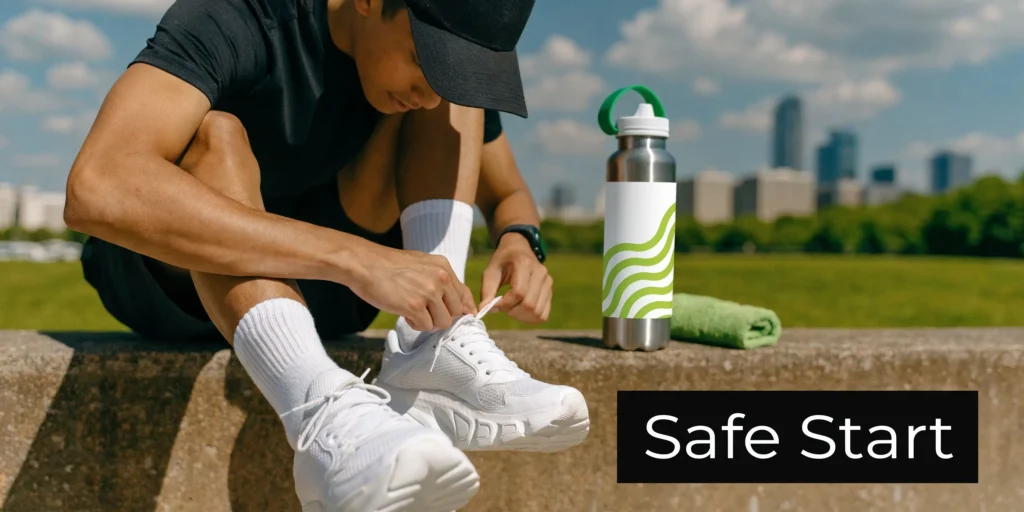
According to the Mayo Clinic, beginners can make significant strength progress with just two or three 20- to 30-minute sessions per week in this strength training guide from Mayo Clinic. That should take pressure off right away. You are not trying to train like a competitive athlete.
Check your starting point
You do not need a full fitness assessment. You do need honesty.
Ask yourself:
- Can you sit down and stand up without using your hands?
- Can you get onto the floor and back up with control?
- Do you have ongoing pain in your shoulders, knees, hips, or back?
- Have you exercised at all in the last few months?
- Do you feel steady on one leg?
If you have a medical condition, a recent injury, dizziness with exercise, chest pain, or major joint limitations, talk to a clinician before starting.
If you are generally healthy but deconditioned, start with the easiest variation of each movement. There is no prize for beginning too hard.
Set a goal that means something
“Get toned” is not a useful training target. It sounds motivating, but it gives you nothing to act on.
Better goals are concrete:
- Do 10 push-ups using a bench or countertop
- Carry heavy grocery bags without your grip failing
- Squat down and stand up smoothly
- Move from home workouts to a gym routine without feeling lost
Those goals change how you train. They also give you a real way to notice progress.
Learn the small terms that confuse beginners
A little gym language goes a long way.
| Term | Plain-English meaning |
|---|---|
| Rep | One complete repetition of an exercise |
| Set | A group of reps done before resting |
| Form | How your body performs the movement |
| Rest | The pause between sets |
| Resistance | The thing making the exercise hard, such as bodyweight, a band, or a dumbbell |
When someone says “do 2 sets of 10 reps,” they mean do the movement 10 times, rest, then repeat another 10.
Know the difference between effort and pain
New lifters often stop too early because normal effort feels alarming. Others push through pain because they think discomfort always means growth.
Use this simple distinction:
- Muscle effort: burning, shaking, heaviness, fatigue
- Post-workout soreness: stiffness or tenderness that shows up later
- Pain: sharp, stabbing, sudden, or joint-specific discomfort
Pain changes how you move. Effort does not.
If you want a broader look at reducing risk while staying active, this guide on preventing sports injuries covers practical basics that pair well with beginner strength work.
Tip: Stop any exercise that causes sharp pain, numbness, or a sudden loss of control. Regress the exercise, shorten the range of motion, or get coaching.
Build a simple pre-workout routine
Do the same short setup before every session. It makes training feel familiar.
- Clear your space: You need room to squat, hinge, push, and carry safely.
- Wear stable shoes or train barefoot at home if the surface is safe: Slippers are a bad idea.
- Warm up with easy movement: March in place, do arm circles, and practice the movement without load.
- Keep water nearby: Not because hydration is magic, but because small frictions derail habits.
This is enough. You do not need a complicated activation sequence to begin.
Mastering the Five Foundational Strength Movements
Most beginner programs feel random because they are built around exercises, not movement patterns. Learn the patterns first and the exercise list stops being confusing.
Your whole beginner phase can revolve around five patterns: squat, hinge, push, pull, and carry.
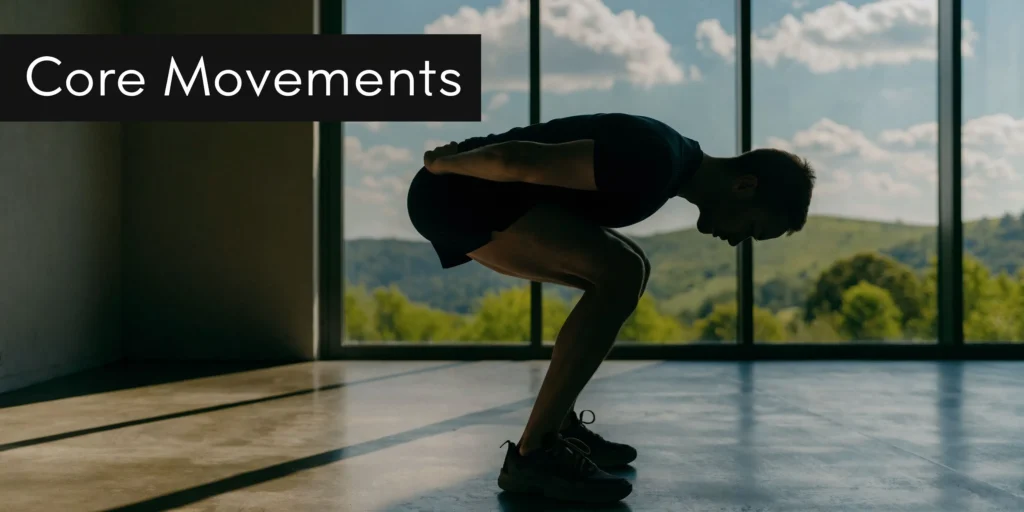
If you can perform one version of each well, you already have the foundation of a real strength program. For more broad beginner conditioning ideas alongside these patterns, this beginner fitness article is a useful companion.
Squat
The squat trains you to lower and raise your body under control. It builds strength in your legs and teaches you to stay braced through your trunk.
Start with: bodyweight squat to a chair
How to do it:
- Stand with feet about shoulder-width apart.
- Reach your hips back slightly as your knees bend.
- Lower until you lightly touch a chair or box.
- Stand back up by pushing through your whole foot.
What it should feel like:
- Work in the thighs and glutes
- Stable feet
- Controlled lowering, not dropping
Common mistakes:
- Knees collapsing inward
- Heels lifting
- Chest folding down too much
- Crashing onto the chair
A good cue is “sit back and down, then stand tall.”
If a full squat feels difficult, reduce the depth. If it feels easy, hold a dumbbell or backpack at your chest for a goblet squat.
Hinge
The hinge is different from the squat. In a hinge, your hips move back more and your torso leans forward while your spine stays neutral. This pattern trains the back side of your body.
Start with: glute bridge, then dumbbell Romanian deadlift
How to do a glute bridge:
- Lie on your back with knees bent and feet flat.
- Brace your midsection.
- Drive through your feet and lift your hips.
- Pause, squeeze your glutes, then lower with control.
What it should feel like:
- Glutes and hamstrings doing the work
- Little to no strain in the lower back
Common mistakes:
- Overarching at the top
- Pushing from the toes
- Rushing the lowering phase
When you are ready to stand up and hinge with load, use a light pair of dumbbells and practice sliding your hips back while keeping the weights close to your legs.
Push
Push patterns train the chest, shoulders, and triceps. They also teach full-body tension if you do them well.
Start with: incline push-up against a wall, countertop, or sturdy bench
How to do it:
- Place hands slightly wider than shoulder width.
- Walk your feet back until your body forms a straight line.
- Lower your chest toward the surface.
- Press away until your elbows straighten.
What it should feel like:
- Chest, shoulders, and arms working together
- Core staying tight so your hips do not sag
Common mistakes:
- Elbows flaring hard out to the sides
- Head reaching first
- Lower back sagging
If floor push-ups are too hard, raise the hands higher. If incline push-ups become easy, lower the surface over time.
Pull
Beginners often neglect pulling because it is harder to improvise at home. Do not skip it. Pulling helps posture, upper-back strength, and shoulder balance.
Start with: one-arm dumbbell row or band row
How to do a one-arm dumbbell row:
- Place one hand on a bench, chair, or your thigh for support.
- Hinge forward with a flat back.
- Let the weight hang from a straight arm.
- Pull your elbow back toward your hip.
- Lower slowly.
What it should feel like:
- Mid-back and lats doing the pulling
- Very little shrugging
Common mistakes:
- Twisting the torso
- Jerking the weight
- Pulling the shoulder up toward the ear
If you have no dumbbell, a loaded backpack works. If you have a resistance band, anchor it safely and row toward your ribs.
A visual demo can help if this pattern feels unfamiliar:
Carry
Carries are simple and brutally useful. You pick something up and walk with it. That trains grip, posture, trunk stability, and total-body coordination.
Start with: farmer carry using grocery bags, dumbbells, or kettlebells
How to do it:
- Stand tall holding weight at your sides.
- Walk slowly with short, controlled steps.
- Keep shoulders level and ribs stacked over hips.
What it should feel like:
- Grip working hard
- Midsection braced
- No leaning side to side
Common mistakes:
- Taking fast, sloppy steps
- Shrugging the shoulders up
- Letting the weights swing
How these patterns become a real workout
Pick one exercise from each pattern and you can build a full-body session almost anywhere.
Example home workout:
- Chair squat
- Glute bridge
- Incline push-up
- One-arm row
- Farmer carry
Remember: You do not need dozens of exercises. You need a small group of reliable movements you can repeat and improve.
Focus on control first. Then range of motion. Then resistance. That order is what turns an absolute beginner into a confident novice.
Designing Your First Weekly Workout Schedule
Exercises matter. Schedule matters more.
A beginner who knows exactly when to train, what to do, and when to stop is far more likely to stay consistent than someone chasing random workouts. Structure removes decision fatigue.
The basic rule is simple. Use a full-body routine and repeat the same core lifts often enough to learn them.
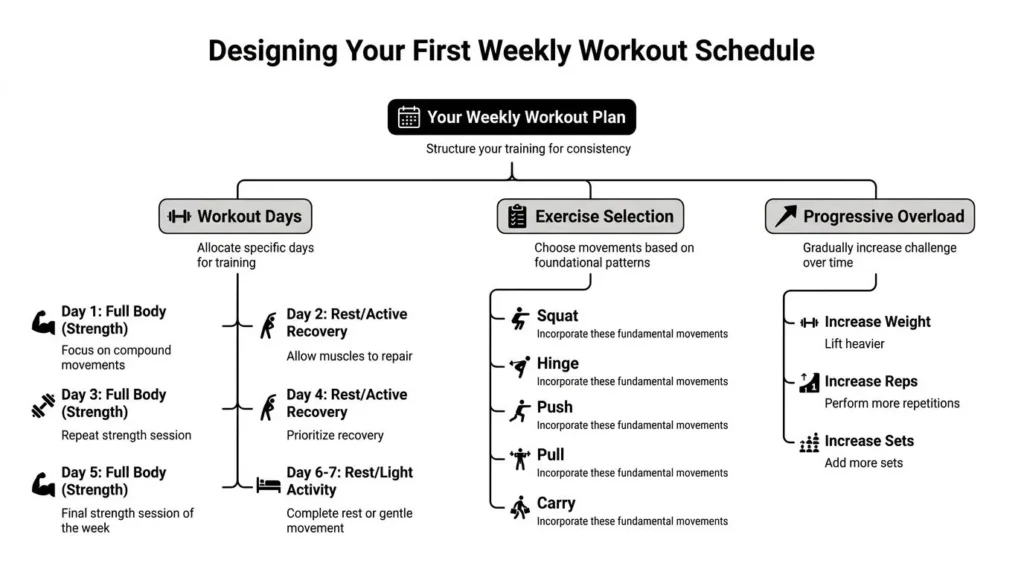
According to Harvard Health, a strong beginner starting point is 8 to 12 repetitions per set, with the last two reps feeling challenging. If you can do more than 12 easily, the weight is too light. If you cannot reach 8, it is too heavy. Harvard also advises allowing at least 48 hours of recovery before training the same muscle group again in this guide to starting a strength training program.
The key variables that matter
You do not need to become a programming expert. Just understand these four levers.
- Frequency: How many days you train each week
- Sets: How many rounds you do of an exercise
- Reps: How many repetitions you do in each set
- Rest: How long you recover between sets
For most beginners, two or three full-body sessions per week is enough. Keep the plan boring on purpose. Repetition builds skill.
A simple rule for progressive overload
Progressive overload means making the work slightly harder over time so your body has a reason to adapt.
That can mean:
- adding a little weight
- doing more reps with the same weight
- adding a set
- choosing a harder variation
Use this beginner rule: if you complete all your sets with good form and the final reps still feel controlled, make one small change next time.
Tip: Increase only one thing at a time. Do not add weight, reps, and extra exercises all in the same week.
Sample two-day home schedule
This works well if you have very little equipment.
| Day | Exercises |
|---|---|
| Day 1 | Chair squat, glute bridge, incline push-up, one-arm backpack row, carry |
| Day 2 | Bodyweight squat, hip hinge drill or dumbbell Romanian deadlift, wall or bench push-up, band row, carry |
For each exercise, start with 2 sets in the target rep range. Rest long enough to perform the next set well.
Sample three-day dumbbell schedule
If you have adjustable dumbbells or access to a gym, this is a smooth next step.
| Day | Exercises |
|---|---|
| Day 1 | Goblet squat, dumbbell Romanian deadlift, dumbbell floor press, one-arm row, carry |
| Day 2 | Split squat, glute bridge or hip thrust, overhead press, row variation, carry |
| Day 3 | Goblet squat, Romanian deadlift, incline push-up or dumbbell press, row variation, carry |
How to know you are ready for the gym
You do not need to “earn” the gym through months of bodyweight work. You are ready when you can do three things:
- Set up basic positions safely
- Control the lowering phase of each movement
- Recognize when a weight is too light or too heavy
At that point, machines, dumbbells, and barbells become tools instead of obstacles.
A confident novice is not someone using advanced methods. It is someone who can follow a plan, recover from it, and repeat it next week.
Your Complete 8-12 Week Beginner Strength Plan
The first few months should feel predictable. You are practicing the same movement families, adding challenge gradually, and avoiding the mistake of program-hopping.
Beginner systems often use linear progression, such as adding 5 pounds per session on key lifts when appropriate, while more advanced plans vary intensity through periodized waves. For a novice, the main job is simpler: stay consistent and master the movements before adding complexity, as explained in this strength program design resource.
How to use this plan
Train on nonconsecutive days if you choose three sessions. If two sessions fits better, alternate Day A and Day B and continue the sequence next week.
Use home versions first if needed. Move to dumbbells or gym equipment when the listed exercise feels stable and repeatable.
8-Week Beginner Full-Body Strength Program
| Week | Day A (e.g., Monday) | Day B (e.g., Wednesday) | Day C (e.g., Friday) |
|---|---|---|---|
| 1 | Chair squat 2 sets, glute bridge 2 sets, incline push-up 2 sets, one-arm row 2 sets, carry 2 rounds | Bodyweight squat 2 sets, hip hinge drill 2 sets, wall push-up 2 sets, band or backpack row 2 sets, carry 2 rounds | Repeat Day A if training 3 days. If not, rest |
| 2 | Same exercises. Add reps if form stays solid | Same exercises. Slow the lowering phase | Repeat Day A if training 3 days. If not, rest |
| 3 | Bodyweight or goblet squat 2 to 3 sets, glute bridge 2 to 3 sets, incline push-up 2 to 3 sets, row 2 to 3 sets, carry | Squat variation 2 to 3 sets, dumbbell Romanian deadlift or hinge drill 2 to 3 sets, push-up variation 2 to 3 sets, row 2 to 3 sets, carry | Repeat Day A if training 3 days. If not, rest |
| 4 | Keep the same exercises. Add a small amount of load if available | Keep the same exercises. Improve control and range of motion | Repeat Day A if training 3 days. If not, rest |
| 5 | Goblet squat, dumbbell Romanian deadlift, dumbbell floor press or lower incline push-up, one-arm row, carry | Split squat or chair-assisted split squat, glute bridge, overhead press if comfortable, row, carry | Repeat Day A if training 3 days. If not, rest |
| 6 | Same movements. Add reps or a small weight increase | Same movements. Stay smooth and controlled | Repeat Day A if training 3 days. If not, rest |
| 7 | Continue Week 6 pattern. Aim for stronger execution, not more variety | Continue Week 6 pattern. Keep full-body balance | Repeat Day A if training 3 days. If not, rest |
| 8 | Use your most stable versions of squat, hinge, push, pull, and carry | Repeat with slightly more challenge if technique holds | Repeat Day A if training 3 days. If not, rest |
If you want to continue to week 12
Do not reinvent the plan. Extend it.
- Weeks 9 to 10: keep the same exercise list and progress load or reps modestly
- Weeks 11 to 12: move one or two main lifts to more formal gym versions, such as goblet squat to machine squat, or backpack row to dumbbell row
That transition is where many beginners finally feel like lifters. Not because the gym changed them overnight, but because they built enough skill to use it with purpose.
Simple Nutrition and Recovery for Muscle Growth
Beginners often make training harder than it needs to be, then make eating even harder. They hunt for the perfect macro split, pre-workout, recovery drink, and supplement stack before they have built basic habits.
You do not need that.
What helps most at the start is simple: eat enough quality food, recover seriously, and stop acting like soreness is a badge of honor.

Eat like someone who wants to recover
Your muscles need building material. That does not mean your meals need to look like a bodybuilding contest prep plan.
Keep it practical:
- include a protein source at meals
- eat carbohydrates that give you training energy
- add fruits or vegetables regularly
- do not under-eat and expect your body to feel powerful
Simple meals work well. Chicken, rice, vegetables. Greek yogurt with fruit. Eggs and toast. Beans with potatoes and a salad. If planning meals is the part that trips you up, these healthy meal prep ideas can help you keep food simple and repeatable.
Sleep is part of the program
A beginner can still gain strength while living imperfectly. But poor sleep makes everything harder.
Bad sleep affects effort, concentration, coordination, and patience. In strength training, that means sloppy reps, skipped sessions, and more frustration.
You do not need a perfect night every night. You do need to respect sleep as training support, not an optional extra.
Try this:
- keep a consistent bedtime when possible
- avoid cramming hard workouts late if they keep you wired
- build a short wind-down routine instead of scrolling until you pass out
Hydration is boring and important
Hydration advice gets exaggerated, but the basic principle is not complicated. If you are dehydrated, training feels worse.
Drink water through the day. Have some before training. Keep some nearby during the session. That is enough for most beginners.
Recovery is not doing nothing
Recovery includes rest days, but it does not always mean total stillness.
Useful recovery can look like:
- walking
- easy mobility work
- light stretching
- a shorter session focused on technique
Key takeaway: Muscle growth support for beginners comes mostly from consistent meals, enough fluid, and sleep you can repeat. Supplements are optional. Habits are not.
The strongest nutrition plan is the one you can follow while living a normal life.
Frequently Asked Beginner Questions
The first months of strength training are full of small doubts. Most are normal. None of them mean you are failing.
What is the difference between good soreness and bad pain
Good soreness usually feels dull, stiff, or tender in the muscles you trained. It often shows up later, especially the next day.
Bad pain is sharper and more specific. It may show up during a rep, change your movement, or center on a joint. If that happens, stop the exercise and adjust.
What if I miss one workout
Do the next scheduled session and move on.
Do not try to cram missed workouts into the same week. That usually leads to extra fatigue and messy technique. One missed day does not erase progress.
What if I miss a whole week
Restart slightly below where you left off.
Use the same exercises, but make the first session back easier. Your body usually regains rhythm quickly when the layoff is short. The mistake is treating the comeback workout like a test.
How long until I see results
Visible changes and strength changes do not always happen on the same timeline. Some beginners notice better control, better posture, or easier daily tasks before they notice physical changes in the mirror.
Harvard’s beginner guidance notes that measurable strength changes can appear after 4 to 6 weeks of consistent training, as discussed earlier in the article. That is a useful window, but your real job is staying consistent long enough to benefit from it.
Do I need supplements
No. Not to begin.
If your training, food, and sleep are inconsistent, supplements will not solve the main problem. Focus on regular meals, enough water, and repeated training first.
Should I train through a sticking point
Sometimes the weak part of a lift is not the whole lift. It is one position inside the lift.
A useful beginner principle is to train the full movement with control. A common question is how to handle weak positions or “sticking points.” While that becomes more advanced later, beginners benefit from using full range of motion, such as squatting to full depth they can control, because it builds strength across the entire exercise and helps prevent weak spots from developing, as shown in this video discussion on training sticking points.
How do I know when I have moved from beginner to confident novice
You are there when basic training stops feeling mysterious.
That usually means:
- you can set up your main exercises without confusion
- you know what a challenging set feels like
- you can adjust an exercise up or down without panic
- you no longer need a brand-new workout to stay interested
That is a big shift. It means you have stopped “trying to start” and started.
If you want more approachable health and training reads in the same plain-language style, maxijournal.com publishes articles across health, sports, science, education, and related topics for curious everyday readers.
Discover more from Maxi Journal
Subscribe to get the latest posts sent to your email.