If you’ve heard that antioxidants are always the “good guys,” glutathione is where that simple story starts to break down.
Glutathione is often called the body’s master antioxidant. That label isn’t wrong. In healthy cells, it helps control oxidative stress and supports basic cell survival. But cancer biology doesn’t reward simple labels. A molecule that protects normal tissue can also be hijacked by tumor cells. That’s why people searching for answers about glutathione and cancer run into headlines that seem to contradict each other.
One source says antioxidants protect cells. Another warns that glutathione may help tumors resist treatment. Both ideas can be true, depending on the setting.
This is the part many readers find unsettling. If glutathione is natural, and if healthy cells need it, how can it also act like a kind of superfood for cancer? The short answer is context. Cancer cells don’t use normal biology normally. They repurpose it.
For readers who want a broader foundation before focusing on this one molecule, Hirschfeld Oncology has a helpful overview on understanding antioxidants in cancer care. It gives useful context for why antioxidant questions become much more complicated once cancer enters the picture.
The Antioxidant Paradox in Cancer
The public discussion usually starts from a comforting assumption. Oxidative stress is harmful. Antioxidants reduce oxidative stress. Therefore, more antioxidants must be better.
That logic works only up to a point.
Cancer cells also face oxidative stress. In fact, many tumors live under constant internal pressure. They divide quickly, generate metabolic waste, and survive in harsh environments. A healthy cell uses antioxidant systems to stay balanced. A cancer cell can use those same systems to stay alive when it otherwise might die.
Why the advice sounds contradictory
The confusion around glutathione and cancer comes from mixing two different questions:
- What does glutathione do in a healthy cell? It helps protect normal cellular machinery.
- What does glutathione do inside a tumor? In some cancers, it can strengthen the tumor’s defenses.
Those aren’t opposing facts. They’re the same biology viewed in different settings.
The “friend or foe” question has a frustrating answer. Glutathione can be both, because tumors borrow the same survival tools that healthy cells use.
A major shift in scientific thinking arrived in the late 2010s and early 2020s. A 2018 review in the Journal of Cell Biology described evidence that increased glutathione helps tumor cells survive oxidative stress, promotes progression, and contributes to chemoresistance, with links noted in melanoma, liver, breast, colon, larynx, and lung cancers (Journal of Cell Biology review).
That changed the framing. Glutathione was no longer seen only as a cellular shield. In cancer, it became a context-dependent molecule. Helpful in one setting. Harmful in another.
Understanding Glutathione’s Role in Healthy Cells
Before cancer complicates the picture, it helps to know why glutathione earned its reputation in the first place.
Think of glutathione as a cell’s maintenance and emergency response team. It doesn’t do just one job. It handles cleanup, damage control, and support for other protective systems. When a healthy cell is exposed to metabolic stress, toxins, or unstable molecules, glutathione helps keep the situation from escalating.
Three jobs that make glutathione so important
Here’s a practical way to picture it.
Firefighting against oxidative stress
Cells constantly generate reactive molecules as part of ordinary life. Left unchecked, those molecules can damage proteins, membranes, and DNA. Glutathione helps neutralize them before that damage spreads.Waste handling and detox support
Cells also need ways to process and remove harmful compounds. Glutathione participates in detoxification pathways, which is one reason it’s often discussed in liver health and environmental stress.Recharging other defenses
Antioxidant systems don’t work alone. Glutathione helps maintain the broader protective network inside the cell, acting less like a solo hero and more like a key member of a coordinated team.
Why healthy cells need it
A normal cell doesn’t want zero oxidation. It wants balance. Oxidative chemistry is part of life. The problem comes when stress overwhelms control systems.
That’s why the “master antioxidant” label persists. Glutathione is woven into everyday cell survival. Without it, cells become more vulnerable to wear, damage, and dysfunction.
A simple analogy helps. In a well-run city, sanitation workers, firefighters, and electricians are all essential. Glutathione behaves a bit like all three. It removes hazards, limits damage, and keeps critical systems running. No one would call that harmful in a healthy neighborhood.
Practical rule: When people say glutathione is protective, they’re usually describing its role in normal physiology, not necessarily its effect inside an established tumor.
That distinction matters. A molecule doesn’t change its chemical identity when cancer appears. What changes is who is using it, and for what purpose.
The Double-Edged Sword in Cancer Biology
Cancer cells don’t invent new chemistry from scratch. They exploit what already exists.
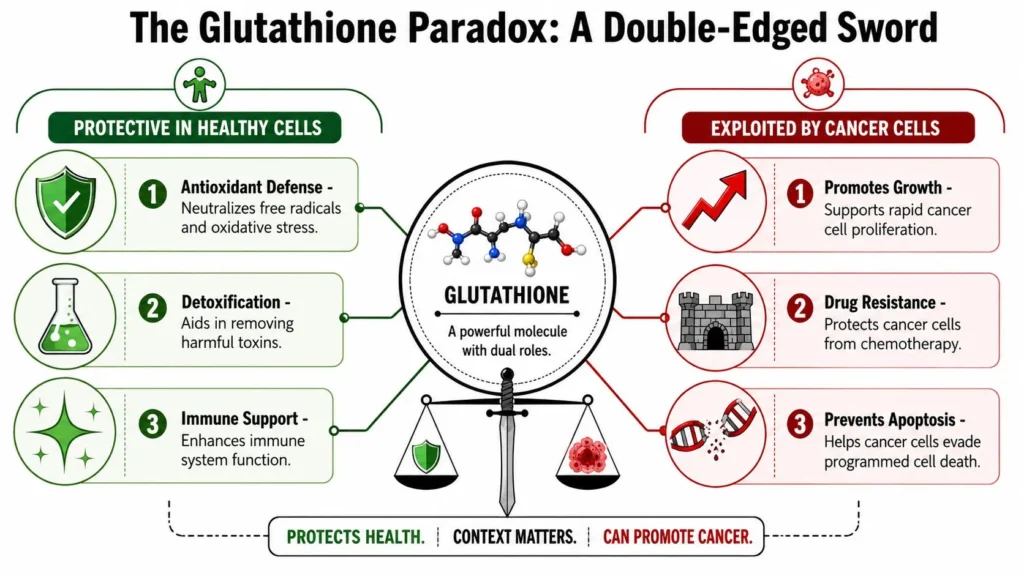
That’s the key to the paradox. The same glutathione system that protects healthy cells can be turned into a survival advantage for malignant ones. A better way to think about this isn’t “good molecule versus bad molecule.” It’s normal defense system used by the wrong cell for the wrong outcome.
How the same shield changes meaning
A healthy cell uses glutathione to survive ordinary stress and recover from injury. A cancer cell may use increased glutathione to survive the very stresses that should limit its growth.
That includes stress created by:
- the tumor’s own chaotic metabolism
- low-oxygen or nutrient-poor regions inside a tumor
- treatment pressure from chemotherapy or radiation
In that setting, glutathione acts less like a wellness nutrient and more like a fortification material. The tumor reinforces its walls with it.
The turning point in scientific thinking
Researchers didn’t always frame glutathione this way. For years, it was discussed mainly as a beneficial antioxidant. The more cancer metabolism was studied, the more incomplete that picture looked.
The 2018 Journal of Cell Biology review marked a significant shift by arguing that increased glutathione helps tumors survive, promotes progression, and contributes to chemoresistance in cancers including breast, colon, and lung. That reframed glutathione as a context-dependent factor in cancer metabolism rather than a purely protective molecule.
If you’re interested in how modern biology uncovers these mechanisms at the molecular level, tools such as CRISPR and gene editing techniques help researchers test which pathways cancer cells depend on and which ones might be vulnerable to treatment.
Why this isn’t really a contradiction
People often hear “glutathione protects cells” and “glutathione can help cancer” and assume one of those claims must be false.
They’re not false. They’re incomplete when stated alone.
A kitchen knife is useful in a home kitchen and dangerous in the wrong hands. The object hasn’t changed. The context has. Glutathione works in a similar way. It is biologically useful. Cancer cells can still misuse it.
| Setting | What glutathione tends to do |
|---|---|
| Healthy tissue | Helps manage oxidative stress and maintain cellular stability |
| Some tumors | Helps malignant cells tolerate stress and resist damage |
| During treatment pressure | May contribute to a cell’s ability to survive attacks meant to kill it |
That’s why the “good guy or bad guy” debate leads nowhere. In oncology, the better question is: under what conditions does glutathione help normal tissue, and under what conditions does it help the tumor more?
How Cancer Cells Exploit Glutathione for Fuel and Defense
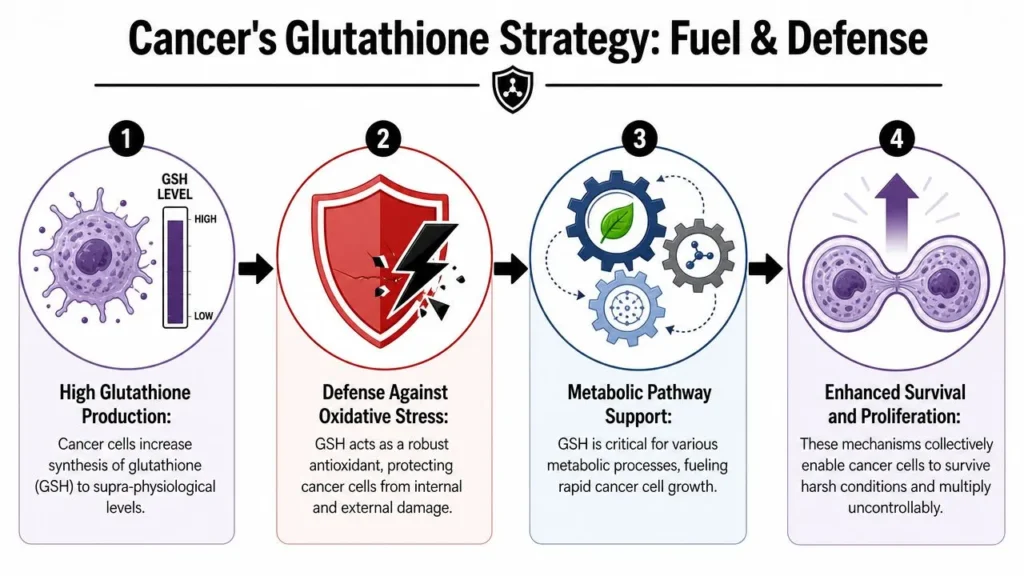
The most useful way to understand glutathione and cancer is to separate two different tumor advantages. In some cancers, glutathione works like armor. In others, or sometimes at the same time, it also becomes a source of raw material.
That second role surprised many people because it moved glutathione beyond the antioxidant story.
Defense against stress and treatment
Many cancer treatments damage tumor cells by pushing them into lethal stress. Chemotherapy and radiation don’t work by “poisoning bad cells” in some magical, selective way. They often work by creating damage that cancer cells can’t cope with.
Glutathione can blunt some of that damage.
When a tumor cell has a strong glutathione system, it may be better able to neutralize reactive stress and survive the assault. That helps explain why high glutathione-related activity has been linked to drug resistance and worse prognosis in some cancers, as discussed in a 2013 NIH review of human tumor studies (NIH review on glutathione in tumors).
Tumors don’t all look the same
That same review makes another point that often gets lost in public discussions. Glutathione patterns vary by cancer type. It reported that glutathione tends to be higher in breast, ovarian, head and neck, and lung cancers, while being lower in brain and liver tumors compared with disease-free tissue. It also noted that colorectal cancer tissue commonly contains about 10–50 nmol/mg-protein of glutathione.
Those details matter because they block oversimplified advice. There isn’t one universal “cancer glutathione level.” Different tumors behave differently.
A claim about glutathione that sounds absolute usually isn’t. Cancer biology is patchy, not uniform.
A short video can help some readers visualize this idea more intuitively.
Glutathione as fuel
The newer and more unsettling finding is that some cancer cells don’t just benefit from glutathione’s protective effects. They can also break down extracellular glutathione and use the cysteine it contains as fuel.
A study summarized by Science Media Centre described this in human tissue and mouse work, and reported that blocking glutathione availability or its breakdown slowed tumor growth in preclinical breast-cancer models (study summary on glutathione feeding cancer cells).
That finding changes the mental model. Glutathione isn’t only a shield around the tumor. In some settings, it can also function like a food supply.
A plain-language analogy
Think of a besieged city.
- First, glutathione helps strengthen the city wall.
- Second, the city may also strip useful materials from incoming cargo and burn them for energy.
Those are different advantages. A tumor that can do both becomes harder to eliminate.
This doesn’t mean every glutathione molecule feeds every cancer. It means researchers now have evidence that some tumors can use glutathione in more than one pro-survival way. That’s a big reason clinicians and scientists are cautious about broad statements.
Rethinking Glutathione Supplementation and Cancer
At this point, the public conversation gets personal fast. If glutathione can help healthy cells, should you take a supplement? And if you have cancer, or are worried about cancer, is supplementation risky?
The most honest answer is that self-prescribing glutathione in the context of cancer is not a good idea.
Why “natural” doesn’t answer the question
A molecule being natural doesn’t make it automatically safe in every medical situation. Insulin is natural. Estrogen is natural. Iron is natural. In the wrong setting, each can create problems.
Glutathione belongs in that same category of “normal but context-sensitive.”
For a person without cancer, over-the-counter marketing often frames glutathione as a general wellness booster. For someone with an existing cancer, an undiagnosed cancer, or active treatment, the calculus is different. If some tumors can use glutathione as defense or fuel, adding more without medical guidance becomes a serious judgment call, not a harmless experiment.
What readers often get wrong
The most common mistake is treating supplements as nutritionally neutral. They’re not. A supplement changes biology. Sometimes only a little. Sometimes in ways we don’t fully predict.
Questions worth asking before taking any glutathione product include:
- What’s the goal? General wellness, recovery support, or something related to cancer treatment?
- What’s the timing? During active therapy is not the same as long after treatment.
- Who is supervising it? A product label can’t assess tumor biology, treatment plan, or recurrence risk.
If you want to see what commercial glutathione products look like on the market, a page such as Lifeworks Integrative Health supplements is useful mainly as a reminder that these products are easy to buy and easy to misunderstand.
The easier a supplement is to purchase, the more important it is to ask whether your biology is the right place to use it.
A cautious bottom line
There isn’t strong support for treating glutathione supplements as a proven strategy for cancer prevention. More importantly, there are plausible reasons for caution in people with cancer or those undergoing treatment.
That doesn’t mean glutathione is “bad.” It means the situation is critical enough that broad wellness advice stops being appropriate. If cancer is part of the picture, this becomes a conversation for an oncologist, not a checkout cart.
Glutathione’s Role in Modern Oncology Treatments
The story doesn’t end with warning labels. Researchers are also trying to use this knowledge in a more strategic way. If some tumors depend on glutathione pathways, those pathways may become treatment targets.
That’s an important shift in perspective. Instead of asking only whether glutathione helps cancer, oncology asks whether clinicians can manipulate glutathione biology to help patients.
Why targeting glutathione isn’t one-size-fits-all
Clinical evidence shows that glutathione levels are not uniform across cancers. Human tumor studies reviewed by NIH found glutathione is often higher in breast, ovarian, and lung cancers, but can be lower in brain and liver tumors. The same review noted that high activity of glutathione-related enzymes is linked to drug resistance and worse prognosis in some cancers.
That variability matters. A strategy that makes sense in one tumor type may make less sense in another.
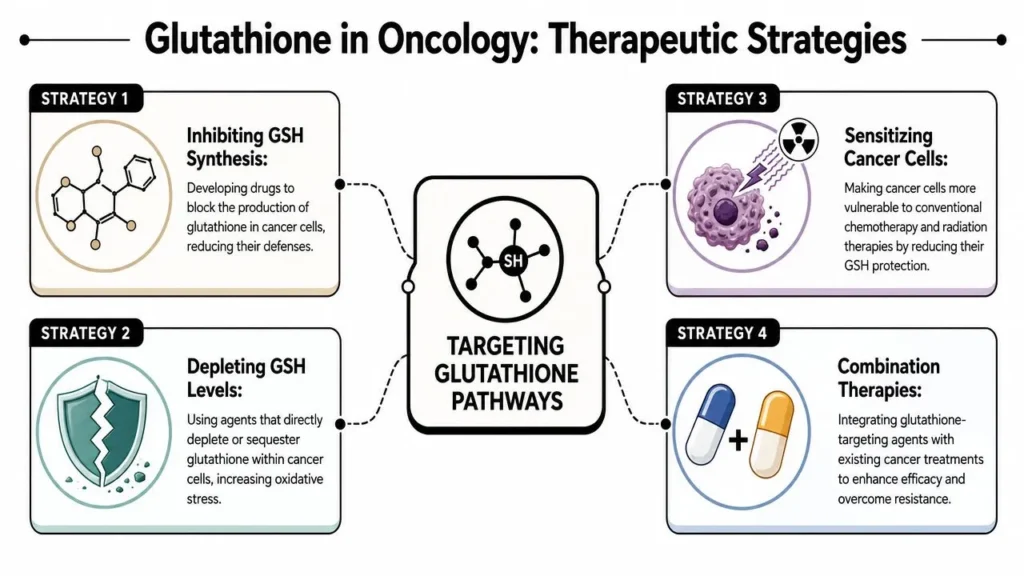
Four broad treatment ideas under study
Researchers are exploring several related approaches:
Block synthesis inside tumors
If a cancer cell relies on making its own glutathione, inhibiting that pathway may weaken its defenses.Deplete available glutathione
Another strategy is to reduce the glutathione pool so tumor cells become more vulnerable to oxidative damage.Increase sensitivity to standard treatment
Lowering glutathione protection may help chemotherapy or radiation work better in resistant tumors.Use combination approaches
The most realistic path may be pairing glutathione-targeting strategies with other cancer therapies rather than relying on a single intervention.
A useful parallel appears in other areas of cancer medicine, where treatment is increasingly adapted to tumor biology. Readers exploring broader treatment concepts may find immunotherapy in cancer care helpful as another example of how oncology tries to exploit cancer’s specific weaknesses.
The balancing act clinicians face
There’s also a subtle challenge here. Oncologists don’t want to wipe out every antioxidant defense everywhere in the body. Healthy tissues need protection too. The goal isn’t blunt destruction. It’s selective pressure against the tumor.
That’s why glutathione research can look contradictory from the outside. In one setting, scientists may want to weaken a tumor’s glutathione system. In another, clinicians may be thinking carefully about how to reduce collateral damage to normal tissue. Same molecule. Different therapeutic objective.
| Clinical question | Why it matters |
|---|---|
| Is glutathione elevated in this cancer type? | It may influence resistance and treatment strategy |
| Are related enzymes highly active? | They can be part of the resistance mechanism |
| Is the aim tumor sensitization or tissue protection? | The treatment approach changes accordingly |
Interpreting Research and Making Informed Choices
Health headlines flatten complexity. Cancer research doesn’t.
When you read about glutathione and cancer, the first question shouldn’t be “Is this true?” It should be “What kind of study is this?” A finding in cells grown in a dish is useful, but it isn’t the same as a result in mice. A mouse study can be important, but it still isn’t the same as a human clinical trial. Each step answers a different question.
A simple way to read the evidence
Use this checklist when a new claim appears:
Check the model
Was the work done in isolated cells, animals, human tissue, or actual patients?Check the setting
Prevention, active treatment, recovery, and recurrence risk are not interchangeable scenarios.Check whether the claim is generalizing
A result in one cancer type doesn’t automatically apply to all cancers.
For readers who want a broader guide to judging medical claims online, this overview on finding credible research sources is a practical place to start.
Talk to your oncologist before starting, stopping, or changing any antioxidant supplement if cancer is part of your history.
The clearest takeaway
Glutathione isn’t a cartoon villain, and it isn’t a universal hero. It’s a necessary molecule that cancer cells can sometimes exploit.
That’s the paradox, and it’s also the resolution. The biology isn’t confused. The messaging often is. Once you stop asking whether glutathione is always good or always bad, the research starts to make more sense.
If this topic affects your own health decisions, bring the question to the doctor who knows your diagnosis, treatment plan, and risk profile. That conversation matters far more than any supplement trend.
If you want more plain-English analysis of science, health, and technology without the hype, visit maxijournal.com. It publishes approachable articles for curious readers who want complex topics explained clearly.
Discover more from Maxi Journal
Subscribe to get the latest posts sent to your email.