You’re probably here with a familiar tension in mind. You’ve seen the classic view of Positano, all pastel houses tumbling toward the sea, and now you’re trying to work out whether the Amalfi Coast will feel magical in real life or just crowded, overpriced, and logistically annoying.
The honest answer is that it can be both.
That’s why planning matters more here than in many other Italian destinations. The Amalfi Coast isn’t just a pretty shoreline. It was inscribed as a UNESCO World Heritage site in 1997, recognized for its outstanding cultural landscape and long history of settlement and adaptation. That matters on the ground. You’re not visiting a resort strip. You’re moving through an old, layered, lived-in place where towns cling to steep slopes, roads are narrow, and beauty often comes with effort.
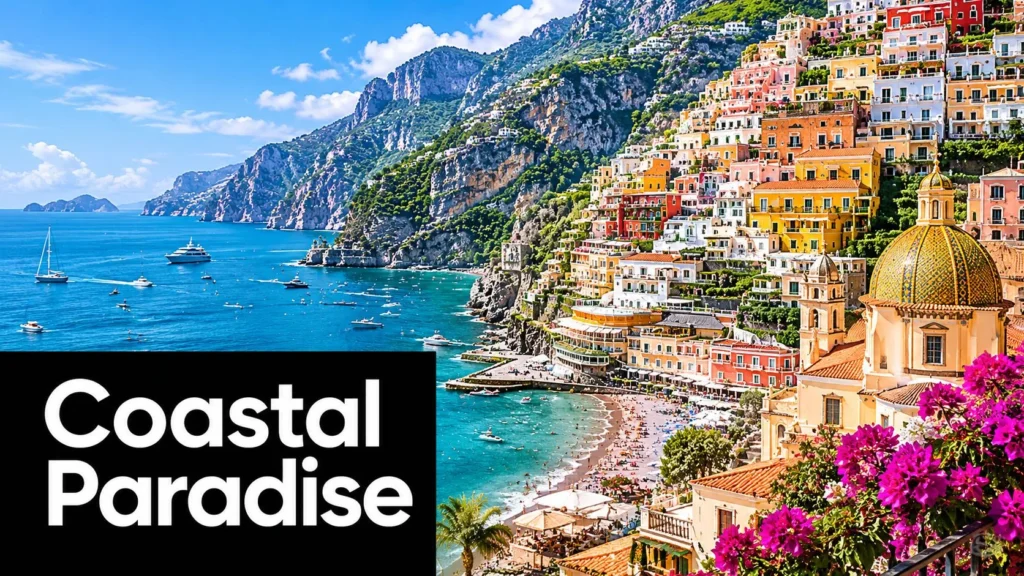
If you’re still deciding whether this trip fits your style, it helps to discover Italy’s coastal gems in a broader context. The Amalfi Coast and Positano sit at the glamorous end of the spectrum, but they’re far from the only compelling coastal stops in the country. For a wider trip-planning view beyond Italy alone, this roundup of top travel destinations in Europe is also useful.
My practical take is simple. If you go expecting effortless luxury at every moment, the coast can frustrate you. If you go expecting steep walks, transport trade-offs, and the need to choose your base carefully, it becomes much easier to enjoy what makes it special. The dream is real. It just works best when you plan for the reality behind the postcard.
An Introduction to Your Amalfi Coast Dream
Most first trips to the Amalfi Coast begin with one mental image. It’s Positano at golden hour, with the tiled dome, stacked houses, and beach scene that looks almost too stylized to be real. Then the planning starts, and the questions change fast. Which town should you stay in? Is Positano worth the price? Can you move around easily without spending half the day in transit?
That’s where many travelers make the same mistake. They plan the coast as if it were one town with one rhythm. It isn’t. The Amalfi Coast and Positano demand a more deliberate approach because the scenery is unified, but the experience changes sharply from place to place.
What the dream gets right
The appeal is obvious for a reason. The coast is dramatic, cinematic, and unusually dense with memorable places. Even short stays can feel full because every transfer, terrace, stairway, and harbor view carries a sense of arrival.
But the dream version usually leaves out the practical side:
- The terrain is steep. You’ll walk up and down constantly.
- The logistics are real. A simple move between towns can shape your whole day.
- The best base isn’t always the prettiest one in photos. Sometimes convenience beats glamour.
Practical rule: On the Amalfi Coast, the quality of your trip often depends less on what you see and more on where you sleep and how you move.
What this guide focuses on
This guide is built around decisions, not fantasy. It looks closely at the trade-offs that matter most: staying in Positano versus nearby towns, choosing ferries versus buses, deciding whether a hike fits your energy level, and knowing when a splurge is worth it.
If you want the polished version of the Amalfi Coast, you can find that anywhere. If you want the version that helps you avoid bad bases, awkward transport days, and unrealistic itineraries, keep reading.
Understanding the Amalfi Coast Vibe and History
The first useful thing to know is that the Amalfi Coast is not shorthand for Positano alone. The broader coast is a 50-kilometer stretch comprising 16 municipalities, and its identity is tied to Amalfi’s history as a major maritime republic, which is why the whole region bears Amalfi’s name rather than just the town itself, as outlined in this overview of the Amalfi Coast’s geography and history.
That history still affects how the coast feels today. These aren’t purpose-built holiday enclaves. They’re old communities shaped by trade, religion, agriculture, and the awkward physics of building on cliffs.
How the main towns differ
If you understand the personality of each place, you make better decisions immediately.
Positano is the visual icon. It’s vertical, stylish, busy, and geared toward travelers who want atmosphere on the doorstep. If you want to open your hotel door and feel like you’ve arrived in the postcard, Positano does that better than anywhere else on the coast.
Amalfi feels more like a working historic center. It has a strong maritime identity, a central harbor function, and a practical energy that often suits travelers who care as much about movement as mood.
Ravello sits above the coast rather than directly on it. It attracts people who want gardens, views, music, and a calmer pace. It can feel removed in a good way, especially if your ideal Amalfi Coast stay involves mornings and evenings away from the waterfront rush.
Then there are the smaller towns and villages. They tend to appeal to travelers who value quiet, lower-key evenings, and a more local rhythm over immediate glamour.
Choose your town by behavior, not by fame
A lot of disappointment on the Amalfi Coast comes from booking the most famous place instead of the most functional one.
Ask yourself:
- Do you want nightlife and a classic arrival feeling? Positano is stronger.
- Do you want easier transport logic? Amalfi often makes more sense.
- Do you want a quieter hilltop atmosphere? Ravello is usually the better fit.
- Do you care more about staying than showing up in the obvious place? A smaller base may suit you better.
The coast rewards travelers who stop thinking in terms of “best town” and start thinking in terms of “best fit.”
That single shift usually saves money, stress, and wasted transit time.
How to Get There and Get Around
Transport is where the Amalfi Coast either starts to feel smooth or starts to wear you down. Most travelers arrive with an optimistic idea that they’ll just “hop around” between towns. Some days that works. Some days it doesn’t. The smart move is to decide in advance what kind of friction you’re willing to tolerate.
For travelers who are comparing car-free trip styles more broadly, this guide on how to get around without a car is a helpful complement.
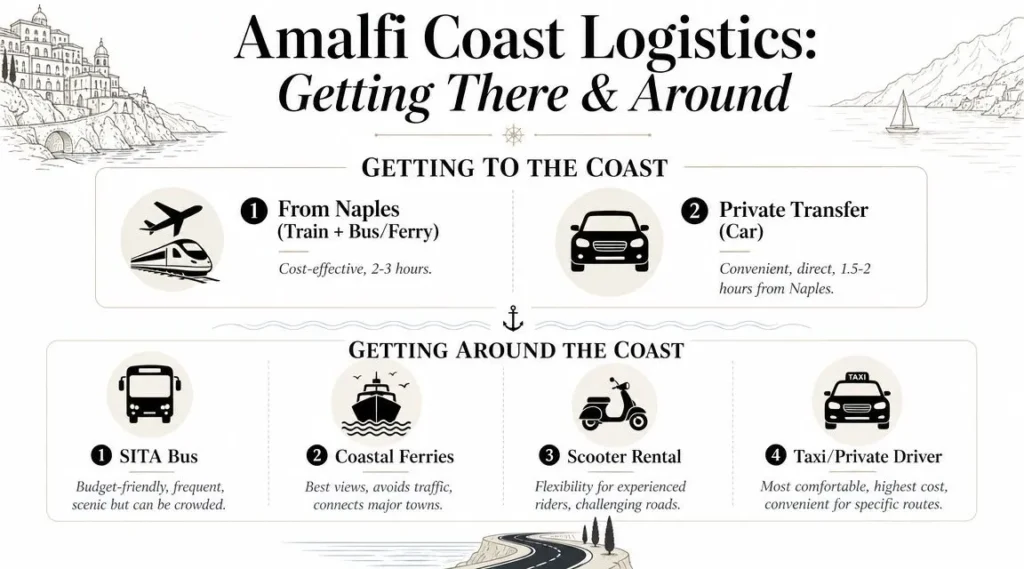
Getting to the coast
Visitors often approach the coast from Naples or Salerno. The key decision isn’t just how fast you arrive. It’s what kind of arrival you want.
A private transfer or taxi is the least mentally taxing option after a flight or train ride. You get dropped where you need to be, and you avoid juggling bags through multiple connections. It’s especially worthwhile if you’re staying high above town level or arriving late.
A train plus onward connection is often the more economical and flexible setup. That usually means reaching a hub first, then continuing by bus or ferry depending on season, weather, and your final town.
A ferry arrival, when available for your route, is the most enjoyable first impression. You avoid road traffic and get the coastline revealed from the water, which is hard to beat after a cramped transfer day.
Getting around between towns
Once you’re on the coast, each transport mode solves a different problem.
Ferries
Ferries are the most pleasant way to travel between major coastal towns when they fit your route. You get open views, no hairpin traffic, and a more relaxed experience overall. They also make day trips feel cleaner and more contained.
What they don’t do is solve every movement problem. Some towns still require walking or an extra transfer once you arrive, and rough weather can complicate plans.
SITA bus
The bus is the budget tool. It connects a lot of the places travelers need, and it can be very useful if you’re patient, lightly packed, and not on a fragile schedule.
The downsides are obvious once you use it in peak periods. Crowding, standing, and slow movement on winding roads can make a short route feel long. If you’re carrying luggage, the bus becomes far less appealing.
Private car or taxi
This is the comfort-first option. It works best for airport or station transfers, dinner transfers at awkward hours, or one-off routes that would otherwise require multiple steps.
It’s not the solution for every day of a trip. The roads are narrow, traffic builds quickly, and paying for private transport repeatedly adds up fast.
Scooter rental
Scooters offer freedom, but only for the right traveler. If you’re already comfortable riding in tight, busy road conditions, a scooter can make short hops and viewpoint stops easier.
If you’re inexperienced, this is not the place to learn. The roads are scenic, but they demand attention.
Amalfi Coast Transport Options Compared
| Method | Avg. Cost | Pros | Cons |
|---|---|---|---|
| Ferry | Higher than bus | Best views, avoids road traffic, enjoyable for day trips | Weather dependent, not door-to-door |
| SITA bus | Budget-friendly | Broad coverage, useful for simple hops | Can be crowded, awkward with luggage |
| Taxi or private driver | Highest cost | Comfortable, direct, low-stress | Expensive for repeated use |
| Scooter rental | Mid-range | Flexible, good for experienced riders | Challenging roads, not ideal for beginners |
If you’re changing hotels, pay for the easiest transfer you can justify. Save the bus for day movement, not for hauling luggage through a crowded travel day.
What usually works best
For most trips, the best combination is mixed rather than purist.
- Arrival day: private transfer or the cleanest direct route available
- Inter-town sightseeing days: ferries when practical
- Selective inland or backup movement: bus
- Special cases: taxi for awkward evening returns or tired legs
That approach keeps the Amalfi Coast and Positano feeling scenic instead of exhausting.
A Deep Dive Into Positano
Positano works best once you accept one thing immediately. It’s not a flat beach town. It’s a vertical village, and your day will be shaped by stairs, slopes, and how often you move between levels.
That’s the source of both its beauty and its friction. The views are dramatic because the whole place drops toward the water in stacked layers. The cost of that drama is physical effort.
How to read the town
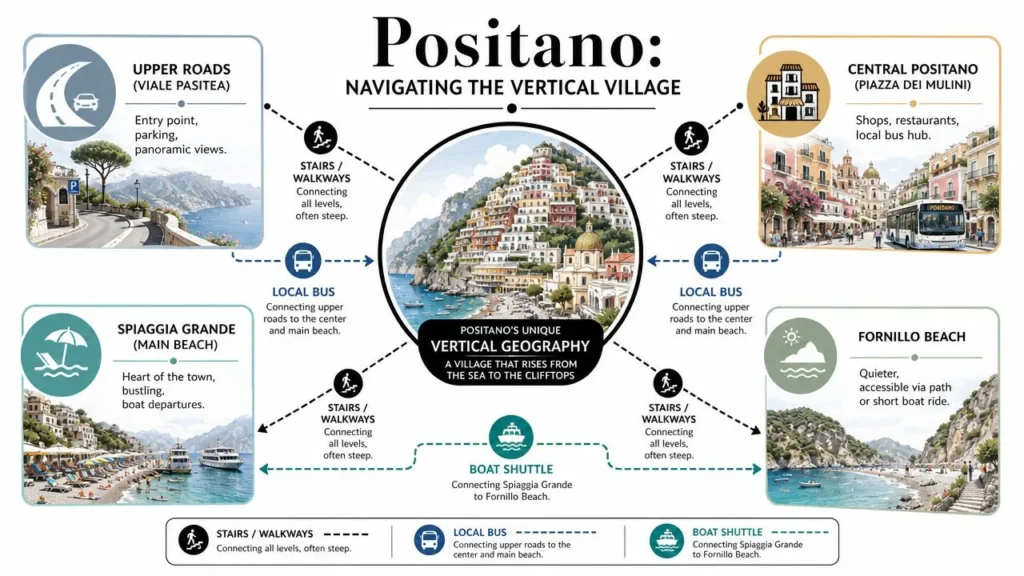
If you’ve never been, think of Positano in bands rather than streets.
Upper roads and arrival points are where many drivers stop, where some hotels sit, and where the first panoramic views open up. These areas can feel removed from the beach, but they’re often quieter.
The central shopping zone, around the main lanes and Piazza dei Mulini, is where many visitors spend the middle of the day. Visitors browse linen shops, ceramic stores, sandal makers, cafés, and small lanes that seem to fold into each other.
The beach level is the social heart. Boats depart here, day-trippers collect here, and the town’s postcard identity feels most concentrated here.
How to move through Positano without wasting energy
The mistake I see most often is treating every up-and-down as casual. It isn’t. In Positano, inefficient walking shows up in your legs by afternoon.
A better approach is to structure the town in loops:
- Start high, walk down with purpose. Do your viewpoint stops and shopping on the descent.
- Use the center as your reset point. Coffee, gelato, or a slow browse works well here.
- Save beach time for one solid block. Don’t bounce repeatedly between sea level and upper streets unless you enjoy the climb.
- Return uphill only once, if possible. That one decision changes how tiring the day feels.
Positano rewards travelers who group their errands, meals, and sightseeing by elevation.
Spiaggia Grande and Fornillo
The two beach experiences most visitors compare are the main beach and Fornillo.
Spiaggia Grande is the obvious one. It’s central, photogenic, and practical if you want to be in the middle of everything. If your ideal beach stop includes people-watching, quick access to boats, and the classic Positano backdrop, this is the one.
Fornillo feels more tucked away. It usually suits travelers who want a more relaxed stretch after they’ve already taken in the main scene. The walk there becomes part of the experience, and that tends to filter the crowd a little.
Neither is “better” in the abstract. The question is whether you want atmosphere or breathing room.
What to see beyond the beach
The Church of Santa Maria Assunta anchors the visual identity of town. Even travelers who aren’t focused on churches usually end up drawn to it because the tiled dome helps define nearly every classic Positano view.
The shopping lanes matter too, especially if you like places that still feel tied to local craft traditions. Positano is one of those towns where browsing can legitimately count as sightseeing. Handmade sandals, resortwear, linen pieces, ceramics, and small design objects all fit naturally here.
To get a feel for the town before you arrive, this visual walkthrough helps:
Is Positano worth the premium
This is the core question behind a lot of Amalfi Coast and Positano planning, and the answer depends on what you value most.
Positano is worth paying for if you want:
- Immediate atmosphere
- Easy access to iconic views
- A destination that feels lively from morning into evening
- That unmistakable sense of being in the center of the Amalfi Coast fantasy
It’s less worth paying for if you care more about room size, quiet nights, easier budgeting, or a base that feels less performative.
The part many guides miss is this: you don’t have to stay in Positano to enjoy Positano. It can work brilliantly as a day stop while another town handles the practical side of sleeping, dining, and recovering.
Top Attractions and Sample Itineraries
The best Amalfi Coast itineraries don’t try to “do everything.” They group places that belong together and leave room for transport delays, long lunches, and the physical reality of moving through steep towns. If you over-schedule here, the coast starts to feel like a series of transfers instead of a holiday.
The places most travelers should prioritize
If it’s your first visit, a few stops consistently justify the effort.
Amalfi town earns time for its historic center and the Duomo di Sant’Andrea. It feels compact but significant, and it gives you a stronger sense of the coast’s older civic identity than a beach-only day ever will.
Ravello works well as a contrast. Villa Rufolo and Villa Cimbrone are the kind of places that slow people down, which is useful on a coast where many visitors otherwise keep rushing.
Positano is best enjoyed with some unstructured time. Even if you’ve already seen the beach and church, the town benefits from wandering.
The Path of the Gods reality check
The Path of the Gods is one of the coast’s signature experiences, but it isn’t a casual add-on. One itinerary source describes it as about 7 km, usually taking 3 to 4 hours, and recommends starting early because summer heat makes it difficult. The route ends with a descent of roughly 1,600 steps toward Positano or Arienzo, as noted in this Path of the Gods travel overview.
That last part is what many travelers underestimate. The ridge section may sound manageable on paper, but the full effort level depends heavily on heat, footwear, and how your legs handle a long staircase finish.
Start the hike early, carry more water than you think you need, and don’t plan a big evening that same day unless stairs barely register for you.
This hike suits active travelers who enjoy walking for its own sake. It’s less ideal for families with very young children, travelers with knee issues, or anyone trying to squeeze it into a one-night Positano stay.
Sample itineraries that actually work
One day
If you only have a day, don’t force a grand tour. Choose Positano and one contrast town.
A strong version looks like this:
- Morning: Arrive early in Positano, walk the center before the busiest period, then head down to the beach
- Midday: Lunch without rushing
- Afternoon: Ferry or road transfer to Amalfi or Ravello
- Evening: Stay for dinner rather than leaving at peak exit time if your schedule allows
Three days
Three days is the sweet spot for a first visit.
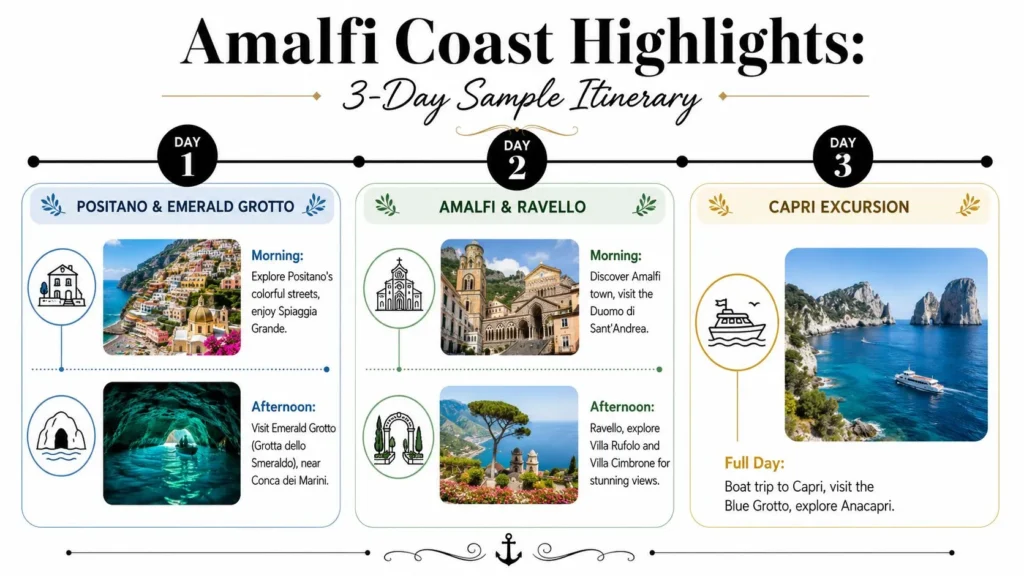
Day one works well for Positano, with enough time for the main lanes, church area, and either Spiaggia Grande or Fornillo.
Day two is ideal for Amalfi and Ravello together. They balance each other nicely, one maritime and grounded, the other set high and calm.
Day three should either be a boat-focused day or a slower coastal day with one anchor activity. That could be the Path of the Gods for the right traveler, or a gentler day that leaves room for swimming, long lunch, and one more scenic stop.
Five days
With five days, stop trying to maximize movement.
A good five-day stay usually includes:
- A dedicated Positano day
- A combined Amalfi and Ravello day
- One hiking or active day
- One sea-focused day
- One deliberately loose day for weather changes, beach clubs, or repeat visits to a favorite town
That final unplanned day matters more than people think. It gives the coast room to breathe.
Where to Stay and Dine on the Coast
Where you sleep matters more on the Amalfi Coast than almost anywhere else in Italy. Not because every hotel is wildly different, but because your base determines your daily friction. A glamorous room in the wrong town for your style can produce a worse trip than a simpler stay in the right place.
One of the most useful planning trade-offs is the Positano versus Praiano decision. A travel guide focused on that exact question notes that Praiano can be a more budget-friendly and less crowded base than Positano, but also warns that many businesses there are seasonal and may begin shutting down after mid-October, which makes timing a real factor in the decision, as explained in this Praiano versus Positano planning guide.
When Positano is the right base
Stay in Positano if your priority is emotional payoff.
You want the classic scene outside your door. You want to walk to aperitivo, browse shops without commuting in, and enjoy the town once day-trippers thin out. That’s the strongest case for paying the premium. The value is not only the room. It’s access to the mood.
Positano also works well for shorter trips. If you’re only staying one or two nights, the convenience of being in the visual center of the coast can justify the extra cost.
When another town is the smarter move
If you’re staying longer, traveling on a tighter budget, or prefer evenings that feel less crowded, a quieter base often wins.
Praiano appeals to travelers who want:
- Less crowd pressure
- A calmer evening atmosphere
- More breathing room in the daily routine
The trade-off is that convenience changes with the calendar. In shoulder season, especially later in the season, a lower-key town can feel restful or inconvenient depending on what’s still open.
Book the town that matches how you want to spend your evenings. Days are easy to fill on the Amalfi Coast. Evenings reveal whether you picked the right base.
How to eat well without turning every meal into a production
Dining on the coast gets easier when you split it into types of meals rather than chasing only “best restaurants.”
Use this mix:
- One standout dinner with a view. Reserve it and treat it as the event.
- One simple lunch from a deli, bakery, or takeaway spot. This is often more relaxing than a formal midday restaurant stop.
- One meal slightly away from the most photographed strip. You’ll usually get calmer service and a more grounded atmosphere.
- Coffee and pastry stops strategically placed on walking routes. On a coast full of stairs, these matter more than people admit.
If you tend to overthink destination dining, I like the decision-making logic in this guide to choosing restaurants in Porto Cervo. It’s about another luxury coastal destination, but the framework transfers well. Don’t just book the prettiest terrace. Think about timing, intent, and whether you want spectacle, comfort, or quiet.
The Amalfi Coast rewards that kind of clarity.
Budget, Safety, and Accessibility Notes
Let’s be blunt: The Amalfi Coast can be done at different spending levels, but it rarely feels cheap. Even when you save on your room, transport, beach access, and scenic-location dining can push the trip upward fast. That doesn’t mean you shouldn’t go. It means you should decide early where your money improves the experience.
Where it makes sense to spend
Paying more is usually justified in a few situations:
- Arrival and departure transfers with luggage
- A well-located base that cuts daily transit friction
- One or two memorable meals instead of constant scenic overpaying
- Flexible planning room for weather or transport changes
Where people often overspend is trying to buy prestige in every category at once. You don’t need a luxury hotel, daily taxis, reserved beach setup, and top-view dinners every night to enjoy the coast.
Safety and disruption are part of the destination
The coast is beautiful, but it’s also physically fragile. Geological research describes the Amalfi Coast as a system of steep cliffs and watersheds that make transport links and cliffside towns susceptible to landslides and closures, especially after intense rainfall, according to this geological analysis of the Amalfi coastline.
That matters for travelers in very practical ways. Roads can be disrupted. Routes can take longer than expected. A simple weather change can alter your ideal day plan.
There’s also broader geological instability behind that fragility. Research cited in a peer-reviewed study measured average potential soil loss in the area at 25,000 kg per 0.01 km² per year, highlighting how much erosion pressure exists in the small catchments feeding the coast, as discussed in this study on erosion and coastal processes.
Build at least one flexible half-day into your itinerary. On this coast, rigid plans break faster than relaxed ones.
Accessibility and physical effort
The Amalfi Coast and Positano are not easy destinations for travelers with limited mobility. Even confident walkers can underestimate the strain of repeated stairs, uneven surfaces, and steep climbs in heat.
A few practical adjustments help:
- Choose lodging close to the level where you’ll spend most of your time
- Avoid changing hotels too often
- Use taxis selectively when legs are fading
- Get travel coverage that fits a multi-transfer itinerary, especially if you’re combining ferries, trains, and road transport. This guide to best travel insurance for international trips is a good starting point.
If you plan around your energy rather than your ambition, the coast becomes much more enjoyable.
Amalfi Coast and Positano FAQs
Is the Amalfi Coast good for families with young children
It can be, but only if you plan carefully. The main issues aren’t culture or safety in the broad sense. They’re stairs, heat, crowds, and patience-testing transfers. Families who do best here usually slow the pace, avoid constant hotel changes, and don’t expect to cover multiple towns every day.
Do you need to book ferries, tours, and restaurants in advance
For anything important, yes. On the Amalfi Coast, the best approach is to pre-book what would materially affect your day if unavailable. That usually means key ferry routes, one or two special dinners, and any tour that anchors your schedule. Leave some room for spontaneity, but don’t leave the essentials to chance.
Is Positano worth visiting if you don’t stay there
Absolutely. Positano works very well as a day stop. In fact, many travelers enjoy it more that way because they get the visual payoff and atmosphere without committing their whole budget to sleeping there.
Should you carry cash
Yes, some. Cards are widely used, but small purchases, quick cafés, and occasional local situations still go more smoothly when you have euros on hand. You don’t need to build your whole trip around cash, but you also don’t want to be the person hunting for an ATM over a minor purchase.
Is the Path of the Gods worth it for casual travelers
Only if you really like walking and don’t mind a demanding descent. It’s famous for a reason, but fame doesn’t make it right for everyone. If you’re indifferent to hiking, you may get more joy from a boat day, a Ravello afternoon, or extra Positano time.
If you enjoy practical, no-nonsense travel writing like this, maxijournal.com publishes approachable articles across tourism and many other subjects, with fresh commentary for curious readers who want clear guidance without the fluff.
Discover more from Maxi Journal
Subscribe to get the latest posts sent to your email.