You’re probably here because the eye area has started doing one of three annoying things. Fine lines seem sharper in bathroom lighting. Concealer settles instead of smoothing. Or every product page claims to be the best anti aging eye cream, even though the jars all look tiny, expensive, and suspiciously similar.
That confusion is reasonable. Eye cream marketing often mixes true skin science with vague promises like “revives,” “renews,” and “restores.” Some formulas really can help. Others are mostly moisturizers in a smaller package. The difference usually comes down to ingredients, packaging, and whether the brand gives you anything measurable to evaluate.
A better way to shop is to stop asking, “What’s the single best eye cream?” and start asking, “Best for what concern, with what ingredients, and with what evidence?” That shift makes the category much easier to understand.
Why Choosing an Eye Cream Feels So Complicated
Walk into a beauty aisle or scroll a retailer’s site and the same pattern shows up fast. One cream says it’s for crow’s feet. Another says it’s for “lifting.” A gel promises de-puffing. A balm says it’s dermatologist inspired. Then you look at the ingredients and half the names are unfamiliar, while the price range jumps from modest to luxury without a clear reason why.
That’s where many people get stuck. They aren’t choosing between good and bad products. They’re choosing between different mechanisms, textures, and claims that aren’t always explained clearly.
Why the category feels harder than face moisturizers
Eye creams target a small area, but that small area can have several problems at once:
- Lines from movement: Smiling, squinting, and rubbing create repeated folding.
- Dryness: The area can look crepey when it’s dehydrated.
- Pigment and shadowing: “Dark circles” may come from discoloration, visible blood vessels, facial structure, or all three.
- Puffiness: Fluid retention and irritation can make the under-eye look swollen.
A single product rarely solves all of those equally well. That’s why one person loves a caffeine gel and another needs a richer retinoid cream.
The right eye cream isn’t the one with the loudest promise. It’s the one matched to the reason your eye area looks older or more tired.
The good news is that this category gets much easier once you stop reading the front of the jar first. The useful clues are usually on the ingredient list, in the texture, and in whether the brand gives any concrete evidence at all.
What Anti-Aging Eye Creams Actually Do
The skin around the eyes behaves differently from the rest of the face. It’s more delicate, it moves constantly, and it’s often the first place where dehydration and collagen loss become visible. That’s why a good eye cream isn’t just a mini face cream. It’s usually designed to hydrate well, irritate less, and deliver actives in a way that this area can tolerate.
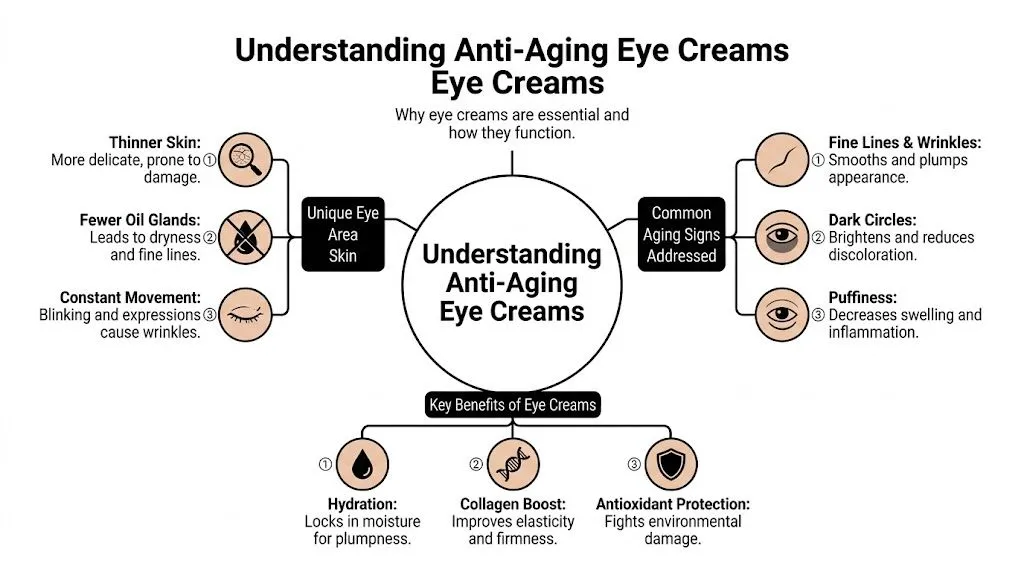
The four main jobs of an eye cream
Most anti-aging eye creams try to do some combination of these:
Hydrate the surface
When skin is dry, fine lines look deeper. Humectants and barrier-supporting ingredients help plump the surface so the area looks smoother.Support collagen and firmness
This matters most for persistent fine lines and a less springy look to the skin.Reduce the look of puffiness
Some formulas aim to temporarily make the eye area look less swollen or heavy.Brighten the under-eye
This is the trickiest claim because “dark circles” can come from more than one cause. Some creams help with discoloration, but they won’t change anatomy.
What counts as real improvement
Science matters. Topical eye cream ingredients can produce measurable changes, not just a softer feel. A review in the medical literature reported that vitamin E showed a 14.07% reduction in periorbital wrinkles after 4 weeks, and niacinamide improved wrinkle appearance on par with prescription-strength tretinoin (0.02%) after 8 weeks with better tolerability. The same review also discussed a clinical study of 76 female subjects ages 30 to 60 using hyaluronic acid cream twice daily for 60 days, with significant improvements in hydration and elasticity, as summarized in the peer-reviewed review on topical ingredients for periocular aging.
Those details matter because they tell you what kind of result to expect. Some ingredients work by immediate hydration. Others need repeated use before the skin changes in a more durable way.
Practical rule: If a product only says “reduces the look of wrinkles” but never tells you what ingredient is doing the work, treat the claim cautiously.
Why specialized formulas can help
Many face products can be used near the eyes if they’re gentle enough, but the eye area often needs more thoughtful formulation. A strong acid, a heavily fragranced cream, or a high-strength retinoid might be fine on the cheeks and miserable near the orbital bone.
That’s why eye creams exist as a category. At their best, they package proven ingredients in a texture and concentration that the eye area is more likely to handle well.
The Power Players Key Ingredients That Deliver Results
A good eye cream formula works like a team, not a single hero ingredient. One ingredient may pull in water, another may support collagen, and another may reduce irritation so you can keep using the product long enough to see results.
That is the key to reading eye cream marketing with a clearer head. “Anti-aging” is not one mechanism. It is a bundle of different jobs.
Retinoids for wrinkles and firmness
If crow’s feet and loss of firmness are your main concerns, retinoids are usually the first ingredient class to check for. They have the strongest track record in dermatology for improving fine lines because they help normalize cell turnover and support collagen production over time.
Around the eyes, that strength comes with a tradeoff. The same ingredient that can improve texture can also sting, peel, or trigger dryness if the formula is too aggressive. For many people, the best retinoid eye cream is not the strongest one on the shelf. It is the one they can use consistently without irritation.
A label that says retinol, retinal, or a gentler retinoid derivative tells you more than vague phrases like “wrinkle repair complex.”
Hyaluronic acid for quick plumping
Hyaluronic acid is useful for a different reason. It is a water-binding humectant, so it helps the upper layers of skin hold onto moisture. If your under-eye area looks more lined at the end of a dry day, this is often the ingredient behind that next-morning smoother look.
Its effect is mostly cosmetic and surface-level, which is not a criticism. It is important to know what problem it solves. Hyaluronic acid is best viewed as a moisture cushion. It helps crepey, dehydrated skin look less crinkled, but it does not do the same job as a collagen-supporting active.
Peptides for longer-term support
Peptides sit in the middle ground between hydration and stronger actives. They are short chains of amino acids used in skincare to signal repair processes, especially those related to collagen and elastin.
Marketing often treats all peptides as interchangeable, and they are not. A formula that lists a specific peptide complex near the middle of the ingredient list is usually more promising than one that hides behind broad claims about “protein technology.” Results also tend to be gradual, which makes peptides a reasonable option for people who want support without the irritation risk that retinoids can bring.
This pairing is common for a reason. Peptides and hydrators often work well together because one improves the look of the skin surface while the other supports slower changes underneath.
Niacinamide, vitamin E, and support actives
Niacinamide is one of the most versatile choices for the eye area because it helps with barrier function and can improve the look of uneven tone and fine lines. It is often a smart pick for sensitive skin, especially for people who have tried stronger anti-aging ingredients and quit because of irritation.
Vitamin E plays a supporting role as an antioxidant and soothing ingredient. It is rarely the only reason a product performs well, but it can make a formula more comfortable, especially in dry or stressed skin.
Support ingredients matter more than many brands admit. Ceramides help reduce water loss and improve barrier resilience. Caffeine can temporarily reduce the look of puffiness. Simple soothing ingredients can also make an active formula easier to tolerate. If you want a basic example of how calming ingredients fit into a routine, this guide to rose water skincare benefits shows why people often pair soothing products with stronger treatments.
Anti-Aging Eye Cream Ingredient Cheat Sheet
| Ingredient | Primary Target | Best For | Things to Know |
|---|---|---|---|
| Retinoids | Collagen support, wrinkles | Crow’s feet, firmness concerns | Strong evidence base. Can irritate if the formula is too aggressive. |
| Hyaluronic acid | Hydration, temporary plumping | Dehydrated under-eyes, fine lines that look worse when skin is dry | Fast cosmetic improvement. Doesn’t replace collagen support. |
| Peptides | Structural support | Early signs of aging, prevention-minded users | Better for steady improvement than instant change. |
| Niacinamide | Wrinkle appearance, barrier support | Sensitive or easily irritated skin | Often easier to tolerate than stronger actives. |
| Vitamin E | Antioxidant support, wrinkle reduction | Dry, stressed skin around the eyes | Often paired with other anti-aging ingredients. |
| Caffeine | Puffiness, tired look | Morning eye bags | Usually best for temporary visible improvement. |
| Ceramides | Barrier support | Dry or reactive skin | Excellent in supportive formulas, especially with actives. |
| Vitamin C | Brightening, antioxidant support | Under-eye dullness and discoloration concerns | Formula stability matters. Not every vitamin C product is equally elegant near the eyes. |
How to Choose the Best Eye Cream For You
You’re standing in the skincare aisle looking at three eye creams that all promise firmer, brighter, younger-looking skin. One says “lifting,” one says “de-puffing,” and one says “age-defying.” The useful question is simpler: which one matches the problem you face?
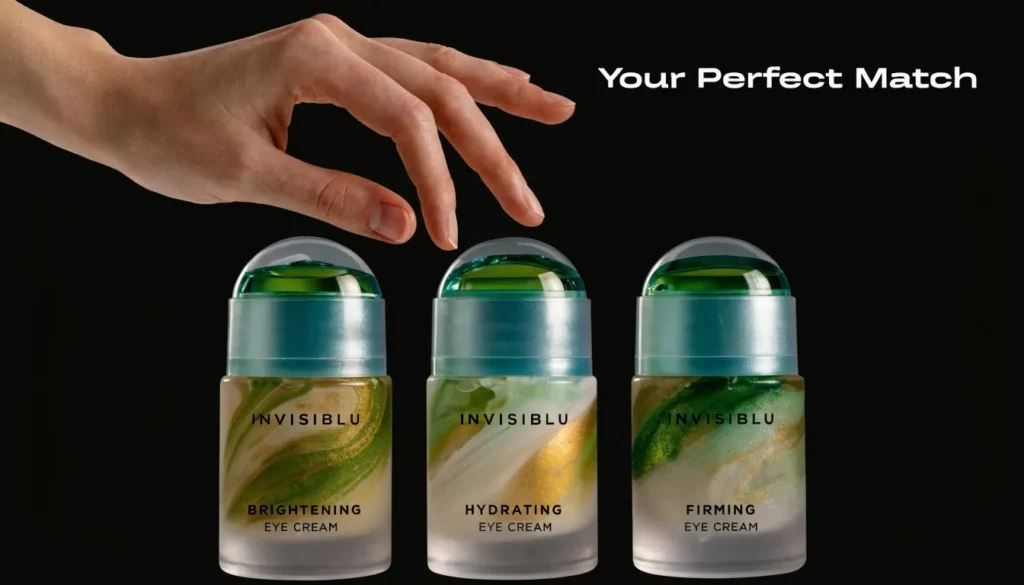
The easiest way to choose well is to treat eye cream labels like a translation exercise. Marketing gives you the headline. The ingredient list tells you what the product is more likely to do. “Anti-aging” is too broad to be useful on its own. Fine lines, puffiness, pigment, dryness, and irritation each call for a different kind of formula.
If lines and crepey texture bother you most
Look for a formula built around one longer-term ingredient and one comfort ingredient.
Retinoids and peptides are the ingredients to scan for if your goal is smoother-looking skin over time. Hyaluronic acid can help the area look less crinkled faster by drawing in water, which matters because dry under-eyes often exaggerate fine lines. One group of ingredients works on skin behavior over time, and the other improves how the surface looks today.
If your eye area is reactive, a gentler peptide-based cream may be easier to use consistently than a strong retinoid formula. Consistency usually beats intensity here.
If dark circles are the main complaint
Dark circles are really three different problems that get grouped under one name.
- Brown discoloration often responds better to brightening ingredients such as niacinamide or vitamin C.
- Blue or purple tones are often related to visible blood vessels under thin skin. Creams may soften the look a bit, but they usually do not erase it.
- Hollow shadows come from structure, not surface pigment. An eye cream can hydrate and smooth the area, but it cannot replace volume loss.
This is why two products with the same “dark circle” claim can perform very differently. A good formula for pigment is not necessarily a good formula for shadowing.
If puffiness and bags are your issue
Choose for timing as much as ingredients.
Caffeine, cooling gel textures, and lighter formulas tend to make the most sense for morning puffiness. They can help the under-eye look less swollen and more awake for a while. A heavy cream may be comforting on dry skin at night, but during the day it can feel too rich on eyes that already look puffy.
Match the texture to your skin, not just the claim
Texture affects whether you will keep using the product and whether the area stays comfortable.
- Dry skin: Cream textures with humectants, ceramides, and a more cushiony feel
- Oily or milia-prone skin: Lightweight gels or gel-creams
- Sensitive skin: Shorter ingredient lists and fragrance-free formulas
- Mature skin: A richer base can help, but the active ingredients still matter more than thickness
Hydration can change the look of the eye area faster than many people expect. Fine lines caused by dryness behave a bit like a wrinkled shirt after steam. They can look smoother before the fabric itself has changed. If that idea helps, this article on how glycerin soap supports moisture balance explains why humectants can make skin look better quickly, even before longer-term ingredients have had time to work.
A practical shortcut is to choose one main goal, then check whether the formula has ingredients that fit that goal and a texture you will actually use every day.
A simple selection framework
Ask these three questions before you buy:
- What bothers me most? Fine lines, darkness, puffiness, dryness, or irritation.
- Which ingredients in this product match that concern? Look past the front label and read the actual formula.
- Will I use this twice a day or nightly without dreading it? A product that stings, pills, or feels greasy usually ends up forgotten.
That is how to choose your best eye cream. Not by chasing the loudest claim, but by matching the formula to the job.
The Art of Application Getting the Most From Your Cream
The right product can still disappoint if you use too much, apply it too close to the lash line, or layer it in the wrong order. Technique matters more than many people realize.
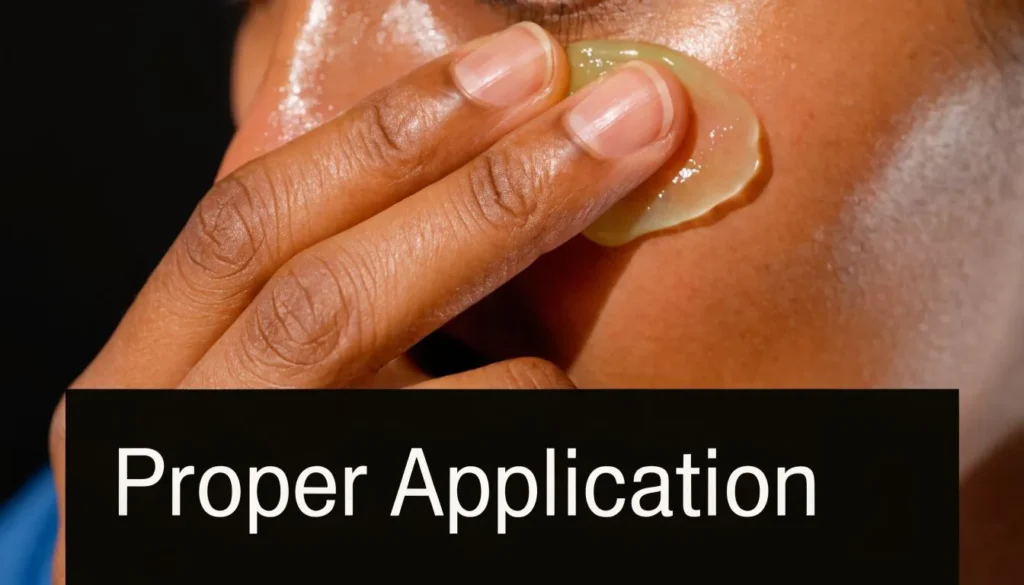
How much and where to apply
Use a very small amount. For most eye creams, a grain-of-rice amount per eye is enough. More product doesn’t mean better results. It usually means more migration into the eyes and more irritation.
Apply it with your ring finger and tap gently along the orbital bone, not directly on the wet lash line and not all over the mobile lid unless the product specifically says it’s suitable there.
Less product, placed consistently in the right zone, usually beats heavy application.
The best order in your routine
As a general rule, apply eye cream after lightweight serums and before heavier moisturizer if the texture is cream-like. If it’s a thin gel, many people prefer it before richer face creams.
A simple rhythm looks like this:
- Morning: Cleanse, light serum if you use one, eye cream, moisturizer, sunscreen
- Evening: Cleanse, treatment serum if desired, eye cream, moisturizer
If your eye cream contains a retinoid, it usually fits best at night.
For a quick visual refresher, this short demo shows gentle under-eye technique and placement:
Common mistakes that waste product
People often blame the cream when the issue is the routine.
- Using too much: This increases stinging and causes pilling under concealer.
- Applying too close to the eye: Product migrates as skin warms.
- Starting strong actives too fast: Sensitive under-eyes often need a slower introduction.
- Skipping sunscreen in the morning: UV exposure works against nearly every anti-aging goal.
If your eye area is reactive, try applying your eye cream every other night at first. Consistency beats intensity.
Beyond the Jar Reading Labels and Managing Expectations
A smart eye cream shopper reads the back of the box more carefully than the front. Marketing language is built to sound impressive. Ingredient lists and measured outcomes are where the useful information lives.
How to read the ingredient list
Ingredients are usually listed in descending order by concentration, at least through the main body of the formula. That doesn’t tell you everything, but it gives clues.
If a product advertises peptides, caffeine, or niacinamide and those ingredients appear very far down the list, that doesn’t automatically make the formula bad. It does mean you should be cautious about assuming the hero ingredient is doing most of the work.
Look for three things together:
- A believable active: Something known to target your concern
- A supportive base: Hydrators and barrier-friendly ingredients
- Packaging that makes sense: Especially for more delicate actives
How to interpret clinical claims
Quantified data offers valuable insights. In a Good Housekeeping Beauty Lab test, RoC Skincare Multi Correxion Even Tone + Lift Eye Cream showed a 19% increase in skin firmness in a clinical evaluation, as reported in the Good Housekeeping Beauty Lab roundup of eye creams.
That kind of claim is much more helpful than “visibly firmer-looking skin.” It doesn’t mean the product is automatically right for everyone, but it gives you something concrete to weigh.
What to trust: Specific claims tied to a measurable outcome are more useful than broad promises like “age-defying” or “rejuvenating.”
Keep your expectations grounded
Even an excellent eye cream has limits. It can improve skin hydration, texture, and some lines. It may help certain types of discoloration or puffiness. It won’t erase deep hollows, dramatically tighten loose skin, or replace procedures when anatomy is the main issue.
That’s why I like to separate eye concerns into two buckets:
| Concern | Creams can help | Creams have limits |
|---|---|---|
| Dehydration lines | Yes | No cream can stop all expression lines |
| Mild early wrinkles | Yes | Deep etched lines may need more than skincare |
| Some discoloration | Sometimes | Structural shadowing often remains |
| Puffiness | Often temporarily | Fat pads and laxity are harder to change |
Patch testing is also worth the extra day. The under-eye is a poor place to “see what happens” with a new active. And if you’re curious about how often skincare marketing leans on broad natural-sounding claims, this look at cinnamon on skin and claim interpretation is a useful reminder that ingredient stories and clinical usefulness aren’t always the same thing.
Frequently Asked Questions About Anti-Aging Eye Creams
Can I just use my regular face moisturizer around my eyes
Sometimes, yes. If your face moisturizer is gentle, fragrance-free, and doesn’t sting, it may be fine around the orbital area. But eye creams can still earn their place when you want targeted ingredients for wrinkles, puffiness, or brightness, or when your regular moisturizer feels too heavy or irritating near the eyes.
How long does it take to see results
It depends on the ingredient and the problem. Hydrating ingredients can make the under-eye look better quickly because they plump the surface. Collagen-supporting ingredients take longer and need regular use. The useful question isn’t “How fast does this work?” but “Is this the right mechanism for my concern?”
Are expensive eye creams actually better
Not automatically. A higher price may reflect elegant texture, packaging, or brand positioning rather than stronger performance. I’d rather buy a mid-priced formula with a sensible ingredient list than a luxury cream that relies on vague language and fragrance.
Should I use eye cream in the morning, at night, or both
That depends on the formula. Caffeine gels often make sense in the morning. Richer creams and retinoid-based formulas often fit better at night. If your skin tolerates it, using a suitable product consistently once or twice daily is more important than chasing a complicated routine.
What if every eye cream irritates me
Simplify. Start with a bland, fragrance-free, hydrating formula. Avoid layering multiple strong actives around the eyes at once. Apply less product, keep it on the orbital bone, and patch test first. Sensitive skin often does better with steady, boring skincare than with ambitious formulas.
What’s the single best anti aging eye cream
There isn’t one universal winner. The best anti aging eye cream for you is the formula that matches your main concern, contains a believable active, and feels comfortable enough to use consistently. If a product has evidence, tolerable texture, and fits your routine, that’s a much better sign than hype.
If you like practical, evidence-aware guides like this one, explore more health, science, beauty, and everyday how-to articles at maxijournal.com.
Discover more from Maxi Journal
Subscribe to get the latest posts sent to your email.