A daily writing journal is so much more than a simple diary. Think of it as a practical, everyday tool for clarity, creativity, and personal growth. For so many successful writers and creators, it’s the non-negotiable habit for processing thoughts, dialing down stress, and unearthing fresh ideas for their next big project.
The Real Benefits of a Daily Writing Journal

Ever wondered why so many creatives are completely devoted to their journaling practice? It’s because the upside goes way beyond just logging what you did today. A daily journal gives you a private, unfiltered space to untangle complicated thoughts, really explore your emotions, and start seeing the patterns in how you think.
For years, my own journal was mostly a pressure-release valve—a place to dump anxieties and frustrations. But over time, I started to notice themes and ideas bubbling up from the pages. What started as a simple self-care habit slowly morphed into an invaluable source for articles, creative concepts, and personal essays. This journey from private reflection to public work is one of the most powerful, and often missed, benefits of sticking with it.
A Tool for Mental Clarity and Stress Reduction
One of the biggest draws to daily journaling is its well-documented mental health benefits. The simple act of writing your thoughts down gives you a tangible way to manage anxiety and process feelings that feel overwhelming. Instead of letting worries spin in your head, you give them a home on the page.
This process brings a sense of order to the chaos. In fact, studies show that people who journal consistently report a huge 25% improvement in their ability to manage stress. The good news doesn’t stop there; those same people often see a 15% boost in their overall productivity, which makes sense when you have a clearer, more focused mind. The growing digital journaling market reflects just how many people are finding this to be true.
A journal is your private sanctuary. It’s a place where you can be completely honest with yourself without fear of judgment, leading to profound self-awareness and emotional release.
Sparking Creativity and Unlocking New Ideas
Beyond the therapeutic angle, a daily writing journal is a serious engine for creativity. It becomes your personal idea vault, capturing fleeting thoughts, interesting conversations, and random observations that you would otherwise forget. I like to think of it as a “thought garden,” where you plant little seeds of ideas that can later grow into full-blown projects.
This practice trains you to be a better observer of your inner and outer worlds. You might find yourself jotting down:
- Intriguing snippets of dialogue you overhear at a coffee shop.
- Reflections on an article or a book that challenged your perspective.
- A vivid dream that sparked a unique story concept.
- Questions about new technology or a scientific breakthrough.
Over time, these entries build into a rich archive of raw material. When you feel stuck or uninspired, you can flip through your journal and discover unexpected connections and fresh angles for your next piece. This habit is especially powerful if you’re interested in writing about self-care tips for mental health, because it gives you a direct line to your own authentic experiences.
Choosing Your Journaling Medium: Paper Or Pixels
Your first big decision is where your daily writing will actually live. This isn’t just a small detail—the medium you pick will shape your entire journaling experience. Are you drawn to the classic feel of pen on paper, or does the convenience of a digital app fit your life better?
There’s no one-size-fits-all answer here. The right choice really comes down to your personality, your daily routine, and what you’re hoping to get out of this habit. Let’s look at both sides so you can find your perfect match.
The Case For The Classic Paper Journal
There’s a kind of magic to a physical notebook that an app just can’t replicate. The feeling of a good pen gliding across the page, the smell of the paper, the simple weight of the journal in your hands—it all adds up to a powerful ritual.
For a lot of writers I know, this physical act helps to slow down the frantic pace of their thoughts. It encourages a more mindful and deliberate connection to the words they’re putting down.
And in our hyper-connected world, a paper journal offers a massive benefit: freedom from distractions. A notebook doesn’t have notifications, pop-up ads, or the temptation to just “quickly check” your email. It’s a dedicated, quiet space just for you and your thoughts.
The appeal of a real, physical journal is still incredibly strong. Even with all the apps available, the market for traditional diaries and planners was valued at around $1.3 billion recently and is expected to keep growing. It just goes to show how many of us crave that tangible connection. You can dig into the numbers in this market analysis from Business Research Insights.
The Power Of The Digital Journal
On the flip side, digital journaling apps bring a whole suite of modern advantages to the table. Their biggest strength is simple convenience. Your journal is always on your phone, tablet, or laptop, ready whenever an idea strikes—whether you’re in line at the grocery store, on your commute, or just before you fall asleep.
This easy access makes sticking with the habit much simpler, especially if you have a hectic schedule. But it’s the extra features where digital tools really shine.
- Effortless Search: Need to find that entry from three years ago about a specific idea? Just type in a keyword. This is a game-changer for tracking themes or pulling old ideas for new projects.
- Enhanced Security: Most apps have password or fingerprint locks, keeping your private thoughts truly private. No more hiding your notebook under the mattress.
- Multimedia Integration: You can easily add photos, voice memos, or even location tags to your entries. This creates a much richer, more dynamic record of your life.
- Cloud Syncing: Your journal is automatically backed up and available on all your devices. You’ll never have to worry about losing years of writing if you lose your phone or spill coffee on your laptop.
Making Your Decision: A Side-By-Side Look
So, paper or pixels? The choice really boils down to what you value most in your daily writing practice. Are you after a quiet, tactile escape, or a powerful, feature-rich tool that fits neatly into your digital life?
To make it easier, here’s a quick comparison to help you weigh your options.
Paper vs Digital Journaling: A Quick Comparison
This table should help you decide whether a traditional notebook or a modern app is the right starting point for you by comparing what matters most in a daily journaling practice.
| Feature | Paper Journal | Digital Journal |
|---|---|---|
| Writing Experience | Tactile, sensory, and deliberate. Promotes slower, more mindful writing. | Fast, convenient, and editable. Can feel less personal for some. |
| Accessibility | Limited to where you carry the physical notebook. | Available anywhere you have your phone, tablet, or computer. |
| Security | Relies on physical hiding spots. Vulnerable to being found. | High security with passwords, biometrics, and encryption. |
| Searchability | Requires manual flipping through pages. Difficult to find old entries. | Instant and powerful keyword searching across your entire archive. |
| Cost | Ongoing cost of buying new notebooks and quality pens. | Often a one-time purchase or a small subscription fee for premium apps. |
| Durability | Susceptible to damage from spills, fire, or simple wear and tear. | Securely backed up to the cloud, protecting against data loss. |
Ultimately, you don’t have to be a purist. I know plenty of writers who use a hybrid approach. They might keep a beautiful leather-bound journal for longer, reflective entries on the weekend, but use a simple phone app to jot down quick thoughts and ideas during a busy workday.
The best advice is to experiment. Try both and see which one makes you want to write every day.
Building a Journaling Habit That Actually Sticks
The initial rush of starting a daily writing journal is great, but making it stick is the real challenge. So many of us give up because we set the bar way too high, aiming for deep, multi-page entries from day one. When life gets busy, we miss a day, feel guilty, and the journal ends up back on the shelf.
The secret isn’t about finding more willpower. It’s about being strategic. You need a gentle, consistent practice that weaves itself into your daily life until it feels as automatic as pouring your morning coffee.
Start with a Tiny Goal
Your first goal should be so small it’s almost impossible to skip. Don’t worry about filling a page—just commit to writing one single sentence a day. This is the “tiny habit” method, and it works because it completely removes the pressure of staring at a blank page.
That one sentence can be anything at all:
- A quick thought about your commute.
- One thing that made you smile.
- A question that’s been bouncing around your head.
This tiny action is powerful. It builds momentum. On days you have more to say, you will. On days you’re swamped, you’ll still hit your goal, keep your streak alive, and reinforce the identity of being someone who writes daily.
Link Your Journaling to an Existing Habit
The best way to build a new habit is to piggyback it onto one you already have. This technique is called habit stacking, and it means you don’t have to find “new” time in your schedule.
For instance, you might decide: “Right after I start the coffee maker, I’ll write my one sentence.” The existing habit (making coffee) becomes the trigger for the new one (writing).
Here are a few other common habit stacks that work well:
- During your commute: If you take the train or bus, use that built-in downtime to jot a few lines in a digital app.
- Before bed: Make it the last thing you do after brushing your teeth.
- At your desk: Before you open your email for the day, write a quick entry to clear your head.
By anchoring your new journaling habit to a pre-existing one, you eliminate the need to rely on memory or motivation. The old habit automatically cues the new one, making consistency feel almost effortless.
Create an Inviting Writing Environment
Your surroundings can either invite you to write or create friction. You don’t need a fancy writer’s studio, but a small, dedicated “writing sanctuary” makes a huge difference. It’s a physical cue to your brain that it’s time to switch gears and reflect.
This could be as simple as leaving a beautiful notebook and your favorite pen on your nightstand. For digital journalers, it might be a clean home screen on your tablet with a shortcut that opens directly to your Day One or Notion page.
This quick comparison can help you decide whether a paper or digital setup is the right fit for your lifestyle.
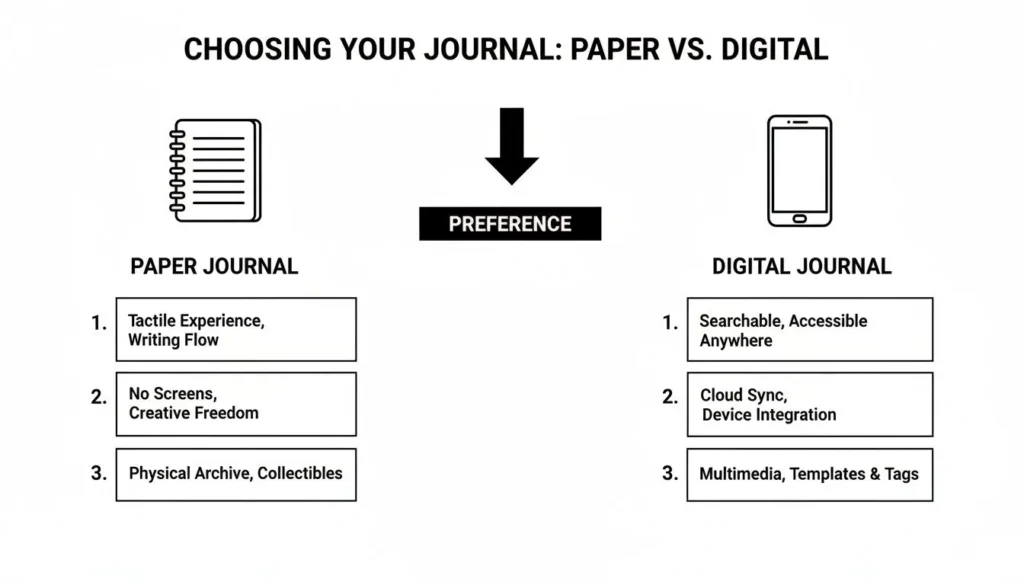
Whether you crave the tactile feel of pen on paper or need the searchability and portability of a digital app, the goal is the same: choose the path of least resistance.
The whole point is to lower the “activation energy” it takes to get started. If your journal is right there, open and waiting, you’re much more likely to use it than if it’s tucked away in a drawer.
For example, a busy parent might find five minutes of quiet in the car after school drop-off. Keeping a small Moleskine in the glove compartment makes it easy to capture thoughts in that brief window of peace. A remote worker could use their daily writing journal to create a clear boundary between their professional and personal life, writing for ten minutes to decompress before shutting down their laptop for the day.
Making your daily writing journal habit stick is about strategy, not struggle. Start small, stack the habit onto an existing routine, and make your writing space inviting. Soon enough, journaling will shift from a chore to a cherished ritual you can’t imagine your day without.
Never Face a Blank Page Again With These Prompts
We’ve all been there. You sit down, journal open, ready to write… and nothing comes. The blinking cursor or the empty page feels like a challenge you just can’t meet today. It’s one of the biggest reasons people give up on a daily writing habit.
This is exactly where prompts come in. Think of them as a little nudge—a starting point that removes the pressure of having to come up with a brilliant idea from thin air. Instead of inventing, you’re simply responding. It’s a much easier way to get the words flowing.
To make sure you never run out of ideas, we’ve put together 90 days of prompts you can turn to anytime. They’re split into two themes: Self-Discovery and Creative Ignition. Bookmark this page, and you’ll always have a spark to get you started.
30 Days Of Self-Discovery Prompts
These prompts are all about looking inward. They’re designed to help you explore your own thoughts, feelings, and memories, building self-awareness one entry at a time. Use them to get to know yourself a little better.
- Describe a time you felt completely at peace. Where were you?
- What is one small thing that brought you joy today?
- If you could give your teenage self one piece of advice, what would it be?
- Write about a fear you have and where you think it comes from.
- What does your ideal morning routine look like? How does it compare to your current one?
- Describe a challenge you overcame and what you learned from it.
- Who is someone you admire, and what specific qualities do you respect in them?
- Write a letter to someone you need to forgive (you don’t have to send it).
- What is a skill you’ve always wanted to learn, and what’s stopping you?
- Describe a place, real or imagined, where you feel most like yourself.
- What is one assumption people make about you that is untrue?
- If you had an extra hour every day, how would you spend it?
- What is a “win” you’ve had recently, big or small?
- Write about a moment when you felt truly proud of yourself.
- What are three things you’re grateful for right now, and why?
- Describe a song that holds a strong memory for you.
- What activity makes you lose track of time?
- If you could have any superpower, what would it be and how would you use it?
- What’s a piece of criticism you received that was actually helpful?
- Write about a belief you hold that has changed over time.
- What does “success” look and feel like to you, personally?
- Describe a time you felt truly listened to.
- What is something you are currently worried about? Write it down to get it out of your head.
- What traditions or rituals from your childhood do you cherish?
- If your body could talk, what would it tell you right now?
- What is a simple pleasure you could add to your day tomorrow?
- Describe a dream you remember vividly.
- What is an opinion you hold that you’d be willing to debate?
- Who has been your greatest teacher in life?
- Looking back at this month, what is one lesson you’ve learned?
Prompts aren’t just for newbies. Even seasoned writers get stuck in a rut. A good prompt can jolt you out of your usual thinking patterns and open up entirely new avenues of thought—a classic trick for shaking off a creative block.
If you find that the blank page is a frequent enemy, you might want to check out our full guide on how to overcome writer’s block for more in-depth strategies.
60 Days Of Creative Ignition Prompts
This next batch is all about firing up your imagination. These prompts are perfect for coming up with story ideas, brainstorming characters, or just playing around with words. Your journal is a creative sandbox—there are no rules and no wrong answers here. Have fun with it!
- You find a key that can open any door. Where do you go first?
- Write a scene from the perspective of an inanimate object in your room.
- An old oak tree starts sending you letters. What does the first one say?
- Describe the color blue to someone who has never seen it.
- You wake up with the ability to understand animals. What is the first conversation you have?
- Invent a new holiday and describe its traditions.
- Write a story that begins with the line: “The map was a complete lie.”
- Describe a city on Mars a hundred years from now.
- You receive a package containing an item you lost as a child. What is it, and who sent it?
- Write a poem about the sound of rain on a window.
- A new scientific discovery proves that time is not linear. How does this change daily life?
- Describe a meal so delicious it feels magical.
- Write a conversation between the sun and the moon.
- You’re a travel blogger visiting a place that doesn’t exist on any map.
- Create a character who has a strange and wonderful pet.
- Write a story set in a library where books can talk.
- What if plants were the dominant species on Earth?
- Describe a fashion trend from the year 2200.
- You discover a hidden button on your smartphone. What does it do?
- Write a eulogy for a fictional character.
- What does hope smell, taste, and feel like?
- Invent a sport that could only be played in zero gravity.
- You’re an art restorer who finds a secret message in a famous painting.
- Write a story about a musician who can control emotions with their music.
- Describe an ancient ruin from a forgotten civilization.
- Your shadow starts acting on its own. What does it do?
- Write a recipe for something abstract, like “courage” or “patience.”
- A character finds a journal from one of their ancestors. What’s the most surprising entry?
- Describe a festival that celebrates the stars.
- You’re a detective investigating a crime where the only witness is a ghost.
- Write a short story titled “The Last Bookstore.”
- If you could interview any historical figure, who would it be and what would you ask?
- A new technology allows people to sell their memories. Would you use it?
- Write a poem about silence.
- You find a photograph of yourself in a place you’ve never been.
- Describe the world from the perspective of a honeybee.
- A mysterious new color is discovered. What is it called and what does it look like?
- Write about a world where everyone’s dreams are broadcast on public screens.
- Create an advertisement for a product that solves an impossible problem.
- Write a story where the main character is a robot trying to understand love.
- Describe a journey to the center of the Earth.
- An app can predict the exact moment you’ll meet your soulmate. Do you download it?
- Write a monologue from a villain who believes they are the hero.
- You’re an architect designing a house for a cloud.
- Write a story that takes place entirely during a power outage.
- What if dogs were the world’s leading scientists?
- Describe the feeling of visiting a place for the very first time.
- A character inherits a shop that sells magical pets.
- Write a myth explaining why the leaves change color in the fall.
- You can travel to the setting of any book. Where do you go?
- Describe a sound that no one has ever heard before.
- Write a scene where a character says goodbye without using words.
- A mysterious fog rolls into town, causing people to forget their names.
- Create a character who can talk to plants.
- Write about a society that lives on giant floating islands in the sky.
- A new game becomes a global obsession. What are the rules?
- Describe a piece of art so powerful it changes anyone who looks at it.
- Write a story about a friendship between a child and a star.
- You find a watch that can stop time for everyone but you. What do you do?
- Write a letter of thanks to the last book you read.
Turning Your Journal Entries Into Published Work

Think of your daily writing journal as a gold mine. Hidden inside those private reflections are the raw materials for compelling articles, blog posts, and stories. The real work is learning to spot those valuable nuggets and polish them for an audience.
This isn’t just about navel-gazing; it’s a practical method for turning your personal practice into public work that connects with people. Many of the best published pieces I’ve read started as a single, unassuming line in a notebook.
How to Mine Your Journal for Ideas
The first move is to become an archaeologist of your own writing. I recommend setting aside time every few weeks to scan your entries, but with a specific goal: you’re not there to relive the moments, but to hunt for patterns and sparks of inspiration.
Keep an eye out for recurring themes. Are you constantly wrestling with the same question about work-life balance? Do you find yourself jotting down observations about a new social trend over and over? These are your content pillars, hiding in plain sight.
For instance, a handful of entries detailing your frustrations with finding the right project management app can easily become a detailed software review or comparison article. A single, powerful reflection on a tough conversation might be the perfect start for a personal essay.
Building an Article from a Single Thought
Once you’ve snagged a promising idea, the next step is to give it some bones. Let’s run through a quick, real-world example. Say you find an entry that reads: “Tried that new AI transcription tool. Accuracy is wild, but it’s strange hearing my own voice played back perfectly. Makes me think about how we perform online.”
That’s your starting point. Here’s how to build a full article from that one thought.
- Expand the Core Idea: What specific feelings did it trigger? Did you think about the psychological weirdness of hearing a perfect transcript of your own voice? Did it make you ponder digital identity or the future of remote meetings?
- Create a Structure: Organize these thoughts into a logical sequence. A simple outline might be: Intro (the initial observation), Body 1 (the app’s actual features), Body 2 (the psychological impact), Body 3 (broader implications for work and life), and a Conclusion.
- Layer in Research: Back up your personal observations with a few external facts or data points. This adds authority and turns a simple reflection into a well-rounded article that offers real value.
- Refine and Polish: Now, edit for clarity and flow. The key is to shift the focus from an “I” story to a “you” story, making it relevant and useful for your reader.
This is exactly how a fleeting thought in your daily writing journal becomes a polished piece ready for a platform like maxijournal.com. If you’re building a home for your work, it’s a good idea to learn how to start a blog and own your platform.
The bridge between private journaling and public writing is built with intention. It requires you to consciously look for the universal themes within your personal experiences and shape them into a narrative that resonates with others.
This process is more relevant than ever. Thanks to the explosion in smartphone use and a bigger focus on mental wellness, the digital journaling space is booming. The market, valued at $6.34 billion in 2026, is on track to hit $9.64 billion by 2030, which tells you just how many people are already capturing their ideas on screens. You can dig into more data on the growth of the digital journal market.
Your journal, whether on paper or a device, is a content engine. Once you learn to mine it, you’ll have an endless supply of unique, authentic ideas for your public writing.
Got Questions About Journaling? We’ve Got Answers.
Jumping into a daily writing habit is exciting, but it almost always brings up a few questions. Getting stuck on the “rules” can stop you before you even begin. Let’s clear up some of the most common sticking points so you can get back to what matters: writing.
How Long Should I Write Each Day?
Forget about a magic number. When you’re building a new habit, the goal is consistency, not volume. Aiming for just 5 to 10 minutes a day is a perfect starting point.
Some days, you might only jot down a single, meaningful sentence. That’s a win. Other days, you’ll look up and realize you’ve filled three pages. That’s also a win. The point is to make journaling a release, not another chore on your to-do list.
Listen to your energy levels. Let the practice be flexible. You’ll eventually settle into a natural rhythm that works for you.
What if I Miss a Day of Journaling?
It’s going to happen. Life gets in the way. Don’t sweat it. A journal is your tool; you aren’t a slave to it. Missing a day—or even a week—doesn’t mean you’ve failed or broken the habit.
The most important thing? Just start again. Don’t fall into the trap of trying to “catch up” on missed entries. That turns a creative outlet into a homework assignment, and nobody wants that.
Your journal will always be there waiting for you. The goal isn’t a perfect, unbroken streak. It’s about creating a resilient practice you can return to again and again, without guilt or judgment.
Simply open to a new, blank page and write about today. That’s it. The habit is built by returning, not by being perfect.
Should My Journal Be Completely Private?
For most people, the answer is an emphatic yes. Privacy is what unlocks the raw honesty that makes journaling so effective. It gives you a safe space to wrestle with tough emotions, explore half-baked ideas, and be your most authentic self without an audience.
Keeping it private is straightforward:
- Digital Journals: Use an app with a strong password or biometric lock. This keeps your thoughts secure, even on a shared device.
- Paper Journals: Find a safe spot. A locked desk drawer, a specific box on a high shelf—anywhere it won’t be casually stumbled upon.
Knowing your words are for your eyes only frees you from the pressure to perform or self-censor. You can always decide to adapt a journal entry into something public later, but that’s a separate step. The initial act of writing thrives in privacy.
Do I Need to Worry About Perfect Grammar and Spelling?
Absolutely not. In fact, worrying about perfect mechanics is one of the fastest ways to kill your journaling flow. Think of your journal as a “brain dump”—a first draft of your consciousness.
The goal is to get thoughts and feelings down on the page as they appear, long before your inner editor has a chance to chime in. Perfectionism is the enemy of progress here. It chokes creativity and keeps you from getting to the good stuff. If you ever decide an entry has the makings of a polished article, that’s the time to switch into editor mode.
Ready to turn your thoughts into published work? maxijournal.com is always looking for fresh voices at the intersection of technology, arts, health, and more. Share your unique perspective with a growing community of curious readers. Explore how you can contribute to maxijournal.com today.
Discover more from Maxi Journal
Subscribe to get the latest posts sent to your email.