Welcome to the definitive guide on building exceptional passing skills in young athletes. In youth football, the ability to pass accurately and intelligently is not just a skill-it’s the language of the game. It connects teammates, creates opportunities, and forms the bedrock of every successful team. This article moves beyond generic advice to provide a detailed breakdown of 8 crucial football passing drills for youth, complete with step-by-step instructions, coaching insights, and age-appropriate progressions.
These drills are designed to build a strong foundation, focusing on everything from the simple mechanics of a crisp, one-touch pass to the spatial awareness required for complex combination play. Mastering these fundamentals is what separates good players from great ones, giving them the confidence to control the game’s tempo and break down defenses. Each drill offers specific, actionable steps to ensure players grasp not just the how but also the why behind each movement.
Whether you’re a parent coaching from the sidelines or a dedicated youth coach, this resource is designed to help you cultivate the next generation of confident, skilled passers. You will find practical exercises covering:
- First-touch control and quick release.
- Possession under pressure (Rondos).
- Passing accuracy through gates.
- Combination play like the give-and-go.
Let’s transform potential into performance on the pitch.
1. Wall Pass and First Touch Progression
The Wall Pass and First Touch Progression is a foundational drill that sharpens a player’s ability to receive and distribute the ball with precision. It’s a simple yet effective method where a player uses a wall, rebounder, or a partner to practice passing and controlling the return. This drill is a staple in top youth academies, including those at Manchester United and Arsenal, because it allows for high repetition in a short amount of time, rapidly building muscle memory for clean first touches and accurate passes.
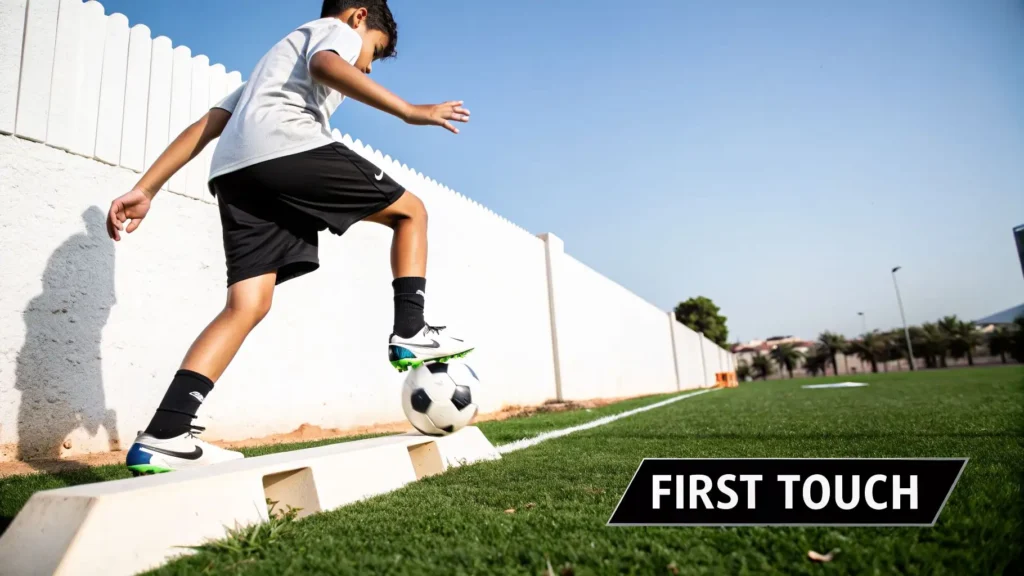
The primary goal is to develop a controlled first touch that sets up the next action, a crucial skill for maintaining possession and playing at a faster pace. This drill is one of the most effective football passing drills for youth because it isolates fundamental skills without the pressure of defenders. Players learn to adjust their body shape, judge the ball’s pace, and make quick decisions.
Coaching Tips and Progressions
To get the most out of this drill, focus on gradual advancement. Start young players at a comfortable distance (5-10 meters) and have them focus on the quality of their two-touch sequence: control, then pass.
- Foot Variation: Encourage players to use both their left and right feet, as well as the inside and outside of the foot for both passing and receiving.
- Movement: Progress from stationary passing to dynamic movement. Players can receive the ball, take a touch to the side, and pass from a new angle.
- Tempo Increase: As comfort grows, challenge players to perform the drill faster, eventually working towards one-touch passing to improve reaction time.
- Game Scenarios: Add cones to simulate defenders, forcing players to take their first touch into space and away from pressure.
Key Insight: The quality of the first touch determines the success of the next pass. A good first touch should move the ball into a space where the player can immediately play the next ball without extra, unnecessary touches.
This drill is ideal for warm-ups or technical sessions. Before starting any intense training, it’s always wise to be aware of proper physical preparation. You can find valuable information on how to prevent sports injuries to ensure players stay healthy throughout the season.
2. Triangle Passing (Possession Drill)
Triangle Passing is a dynamic drill that teaches the core principles of possession football by having three players pass and move in a triangular formation. This drill is central to the tiki-taka philosophy popularized by Pep Guardiola and is a cornerstone of training at academies like Barcelona’s La Masia and Liverpool FC. It focuses on creating passing angles, timing movements off the ball, and making quick decisions to keep the ball circulating.
The drill’s primary objective is to instill positional awareness and the importance of supporting the player on the ball. It is one of the most effective football passing drills for youth because it simulates the constant movement and quick passing sequences required to break down defenses in a real match. Players learn to think one or two steps ahead, anticipating where their teammates will be and where the next pass should go.
Coaching Tips and Progressions
To ensure players grasp the concepts, start with a larger triangle (around 15 meters between cones) to give them more time and space. As they become more proficient, you can introduce progressions to increase the challenge and replicate game-like intensity.
- Touch Restrictions: Begin with two-touch passing (control, then pass) and advance to one-touch passing to speed up play and decision-making.
- Tighter Space: Gradually reduce the size of the triangle to force quicker reactions, better close control, and more precise passes under pressure.
- Add Defenders: Introduce a passive defender in the middle to close down passing lanes, then progress to an active defender trying to win the ball back.
- Directional Play: Instruct players to receive on their back foot to open up their body and play the next pass forward, encouraging positive, attacking football.
Key Insight: The player without the ball is just as important as the player with it. Constant movement to create a clear passing option for the teammate in possession is the secret to making this drill, and possession football, successful.
This drill builds not only technical passing skills but also the cardiovascular endurance needed for the game. Maintaining a high level of fitness is crucial for young athletes, and you can find helpful advice with these fitness tips for beginners to support their physical development.
3. One-Touch Passing Progression
The One-Touch Passing Progression is a high-tempo drill designed to sharpen quick thinking, reaction speed, and technical precision under pressure. Players are challenged to pass the ball immediately upon receiving it, eliminating the safety net of a controlling touch. This drill is a cornerstone in the development philosophy of top academies like Bayern Munich and Ajax, where the speed of play is paramount. It forces players to think one step ahead, anticipating the ball’s arrival and pre-planning their next action.
The primary goal is to improve a player’s ability to play quickly in tight spaces, a vital skill in the modern game. This entry is one of the most important football passing drills for youth because it directly translates to game situations where time and space are limited. Players learn to open their body, communicate effectively, and execute a pass with minimal hesitation, all of which contribute to a faster and more fluid team style.
Coaching Tips and Progressions
Due to its intensity, this drill should be introduced gradually, starting with simple pairs before moving to more complex setups. Keep sessions relatively short (10-15 minutes) to maintain high quality and concentration.
- Start Simple: Begin with two players passing one-touch back and forth from a stationary position. The focus is purely on the technical execution and timing.
- Introduce Movement: Progress to players moving towards the ball to meet the pass, simulating a more realistic game scenario. Add a third player to create a passing triangle.
- Add Pressure: Incorporate a passive defender who applies light pressure, forcing the passer to be more aware of their surroundings.
- Verbal Cues: Use calls like “man on” to signal pressure or “time” to indicate space, helping players develop their on-field awareness and decision-making.
Key Insight: Successful one-touch play depends on anticipation, not reaction. Players must learn to read the game, adjust their body shape before the ball arrives, and know their next pass before they receive it.
This drill is excellent for developing the mental speed required for high-level football. To further support a young player’s development, it’s beneficial to understand their psychological needs. You can explore insights on how sports psychology can improve youth sports to create a more supportive coaching environment.
4. Rondo (Possession Under Pressure)
The Rondo is a classic possession drill where a group of players with a numerical advantage works to keep the ball away from one or two defenders in a tight space. It is a cornerstone of training methodologies at world-class academies like Barcelona’s La Masia and is heavily used by coaches like Pep Guardiola to instill principles of quick passing, intelligent movement, and composure. The drill’s simplicity belies its incredible effectiveness in teaching multiple skills at once.
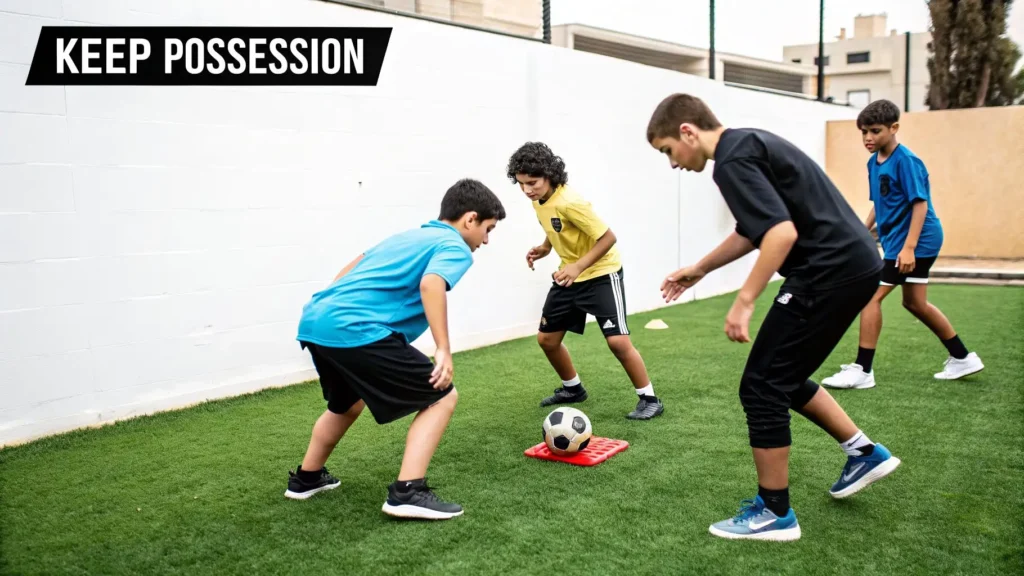
The primary goal is to develop rapid decision-making and precise passing under the constant threat of a defender. For this reason, it is one of the most game-realistic football passing drills for youth players can perform. It teaches attackers to support the player on the ball by creating good passing angles, while simultaneously training defenders to press intelligently and anticipate passes.
Coaching Tips and Progressions
To effectively implement the Rondo, start with a basic setup and add complexity as players become more proficient. The intensity and focus can be adjusted to suit different skill levels.
- Ratios: Begin with a 4-vs-1 setup for younger or less experienced players to ensure they find success. As skills improve, progress to a more challenging 5-vs-2 or 6-vs-2.
- Touch Restrictions: Initially, allow unlimited touches for the attacking players. To increase the difficulty and speed of play, introduce a two-touch or one-touch limit.
- Grid Size: A smaller area increases the pressure and demands quicker thinking and technical precision. A larger area gives players more time and space, making it easier to maintain possession.
- Intensity: Keep the drill engaging by rotating defenders every 1-2 minutes or whenever a defender wins the ball. This ensures the defenders maintain a high work rate.
Key Insight: The Rondo is more than just a passing drill; it’s a decision-making exercise. Players learn not just how to pass, but when and where to pass to keep possession and break pressure.
This drill is an excellent way to start a training session as it gets players moving, thinking, and communicating immediately. It bridges the gap between unopposed technical work and the complexities of a full-sided game.
5. Directional Passing Gates (Cone Passing)
The Directional Passing Gates drill, often called Cone Passing, is a highly effective exercise that forces players to focus on the precision and direction of their passes. By setting up small cone “gates” across a training area, players are challenged to pass the ball through these specific targets to a teammate. This method is heavily integrated into top European youth academies, particularly in Germany and the Netherlands, because it directly translates to game situations where players must thread passes between defenders to break lines.
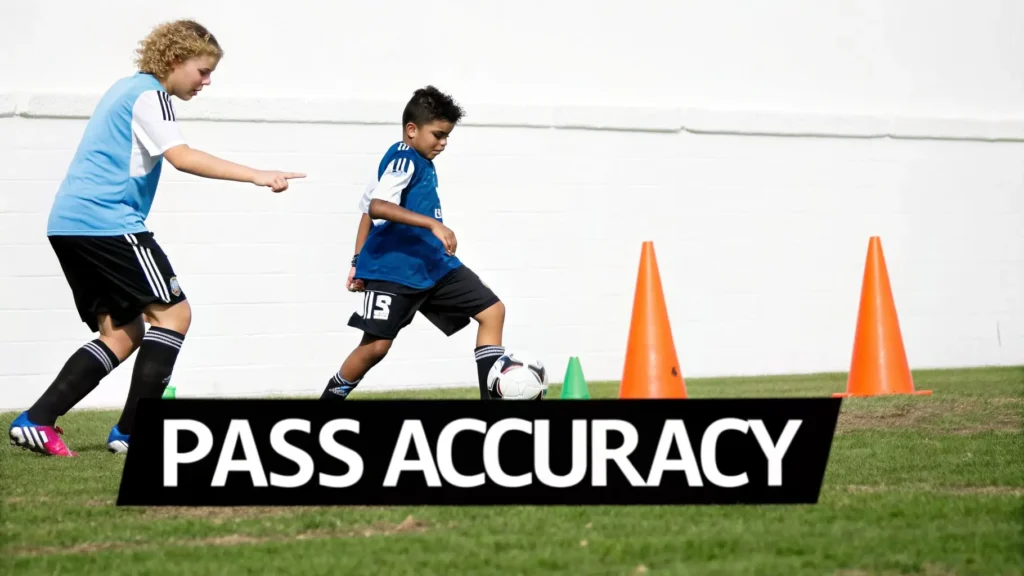
The primary goal is to improve not just passing accuracy but also a player’s awareness of passing lanes and angles. This is one of the most game-realistic football passing drills for youth because it simulates the need to find open channels in a crowded midfield. Players learn to weigh their passes correctly, aim for specific spots, and think a step ahead about where the ball needs to go to keep possession moving forward.
Coaching Tips and Progressions
To maximize development, start with static players and gradually introduce movement and complexity. The setup is simple, requiring only cones and a ball, making it accessible for any training session.
- Vary Gate Size: For younger or less experienced players, start with wider gates (2-3 yards). As skill improves, narrow the gates to increase the challenge and demand greater accuracy.
- Introduce Movement: Progress from stationary passing to having both the passer and receiver move. For example, the receiver can run through a gate before getting the pass, forcing the passer to lead them.
- Add Restrictions: Challenge players with touch limitations (e.g., two-touch only) or time pressures to force quicker decision-making and execution.
- Create a Scoring System: Turn the drill into a competitive game by awarding points for each successful pass through a gate. This increases engagement and focus.
Key Insight: This drill teaches players to see the game in terms of lines and channels. A successful pass isn’t just about getting the ball to a teammate; it’s about breaking a defensive line and putting the receiver in an advantageous position.
6. Long Ball and Switch Pass Progression
The Long Ball and Switch Pass Progression is a crucial drill for developing a team’s tactical flexibility. It focuses on teaching young players how to accurately play long passes to switch the point of attack, a key strategy for breaking down organized defenses. This drill is heavily emphasized in elite academies like Liverpool FC and Manchester City, which train their youth players to execute these game-changing passes with precision and speed, stretching opponents and creating space.
The primary goal is to build the technique, power, and vision required to move the ball effectively over long distances. It stands out among football passing drills for youth because it directly translates to tactical awareness, helping players understand when and why to switch play. This progression helps develop a player’s passing range, decision-making under pressure, and the physical strength needed for powerful, driven passes.
Coaching Tips and Progressions
Proper technique is paramount to avoid injury and ensure accuracy over distance. Start with shorter long passes (20-25 meters) before asking players to hit longer targets, building confidence and reinforcing correct form.
- Technique First: Emphasize proper body shape, a firm plant foot, and following through the ball. Young players should focus on a clean strike before adding power.
- Pass Variation: Coach players to use both the inside of their foot for a lofted, curling pass and their laces for a low, driven pass to a teammate’s feet.
- Add Movement: Introduce dynamic elements where the receiver must move to meet the pass, simulating a winger making a run. The passer can also take a touch to set up the pass.
- Introduce Pressure: Once the technique is solid, add a passive defender to close down the passer, forcing a quicker decision and execution.
Key Insight: A successful switch of play is not just about distance; it’s about the quality and timing of the pass. The pass should be played into the path of the receiving player, allowing them to control the ball while moving at speed.
Executing a powerful long pass involves complex body mechanics, much like a powerful serve in other sports. Understanding the kinetic chain can be beneficial, and you can find related principles in articles that explore tennis serve techniques to see how power is generated through the body.
7. Combination Play (Give and Go / One-Two Progression)
Combination play, specifically the give-and-go or one-two pass, is a dynamic drill that teaches players to use quick, coordinated passes to move the ball up the field and bypass opponents. It involves a player passing to a teammate and immediately running into space to receive a return pass. This sequence is a cornerstone of attacking football, and top academies like those in France and at Portuguese clubs such as Benfica and Porto introduce these patterns early to develop intelligent player movement and tactical awareness.
This drill’s primary objective is to teach players how to create space and maintain momentum through teamwork. By practicing the one-two, young athletes learn about timing, off-the-ball movement, and trusting their teammates. As one of the most effective football passing drills for youth, it shifts the focus from individual skill to collective play, showing players how passing and moving together can break down even a well-organized defense.
Coaching Tips and Progressions
To effectively teach the give-and-go, start with the basics in a controlled environment and gradually add complexity. The initial focus should be on the timing of the pass and the quality of the run.
- Start Without Opposition: Begin with two players passing and moving in a straight line or around a cone. This builds the fundamental rhythm of the sequence.
- Verbal Cues: Encourage players to use verbal cues like “wall” or “one-two” to signal their intent, improving communication and timing.
- Add Passive Defenders: Introduce a stationary or slow-moving defender to force players to think about the angle and weight of their passes.
- Full Pressure Scenarios: Progress to drills with active defenders, challenging players to execute the combination play in game-like situations and from different areas of the field.
Key Insight: The success of a give-and-go depends on the first player’s commitment to the forward run. The runner must accelerate into a dangerous space immediately after releasing the ball, trusting their teammate to deliver the return pass.
8. Transition Passing (Attack-to-Defense Switching Drill)
The Transition Passing drill is a dynamic exercise that simulates the rapid switch between attacking and defending phases of a match. Players practice quick passing sequences while their roles abruptly change, developing cognitive speed, adaptability, and spatial awareness. This drill is central to modern tactical systems seen in elite clubs like Liverpool FC and RB Leipzig, whose youth programs emphasize the ability to react instantly when possession is lost or won.
The primary objective is to train players to think and act during moments of transition. It teaches them to immediately pressure the ball after losing it or to find a forward pass the instant it’s regained. This exercise is one of the most game-realistic football passing drills for youth because it links technical passing skill with tactical decision-making, preparing players for the chaotic, unpredictable nature of a real match.
Coaching Tips and Progressions
To effectively implement this drill, coaches should focus on creating clear, high-intensity scenarios that demand quick thinking. Start with a basic setup where one team attacks a goal while the other defends, and upon a turnover or a coach’s signal, the roles instantly reverse.
- Verbal Cues: Use a sharp whistle or a loud command like “Switch!” or “Turnover!” to signal the moment of transition. The immediacy of the cue is key to training reaction speed.
- Time Constraints: Keep each phase of play short (30-45 seconds) to maintain high intensity and focus. This forces players to make quick decisions under pressure.
- Player Roles: Ensure all players rotate through both attacking and defending roles so they experience the transition from both tactical perspectives.
- Adding Complexity: Progress from a simple possession-based switch to drills involving small goals or specific target players. This adds a directional purpose to the attack and defense.
Key Insight: The first few seconds after a change in possession are often the most critical in a game. This drill trains a player’s mind to eliminate hesitation and act decisively, whether it’s to launch a counter-attack or to start a counter-press.
8-Drill Youth Football Passing Comparison
| Drill | Implementation complexity | Resource requirements | Expected outcomes | Ideal use cases | Key advantages |
|---|---|---|---|---|---|
| Wall Pass and First Touch Progression | Low — simple progressions from static to dynamic | Minimal — wall or partner, ball, small space | Better first touch, passing accuracy, foot coordination | U8–U12 individual or small-group fundamentals | Effective fundamentals, low cost, immediate feedback |
| Triangle Passing (Possession Drill) | Low–Medium — requires coordinated movement | 3+ players, cones, moderate space | Movement off ball, spacing, one/two-touch passing | U10–U16 possession and rhythm work | Directly transferable, scalable progressions |
| One-Touch Passing Progression | Medium–High — cognitively and technically demanding | Pairs/groups, space, optional defenders, high coach input | Quick decision-making, reaction speed, technical execution | U12–U18 advanced technique sessions | Develops elite fast passing under pressure |
| Rondo (Possession Under Pressure) | Medium — simple setup but needs organization | 5+ players, small grid, cones | Composure under pressure, quick passing, pressing skills | U10–U18 group possession and pressing drills | Game-realistic, trains offense and defense simultaneously |
| Directional Passing Gates (Cone Passing) | Low — easy setup with clear goals | Cones/gates, space; solo or group use | Directional accuracy, spatial awareness, measurable precision | U8–U14 technical accuracy and drilling | Objective feedback, adaptable, low equipment cost |
| Long Ball and Switch Pass Progression | Medium — technique and tactical focus | Large space, balls, groups, coaching for distance work | Long-range accuracy, power, switching-play awareness | U12–U18 tactical wide-field practice | Develops switching play, leg strength for distance passes |
| Combination Play (Give and Go / One-Two Progression) | Low–Medium — needs timing and coordination | Small groups, cones, moderate space | Pass-and-move coordination, timing, creating space | U10–U18 attacking pattern development | Highly transferable, encourages creativity, easy to teach |
| Transition Passing (Attack-to-Defense Switching Drill) | High — complex to organize and coach | Large groups, zones/full pitch, high fitness demands | Rapid adaptability, transition decision-making, conditioning | U14–U18 teams practicing press/counter systems | Realistic match transitions, builds physical and mental intensity |
Putting it All Together: Building the Complete Passer
Mastering the art of the pass is a continuous journey, one built on a foundation of deliberate practice and intelligent coaching. The eight football passing drills for youth detailed in this guide provide a complete framework, moving players from mastering individual mechanics to executing complex team-based sequences under pressure. By progressing from the foundational Wall Pass and First Touch drill to the strategic chaos of Transition Passing, you are building a player’s technical, tactical, and cognitive abilities in unison.
The real value emerges when you integrate these drills into a cohesive training plan. A successful session might start with the Triangle Passing drill to establish rhythm and communication, then escalate the intensity with a competitive Rondo to sharpen decision-making in tight spaces. Finishing with a Directional Passing Gates or Combination Play drill connects these isolated skills directly to game-day objectives like breaking defensive lines or creating scoring chances. This thoughtful sequencing ensures that each skill builds upon the last, creating intelligent and adaptable players.
From Drills to Game-Day Dominance
Remember, the goal is not simply to complete a drill but to understand its purpose. Constantly ask your players: “Where would this happen in a game?” This connection is vital.
- Build the Foundation: Consistently using drills like the Wall Pass and One-Touch Progression ingrains muscle memory for proper technique- a firm ankle, correct body shape, and precise weight on the ball.
- Develop Game Intelligence: Drills such as the Rondo and Transition Passing force players to think ahead, scan the field, and make split-second decisions, which are the hallmarks of an elite player.
- Encourage Teamwork: The Give and Go and Long Ball drills are not just about passing; they are about timing, movement off the ball, and building trust between teammates.
Ultimately, effective passing is about more than just getting the ball from point A to point B. It’s about communication, vision, and the collective ability to control the tempo of a match. By implementing these varied and progressive football passing drills for youth, you are giving your players the tools they need to not only improve their individual skills but also to elevate the performance of their entire team. Celebrate the small victories, focus on positive reinforcement, and watch as your players develop from simple passers into true playmakers who understand the beautiful game on a deeper level.
For more expert coaching guides, player development strategies, and in-depth sports analysis, explore the resources at maxijournal.com. We provide the actionable insights coaches and players need to gain a competitive edge. Visit us at maxijournal.com to continue your journey.
Discover more from Maxi Journal
Subscribe to get the latest posts sent to your email.