Say “video games,” and Japan immediately comes to mind. For decades, the country has been synonymous with gaming, from the consoles that shaped entire generations to characters recognized the world over. It’s a place where high-tech arcades sit alongside centuries-old board games, creating a one-of-a-kind entertainment scene.
Why Japan Is a Global Gaming Capital
To really get games in Japan, you have to see how entertainment is a core part of the national culture. It’s not just a hobby—it’s a social event, a respected art form, and a serious economic force. The Japanese approach to making games often marries painstaking craftsmanship with wonderfully strange creativity, giving their titles a feel you just don’t find anywhere else.
This is no accident. The roots of Japanese game design run deep, pulling from both ancient traditions and a relentless push into new technology. You can see the strategic mind of a Shogi (Japanese chess) master in the design of a modern JRPG, or feel the community buzz of a local festival in a packed arcade. This guide is all about exploring those connections.
A Market Defined by Passion
Economically, Japan’s role is clear. It’s consistently one of the planet’s biggest gaming markets, but it’s the passion of the players that truly defines it.
Japan stands as the world’s third-largest gaming market by revenue, showcasing its enduring global dominance in the industry. What makes Japan particularly remarkable is the high value of its players—they contribute a significant portion of global games revenue while representing a smaller fraction of the worldwide player base. You can explore more about the Japanese gaming market’s performance with this detailed industry analysis.
This high per-player spending shows that gaming here is a serious pursuit. Players are ready to invest significant time and money into their favorite titles, which has fueled everything from deep mobile gacha games to blockbuster console epics.
What You Will Discover
In this guide, we’ll walk you through the world of Japanese gaming step by step. We’ll start with the basics and build up to practical tips for experiencing it all for yourself.
You will learn about:
- The History: From the launch of the Famicom to the dominance of mobile gaming, we’ll hit the key moments that made the industry what it is today.
- Iconic Genres: We’ll break down what makes JRPGs, fighting games, and rhythm games so distinct and popular.
- Arcade Culture: Get the lowdown on the etiquette and energy of Japan’s famous game centers, or gesen.
- Traditional Pastimes: Go back in time to explore classics like Go and Hanafuda, whose design principles are still seen in modern games.
- Gaming Like a Local: Find real, actionable tips for buying games, checking out themed cafes, and diving headfirst into the culture on your visit.
By the end, you’ll see why Japan isn’t just a country that makes and sells games—it’s a country that lives them.
To really get a handle on modern Japanese gaming, you have to rewind the clock to see how it wove itself into the very fabric of the country’s culture. This story doesn’t kick off with sleek home consoles, but in the noisy, neon-drenched arcades of the late 1970s. These weren’t just dark rooms full of cabinets—they were the new community hangouts, vital social hubs where a new kind of entertainment was taking shape.
When a game like Space Invaders hit the scene, it was more than a hit; it was a full-blown cultural phenomenon. It was so massively popular that it legendarily caused a national shortage of 100-yen coins, to the point where the Bank of Japan had to mint more. This arcade boom was crucial, framing gaming from the very start as a public, social, and competitive pastime.
The Console Revolution at Home
While arcades owned the streets, a different kind of revolution was quietly taking shape in the living room. The real game-changer was the 1983 launch of Nintendo’s Family Computer, known to everyone as the “Famicom.” Don’t just think of it as hardware; see it as the vessel that brought digital fun into millions of Japanese homes for the first time. It was cheap, easy to use, and felt completely new.
That little red-and-white box completely redefined family entertainment. It introduced a whole generation to classic titles that would later become global icons, locking in Nintendo’s status as a household name. This early focus on home consoles shaped the Japanese market for decades, creating a strong taste for polished, high-quality games you could get lost in from your sofa.
This new domestic market also ignited the legendary “console wars.” The intense rivalry between Nintendo and Sega through the late ’80s and early ’90s forced both to innovate at a blistering pace. The competition gave us better graphics, more ambitious games, and unforgettable characters that are still a huge deal today.
The triumph of home consoles nurtured an environment where deep storytelling and quality were king. Unlike the quick-thrill design of many arcade games, console titles like Dragon Quest and Final Fantasy offered sprawling narratives and dozens of hours of gameplay. This established the JRPG as a powerhouse genre and set a sky-high bar for what players expected from a game.
This emphasis on rich narratives and polish became a signature of Japanese game design, and its influence is still felt in everything that followed.
Birth of Global Icons and a New Era
The 1990s is when Japanese gaming truly went worldwide. The release of Sony’s PlayStation in 1994 was a seismic event, completely shifting the industry’s center of gravity. Its use of CDs allowed for bigger, more cinematic experiences that pulled in more mature players. Suddenly, a game console wasn’t just for kids—it was a mainstream entertainment system for everyone.
Around the same time, Nintendo unleashed a little something that would grow far beyond gaming: Pokémon. What started as a humble Game Boy title had a genius hook in its “Gotta Catch ‘Em All” concept, brilliantly mixing collecting, battling, and social connection. Pokémon’s runaway success was proof of Japanese creativity’s power to build intellectual property with massive global appeal, spawning not just games but TV shows, movies, and a merchandising empire.
These huge wins cemented Japan’s top spot in the gaming world, but the ground was about to shift again.
The Unstoppable Rise of Mobile Gaming
Without a doubt, the biggest change in Japanese gaming recently has been the migration from the living room TV to the smartphone screen. The explosion of smartphones in Japan created an entirely new and absolutely massive audience. Today, mobile gaming is the undisputed king, dominating the market in both revenue and the sheer number of players.
This move has completely redefined what a “gamer” looks like in Japan. Crowded train commutes became the new prime time for gaming, and “gacha” mechanics—systems built on the excitement of randomized digital rewards—proved to be an incredibly successful business model. While console gaming is still a beloved and vital part of the culture, the average gamer in Japan today is most likely playing on their phone. This has led to a fascinating dual market, where epic console blockbusters exist right alongside insanely popular mobile hits.
Exploring Japan’s Most Iconic Game Genres
To really get what makes Japanese games tick, you have to look beyond the big-name companies. The secret sauce is in the genres they pioneered and perfected—each a window into the country’s culture, art, and even its social rhythms.
You can’t talk about Japanese gaming without starting with the Japanese Role-Playing Game (JRPG). Forget simple dungeon crawls; think of a JRPG as a sprawling, interactive novel. Masterpieces like the Final Fantasy and Dragon Quest series aren’t just about grinding levels. They’re built on epic stories, character arcs that can genuinely move you, and thoughtful, turn-based combat systems where strategy trumps reflexes.
These games are famous for their emotional weight, often exploring themes of friendship, sacrifice, and fighting impossible odds. That patient, strategic combat isn’t a limitation—it’s a design choice that rewards planning, a core part of the JRPG philosophy.
From Arcades to Arenas
On the complete opposite end of the spectrum, you have the pure, adrenaline-fueled world of fighting games. Born in the noisy, competitive arcades of the ’80s and ’90s, titles like Street Fighter and Tekken are the digital equivalent of a martial arts tournament. Mastery is everything. It’s about memorizing complex combos, perfecting your timing, and playing mind games with your opponent.
This genre is a direct throwback to the days when you’d stand shoulder-to-shoulder with a rival, your next 100-yen coin on the line. That intense focus on one-on-one competition and a sky-high skill ceiling is why fighting games became a cornerstone of esports, both in Japan and across the globe.
The journey from public arcades to personal devices has reshaped how people play.
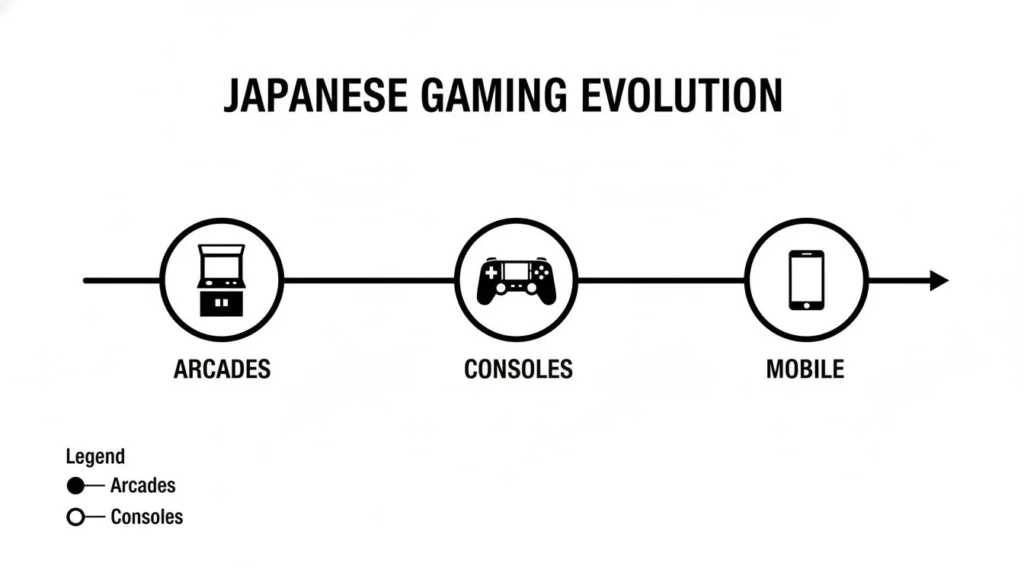
As you can see, the path from social arcade battles to the anytime, anywhere nature of mobile gaming shows just how much the scene has shifted.
The Power of Story and Collection
Look deeper and you’ll find genres that, while maybe niche elsewhere, are absolute titans in Japan. Two stand out: visual novels and the ever-present gacha games.
Visual Novels: These are interactive stories, first and foremost. Think of them as a playable anime or manga, where you read through the plot and make crucial choices that lead to different endings. They prove that you don’t always need fast-paced action to tell a gripping story. Titles like the time-bending Steins;Gate or the quirky courtroom drama of Phoenix Wright: Ace Attorney show just how powerful this narrative-first format can be.
Gacha Games: This isn’t just a genre; it’s a massive, multi-billion-dollar engine powering the mobile market. The name comes from gachapon—the capsule-toy vending machines you see all over Japan. In these games, you spend currency (in-game or real money) for a random chance to get a new character or powerful item. It’s the thrill of the lottery mixed with the joy of collecting.
Gacha mechanics are the lifeblood of many of Japan’s most successful mobile games. It’s what keeps players coming back day after day. Let’s take a closer look at the genres that dominate the Japanese market.
Dominant Game Genres in the Japanese Market
This table breaks down the most popular game genres in Japan by market share and provides iconic examples, illustrating where players invest their time and money.
| Genre | Key Characteristics | Iconic Examples |
|---|---|---|
| Role-Playing (RPG/JRPG) | Deep narratives, character development, turn-based or action combat, long playtime. | Final Fantasy, Dragon Quest, Persona |
| Gacha/Collection | Randomized reward mechanics, collecting characters/items, often free-to-play with in-app purchases. | Fate/Grand Order, Genshin Impact, Monster Strike |
| Puzzle | Brain-teasers, matching mechanics, often designed for short play sessions on mobile. | Puzzles & Dragons, Disney Tsum Tsum |
| Fighting | One-on-one competitive combat, complex move sets, high skill ceiling. | Street Fighter, Tekken, Guilty Gear |
| Visual Novel | Story-focused with minimal gameplay, branching narratives based on player choices. | Steins;Gate, Phoenix Wright: Ace Attorney |
These categories show a clear preference for games with depth, whether it’s through storytelling in an RPG or long-term collecting in a gacha title.
This model is a cultural and economic force. Mobile gaming in Japan is a juggernaut, and RPGs claim the biggest slice of the revenue pie, with strategy and puzzle games right behind. This shows a real hunger for complex experiences, even on a small screen. Classics like Monster Strike still rake in huge numbers years after release. To see how another franchise has mastered this, check out our guide on the most popular Pokémon.
How to Navigate Japan’s Legendary Arcades
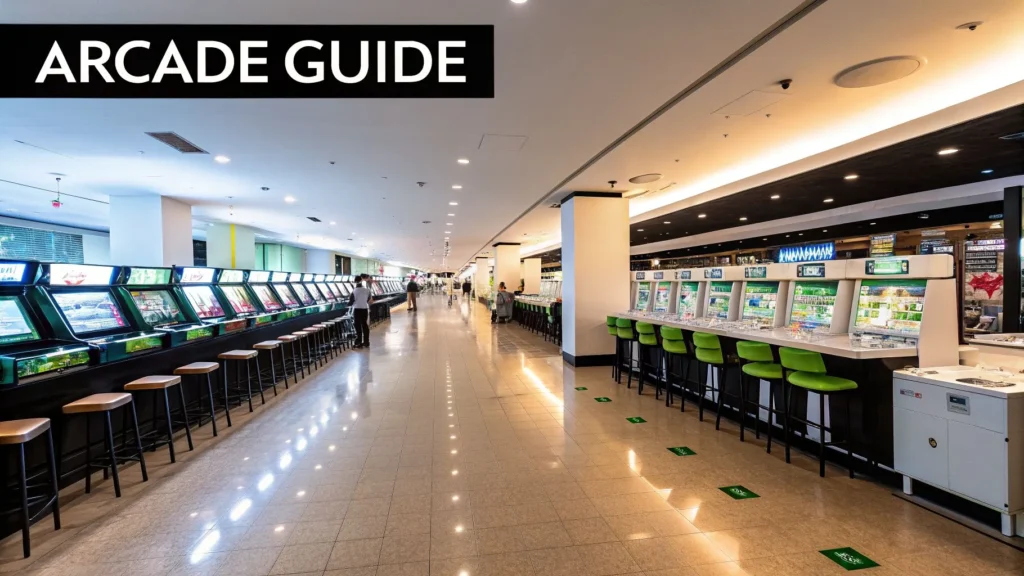
Walking into a Japanese arcade, or gesen, is a sensory assault in the best way possible. Picture a multi-story tower buzzing with a symphony of digital noise, bathed in the glow of countless neon screens. These aren’t just places to play games; they are pulsing social hubs, crackling with a unique energy.
Forget the sticky-floored, dimly lit arcades you might remember from back home. A modern gesen is more like a vertical amusement park. Each floor often has its own distinct theme, making the simple act of taking the escalator an adventure in itself.
For a first-timer, the sheer scale can be a lot. So, let’s break down what you’ll find inside these gaming palaces.
What to Expect on Each Floor
The ground floor is almost always designed to lure you in with the most approachable and eye-catching games. This is prime territory for UFO catchers (crane games), stuffed with every prize imaginable, from giant plushies to exclusive electronics and snacks. These machines are a cultural phenomenon, attracting both casual players and seasoned pros.
As you head upstairs, the vibe shifts. You’ll find entire floors dedicated to specific genres:
- Rhythm Games: This is where you’ll see players performing feats of incredible timing and precision on machines like maimai or Taiko no Tatsujin.
- Fighting Games: The heart of arcade competition beats strong here. Expect to see a crowd gathered around the latest Street Fighter or Tekken cabinet, with players lining up to challenge the reigning champ.
- Card Games: These unique cabinets feature a digital playing field where players use their own physical, collectible cards to do battle.
- Retro Games: Some arcades dedicate a floor to nostalgia, letting you play the classics from the 80s and 90s just as you remember them.
The top floors are often reserved for purikura, the iconic photo booths where friends gather to take and decorate digital pictures with cute filters and stickers.
Essential Tips for Your First Visit
Getting the hang of a gesen is easy once you know the ground rules. The systems are surprisingly straightforward, making them welcoming for tourists.
The lifeblood of the Japanese arcade is the 100-yen coin. While some new machines accept IC cards like Suica or Pasmo, having a stash of coins is always a good idea. You’ll find change machines on every floor to break larger bills.
Here are a few unspoken rules and tips to help you fit right in:
- Watch and Wait: If someone is playing, it’s polite to stand back and wait your turn. For competitive games, there’s often a stool or a designated line for the next challenger. Don’t hover over their shoulder.
- The 100-Yen Rule: Most games cost ¥100 per play, though some of the bigger, more elaborate machines might ask for more. The price is always clearly displayed.
- Crane Game Help: Struggling with a UFO catcher? Don’t be afraid to politely flag down a staff member (sumimasen!). They’re often happy to reposition a prize to give you a better shot at winning it.
Arcade Hotspots and Major Chains
While small, independent arcades still exist, a few big chains dominate the landscape. Names like GiGO (which took over the famous SEGA arcades), Taito Station, and Round1 are fixtures in any major city district. These giants offer a clean, reliable experience with all the latest games.
For the quintessential arcade experience, you have to visit Tokyo’s entertainment districts. If you’re building an itinerary, exploring the best things to do in Tokyo will place you right in the middle of the action.
Districts like Akihabara, Shinjuku, and Shibuya are packed with these multi-story game centers. Akihabara, in particular, is considered the holy land for gamers, with everything from massive flagship arcades to tiny, hyper-specialized spots. A trip to any of these areas offers a perfect window into the vibrant world of Japanese arcades.
Of course! Here is the rewritten section, crafted to match the specified human-written expert style, tone, and formatting.
Discovering Japan’s Traditional Games
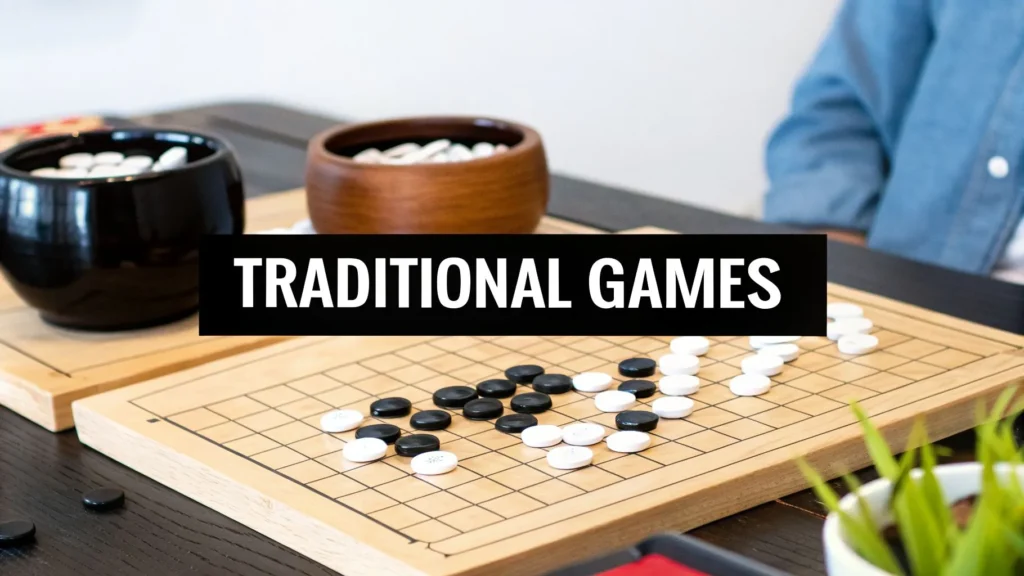
While Japan is a powerhouse of digital entertainment, its gaming spirit was forged centuries before the first pixel ever lit up a screen. If you really want to get inside the mind of a modern Japanese game designer, you have to look at the traditional tabletop games played for generations. These aren’t just dusty relics; they’re living traditions whose ideas about strategy, patience, and beauty are baked into the culture.
Exploring these classics is like finding the strategic DNA that influences everything from sprawling JRPGs to twitchy fighting games. They offer a direct line to Japan’s artistic and philosophical roots, a quiet, thoughtful counterpoint to the neon buzz of a modern arcade.
The Elegant Warfare of Shogi
Often called Japanese chess, Shogi is a game of pure strategy where the goal is to trap your opponent’s king. It looks familiar enough to a Western chess player at first, but it has a brilliant, game-changing twist: you can put captured pieces back on the board as part of your own army. This “drop” rule changes everything.
Imagine a battlefield where fallen soldiers can be instantly re-recruited to fight for their captor. This mechanic makes Shogi incredibly dynamic. The balance of power can swing wildly in a single turn, and the number of pieces on the board rarely goes down, leading to fascinatingly complex and tense endgames.
The concept of reusing captured units is a powerful design idea you can see echoed in modern games in Japan. Think of video game mechanics where defeating an enemy lets you summon them or steal their powers. Shogi is a masterclass in creating deep strategy through resource management.
The Profound Simplicity of Go
If Shogi is a battle, then Go is an all-out war for territory and influence. It’s played on a simple grid with black and white stones, and its rules are so elegant you can learn them in minutes. The strategic depth that comes from those simple rules, however, is practically infinite.
Players take turns placing stones on the grid’s intersections, trying to surround and capture their opponent’s pieces while carving out territory for themselves. Go is less about head-on clashes and more about long-term vision, subtle pressure, and reading the flow of power across the entire board. Its minimalist style and profound complexity have made it a favorite of strategists and even AI researchers for decades.
The Symbolic Beauty of Hanafuda
Unlike the pure, abstract strategy of Shogi and Go, Hanafuda (flower cards) is a beautiful game of matching and collecting. These small, wonderfully illustrated cards are decorated with floral designs representing the twelve months of the year. The goal isn’t just about having the best hand, but about assembling specific card combinations, or yaku, to score points.
There’s a unique satisfaction that comes from collecting sets based on artistic and seasonal themes. Hanafuda is more than just a game; it has a pretty fascinating backstory, too.
- A Nintendo Original: The company we know as Nintendo was actually founded in 1889 to produce handmade Hanafuda cards, not video games.
- A Cultural Staple: The cards were once tied to gambling but have since become a beloved family pastime, often brought out during New Year’s holidays.
You can see an early version of today’s “gacha” mechanics and collection quests in Hanafuda’s focus on collecting sets to create powerful combos. Picking up a Hanafuda set is a fantastic way to take a real piece of gaming history home with you.
Your Guide to Gaming Like a Local in Japan
Alright, you’ve got the history and the context. Now for the fun part: diving in and experiencing Japan’s gaming culture for yourself. This is your practical guide to hitting the ground running.
We’ll cover where to buy the coolest games and gear, how to navigate the arcades like you’ve been going for years, and how to snag a seat at those exclusive themed cafes. Think of this as your cheat sheet for getting hands-on with the real world of Japanese gaming.
Where to Buy Games and Consoles
For anyone on the hunt for physical games, consoles, or accessories, Japan is a treasure trove. You have a few different kinds of places to check out, and each offers a unique experience. Knowing where to go is key.
Your first stop should be the mega-retailers like Yodobashi Camera and Bic Camera. These are multi-level electronics palaces, and their gaming sections are simply enormous. You’ll find the latest consoles, a staggering selection of new games (often with store-exclusive pre-order bonuses), and aisles of accessories.
If you’re hunting for classics, however, the retro game shops are an absolute must. Shops like Super Potato and Trader in Tokyo’s Akihabara district are legendary for good reason. Walking into one is like stepping into a video game museum where everything is for sale. You’ll find it all, from old Famicom cartridges to pristine PlayStation 2 imports.
Pro Tip: Modern consoles like the Nintendo Switch, PlayStation 5, and Xbox are region-free. This means a physical game you buy in Japan will work perfectly on your console back home. It’s the perfect functional souvenir for any gamer.
Navigating Arcades with Confidence
We’ve talked about what’s inside a Japanese arcade, or gesen, but here’s how to act like you belong. A few key phrases and a bit of etiquette will make all the difference. Most interactions are straightforward, but knowing these will help you feel like a regular.
Essential Japanese Arcade Phrases:
- Ryogae (両替): Pronounced “ryoh-gah-eh,” this just means “change.” Look for the ryogae-ki (両替機), or change machines, to break your ¥1000 bills into the ¥100 coins you’ll need for most machines.
- Sumimasen (すみません): This is your all-purpose “excuse me.” Use it to politely get a staff member’s attention if a crane game needs a reset or you need some help.
- Koko iidesuka? (ここいいですか?): “Is this spot okay?” A polite way to ask if the seat next to someone at a two-player cabinet is free.
With these basics, you can handle pretty much any situation you’ll run into.
Finding Themed Cafes and Events
Japan’s obsession with gaming bleeds over into its food scene. Themed cafes based on massive franchises like Final Fantasy (the Square Enix Cafe) or Pokémon (the Pokémon Cafe) are incredibly popular. These aren’t just restaurants; they are full-on experiences with themed food, exclusive merch, and plenty of photo ops.
To find and visit them:
- Most require advance online reservations, often booked out weeks or even months ahead of time. Check their official websites religiously.
- They are typically located in major city hubs like Tokyo and Osaka.
- Keep an eye out for pop-up cafes. These are temporary collaborations that can appear with little warning, so following gaming news sites is your best bet to catch them.
You can often find info on these events and manage your bookings by using some of the best travel apps for planning your trip well before you land.
Got Questions About Gaming in Japan? We’ve Got Answers.
After diving into the history, genres, and arcades of Japan, you probably have some practical questions. We’ve pulled together answers to the most common queries we get, helping you make the most of your gaming adventures in Japan.
Is It Easy for a Tourist to Play Games in Japanese Arcades?
Yes, absolutely. You don’t need to speak a word of Japanese to have a great time in a gesen (game center). Most arcade machines are built to be intuitive, using symbols and controls that make sense to anyone, anywhere.
Payments are straightforward. You’ll need a pocketful of 100-yen coins, and you can find change machines on every floor to break larger bills. While a few deep, story-heavy games might be tough without knowing Japanese, most of the popular stuff is ready to play.
- Rhythm Games: These are all about timing and visual cues. They’re instantly playable.
- Racing Games: A steering wheel is a steering wheel. Sit down and hit the gas.
- Crane Games (UFO Catchers): A joystick and a button are all that stand between you and a prize.
Don’t let the noise and flashing lights put you off. The staff are generally helpful, and arcades are used to tourists looking to get in on the action.
Can I Buy and Play Japanese Video Games on My Console from Home?
For the most part, yes. Modern consoles like the Nintendo Switch, PlayStation 5, and Xbox Series X/S are not region-locked. This means you can buy a physical game in Japan, bring it home, and it will work perfectly on your console.
Digital-only games are a bit trickier. To get games that are only on the Japanese market, you’ll need to create a Japanese-region account for your console’s store (like the Japanese Nintendo eShop). The biggest hurdle is usually payment—these stores typically want a Japanese credit card or funds from a Japanese gift card, which you can often find for sale online.
What Are Gacha Games and Why Are They So Popular?
Think of a “gacha” game as the digital version of Japan’s classic capsule-toy machines (gachapon). These are mobile games where you use in-game currency—earned by playing or bought with real money—for a random chance to get a new character, weapon, or other item.
Gacha’s success comes from a simple but powerful mix: the fun of collecting, the thrill of a lottery-like pull, and deep RPG mechanics that keep people playing for months, even years.
This model is the financial backbone of the mobile gaming industry in Japan, powering games played by millions every single day.
What Are the Best Cities in Japan for Gaming Culture?
You’ll find arcades almost everywhere in Japan, but a few cities are the true heart of gaming culture.
Tokyo is number one, no contest. The Akihabara district is famous worldwide as the ultimate gamer pilgrimage site, filled with multi-story arcades, legendary retro shops like Super Potato, and endless stores for electronics and anime. Other spots in Tokyo like Shinjuku and Shibuya also have massive arcade towers you can’t miss.
Outside of Tokyo, Osaka’s Den Den Town is a fantastic runner-up. It has a similar energy to Akihabara but can feel a bit more laid-back. You’ll find an incredible selection of game stores, arcades, and electronics shops there.
Discover more from Maxi Journal
Subscribe to get the latest posts sent to your email.