The UFC was bought for $2 million in January 2001, but Dana White did not buy it by himself. Lorenzo and Frank Fertitta bought the company from Semaphore Entertainment Group, and White was the key partner who brought them the deal, took a minority stake often reported at around 10 percent, and became president.
That matters because the popular version of this story gets the central fact wrong. If you ask, “how much did dana white buy ufc for,” the accurate answer isn’t just a price tag. It’s a deal structure. White identified the asset, convinced the capital partners, and then helped run the turnaround that made the acquisition one of the most consequential sports business deals of the century.
The Misconception Behind the Billion-Dollar Question
The billion-dollar version of the UFC story misses the part that matters most to investors. The headline was never the full transaction. The key questions are who supplied the acquisition capital, who controlled the company through Zuffa, and how Dana White fit into a structure that separated ownership from operating authority.
That distinction matters because “how much did Dana White buy the UFC for” compresses several different business events into one line. The purchase price in 2001 gets mixed together with White’s minority stake, his role as president, and the far larger valuation attached to the company years later. Those are related facts, but they are not the same fact.
Why the wording matters
The question is better broken into three parts:
- What was the acquisition price? The UFC sold for $2 million in 2001.
- Who funded and controlled the purchase? The Fertitta brothers, through Zuffa, were the buyers.
- What was White’s actual contribution? He brought the opportunity to the Fertittas, stayed on as president, and helped turn a distressed combat sports property into a premium media asset.
That framework produces a more accurate reading of the deal. White was central to the outcome, but central does not mean sole buyer. In sports business, those roles often split. One side provides capital and governance. The other provides operating vision, promotional execution, and the credibility to keep the product growing.
The UFC is a clean example of that split.
The better way to read the deal
A better interpretation is that White helped assemble and run an acquisition at a moment when the asset looked commercially impaired. The low entry price reflected legal pressure, distribution problems, and limited mainstream acceptance. It did not mean the business was simple to fix.
That is why the later valuation jump needs context. The return came from more than buying low and selling high. It came from rebuilding distribution, improving regulation, growing pay-per-view, and professionalizing management over time. It also came from preserving continuity at the top. During the 2016 sale, White remained president, which reduced execution risk for the buyers and supported the value of the asset beyond the headline purchase price.
One detail often missed in retellings is that sports properties are not valued only on brand recognition. They are valued on cash flow, media rights potential, and the cost of getting the product in front of paying audiences. For the UFC, distribution access was part of the investment case, not a side issue. That is the financial mechanic behind the story, and it explains why the popular version is too simple.
The Real Deal How Zuffa Acquired the UFC for $2 Million
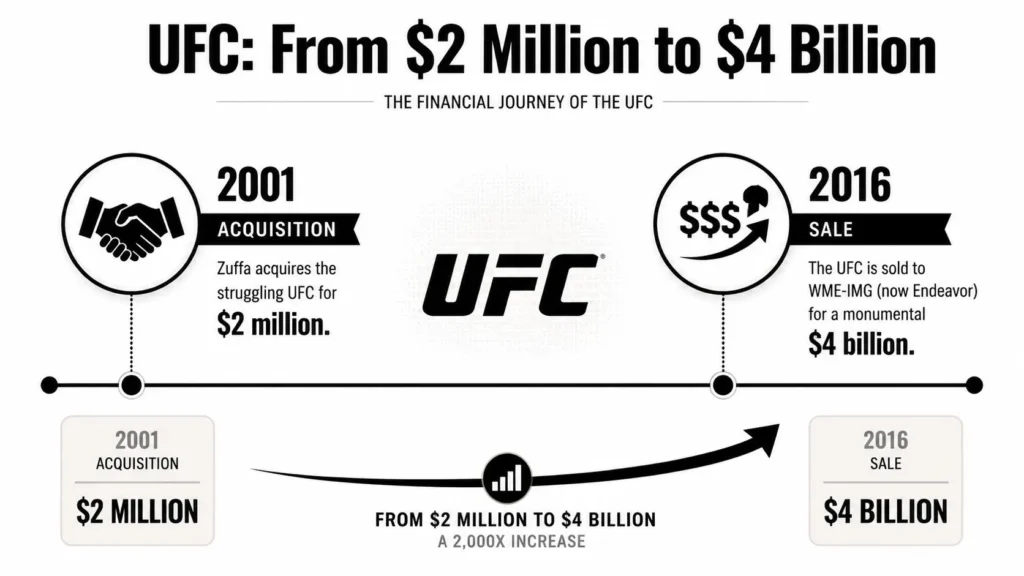
The headline number gets repeated so often that it flattens the actual transaction. Zuffa acquired the UFC in early 2001 for $2 million, but that figure described the company purchase, not the full economic effort required to make the property commercially usable.
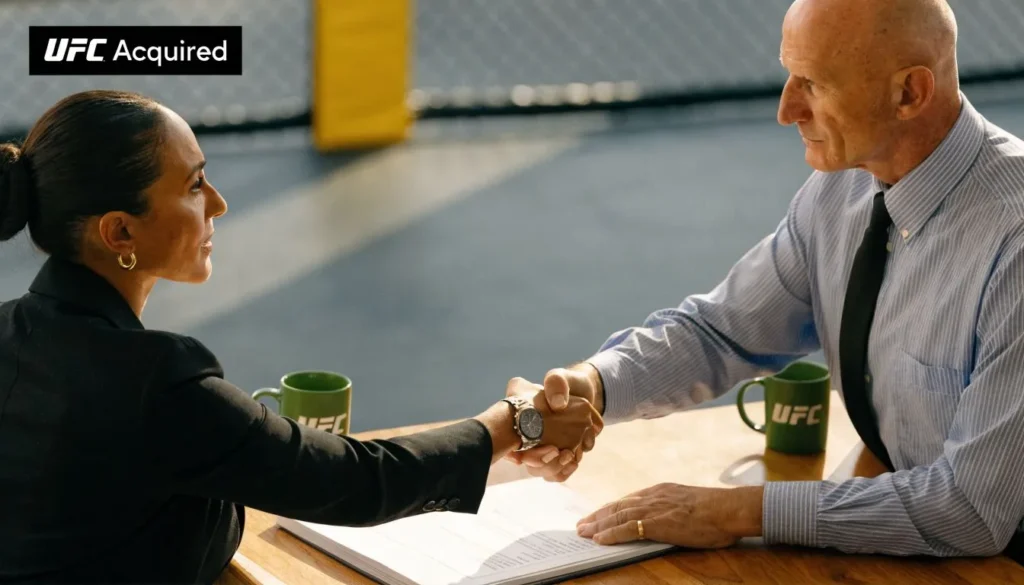
That distinction matters. The value of a sports property does not sit only in trademarks and event inventory. It also sits in who controls distribution, merchandising, and the day-to-day operation needed to turn a troubled league into a repeat-purchase media product. In the UFC’s case, Dana White brought the opportunity to Lorenzo and Frank Fertitta, the Fertittas supplied the capital through Zuffa, and White took the president role plus an ownership stake that aligned his compensation with long-term growth.
A cleaner way to read the deal is to separate the players from the asset:
- Zuffa: The acquisition vehicle that bought the UFC business.
- Lorenzo and Frank Fertitta: The principal investors and controlling owners.
- Dana White: The executive advocate for the acquisition, then the operating leader charged with rebuilding the brand.
That structure was more complex than the popular retelling suggests. White did not personally buy the UFC outright. He helped assemble an acquisition group, then stayed in the operator’s chair. In sports business terms, that reduced one common post-deal problem. The buyers did not need to search for a promoter who understood the product after closing.
The less discussed financial mechanic is that ownership of the promotion alone was only part of the equation. Reporting and later commentary around the early Zuffa period have pointed to separate spending tied to distribution and merchandising rights, which helps explain why the famous $2 million figure understates the true cost of getting control over the UFC’s revenue engine. For readers who follow the broader economics of leagues and combat sports, this kind of sports business coverage and analysis is often more useful than a simple purchase-price headline.
White’s equity also mattered for valuation discipline, not just optics. A minority stake gave him direct exposure to upside if live events, pay-per-view, sponsorship, and regulation improved. That incentive structure helps explain why he became more than a public face. He became part of the asset itself, because his continued role lowered execution risk.
A short visual recap helps:
The important takeaway is precise. Zuffa bought the UFC for $2 million, but the investable thesis was larger than that number. It involved capital, rights control, and management continuity from day one.
Why So Cheap The UFC’s Pre-Zuffa Struggles
A $2 million purchase price sounds absurd in hindsight only if you forget what the UFC looked like in 2001. This was not a polished league waiting to be discovered. It was a troubled asset with serious commercial and regulatory baggage.

Verified reporting and business summaries describe the pre-turnaround UFC as financially struggling, largely unsanctioned, and viewed as a fringe sport. That context is the only way the headline number makes sense.
A distressed asset, not a bargain-bin luxury
Buyers weren’t looking at a mature sports league. They were looking at a brand with weak institutional support and a limited path to mainstream distribution. The low price reflected those conditions.
Then there’s the detail most retellings leave out. The acquisition wasn’t only about the company itself. According to Bloody Elbow’s reporting on White’s comments about the transaction, the global distribution and merchandising rights were acquired separately for approximately $3 million, which was 50 percent more than the base $2 million purchase price for the company.
That one fact changes how the whole deal should be interpreted.
The smart money wasn’t only buying the cage. It was buying the right to package, distribute, and monetize the brand beyond the cage.
The hidden value sat in the rights
If you only focus on the $2 million headline, you miss the financial mechanics that made the asset powerful. Distribution and merchandising rights are what allow a sports promotion to expand beyond live events into a broader media and consumer business.
That’s why this deal still resonates with people who follow sports ownership. The company may have looked damaged, but the rights structure offered room to build.
Three reasons the low headline price can be misleading:
- The operating company was weak: Commercially, the UFC needed repair before it could attract broad legitimacy.
- The rights package mattered more than many fans realize: Separate control of distribution and merchandising created the foundation for future monetization.
- The market discounted the stigma: The business had image problems that scared away less patient buyers.
For readers who follow broader sports industry analysis, Maxi Journal’s sports category shows how often value sits below the headline in media rights, sponsorship, and ownership structure.
The Payoff The UFC’s $4 Billion Sale in 2016
The headline number invites the wrong question. The 2016 sale did more than prove that a once-marginal fight company had become expensive. It showed that UFC had been rebuilt into a media rights business with predictable cash flow, global event inventory, and enough management continuity to support a private-equity style valuation.
In 2016, a buyer group led by WME-IMG acquired UFC for $4 billion, a price that ESPN reported was the largest single transaction for a sports organization at the time. ESPN also noted that the valuation was roughly seven times the company’s estimated 2015 gross revenue of about $600 million.
What the buyer group was actually pricing
A seven-times-revenue multiple looks aggressive if you view UFC as a fight promoter. It looks more rational if you view it as a scarce sports property with year-round programming, international growth potential, and direct ties to pay-per-view, sponsorship, licensing, and live gate revenue.
The composition of the buyer group matters here. WME-IMG brought entertainment and talent packaging reach. Silver Lake, KKR, and MSD Capital brought financial discipline and a willingness to pay for future earnings expansion, not just current income. That combination suggests the acquirers saw UFC as an asset they could scale across media, events, and commercial partnerships.
That point connects back to the original Zuffa purchase. The Fertittas did not just buy a troubled promotion. They also secured distribution and merchandising rights through separate transactions, which gave later buyers a cleaner and more valuable rights structure to underwrite. If you want to understand why some ownership deals create outsize returns, a practical framework like this guide on building a business plan around revenue streams and rights control is more relevant than it may sound.
The sale price reflected continuity as much as growth
The $4 billion figure also included an operating assumption that often gets overlooked. UFC was sold with Dana White staying in place as president, which reduced execution risk for the new owners and preserved the public face of the brand. In sports business terms, that matters. Buyers were not paying only for past growth. They were paying for the odds that the growth engine would keep running after closing.
| Year | Event | Valuation |
|---|---|---|
| 2001 | Acquisition by the Fertitta-led group | $2 million |
| 2016 | Sale to WME-IMG-led consortium | $4 billion |
| 2024 | Estimated UFC valuation | $11.3 billion |
The raw jump from $2 million to $4 billion is why the deal still gets cited. The more useful lesson is how that value was built. Rights control, brand rehabilitation, disciplined expansion, and retained leadership turned a distressed combat-sports property into an institutional asset that astute buyers could model with confidence.
Dana White’s Evolving Role From President to CEO
One of the sharpest signs of Dana White’s importance came when the UFC sold in 2016. He didn’t disappear in the exit. He stayed.
According to CBS News’ profile of White and the UFC’s later valuation, after the 2016 sale, Dana White remained as president with a continued ownership stake. Following the 2023 formation of TKO Group Holdings, the UFC’s valuation reached an estimated $11.3 billion, and White was promoted to UFC CEO.

Why retention mattered in the sale
This is one of the most overlooked mechanics in the entire transaction. Buyers often want continuity, but they don’t always insist on it with this much visibility. In the UFC’s case, keeping White in place reduced transition risk.
He wasn’t just another executive. He was central to the company’s negotiating posture, promotion style, and public image. By retaining him, the new owners preserved the person most associated with the UFC’s commercial identity.
That tells you the 2016 sale wasn’t solely a cash-out. It was also an operator-retention deal.
From minority partner to enduring power center
White’s trajectory is unusual because it combines three roles over time:
- Minority owner: He had equity exposure from the early era.
- President: He remained the operating face after the sale.
- CEO under TKO: His title rose alongside the UFC’s larger corporate structure.
That kind of continuity is rare in headline sports transactions. It also shows that the market didn’t value White only for what he had done. It valued what buyers believed he could continue to do.
Operational continuity is a quiet driver of enterprise value, whether you’re looking at a fight promotion or studying ways to improve operational efficiency in any other company. The UFC’s ownership history is a sharp example of that principle in the wild.
Common Questions About UFC’s Ownership Answered
Did Dana White buy the UFC himself?
No. White did not personally acquire the company in the way the search query implies. He was part of the original ownership group and became the operating force behind the promotion, but the acquisition vehicle and capital came from Zuffa.
That distinction matters because people often collapse two separate questions into one. One is who funded and legally purchased the UFC. The other is who built it into a much more valuable sports property. White was central to the second answer.
Does the $2 million headline capture the whole acquisition cost?
Only if you ignore the transaction structure.
The UFC entity changed hands for $2 million, but the broader economics were larger because related distribution and merchandising rights sat outside that headline figure. For valuation purposes, that means the famous purchase price is real, but incomplete. Analysts studying the deal look at the asset package, not just the sticker price attached to the company itself.
What was the return on that original purchase?
Using the commonly cited $4 billion sale price from 2016 against a $2 million purchase price, the gain was about 199,900%.
That figure is so large that a smaller error changes the story. Calling it a 2,000% return understates the scale of the value creation by a factor of nearly 100. It also misses the business lesson. This was not a strong asset that became slightly better. It was a distressed combat sports property that was turned into an institution buyers were willing to value like premium media inventory.
Why did buyers keep Dana White in charge after the 2016 sale?
Because continuity had financial value.
In many acquisitions, the buyer wants the asset and can replace management later. The UFC sale worked differently. White remained President after the transaction because the buyers were not only purchasing a library, a brand, and live event rights. They were also buying a promotional machine that still depended on a recognizable operator to negotiate fights, market events, and maintain relationships across the sport.
That retention reduced execution risk at the exact moment the UFC was being folded into a larger entertainment investment thesis.
What is the smarter way to read UFC ownership history?
As a case study in transaction design, not just headline prices.
Three points matter more than the trivia version of the story:
- The initial acquisition involved more than the company sale price alone.
- The 2016 exit reflected both media value and confidence in management continuity.
- White’s role changed over time, but his commercial importance did not disappear when ownership changed.
The popular question asks who bought the UFC. The better question is which pieces of the business were acquired, retained, and monetized at each stage.
That is why this deal still gets studied. It shows how value in sports is often created outside the headline number, through rights control, operating continuity, and timing a sale when institutional capital starts pricing a league like a long-term media asset.
If you like clear breakdowns of sports, business, and culture without the usual noise, visit maxijournal.com for more accessible analysis and commentary across the topics people follow.
Discover more from Maxi Journal
Subscribe to get the latest posts sent to your email.