If you want to build study habits that actually stick, the secret is surprisingly simple: focus on consistency over cramming. A structured daily routine breaks learning down into small, repeatable actions that create long-term knowledge, not just frantic, short-term memorization.
Laying the Groundwork for Lasting Study Habits
Forget the myth that academic success is reserved for those who can afford expensive tutors or pull caffeine-fueled all-nighters. The real key to effective learning is building a solid foundation of consistent, repeatable actions. These routines, not sheer willpower, are what turn studying from a dreaded chore into a powerful, almost automatic skill.
The way we learn has shifted dramatically. A staggering 81% of college students had to completely overhaul their study habits after the pandemic. This isn’t just a random change; it shows a massive move toward more adaptable and consistent learning methods. The data backs this up: students who log a steady 3-4 hours of studying daily show much better retention. In fact, the 34.4% of US students in this sweet spot consistently outperform the 50.5% who study for less than two hours a day.
Why Consistent Routines Trump Cramming
Cramming is a recipe for stress and anxiety. It tricks your brain into a false sense of security, but the information is fragile, stuck in short-term memory. It’s like trying to build a house in a single day—it might look okay from a distance, but the foundation is a mess, and it’s bound to fall apart.
A true study habit isn’t about intensity; it’s about rhythm. A steady, predictable routine reduces decision fatigue and makes it easier to start, which is often the hardest part of any task.
Short, consistent study sessions are powerful because they tap into a principle called spaced repetition. When you revisit information at strategic intervals, you’re sending a clear signal to your brain that this knowledge is important. This process is what helps move information from your crowded short-term memory into your much more reliable long-term storage.
Core Principles for Success
To get started, it’s helpful to understand the basic pillars of habit formation. These aren’t complicated rules, but foundational ideas that make any new routine easier to build and maintain.
Core Principles for Building Study Habits
| Principle | Actionable Advice | Why It Works |
|---|---|---|
| Start Small | Don’t try to study for three hours on day one. Start with just 25 minutes. | Making the initial task incredibly easy removes the mental barrier to getting started. |
| Track Progress | Use a calendar, a simple notebook, or a habit tracker to mark each successful study day. | This creates a visual chain of success. You won’t want to “break the chain,” which is a powerful motivator. |
| Prioritize Well-Being | Ensure you’re getting enough sleep, eating well, and managing stress. | A tired or stressed brain can’t learn effectively. Your mental state is the foundation for all cognitive tasks. |
Building a solid study habit isn’t just about what you do, but how you support the person doing it—you.
Start Small: Seriously, don’t aim for a marathon session right out of the gate. A 25-minute block is perfect. The goal is to make the habit so easy to start that you have no excuse to skip it.
Track Your Progress: Get a calendar and put a big “X” on every day you complete your session. Watching that chain grow creates a powerful sense of accomplishment and makes you want to keep the streak alive.
Prioritize Well-Being: You can’t pour from an empty cup. Effective studying demands a healthy mind. Getting enough sleep and keeping stress in check are just as vital as any memorization technique. For more on this, check out our guide on essential mental health and self-care tips.
Crafting a Study Plan That Fits Your Life
Let’s be honest: most generic study schedules are doomed to fail. Why? Because they completely ignore the single most important factor—you. The real secret to building study habits that actually stick is creating a plan that works with your life, not against it.
This process begins with a simple time audit. Before you can map out a new routine, you need a crystal-clear picture of your current one.
For just one week, track where your time goes. Be brutally honest. Log everything from classes and work to your commute, meals, and social time. You’ll likely discover hidden pockets of time you never knew you had, like a 30-minute lunch break or a 45-minute bus ride that’s perfect for a quick review.
Matching the Plan to the Person
A study plan is deeply personal; there is no one-size-fits-all solution. Your schedule needs to be built around your unique circumstances.
Here are a few common scenarios I see all the time:
The Full-Time University Student: Your life is a whirlwind of lectures, labs, and campus events. Your best bet is to build your study plan around your class schedule. Use the gaps between classes to your advantage. Got a 90-minute break between Biology and English? That’s your golden ticket to hitting the library and knocking out some practice problems.
The Part-Time Online Learner: Flexibility is your greatest asset and your biggest challenge. Without a rigid schedule, you need to create one. I recommend blocking out specific, non-negotiable times each day—say, 7 PM to 9 PM—and treating them like a mandatory class. Consistency is key.
The Working Professional: You’re juggling a full-time career while studying for a new certification. Your study time will have to be squeezed into the margins of your day. This might mean waking up an hour earlier, using your lunch break, or dedicating a focused three-hour block on Saturday morning.
The best study plan is the one you actually stick to. It’s far better to schedule three realistic 45-minute sessions you know you’ll complete than one ambitious four-hour marathon you’ll constantly push off.
Setting SMART Goals for Every Session
A plan without clear targets is just wishful thinking. To get the most out of every single study block, you need to set SMART goals: Specific, Measurable, Achievable, Relevant, and Time-bound.
A vague goal like “study for the test” is a recipe for procrastination. It’s too big and undefined.
Instead, get granular.
- Specific: “I will complete 20 practice problems from Chapter 5.”
- Measurable: The goal is 20 problems. You know exactly when you’re finished.
- Achievable: Can you do 20 problems in an hour? It’s a stretch, but it’s possible.
- Relevant: These problems are directly tied to the material on your upcoming quiz.
- Time-bound: The deadline is the end of this one-hour study block.
This simple framework transforms a huge task into a series of small, manageable wins.
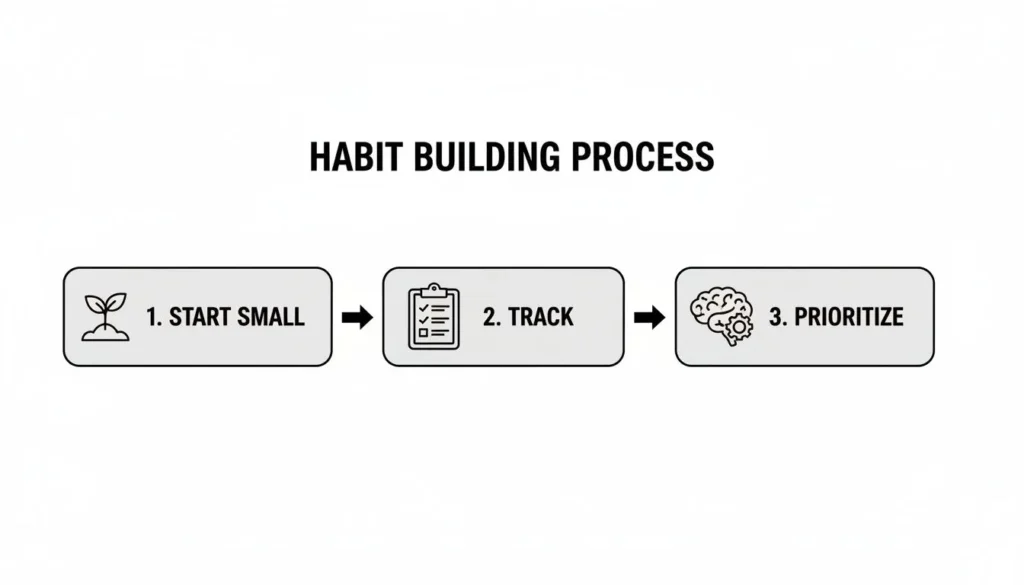
As you can see, building a solid habit comes down to starting small, tracking your progress, and always prioritizing what’s most important. Using a digital tool can make this even easier. If you’re looking for recommendations, check out some of the best productivity apps for students to find a tracker that fits your new routine.
Using Science-Backed Techniques to Study Smarter

If your study routine still revolves around highlighting textbooks and rereading your notes, you’re working way harder than you need to. To really lock in what you’re learning, you have to get your brain actively involved.
These aren’t just clever tricks; they’re methods backed by cognitive science. They force you to interact with the material, not just passively absorb it. That small shift can make a huge difference, turning long, frustrating hours into genuinely effective learning.
Embrace Spaced Repetition
Think of your brain like a muscle. You can’t just lift a heavy weight once and expect to be strong forever. Information naturally fades over time—psychologists call this the “forgetting curve.” The best way to fight it is with spaced repetition.
This means reviewing material at increasing intervals. The first review might be a day later, the next a few days after that, then a week, and so on. It feels much more effective than cramming because it is. Spacing sessions over several days—known as distributed practice—can lead to 200% better recall compared to a single marathon session.
Many students use flashcard apps like Anki that have this principle built-in, with some reporting grade boosts of up to 50%. According to HolonIQ’s 2026 Outlook, this kind of ‘long-term transformation’ is becoming a cornerstone of modern education.
Spaced repetition is like watering a plant. You don’t dump a month’s worth of water on it at once. You give it what it needs at regular intervals to help it grow strong and healthy.
Master Concepts with Active Recall
Active recall is the simple act of pulling information out of your brain, rather than just putting it in. It’s the difference between glancing at the solution and actually trying to solve the problem from memory first.
Every time you force yourself to retrieve a fact or concept, you strengthen the neural pathway to it, making it easier to find next time.
Here are a few practical ways to use active recall:
- Flashcards: A classic for a reason. Don’t just flip them. Try to say the answer out loud before you check to add another layer of processing.
- Concept Maps: After you finish a chapter, close the book. Grab a blank sheet of paper and try to sketch out a map connecting all the key ideas and definitions from memory.
- Practice Questions: Work through problems from old exams or the end of the chapter without peeking at your notes. The struggle is a good thing—it’s your brain building connections.
We go into even more detail on these strategies in our guide on how to improve memory retention.
Use the Feynman Technique for True Understanding
Here’s a simple truth: if you can’t explain something in simple terms, you don’t really get it. That’s the entire idea behind the Feynman Technique, an incredibly powerful method for identifying exactly where your understanding breaks down.
It works in four simple steps.
First, choose a concept you’re trying to learn. Next, try to teach it to someone else—or just pretend you are. The key is to use simple language, as if you were explaining it to a middle schooler.
As you explain, you’ll inevitably hit spots where you get stuck or have to use technical jargon. These are your knowledge gaps. That’s the third step: go back to your notes or textbook to fill in those specific gaps. Finally, review and simplify your explanation one last time until it’s perfectly clear.
This process is so effective because it moves you beyond simply recognizing a term to truly understanding how it works and fits into the bigger picture.
Finding Your Ideal Study Rhythm and Duration

When you’re trying to build good study habits, it’s easy to get hung up on one question: “How long should I study?” But there’s no magic number.
The real answer is that quality and consistency will always beat sheer quantity. A couple of truly focused hours will serve your brain far better than a full day of distracted, low-energy cramming. The goal is to find a rhythm that works with your energy, not against it.
Ever wonder how some students seem to learn more by studying less? It’s all about their approach. A nationwide survey from GCU revealed that 50.5% of US college students study for less than two hours a day, a group that consistently falls behind.
The sweet spot seems to be three to four hours, where 34.4% of students land. Interestingly, the most successful students, making up 22.7% of those surveyed, average between 6-10 hours per week. You can see more data from the full survey analysis on GCU.edu.
Pinpoint Your Peak Productivity Hours
Your brain isn’t built to run at 100% capacity all day. Everyone has natural cycles of high and low energy, known as a chronotype. Some of us are “morning larks,” sharpest before noon, while others are “night owls” who only hit their stride after the sun goes down.
To find your peak time, try tracking your focus levels for a week. Make a note of when you feel most alert and ready to tackle tough material. Once you spot that window, protect it. Schedule your most demanding study sessions then.
Don’t fight your body’s clock—build your routine around it. Forcing yourself to study at 6 AM when you’re a night owl is a fast track to burnout.
The best time to study isn’t when you think you should; it’s when your brain is actually ready to learn. Working with your body’s internal clock is smarter than working against it.
Use Frameworks to Maintain Focus
Once you’ve identified your ideal study time, the next hurdle is staying focused. This is where a simple framework can be a game-changer, keeping your mind on track and your energy from fading.
One of the most popular and effective methods is the Pomodoro Technique. It’s incredibly straightforward:
- Choose one task to work on.
- Set a timer for 25 minutes and focus on that single task. No multitasking.
- When the timer rings, take a short 5-minute break. Get up, stretch, look away from your screen.
- After four of these cycles, take a longer break of 15-30 minutes.
This technique works because it turns a daunting “study session” into small, manageable sprints. Those scheduled breaks are crucial; they give your brain a chance to rest and reset, preventing the mental fatigue that kills focus. It’s a powerful tool for building discipline and making your study habits truly stick.
Navigating Procrastination, Burnout, and Other Roadblocks

Let’s be real. Even with the best-laid plans, you’re going to hit a wall. Procrastination will creep in, and burnout will make even looking at a textbook feel like a monumental task. The goal isn’t to pretend these things don’t exist—it’s to have a game plan for when they show up.
Think of these obstacles as signals. They’re telling you something in your routine needs a tweak. Learning how to read those signs and react is what separates a short-lived attempt from a truly resilient study habit.
Strategies to Overcome Procrastination
Procrastination rarely comes from laziness. It’s almost always an emotional reaction to feeling overwhelmed, anxious, or just plain bored by a task. The trick is to make the act of starting so laughably easy that you have no excuse not to.
One of the most powerful methods I’ve seen work is the two-minute rule. Instead of a huge, vague goal like “study for the history final,” break it down into something you can do in under two minutes. For example, “open my history notes to Chapter 10.”
That’s it. Once you’ve taken that tiny first step, momentum often kicks in and makes it much easier to keep going. You’re disarming the anxiety that fuels the procrastination in the first place.
The secret to beating procrastination isn’t about conjuring up a massive wave of motivation. It’s about making the first step so small and non-threatening that you don’t even need motivation to do it.
Another great technique is task pairing. This involves linking a task you don’t love (like studying) with something you actually enjoy. For instance, you could commit to reviewing flashcards for 15 minutes while you have your morning coffee. Your brain starts to build a positive association with studying, which makes it feel less like a chore.
Recognizing and Preventing Burnout
Burnout is a different beast entirely. It’s more than just feeling tired—it’s a state of deep emotional, physical, and mental exhaustion from long-term stress. It’s the silent killer of consistency, slowly draining your drive until you feel completely empty.
The best defense is spotting the early warning signs. Keep an eye out for these:
- Persistent Fatigue: You feel drained no matter how much you sleep.
- Cynicism or Detachment: You start feeling negative, resentful, or just plain indifferent about your classes and goals.
- Reduced Performance: You’re putting in the hours, but your concentration is shot and your grades might be slipping.
To prevent burnout, you have to start treating rest as a non-negotiable part of your study process, not as a reward you get only after you’re completely finished.
Proactive Anti-Burnout Habits
Here are a few practical habits to build into your routine to keep burnout at bay.
| Habit | How to Implement It | Why It Works |
|---|---|---|
| Schedule Guilt-Free Breaks | Block out specific, non-negotiable downtime in your calendar, just as you would a study session. | This trains your brain to view rest as a required activity, not a sign of weakness, which helps prevent a cycle of guilt. |
| Protect Your Sleep | Aim for 7-9 hours of quality sleep per night. Keep a consistent sleep schedule, even on weekends. | Sleep is crucial for memory consolidation and emotional regulation, directly fighting off mental exhaustion. |
| Set Clear Boundaries | Define a hard stop time for studying each day. When that time comes, you are done. Period. | This prevents your study time from bleeding into your personal life, giving your brain a chance to truly disconnect and recharge. |
Ultimately, getting past these common hurdles comes down to self-awareness and making smart adjustments along the way. By understanding the psychology behind why you procrastinate and the very real physical toll of burnout, you can build study habits that are not only effective but also sustainable for the long run.
Frequently Asked Questions About Study Habits
When you’re trying to build better study habits, a few questions always seem to pop up. Let’s tackle some of the most common ones I hear so you can get past the confusion and start making real progress.
How Long Does It Take to Build a Good Study Habit?
Many of us have heard the old 21-day rule, but the science tells a different story. Research points to an average of about 66 days for a new behavior to truly become second nature. But honestly, the specific number isn’t what matters—consistency is.
The real goal isn’t to be perfect. You’re going to miss a study session here and there. It happens. What separates a temporary slump from a failed habit is getting right back to it the next day. That resilience is everything.
Building a solid study habit is a marathon, not a sprint. Focus on just showing up consistently. Forgive the occasional slip-up. Progress over perfection is the mindset that will get you there.
To make it stick, start with something you can’t say no to, like a single, focused 30-minute study block each day. Let that small routine cement itself over two or three months. Before you know it, it’ll feel as automatic as brushing your teeth.
Is It Better to Study in the Morning or at Night?
The simple answer? There isn’t one. The “best” time to study is completely personal. It all comes down to your chronotype—are you a morning person who’s sharp at sunrise, or a night owl who does their best work after dark?
The right time to hit the books is whenever you feel most alert, focused, and energized. The only way to find it is to experiment. Try studying at different times of the day for a week and see when you feel the most productive.
Once you’ve identified your peak window, guard that time. Build your routine around it. At the end of the day, consistency is far more important than the actual hour on the clock.
How Can I Stay Focused and Avoid Phone Distractions?
Your phone is probably the single biggest obstacle to deep, effective studying. The best strategy is to create a fortress of focus by making distractions physically and digitally unavailable.
Create a No-Phone Zone: It sounds simple, but it works. Leave your phone in a different room while you study. The “out of sight, out of mind” principle is incredibly powerful.
Use Blocker Apps: If you find your self-control wavering, lean on technology for help. Apps like Freedom or Forest can block distracting websites and apps on your devices for a set amount of time.
Communicate Your Hours: Let your friends and family know when your dedicated study times are. A simple heads-up can drastically reduce interruptions and set clear expectations for everyone.
Combine these tactics with a time-management system like the Pomodoro Technique. It will train your brain to focus in short, intense bursts, making every study session count.
What Should I Do When I Feel Completely Unmotivated?
Motivation is fickle. You can’t rely on it. On the days you feel completely drained, you have to rely on your system, not your feelings.
The trick is to make the first step ridiculously easy. Try the “five-minute rule”: commit to studying for just five minutes. Getting started is almost always the hardest part. Once you’re over that initial hurdle, you’ll often find the momentum to keep going. Another great trick is to promise yourself an enjoyable activity right after, which helps build a positive feedback loop.
At maxijournal.com, we believe in making knowledge accessible and learning a lifelong journey. For more insights into education, technology, and personal growth, explore our daily articles at https://maxijournal.com.
Discover more from Maxi Journal
Subscribe to get the latest posts sent to your email.