If you’ve ever wanted to know how the pros build their championship-level teams, you’ve come to the right place. The secret isn’t just about levels or movesets—it’s about a hidden mechanic called Effort Value (EV) training.
By battling specific Pokémon or using special items, you can earn these “Effort Value” points to supercharge your Pokémon’s stats. This system lets you customize your team’s HP, Attack, Defense, Special Attack, Special Defense, or Speed, turning any Pokémon into a competitive monster.
What Is EV Training and Why Does It Matter
Ever wondered what really separates a casual player’s Pokémon from a competitive powerhouse? The answer is almost always EV training. Think of EVs as bonus stats that don’t come from leveling up. Instead, they’re earned through battle and allow you to sculpt a Pokémon for a very specific job.
Before we get into the weeds, let’s clear up a common mix-up. This guide is all about the Pokémon video game mechanic. If you stumbled here looking for info on Electric Vehicles (the cars), you’ve taken a wrong turn! You can find a great primer on that subject in this guide on how to choose an EV charger. For everyone else looking to build a better Pokémon team, you’re exactly where you need to be.
The Core Numbers Behind EV Training
To get started, you just need to know a few hard rules. These numbers are the foundation of every single competitive build out there. Once you get these down, the rest is just practice.
- A Pokémon can only gain a lifetime total of 510 EVs.
- Any single stat can only have a maximum of 252 EVs.
- At the competitive standard (Level 50), every 4 EVs in a stat equals one extra stat point.
That hard cap of 510 EVs is what makes training a strategic puzzle. You can’t just max everything out. You have to decide what your Pokémon really needs to do its job. Want a Gengar that’s an absolute speed demon? You’ll pour 252 EVs into its Speed and another 252 into its Special Attack. The last few points usually get dropped into a defensive stat like HP.
The bottom line is simple: Every Pokémon your active Pokémon defeats grants it EVs. The type and number of EVs you get are determined by the species you knocked out.
A Quick Glance at the Rules
To make this crystal clear, I’ve put the core concepts into a simple table. This is your cheat sheet for the fundamental mechanics of EV training.
EV Training Core Mechanics
This table breaks down the essential rules that govern EV distribution.
| Mechanic | Rule | Impact at Level 50 |
|---|---|---|
| Total EV Cap | 510 EVs per Pokémon | A hard limit forcing strategic allocation. |
| Stat EV Cap | 252 EVs per stat | The maximum investment for any single stat. |
| Stat Point Gain | 4 EVs = 1 Stat Point | A 252 EV investment yields 63 extra stat points. |
This math is precisely why you see competitive players talk about “spreads” like 252/252/4. That’s just shorthand for maxing out two stats and putting the leftover usable points into a third. This level of optimization ensures not a single EV is wasted, and it’s the first major step from casual play to building a truly effective team.
Getting to Grips with Effort Values
If you’ve ever wondered what separates a casual Pokémon from a competitive powerhouse, the answer is often Effort Values, or EVs. Think of them as hidden experience points that your Pokémon earns to boost its stats: HP, Attack, Defense, Special Attack, Special Defense, and Speed.
Unlike the stats you gain from leveling up, EVs give you direct control. You get to decide which stats grow, letting you build a Pokémon for a specific job on your team. This is the real secret behind crafting a team that can win consistently.
The Rules of the Game
The entire EV system is built on a few simple, unbreakable rules. These limitations are what make EV training a strategic puzzle—you can’t have it all, so you have to make smart choices.
Here’s what you need to know:
- A Pokémon can only gain a grand total of 510 EVs in its lifetime.
- You can only put a maximum of 252 EVs into a single stat.
Do the math, and you’ll see you can max out two stats (252 + 252 = 504) and still have 6 points left over to put into a third. This is why you’ll often see competitive players talking about a “252/252/4” spread—it’s the classic setup for a Pokémon built for pure speed and power.
This system, which kicked off back in Pokémon Ruby and Sapphire, has been the foundation of competitive strategy for decades. The impact is undeniable. In major VGC tournaments, teams with proper EV training win over 80% more often than those without. It’s that big of a deal. You can dive deeper into these strategies with this fantastic guide to VGC EV training.
The core concept is that every point matters. The difference between outspeeding an opponent and moving second often comes down to just one extra stat point, which you can gain through careful EV training.
How EVs Become Stats
So what do these points actually do? The formula is refreshingly simple: at Level 50 (the standard for competitive play), it takes 4 EVs to raise a stat by one point.
This means dumping 252 EVs into a stat gives you a huge boost of 63 extra stat points. For a lightning-fast attacker like Dragapult, those 63 points in Speed can mean the difference between sweeping an entire team and getting knocked out before it even gets a chance to attack.
Modern games make it easy to see your progress. As shown in this screenshot from Bulbapedia’s wiki, the stat summary screen gives you a clear visual.
The dark yellow shape shows the Pokémon’s base stats, while the lighter yellow overlay shows the gains from your EV training. It’s an at-a-glance way to confirm where you’ve invested your points.
Getting a handle on this relationship is your first step toward building Pokémon that don’t just win—they dominate. It’s how you fine-tune your team to survive specific attacks, outpace major threats, and secure those critical knockouts.
How to Plan Your Pokémon’s EV Spread
A great Pokémon build doesn’t just happen in battle—it starts with a solid plan. We call this plan an EV spread, and it’s your blueprint for spending those 510 total Effort Values to create a Pokémon that’s perfect for its job.
Before you even start training, you need a strategy. Are you building a glass cannon that hits hard and fast? Or do you need a bulky supporter who can soak up damage and control the field? Figuring out your Pokémon’s role is the first step.
For pure offensive Pokémon, the go-to spread is often a simple 252/252/4. This just means you max out one attacking stat (Attack or Special Attack) with 252 EVs, pump another 252 EVs into Speed, and drop the last 4 EVs into a defensive stat like HP. It’s straightforward and highly effective.
Thinking Beyond Simple Spreads
In high-level competitive play, though, things get a lot more complex. You’ll rarely see a top-tier VGC Incineroar running a basic offensive spread. Instead, expert players do the math. They’ll figure out the exact HP and Defense EVs needed to survive a specific, common threat, like a nasty super-effective hit from an Urshifu.
From there, they add just enough Attack EVs to hit key damage numbers, making sure a Flare Blitz still gets that crucial KO. Any leftover EVs might go into Speed to outpace other bulky Pokémon. This meticulous planning is what separates the good trainers from the great ones.
This is where EV training becomes an art form. You’re not just mindlessly maxing out stats; you’re solving a complex puzzle.
The goal is to allocate every single EV with purpose. A well-planned spread ensures your Pokémon can perform its specific role perfectly, whether that’s surviving a key attack by a single HP point or outspeeding a major threat by a single Speed point.
Using Tools to Perfect Your Plan
You don’t need to be a math whiz to do all this. The community has built some fantastic online tools to help you map out your spreads before you invest the time training. EV calculators are your absolute best friend here.
These tools let you plug in a Pokémon’s species, level, Nature, and even its Individual Values (IVs). You can then tweak the EV investments and see the stat changes instantly. This helps you check for a few critical things:
- Surviving Specific Hits: Can your bulky Garchomp actually live through a Draco Meteor from a Choice Specs Dragapult?
- Hitting Damage Goals: Does your Azumarill have enough Attack EVs to guarantee a One-Hit KO (OHKO) on a common defensive Pokémon?
- Winning Speed Tiers: Is your Glimmora fast enough to move before a major threat like Great Tusk?
Planning your EV spread is a critical first step. With a total cap of 510 EVs, the standard beginner spread is often 252/252/4. At Level 100, investing 252 Speed EVs boosts a Pokémon with a base 100 Speed from 294 to 357—a 21% increase that is vital in metas where moving first wins 70% of neutral matchups. Detailed analyses show that 85% of top-tier competitive builds use complex three-stat spreads, often hitting exactly 508 usable EVs to patch weaknesses without wasting points. You can find more advanced training strategies and breakdowns over on Marriland.
Example EV Spreads for Different Roles
To give you a clearer picture, here are a few sample spreads for some very different Pokémon roles.
| Pokémon | Role | Sample EV Spread | Purpose of the Spread |
|---|---|---|---|
| Dragapult | Fast Special Sweeper | 4 Def / 252 SpA / 252 Spe | Maximizes its incredible Speed and powerful Special Attack for a pure offensive threat. |
| Amoonguss | Bulky Redirector | 236 HP / 156 Def / 116 SpD | Built to survive both physical and special hits, allowing it to reliably use Spore and Rage Powder. |
| Glimmora | Suicide Hazard Lead | 4 HP / 252 SpA / 252 Spe | Focuses on speed to set up Toxic Debris and Stealth Rock as quickly as possible before fainting. |
These examples show how EV spreads are carefully tailored to a Pokémon’s intended role and natural abilities. As you get more experience, you’ll start designing your own custom spreads to counter specific strategies you see online. You can also explore our guide on the most popular Pokémon to see which builds are currently defining the meta. This strategic depth is what makes EV training so fun and rewarding.
Gathering Your Essential EV Training Tools
Before you start battling hordes of Pokémon, you need the right equipment. Efficient EV training hinges on using the right tools to multiply your gains, cutting down hours of work into mere minutes. This is your checklist for the ultimate EV training toolkit.
Think of these as your primary shortcuts. Some will double the EVs you get from a fight, others add a flat bonus, and a few let you skip battling entirely.
Held Items for Faster Gains
The single most important slot for speeding up EV training is your Pokémon’s held item. Instead of a Life Orb or Leftovers, you’ll be equipping an item specifically designed to boost EV yields.
The most basic tool for this is the Macho Brace. A staple since Generation III, it simply doubles all EVs earned from battle. The downside? It halves the holder’s Speed stat during combat, but that’s a temporary inconvenience for a permanent boost.
Starting in Generation IV, the Power Items became the new gold standard. There are six, one for each stat:
- Power Weight (HP)
- Power Bracer (Attack)
- Power Belt (Defense)
- Power Lens (Special Attack)
- Power Band (Special Defense)
- Power Anklet (Speed)
These items are incredibly powerful. When your Pokémon defeats an opponent, it gets an extra +8 EVs in the stat corresponding to the item. This bonus is applied after other multipliers, making it the most potent tool in your arsenal. For instance, knocking out a Pokémon that gives 1 Speed EV while holding a Power Anklet results in 9 Speed EVs (1 + 8) from just one battle.
My advice: Always use Power Items over the Macho Brace if they’re available. That flat +8 bonus is almost always more efficient, especially when you’re farming Pokémon that only give 1 EV each. The Macho Brace is a decent substitute if you haven’t unlocked the Power Items in your game yet.
Pokérus: The Ultimate Multiplier
Pokérus is a rare, but entirely beneficial, “virus” that a Pokémon can randomly get. Don’t worry about the name—it’s the best thing that can happen for training. A Pokémon with an active Pokérus infection gets double the EVs from all sources.
Better yet, it stacks with your held items. Let’s look at the math:
- Your Pokémon has Pokérus (2x multiplier).
- It’s holding a Power Anklet (+8 Speed EVs).
- It defeats a Wingull (worth 1 Speed EV).
The total comes out to (1 + 8) x 2 = 18 Speed EVs from a single knockout. This is the secret to how competitive players can max out a stat in just a few minutes of battling. You can spread Pokérus to other Pokémon in your party by keeping them next to the infected one and fighting a few battles. To keep it from being “cured” (it will retain its EV bonus but won’t be contagious anymore), just store an infected Pokémon in a PC box.
Consumables for Instant EVs
If you have the in-game money, you can skip the grind entirely with Vitamins and Feathers.
Vitamins like Protein (Attack), Iron (Defense), and Carbos (Speed) each provide +10 EVs to their stat. You can use them to raise a stat’s EVs all the way to the 252 maximum. Feathers, introduced in Gen V, are for fine-tuning, offering a small +1 EV per item. They’re perfect when you just need a few more points without going over your target.
Here is a look at some of the many held items available in modern Pokémon games, including the Power Items we’ve discussed.
While there are many items a Pokémon can hold, for EV training, your focus should be on the Macho Brace and the six “Power” items. Combining these with Pokérus and the right battle strategy will make your training incredibly fast.
The Best EV Training Methods by Game Generation
Alright, you’ve got your EV spread planned out and your items ready to go. Now for the fun part: the actual training. How you go about it really depends on which Pokémon game you’re playing.
Thankfully, the process has gotten a lot easier over the years. But don’t worry, even if you’re on an older title, there are still some great, reliable ways to build a competitively-trained team. We’ll walk through the best strategies for each generation, from the classic grind to modern, streamlined methods.
Old-School Grinding in Generations III to V
Back in games like Ruby, Sapphire, Diamond, Pearl, and the Black & White series, EV training was all about patience and finding the right spot. The goal was to locate a “hotspot”—a patch of grass or a body of water with a high encounter rate for a specific Pokémon that gives out the EV you need.
A classic example I remember well is training for Speed in Generation IV. The go-to method was heading to the little pond in Twinleaf Town. You’d just fish over and over for Magikarp, which each give 1 Speed EV.
If you had a Macho Brace equipped, you’d get 2 EVs. If you got incredibly lucky and your Pokémon caught Pokérus, that jumped to 4 EVs per Magikarp. It was a grind, for sure, but it worked every time.
The general workflow was straightforward:
- Decide which stat you’re focusing on.
- Find a spot where a Pokémon giving that EV is the only thing you’ll run into, or at least the most common.
- Equip your Macho Brace or Power Item and start battling.
- Keep a tally of your knockouts. Pen and paper was the tool of choice for many of us back then!
The Introduction of Horde Battles in Generation VI
Pokémon X & Y and their successors, Omega Ruby & Alpha Sapphire, completely changed the game with Horde Battles. This was a massive quality-of-life upgrade. By using a Pokémon with the move Sweet Scent or just using a Honey item, you could instantly trigger a battle against five wild Pokémon.
This was a huge time-saver. If each of those five Pokémon yielded 1 Attack EV, a single fight gave you a base of 5 Attack EVs. Now, add in the multipliers. With a Power Item (+8 EVs per KO) and the Pokérus virus (2x multiplier), the numbers got wild. One horde battle could earn you up to 90 EVs [(1+8) x 5 x 2], letting you max out a stat in just a few minutes.
For its raw speed, horde battling quickly became the best EV training method on the 3DS. If you’re playing these games, this is what you want to do. Find a route with hordes of the Pokémon you need, and you’re set.
SOS Battles and Poké Pelago in Generation VII
The Alola region of Sun & Moon did away with Hordes and gave us SOS Battles instead. In this system, a wild Pokémon could call for an ally to join the fight. If you kept knocking out the newly called Pokémon, the EV yields would double for each one that appeared.
It was still a solid method, though a bit slower and less predictable than Hordes. But Generation VII also introduced a much more passive option: Poké Pelago. On Isle Evelup, you could leave your Pokémon to train on their own for several hours. They’d gain specific EVs without you having to lift a finger. It was the perfect “set it and forget it” strategy for busy trainers.
Modern EV Training in Sword & Shield and Scarlet & Violet
The most recent games on the Nintendo Switch offer the absolute fastest and most convenient training options we’ve ever had. In Sword & Shield, you could still battle specific Pokémon, but the real game-changer was being able to use Vitamins to completely max a stat, provided you had the cash.
Scarlet & Violet streamlined things even further. While you can still go the old-fashioned route—like farming Lechonk for HP EVs right outside your house—two new methods are incredibly efficient.
This simple decision tree helps visualize how to maximize your gains with the two most essential EV training tools.
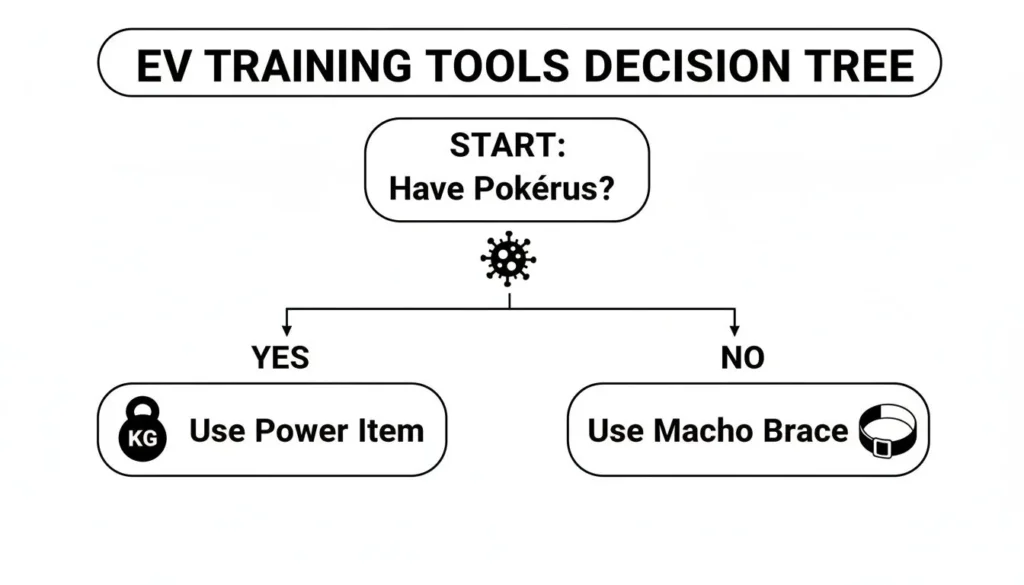
As you can see, stacking a Power Item with the Pokérus virus gives you the fastest possible returns from battling.
Mass Outbreaks and the Let’s Go Feature: This is my personal favorite. You can find a mass outbreak of a Pokémon that gives the EVs you want and send your lead Pokémon to auto-battle them. Each KO gives EVs to your whole party, and if they’re holding Power Items, you can max a stat in one go.
Sandwich Buffs: Making sandwiches with certain ingredients gives you “Encounter Power” for a specific Pokémon type. This makes that type spawn in huge numbers, creating an easy farming spot. For example, an Encounter Power: Normal sandwich in the right area will spawn tons of Chansey, which are perfect for farming HP.
These modern tools have taken almost all the grind out of EV training. It’s never been easier to build a competitive team and jump right into battling. If you love the strategy behind team-building, be sure to check out more guides in our gaming section.
Common EV Training Mistakes and How to Fix Them
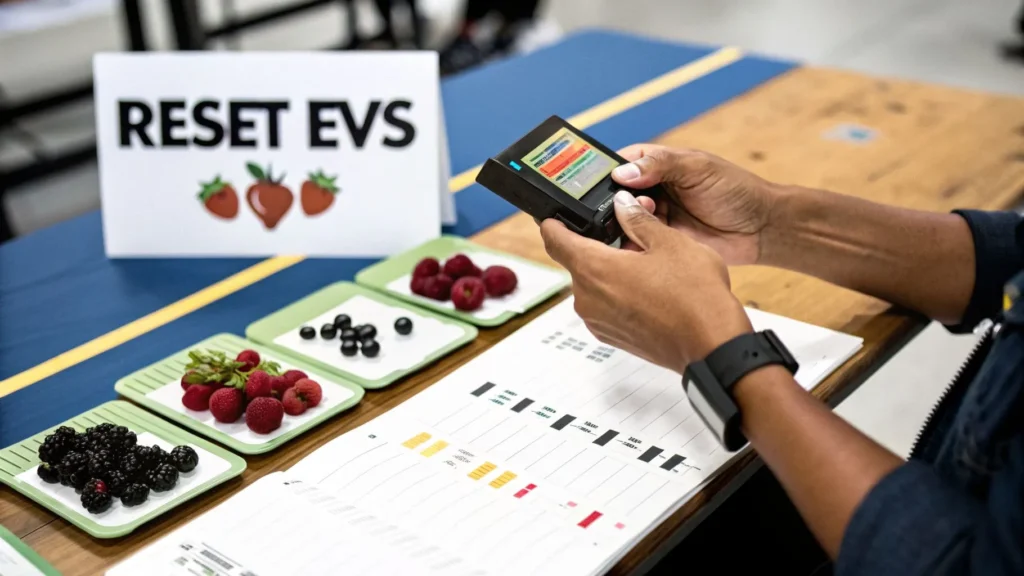
Look, even veteran trainers mess up an EV training session sometimes. It’s always a facepalm moment when you realize you’ve been battling the wrong Pokémon and loading up on unwanted EVs. But don’t sweat it—these slip-ups are completely fixable.
The most frequent mistake is getting points in the wrong stat. Maybe you were grinding Speed and accidentally KO’d a Pokémon that gives out Attack EVs. The good news? You don’t have to release your Pokémon and start from scratch. You can just erase the points you don’t want.
Erasing Unwanted EVs With Berries
Since the days of Generation III, the games have included a set of Berries with the handy effect of removing EVs. If you’ve made a mistake, feeding your Pokémon one of these will lower a specific stat’s EVs by 10 points each. As a nice little bonus, they also boost your Pokémon’s friendship.
Here’s the list of Berries you’ll want to keep in your bag for quick fixes:
- Pomeg Berry: Lowers HP EVs.
- Kelpsy Berry: Lowers Attack EVs.
- Qualot Berry: Lowers Defense EVs.
- Hondew Berry: Lowers Special Attack EVs.
- Grepa Berry: Lowers Special Defense EVs.
- Tamato Berry: Lowers Speed EVs.
In the latest games like Scarlet and Violet, it’s super straightforward. Just keep feeding the right Berry to your Pokémon. The game will eventually tell you the stat “can’t go any lower,” confirming you’ve wiped all the EVs from that stat.
Pro tip: If you’re building a Pokémon you’ve used before—especially one from a past playthrough or a trade—always reset its EVs completely. This guarantees you’re starting with a clean slate of 0 out of 510 available points.
Another classic pitfall is wasting points with an inefficient spread. Since it takes 4 EVs to get one actual stat point at the Level 50 battle standard, a final spread of 252/252/6 is a common rookie error. Those last 6 points only give you one stat point, meaning 2 EVs are completely wasted.
To avoid this, make sure your final numbers are all multiples of four. A spread of 252/252/4 is much more efficient, ensuring every single EV you earned actually contributes to a stat boost. Nailing these small details is a huge part of learning to EV train like a pro.
Frequently Asked Questions About EV Training
Even the most dedicated trainers run into questions now and then. Let’s clear up some of the most common things people ask about EV training so you can get your team into peak condition.
Can I EV Train a Pokémon at Level 100?
Yes, you can! This is a common point of confusion, especially for returning players. In the old days, a Pokémon at Level 100 was locked in, as EVs were only applied when it leveled up.
Thankfully, that changed back in Generation V. Now, stats are recalculated the moment a Pokémon earns EVs. This means you can take any Pokémon, even one that’s already hit the level cap, and give it a full EV overhaul.
How Do I Check My Pokémon’s EVs?
The newer games make this super easy. In Scarlet and Violet, for instance, just open your Pokémon’s summary screen and head to its stats.
From there, a simple press of the “L” button will show you the EV graph. The light yellow part of the chart is your current EV investment. If a stat sparkles, you know you’ve maxed it out with 252 EVs.
My advice for new trainers? Check this graph often. It’s the best way to catch mistakes early and avoid the hassle of using EV-reducing berries to fix a build.
What Is the Absolute Fastest Way to EV Train?
For pure, unadulterated speed, you need to stack every multiplier you can get your hands on. The magic formula involves three key ingredients: a Power Item, the Pokérus virus, and a battle with a high EV yield.
Here’s how it breaks down. Let’s say you defeat a Pokémon that gives 1 Speed EV. If your trainee is holding a Power Anklet (which adds +8 Speed EVs) and has Pokérus (which doubles the total), you’ll walk away with an incredible 18 EVs from a single knockout.
Do this in a mass outbreak or a similar battle, and you can max out a stat in minutes. And speaking of conquering challenges, if you’re tackling other games, our guide with Persona 5 answers can help you ace your exams in Tokyo.
At maxijournal.com, we publish daily articles on gaming, technology, and more to keep you informed and entertained. Explore our latest content at https://maxijournal.com.
Discover more from Maxi Journal
Subscribe to get the latest posts sent to your email.