Your dog comes in from the yard, flops onto the rug, and you spot it. A tick, tucked behind the ear. Or maybe your cat has been scratching for days, and now you are seeing little black specks in the fur that make you think, “Great. Fleas.”
That moment sends many pet owners into the same spiral. You want something that works fast, lasts a while, and does not turn daily life into a medication schedule. That is why flea and tick collars stay popular. You put one on, and in theory, you get months of protection without monthly reminders.
But collars are not a simple yes-or-no product. They sit right on your pet’s body. People touch them. Children hug the pet wearing them. Cats groom themselves. Dogs sleep on couches and beds. Thus, the key question is not just, “Will this kill fleas and ticks?” It is also, “What is touching my pet, my hands, and my home?”
I’m going to walk through flea and tick collars the way I would in a veterinary exam room. Plain language. No scare tactics. No sugarcoating. Just what these collars are, how they work, what ingredients matter, where safety concerns get more serious, and how to decide whether one fits your pet and your household.
The Constant Worry of Fleas and Ticks
Many owners do not start by comparing ingredient classes. They start with a problem that feels urgent.
Your dog loves hiking trails. Your cat slips onto the screened porch and watches birds for hours. You run your hand over the coat at bedtime and feel something small and wrong. Then the mental checklist starts. Is it one tick or more? Did fleas get into the house? Do I need to wash all the bedding now?
That stress is part of why flea and tick collars appeal to busy households. A collar feels easier than remembering a dose every month. It feels familiar too, almost like a regular collar with an extra job.
Why collars seem so practical
A flea product can be hard to keep straight when you are balancing work, school pickup, and the normal mess of pet care. Collars promise a more hands-off routine.
They also feel less invasive to some owners than pills or topical liquids. If your dog spits out tablets or your cat hates having anything applied between the shoulder blades, a collar sounds like the simpler path.
Still, convenience can hide complexity.
A common concern owners miss
When owners ask about collars, they usually inquire whether the product is safe for the dog or cat. That is the right starting point, but it is not the whole picture.
A flea and tick collar can affect more than the animal wearing it. If a child pets the dog and then rubs their eyes, that matters. If an adult with sensitive skin handles the collar every day, that matters too. If a pet sleeps pressed against a pillow or blanket, that matters in a practical sense for exposure.
Key takeaway: A flea and tick collar is not just a pet product. It is a household exposure product.
That does not mean every collar is a bad choice. It means the best choice depends on your pet, your home, and how closely people interact with the animal.
How Modern Flea and Tick Collars Work
Modern flea and tick collars are not just strips of plastic with a smell. The better way to think about them is a slow-release delivery device.
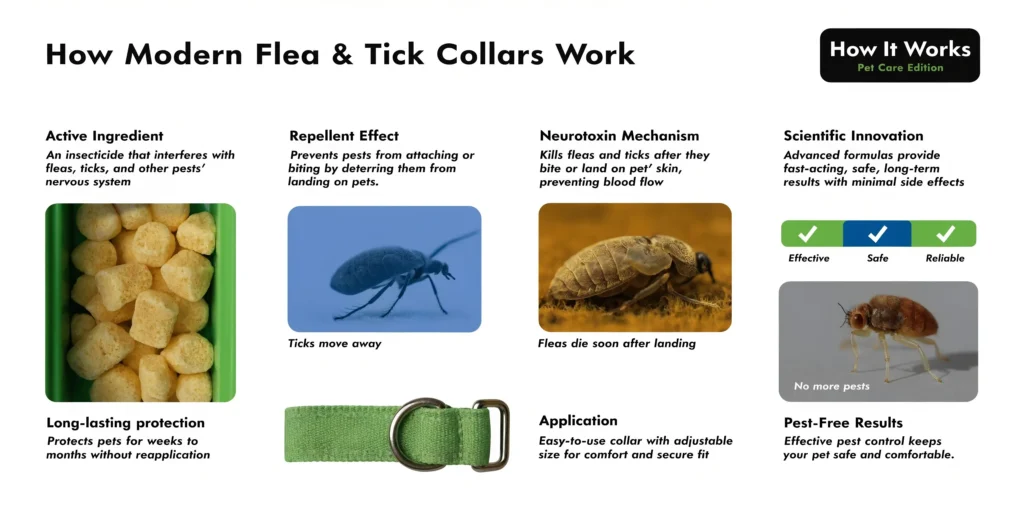
A good analogy is a wearable air freshener, except instead of scent, the collar gradually releases pest-control ingredients in tiny amounts over time. Those ingredients spread onto the skin and coat, where fleas and ticks encounter them.
The polymer matrix idea
Some collars use a polymer matrix. That means the active ingredients are built into the collar material itself, then released gradually instead of all at once.
For example, PetMD explains that flea and tick collars like Seresto use a patented polymer matrix to release low doses of imidacloprid and flumethrin over 8 months, and that these ingredients diffuse into the pet’s skin lipid layer, providing contact protection that can kill fleas within 2 hours without requiring a bite (PetMD on Seresto flea collars).
That “skin lipid layer” phrase confuses many owners. In simple terms, your pet’s skin and coat have natural oils. The ingredients move through those oils across the body surface.
Contact kill versus bite-and-kill
Not all flea products work the same way.
Some products need the pest to bite before the ingredient does its job. Others act on contact. Many collar buyers prefer contact activity because they want fewer bites, less itching, and less chance for a tick to stay attached long enough to become a bigger problem.
Here is the practical difference:
- Contact protection: The flea or tick encounters the ingredient on the coat or skin surface.
- Bite-dependent protection: The pest has to feed first.
- Repellent action: The product discourages attachment or feeding.
- Kill action: The product kills the pest after exposure.
One collar may do more than one of these things. That is why labels can sound crowded with claims.
Why collars can last so long
Long-lasting collars rely on slow, steady release. Instead of a big dose one day and very little later, the collar keeps delivering a small amount over time.
That is also why correct fit matters. A collar that is hanging too loose may not sit and function the way it should. A collar that is too tight creates a different problem, which I will get to later.
What owners often assume incorrectly
People sometimes think a flea collar works like a force field in the air around the pet. That is usually not the best mental model.
A more accurate one is this:
- The collar contains active ingredients.
- Those ingredients move from the collar onto the pet’s skin oils and hair coat.
- Pests meet the active ingredient when they crawl on the animal.
- The ingredient interferes with the pest’s nervous system or survival.
Some collars from brands like Adams and Hartz also use extended-release delivery with ingredients such as tetrachlorvinphos, designed to act continuously on the coat and skin over months rather than days. Their labels also focus heavily on fit, wear time, and practical handling because the product only works well when owners use it correctly.
Practical tip: If a collar sounds “easy,” remember that easy does not mean passive. It still needs correct species selection, proper fit, and household awareness.
A Breakdown of Common Active Ingredients
The ingredient list is where many owners’ eyes glaze over. I get it. Chemical names can make a product label feel unreadable.
But if you can learn a few categories, the label starts making much more sense. You need to know what kind of ingredient you are looking at and the basic job it performs.
Three ingredient groups you will see most often
The most common collar ingredients fall into a few broad buckets.
Neonicotinoids include imidacloprid. These target the nervous system of insects and are used for flea control in some collar products.
Pyrethroids include flumethrin. These also affect the pest’s nervous system and are often used for tick control and broader parasite protection.
Organophosphates include tetrachlorvinphos. These work differently but still target parasite nervous system function. This class tends to make owners and veterinary teams think more carefully about safety, handling, and species-specific risks.
What the label is really telling you
When you read a collar package, you are usually trying to answer four questions:
- What pest is this for?
- How long does it last?
- Is it made for dogs, cats, or both?
- What active ingredient is doing the work?
A label may also mention whether the collar repels, kills, or both. Those words matter. They are not interchangeable.
Common Active Ingredients in Flea & Tick Collars
| Ingredient Class | Example Ingredient | Primary Target | Mode of Action | Typical Efficacy |
|---|---|---|---|---|
| Neonicotinoid | Imidacloprid | Fleas | Disrupts insect nervous system signaling | Long-acting in slow-release collars |
| Pyrethroid | Flumethrin | Ticks and fleas | Disrupts parasite nervous system function | Long-acting in slow-release collars |
| Organophosphate | Tetrachlorvinphos | Fleas and ticks | Cholinesterase inhibition in parasites | Extended-release protection over months in some collars |
Why “active ingredient” matters more than branding
Brand names are useful, but they can distract people from what matters most. Two boxes can look very different on a shelf yet rely on similar chemical logic.
That is why I tell owners to read the active ingredients first, then ask:
- Has my pet reacted badly to something like this before?
- Is this collar specifically made for my species?
- Does anyone in my home have skin sensitivity, asthma-like symptoms, or close daily contact with the pet?
Those questions matter because the same ingredient that controls fleas can create problems if the wrong animal wears it, if the product is used carelessly, or if a household member is sensitive.
One easy example
Think of active ingredients like the engine inside a car. The paint color, marketing, and shape are the outside. The ingredient powers the product.
If you shop by brand familiarity alone, you may miss the part that most affects safety and effectiveness.
Evaluating Efficacy Versus Significant Safety Risks
Your dog comes in from the yard, shakes once, then curls up against your child on the couch. If that dog is wearing a flea and tick collar, the safety question is not only about what happens to fleas and ticks. It is also about what stays on the fur, what gets on hands, and who in the home touches that collar every day.
Some collars protect for months. That long wear time is the selling point. It can also be the reason households miss an important detail: a product can control parasites and still raise real safety concerns for pets and people.

The Seresto controversy
One product has received unusually heavy scrutiny: Seresto.
Investigate Midwest reported that since its introduction in 2012, the Seresto collar generated over 100,000 incident reports, including at least 1,698 documented pet deaths linked to the product as of mid-2020, and nearly 1,000 cases involving human harm (Investigate Midwest on Seresto incident reports).
Incident reports do not prove that a collar caused every event. That part can be confusing, so here is the simple version. A report is more like a smoke alarm than a final fire investigation. One alarm does not prove the cause. A very large number of alarms still deserves close attention.
What a federal watchdog said in 2024
Concern about Seresto did not stop with news reporting.
A 2024 Office of Inspector General report criticized the EPA’s process for assessing Seresto, saying the agency relied on outdated methods and weak incident data systems. The report also said the EPA had received more than 100,000 incident reports related to Seresto collars and recommended stronger review steps (EPA OIG report on Seresto oversight).
For a pet owner, the takeaway is practical. A federal watchdog questioned whether the safety review system was good enough. That matters because these products are used in normal family routines, not in sealed lab spaces.
Why human exposure deserves more attention
This is the part many articles skip.
A flea and tick collar sits on the part of the pet people touch most. Children hug the neck. Adults clip on a leash. Cats rub that area on blankets and pillows. If someone in the home has sensitive skin, asthma, eczema, or a tendency to react to fragrances and chemicals, that daily contact deserves the same attention as the pet’s parasite protection.
The EPA has acknowledged that people can be exposed to pesticide residues from pet collars through skin contact and hand-to-mouth transfer during ordinary handling of treated animals and their bedding (EPA pet collar exposure assessment materials). That does not mean every collar is unsafe for every household. It means the risk conversation should include the people on the couch, in the bed, and on the floor with the pet.
A good way to frame it is this: a collar works like a slow-release patch your pet wears all day. If your pet is the center of household contact, that exposure does not stay limited to the pet.
Questions that make the risk clearer
A safer decision usually starts with a few household questions:
- Who touches this pet most often?
- Does the pet sleep in beds or on upholstered furniture?
- Does anyone in the house have skin sensitivity, asthma, or frequent headaches from chemical odors?
- Will a child regularly cuddle or handle the collar area?
- Can everyone in the home reliably wash hands after touching the collar?
Those questions often change the answer. A collar may make sense for one dog and one household, but not for another.
If your dog develops facial swelling, hives, or sudden itchiness and you are trying to sort out what may be a mild allergic response versus a problem that needs faster care, this guide on can you give a dog Benadryl can help you think through the next step.
Balancing benefit with caution
Some pets do well with collars. Some owners need a long-acting option because monthly products get missed. Consistency matters in parasite prevention, especially in areas with heavy tick pressure.
Still, convenience should not outrank safety screening.
Key takeaway: A flea and tick collar can be effective and still require serious caution, especially in homes with children or people who are chemically sensitive.
The best choice depends on three things working together: the parasite risk in your area, the product’s safety profile, and the day-to-day habits of the people living with the pet.
Choosing and Correctly Fitting the Right Collar
If you decide a collar still makes sense for your pet, the next step is choosing and fitting it well. Many collar problems start with the wrong product or a bad fit, not just the ingredient itself.
The first rule is straightforward. Dog and cat collars are not interchangeable. If the box says dogs only, do not use it on a cat. If it is made for a certain age or size range, stay within that label.
Start with the pet in front of you
I tell owners to think in layers.
Species comes first. Then age. Then size. Then lifestyle. A couch-loving indoor cat has a different risk profile than a trail-running dog. A growing puppy needs fit checks more often than a fully mature adult dog.
Also think about household behavior. If your pet wrestles with another pet and chews at collars, that changes the safety conversation.
The two-finger rule
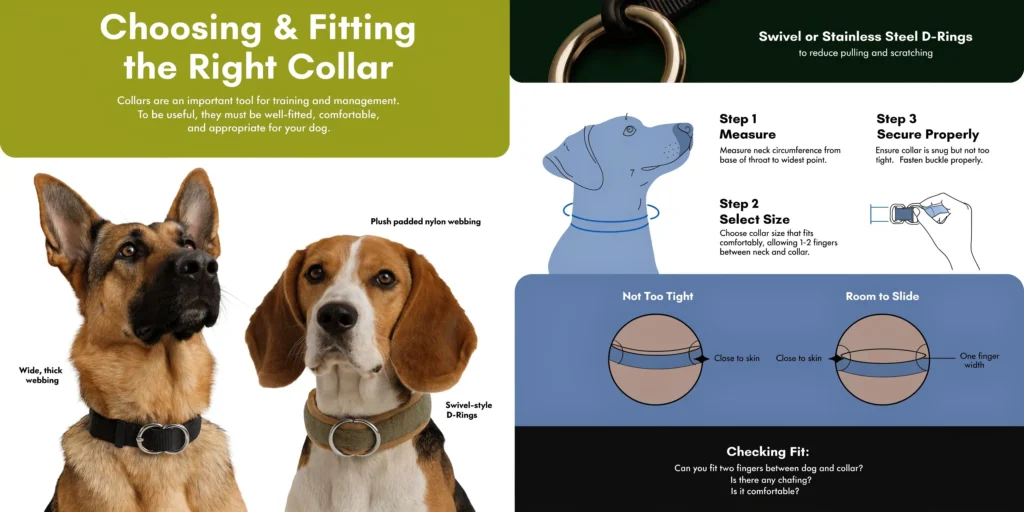
For collars from brands like Adams and Hartz, proper fitting means leaving a two-finger gap between the collar and the neck for comfort and safety, and trimming excess length beyond 1 to 2 inches to reduce chewing risk. Some collars also offer adjustable fits for necks up to 26 inches (Adams flea and tick collar fitting guidance).
That two-finger rule is one of the easiest pieces of advice to remember. Too loose, and the collar may shift or snag. Too tight, and you can get rubbing, pressure, and skin irritation.
A simple fitting routine
- Read the label first. Check species, age, and wear instructions.
- Place the collar high enough on the neck that it sits securely but does not press in.
- Slide two fingers underneath to confirm a comfortable fit.
- Trim extra length if the directions allow it and enough excess remains to invite chewing.
- Watch the first day closely. Look for scratching, redness, or distress.
Ongoing checks matter
A collar is not “set it and forget it.”
Look at the neck regularly, especially in long-haired pets where early irritation can hide under the coat. Growing pets need repeat fit checks. Multi-pet households need extra observation if one animal tends to mouth or groom the other near the neck.
Behavior also tells you a lot. If your dog suddenly freezes when you reach for the neck, that can be a clue. This guide to understanding dog body language can help owners spot stress signals that show up before a skin problem becomes obvious.
Practical tip: A well-fitted collar should be present, not bothersome. If your pet cannot stop focusing on it, something may be wrong.
Recognizing and Responding to Adverse Reactions
You take the dog’s collar off for a quick neck scratch and notice pink skin, a greasy film, or a patch where the fur looks thin. That is often the first clue that the collar is causing trouble.
Reactions can start small and stay local, like a shoe that rubs one spot on your heel. They can also spread beyond the neck if a pet is sensitive to the ingredients or if too much residue transfers to the skin and coat. The sooner you notice a change, the easier it is to respond before irritation turns into a bigger problem.
Signs in pets
Start with the area under the collar. Redness, rubbing, bumps, hair loss, scabs, or an oily residue are all warning signs. Some pets also act uncomfortable before the skin looks dramatic. They may scratch more, turn suddenly toward the neck, resist being touched there, or seem restless.
Whole-body signs need faster attention. Vomiting, diarrhea, drooling, unusual tiredness, tremors, wobbliness, or agitation can signal more than simple skin irritation. Those symptoms call for prompt veterinary advice.
Neck discomfort can also look confusing at home. A dog that keeps pawing, scratching, or twisting its head may seem to have an ear problem when the collar is part of the issue. This guide on why a dog keeps shaking its head can help you sort through the possibilities while you contact your veterinarian.
Signs in people
The pet is not the only one wearing the product, in a practical sense. Anyone who pets the neck, hugs the dog, adjusts the collar, or handles it after removal can come into contact with the active ingredients.
That matters most in homes with children, pregnant family members, people with asthma, and anyone with sensitive skin. Human reactions may show up as a rash, itching, eye irritation, headache, nausea, coughing, or wheezing after contact with the collar or the fur around it. If symptoms start after handling the pet, treat that timing as meaningful, not as a coincidence to ignore.
Recent government reporting has drawn more attention to this household exposure issue, especially with certain collar products discussed earlier in the article. The practical takeaway is simple. A flea and tick collar does not stay neatly contained to the pet. It can transfer residue to hands, furniture, and anyone who cuddles or handles that animal often.
What to do right away
If you suspect a reaction, act in a calm, ordered way.
- Remove the collar promptly. Place it where children and other pets cannot reach it.
- Wash your hands after handling it. If residue is on the pet’s neck or coat, wash that area with mild soap and water, unless your veterinarian gives different instructions.
- Call your veterinarian. Have the product name, active ingredients if available, and the timing of the symptoms ready.
- Watch every exposed person in the home. If someone develops skin, breathing, or stomach symptoms after contact, contact a medical professional or poison guidance service.
- Keep the packaging. It helps your veterinarian or physician identify what was in the product.
Some reactions are urgent. Breathing trouble, collapse, marked weakness, repeated vomiting, tremors, or seizures need immediate veterinary care. If a person has wheezing, facial swelling, trouble breathing, or severe dizziness after exposure, seek emergency medical care right away.
Exploring Alternatives and Integrated Pest Management
A collar is only one tool. Sometimes it is the right tool. Sometimes another option fits the pet or the household better.
That matters because flea and tick control works best when you stop thinking in single products and start thinking in layers.
How the main options differ
Topical treatments go on the skin, usually between the shoulder blades. Owners often like them because there is no collar to wear, but application day can be messy, and some pets hate the feeling.
Oral medications are appealing for owners who want no residue on the coat. The tradeoff is that the pet has to swallow the medication reliably, and not every pet does well with tablets or chews.
Shampoos and sprays can help in specific situations, especially when you need direct action on the coat. But they usually require more hands-on effort and closer repeat use.
Collars offer long wear and low day-to-day effort. Their downside is constant physical contact with the pet and possible contact with people.
Why the environment matters too
If you only treat the pet and ignore the home or yard, you can end up fighting the same infestation again and again.
Integrated pest management means reducing the flea and tick burden from multiple angles:
- On the pet: Use the prevention format your veterinarian thinks best fits the animal and your household.
- In the home: Wash bedding, vacuum regularly, and pay attention to resting spots.
- Outdoors: Manage tall grass, brush, and areas where ticks are likely to wait for passing animals.
A practical way to think about alternatives
If your main concern is human contact with a collar, another format may be worth discussing with your veterinarian.
If your main concern is remembering doses, a longer-acting product may still be the better fit, but the decision should include more than convenience alone.
Frequently Asked Questions About Flea and Tick Collars
Can my cat wear a dog flea collar
No. Do not swap species.
Cats and dogs do not handle every active ingredient the same way. If a label says dogs only, take that seriously.
Can I use a collar with another flea product
Only with veterinary guidance.
Some combinations are appropriate. Others raise the risk of overexposure or confusion if a reaction happens. If you are considering layering products, ask your veterinarian to help you choose a plan rather than doing so on your own.
Are flea and tick collars safe around kids
That depends on the product and the household routine.
If children frequently touch the collar area, cuddle the pet closely, or put their hands in their mouths after petting, the human exposure side deserves extra weight in your decision.
How should I dispose of an old collar
Follow the product label and keep the old collar away from pets and children.
Do not leave it on a counter, toss it loosely in a bag within reach, or let an
Discover more from Maxi Journal
Subscribe to get the latest posts sent to your email.