You meet a dog at the park that looks part Labrador, part mystery. He has the open face and happy tail you expect from a Lab, but his ears sit a little differently, or his coat is fluffier, or his focus is sharper than the average fetch fanatic. He leans into your hand, then sprints after a ball like he has been training for it all week.
That moment hooks a lot of people.
A lab retriever mix often seems like the best of both worlds. You get the Labrador’s warmth and willingness, plus whatever extra qualities came from the other parent. The catch is that “Lab mix” is not one dog. It is a wide range of possible bodies, brains, coat types, and care needs.
This can lead to confusion. People prepare for a generic friendly family dog, then bring home a dog who also needs herding-style jobs, scent games, heavier grooming, or extra joint care.
I want to help you avoid that mismatch. As a trainer and veterinarian, I look at a Lab mix the same way I look at any individual dog. I ask: what traits came from the Labrador side, what traits likely came from the other side, and what does this specific dog need to thrive?
Is a Lab Retriever Mix the Right Dog for You
You are probably here because a Lab mix already has your attention.
Maybe you saw one at a shelter kennel pressing against the door with that soft-eyed “pick me” expression. Maybe your neighbor has one who greets every person like an old friend. Maybe your kids want a dog and you keep hearing that Lab mixes are good family pets.
All of that can be true. But life with a lab retriever mix depends on which mix you bring home.
A Lab crossed with another retriever may feel socially easy and eager to join every family activity. A Lab crossed with a herding breed may still be loving, but more intense, more alert, and more demanding about exercise and training. A Lab crossed with a hound may be delightful and funny, yet more nose-led and less interested in instant obedience.
That is why the first question is not “Are Lab mixes good dogs?” It is “Does this dog fit my real life?”
Ask yourself a few practical things:
- Your schedule: Can someone meet the dog’s daily exercise and training needs?
- Your home: Do you have room for an active medium-to-large dog to move comfortably?
- Your patience: Can you handle shedding, muddy paws, adolescence, and slow progress?
- Your family style: Do you want a constant sidekick or a dog with a more independent streak?
Behavior matters as much as appearance. If you are still learning to read canine signals, this guide to understanding dog body language will help you judge whether a dog is relaxed, worried, overexcited, or tired.
A good match is not the cutest dog. It is the dog whose needs you can meet for years.
If that sounds serious, it is. But it is also encouraging. Once you stop treating “Lab mix” like a fixed category, it becomes much easier to choose well.
Decoding the Lab Retriever Mix Identity
You meet two dogs at a rescue, both labeled “Lab mix.” One barrels over with a tennis ball and a full-body wag. The other hangs back, scans the room, and studies every sound before coming closer. Both labels are accurate. Neither dog will live the same way.
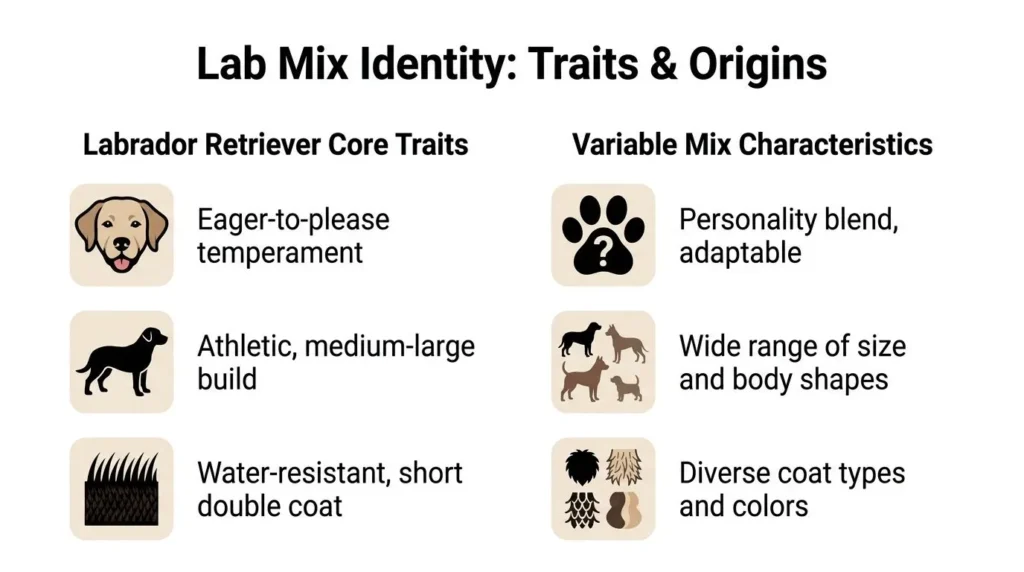
That is the first thing to understand about a lab retriever mix. “Lab mix” is a starting point, not a finished description. The Labrador side gives you a useful base, but the second breed can change size, coat, movement, health tendencies, and day-to-day behavior in ways that matter in real life.
Start with the Labrador side
Labradors were developed as active working dogs. That background often shows up in a mix as an athletic frame, a strong interest in people, enthusiasm for food or toys, and a body built for movement rather than ornament.
When I assess a mixed-breed puppy or rescue, I first look for signs of classic Lab influence:
- Build: medium-to-large, athletic, solid without looking heavy
- Expression: soft face, often with a broader muzzle and open expression
- Coat feel: dense and practical rather than fine, silky, or wispy
- Movement: efficient stride, often with a ready-for-action look
- Behavior clues: interest in carrying objects, social curiosity, strong food motivation
Those clues help, but they do not finish the story.
Then study what the second breed may be adding
Mixed breeding works a lot like combining two sets of instructions. Some dogs follow the Labrador pattern closely. Others pick up very visible traits from the other parent. Littermates can even look and behave like they came from different recipes.
This is why labels alone can mislead people. A “Lab mix” can be broad-headed and easygoing, lean and intense, short-coated and low-maintenance, or fluffy and grooming-heavy.
A few examples make that easier to picture.
Lab and German Shepherd
This mix often looks more angular than a classic Lab. You may see a longer muzzle, darker coloring, larger upright or partly upright ears, and a more watchful expression.
The daily reality can shift too. Many of these dogs seem more environmentally aware. They notice movement, sounds, visitors, and routine changes faster than a typical easygoing retriever type. That does not mean difficult. It means you may be living with a dog who pays close attention to the world and needs direction about what matters.
Lab and Golden Retriever
This mix often keeps a recognizably retriever look, but even here there is a range. Some have fuller coats, feathering on the tail or legs, and a softer outline than a short-coated Lab.
People often assume this cross is completely predictable because both parents are retrievers. In practice, one dog may be socially effortless and bouncy, while another is gentler, more sensitive, and slower to settle in a busy home. Similar family tree. Different dog.
Lab and Poodle
This mix is one of the hardest to judge by label alone. Coat texture can range from nearly Lab-like shedding fur to loose waves to tighter curls. Ear set, muzzle shape, and grooming needs can vary just as much.
That matters because coat type is not a cosmetic detail. It affects brushing, mat prevention, professional grooming costs, and how much time you will spend on maintenance each week.
Common Lab Retriever Mixes at a Glance
| Mix Type | Typical Size | Energy Level | Grooming Needs |
|---|---|---|---|
| Lab and Golden Retriever | Medium to large | High | Moderate to high |
| Lab and German Shepherd | Medium to large | High | Moderate to high |
| Lab and Poodle | Medium to large | Moderate to high | Moderate to high |
| Lab and Border Collie | Medium to large | Very high | Moderate |
| Lab and Beagle | Medium | Moderate to high | Moderate |
Use a table like this as a rough map, not a guarantee. Real dogs do not read breed charts.
What you can predict, and what stays uncertain
You can often make educated guesses from structure, coat, and early behavior. A heavier double coat suggests more shedding. A lighter, springier body may point to a faster, more agile dog. A puppy who checks in with people often may be easier to train than one who is already strongly nose-led or environmentally absorbed.
You cannot promise adult temperament, final size, or exact exercise needs from a photo alone. That is why experienced adopters watch the whole dog. How does the dog move? How quickly does the dog recover from excitement? Does the dog seek people, chase motion, use its nose constantly, or fixate on toys? Those details tell you more than a breed label printed on a kennel card.
The goal is not to identify every ancestor with perfect accuracy. The goal is to predict the life this dog is likely to need. A Lab mix is best understood in layers. Labrador foundation first. Second-breed influence next. Individual personality on top of both, and that final layer is the one you live with every day.
The Friendly and Trainable Lab Mix Temperament
You bring home a Lab mix because he trots over with a loose body, soft eyes, and a toy in his mouth. Two weeks later, you realize that “friendly” can show up in very different forms. One dog leans against your leg and settles. Another greets every visitor like a launched missile. Both can be warm, social dogs. They just need different handling.
That is the part breed labels often miss. A Lab mix usually starts with a people-oriented foundation, but the mix creates a range. Your dog may be easygoing, busy, clingy, highly observant, nose-driven, or all of the above. The goal is not to ask, “Are Lab mixes nice?” The better question is, “What kind of friendly is this dog, and what does that mean at home?”

Why many Lab mixes learn readily
Labradors have a long history in jobs that require cooperation with people, steady nerves, and repeated training. As noted earlier, that reputation is one reason Labs are so common in guide and assistance work. In everyday pet life, the same general traits often give Lab mixes a helpful starting point.
Trainers usually appreciate several patterns that show up often in Lab-based dogs:
- They notice people
- They tend to enjoy rewards, especially food and toys
- They often try again after a mistake
- They can handle repetition better than many dogs
- They usually like doing something with you, not just near you
Those traits matter because training is not about intelligence alone. It is about partnership. A very smart dog who does not care what you are doing can be much harder to teach than a moderately quick dog who keeps checking back in.
That said, trainable does not mean automatic. A sweet Lab mix still needs clear routines, practice, and rest. If you want a practical starting point for reward-based skills, this guide to training your dog step by step fits the way many Lab mixes learn best.
The second breed changes the style of the dog
Here is where future owners often get surprised. The non-Lab side may not change whether your dog can learn. It often changes how your dog takes in the world, what grabs attention, and which habits appear first.
A Lab mix works like a recipe with one familiar base and one ingredient that can shift the whole result. Add herding traits and you may get a dog who watches every moving part of the household. Add hound traits and scent can outrank your voice for a moment. Add another retriever and you may get extra softness, sociability, and a stronger need to stay close to people.
If the mix includes a herding breed
A Lab mixed with Border Collie or Australian Shepherd often learns cues fast and notices tiny changes in movement. These dogs may shine in obedience, trick training, agility, and any game that gives them a pattern to solve.
The challenge at home is often arousal, not attitude. A dog like this may circle children, stare at bikes, patrol windows, or struggle to switch off in a noisy house. That behavior can look dramatic, but it usually reflects a dog whose brain is scanning for work.
If the mix includes another retriever
Lab and Golden mixes are often affectionate, social, and eager to stay connected with their people. Families love this combination for good reason. It often feels gentle and cooperative.
The watch-out is overattachment or overexcitement. Some of these dogs greet with their whole body, shadow their owner from room to room, or have trouble settling after visitors arrive. Early practice with calm greetings, alone-time skills, and place training helps a lot.
If the mix includes a scent hound
A Lab mixed with Beagle or another hound may be funny, loving, and very engaged with the environment. These dogs often use their nose the way a retriever uses its eyes and mouth. Once a scent trail turns on, your request may drop in priority.
That is not a character flaw. It is a competing instinct. Owners who understand this usually do better because they stop reading the dog as defiant and start building training around sniff breaks, long lines, and stronger reinforcement.
Friendly dogs still need manners
One of the most common mistakes with Lab mixes is assuming a pleasant temperament will somehow mature into good behavior. In practice, friendly young dogs rehearse whatever works. Jumping can work. Mouthing can work. Pulling can work. Counter-surfing can work very well.
So watch the early patterns, because they tell you what kind of support this specific dog will need:
- Greeting style. Does the dog approach with four feet on the floor, or hit people chest-first?
- Frustration tolerance. Can the dog wait a few seconds, or does small delay trigger spinning, barking, or grabbing?
- Recovery. After a surprise, does the dog settle quickly or stay keyed up?
- Social style. Does the dog enjoy people calmly, seek constant contact, or get over-aroused around guests?
- Natural outlets. Does the dog love carrying, fetching, sniffing, chasing movement, or solving food puzzles?
These details matter more than a vague label like “good family dog.” Two friendly Lab mixes may live very different daily lives. One needs help learning to settle. Another needs confidence in busy places. Another needs structured games that use the nose before the brain is available for obedience.
Common misunderstandings
A wagging tail is only one body part. It does not guarantee a relaxed emotional state. A social dog can still be overstimulated, and a clever dog can become chaotic if every day feels like recess with no lesson plan.
Lab mixes often do best with the same basic ingredients. Predictable routines. Reward-based teaching. Purposeful outlets for retrieving, carrying, sniffing, or problem-solving. Enough downtime to let the nervous system settle.
That balance is what brings out the best in them. Warmth helps these dogs thrive. Clear expectations help them stay livable.
Fulfilling Your Lab Mixes Exercise and Training Needs

You come home after work, and your Lab mix greets you like a spring that has been compressed all day. There is a shoe in the hallway, a toy under the table, and a dog who looks ready for hour two of the party. That moment often gets labeled as “too much energy,” but the underlying issue is usually mismatch. The dog in front of you needs the right kind of outlet, in the right dose, for that dog’s mix of traits.
A Lab mix is rarely a one-setting dog. One may have the steady retrieve-and-rest rhythm of a classic Labrador. Another may carry the engine of a herding breed, the nose of a hound, or the persistence of a terrier. Exercise and training work best when you stop asking, “How much does a Lab mix need?” and start asking, “What does this individual dog need help doing well?”
Exercise has three jobs
Many owners picture exercise as a fuel tank. Empty the tank, get a calm dog. Real life is less simple. For most Lab mixes, daily activity works more like a three-part routine that supports the body, the brain, and the ability to settle afterward.
Physical work
Physical activity matters, but the best options usually have a purpose. Fetch, hiking, tug, swimming, uphill walks, and scent trails all count. A dog who loves carrying things may feel better after a structured retrieve session than after wandering for the same amount of time.
The mix matters here. A young Lab mixed with a herding breed may need more skill and direction built into exercise. A Lab mixed with a scent hound may get more satisfaction from a long sniff walk and search games than from repeated ball throws. A stockier, lower-drive mix may do well with moderate walks and short play sessions.
Mental work
Training is work. So is problem-solving.
Short sessions often outperform long ones because they keep the dog successful and clear-headed. Practice recalls in the yard. Teach a mat settle. Ask for a sit before the toy is thrown. Hide treats around a room and let the dog search. Five good minutes can take the edge off better than a walk where the dog pulls for thirty.
If you are building skills from the beginning, this guide on how to train your dog gives a helpful starting framework.
Recovery and life skills
This is the part owners skip, and it is often the part that makes the home feel peaceful.
Some Lab mixes get very good at action and very poor at stopping. They can chase, tug, fetch, and race around the yard, then pace the house because nobody taught them how to come down. Rest is a trained skill for many active dogs. Waiting at doors, lying on a mat, chewing calmly after play, and settling while people cook dinner all belong in the exercise plan.
Signs your dog needs a different outlet, not just more activity
A bored dog and an overstimulated dog can look surprisingly similar. Both may bounce off the furniture, grab sleeves, steal socks, or pester you all evening.
Watch for patterns like these:
- Destructive chewing that shows up after quiet days
- Indoor zoomies with jumping or nipping after over-arousing play
- Demand barking or pawing when the dog has learned that chaos starts the fun
- Restless pacing after plenty of movement but little mental work
- Obsessive fetch behavior with trouble disengaging or relaxing later
Those behaviors are clues. They tell you whether your dog needs more structure, more problem-solving, more sleep, or a calmer style of exercise.
A daily rhythm that works in real homes
Many Lab mixes do better with several smaller jobs across the day than with one giant burst of activity.
Morning might be a brisk walk, a few recall reps, and breakfast from a puzzle feeder. Midday could be a sniff session in the yard, a stuffed food toy, or a short training break. Evening often works well with a retrieve game, leash practice, and then a predictable settle period on a bed or mat.
That rhythm helps because it mirrors how dogs regulate themselves. Activity rises. Then it should fall. If every exciting moment is stacked on top of the next, many dogs stay revved up long after the fun is over.
A short demonstration can also help you see timing and reward use in action:
Match the game to the dog
Lab mixes often tell you what they need by what they naturally choose.
- Retriever-leaning dogs often enjoy fetch with rules, carrying objects, delivery games, and water retrieves when safe
- Herding-leaning mixes often thrive with shaping games, directional cues, obstacle foundations, and impulse control around movement
- Scent-driven mixes often prefer treat searches, nose work, hide-and-seek, and long decompression walks with time to sniff
- Very social dogs often need practice staying calm around people more than they need free-for-all greetings
- Sensitive or easily over-aroused dogs often benefit from slower games, predictable routines, and shorter sessions with clear breaks. Here, the “mix” matters most. Two dogs can share Labrador ancestry and still need completely different plans to feel balanced.
One mistake creates a lot of frustrated dogs
Do not build an athlete without building an off switch.
If every outing is high speed, every toy game ends in frenzy, and every bored moment gets solved with bigger excitement, your dog may become fitter without becoming easier to live with. Pair active play with pauses. Reward calm behavior on purpose. End games while your dog can still think. Teach that exciting things start with self-control and end with recovery.
A well-supported Lab mix is not tired. A well-supported Lab mix has outlets that fit its inherited tendencies, training that creates clarity, and enough calm built into the day that the dog can live comfortably in your home.
A Practical Guide to Lab Mix Health and Grooming
You bring home a Lab mix expecting a familiar Labrador package. A few months later, you may be living with a dog who sheds like a snowstorm, grows a curlier coat than expected, or needs much closer watch on joints, ears, or weight than a standard breed label suggested.
That is the part future owners need to understand early. “Lab mix” describes a range, not a fixed template. The Labrador side gives you clues. The other breed changes the details, sometimes a little and sometimes a lot.

Mixed breeding changes risk. It does not erase it
People often hear “hybrid vigor” and assume a mixed dog will sidestep the health problems seen in purebreds. Sometimes mixed ancestry can lower the chance of repeatedly inheriting the same weak points from a narrow breeding pool. It can also combine risks from both sides.
A Lab mixed with Golden Retriever may still be a dog you watch closely for joint stress. A Lab mixed with a breed known for skin trouble, chronic ear irritation, or heavy body condition may carry those tendencies too. The practical lesson is simple. Look at the Labrador side, then look just as hard at the second breed.
Health prediction in mixes works more like a weather forecast than a guarantee. You are not trying to guess one perfect outcome. You are preparing for the likely range.
What deserves your attention over time
You do not need to watch your dog nervously. You do need a habit of noticing small changes before they become large ones.
Joints and mobility
Joint problems rarely begin with a dramatic limp. They often start as small hesitations. Your dog pauses before jumping into the car. A puppy bunny-hops during fast play. An adult rises stiffly after rest or looks slower the morning after a long outing.
Early evaluation matters because weight control, exercise adjustment, home footing, and veterinary care can make a real difference while changes are still mild.
Weight gain
Many Lab mixes are talented eaters. Owners laugh about it at first. Then the waistline disappears, the dog tires sooner, and extra weight starts pressing on already vulnerable joints.
Use meals for training when you can. Keep treats small. Ask your veterinary clinic for your dog’s target weight and body condition score, then recheck it regularly. If you are budgeting for long-term care, it also helps to understand what dog training can cost over time, since feeding habits, manners, and activity routines often work together.
Ears, skin, and coat
Coat and ear care vary widely across Lab mixes. A drop-eared swimmer may need close attention to moisture. A dog with thicker undercoat may trap dirt and dead hair near the skin. A curlier Lab mix may need routine combing all the way to the skin, not just a quick pass over the top.
Odor, licking, redness, flakes, and repeated ear rubbing are early signs worth checking, especially if the second breed is known for allergies or skin sensitivity.
Grooming follows coat type, not the label
This is one of the clearest places where the “mix” changes daily life.
Short double coat
A Lab crossed with another short-coated breed may look low maintenance. In practice, these dogs often need regular brushing, nail care, and seasonal cleanup around the house. Short hair can shed heavily and work its way into fabric more stubbornly than longer hair.
Dense shedding coat
Lab mixes with German Shepherd, Husky, or similar coat influence usually need more brushing during seasonal coat drop. If undercoat is left to pack in, the skin gets less airflow, cleanup gets harder, and some dogs become itchy or uncomfortable.
Wavy or curly coat
Lab mixes with Poodle or other curl-coated influence often need the most owner education. These coats may shed less into the house, but they usually need more hands-on upkeep. Regular combing, clipping, and attention to friction areas such as behind the ears, under the collar, and between the toes become part of normal care.
That difference surprises families all the time. Less visible shedding does not mean less grooming.
A routine that helps you catch problems early
A simple schedule works better than occasional marathon grooming sessions.
- Daily: run your hands over ears, paws, coat, and legs. Feel for debris, moisture, tenderness, or stiffness
- Several times a week: brush based on coat type and how quickly your dog mats or sheds
- Regularly: trim nails, brush teeth, and bathe as needed for coat and lifestyle
- After swimming, rain, or muddy play: dry the ears, feet, and coat well
Grooming works like a home health check. You notice a new lump, sore spot, cracked nail, ear odor, or mobility change because your hands are on the dog often enough to catch it early.
Questions to ask before trouble starts
If you are evaluating a puppy, adolescent, or rescue dog, ask questions that help you predict the range of needs instead of chasing a neat breed label.
- What is known about the parents’ joint health or mobility history?
- What coat type is this dog likely to have as an adult?
- Does this dog seem prone to ear debris, skin irritation, or paw licking?
- How does the dog look later the same day, or the next morning, after harder exercise?
- Does this body shape stay lean easily, or does weight creep up fast?
Those answers give you something more useful than a generic “Lab mix” description. They help you prepare for the dog in front of you.
Finding Your Companion Adoption Breeder and Costs
For a lab retriever mix, the best path is the one that gives you the clearest picture of health, temperament, and support. Emotion can derail judgment here. You fall in love with a face, then skip the questions that protect both you and the dog.
Adoption can be an excellent fit
Shelters and rescues often have wonderful Lab mixes, adolescents and young adults whose personalities are easier to evaluate than those of tiny puppies.
When you visit, watch the dog in more than one setting. A kennel can make a calm dog look frantic or a timid dog look shut down. Ask to see the dog outside, on leash, and if possible, after a few minutes of decompression.
Good questions for a rescue include:
- What has the dog lived with before?
- How does the dog handle being left alone?
- What happens around food, toys, or doors?
- What kind of exercise seems to help this dog settle?
- Has the dog had veterinary evaluation since entering care?
Breeders require careful screening
Some mixed litters are produced thoughtfully. Many are not.
The common blind spot is the belief that a mixed litter does not need the same health diligence as a purebred litter. That is a mistake. The Labrador Site notes that popular mixes such as Goldadors can inherit a high risk for hip dysplasia and certain cancers from both parent breeds, so buyers should ask about genetic screening for the parent dogs in mixed litters as explained in this Lab mix health discussion.
Ask a breeder direct questions:
- What health screening was done on both parents?
- Can I meet the mother and observe her behavior?
- What do you expect this mix to be like as an adult?
- What support do you offer if the match goes badly?
- Will you take the dog back if needed?
If a seller avoids questions, rushes payment, or talks only about color and cuteness, walk away.
About costs
The cost of ownership matters, but precise totals vary widely by region, clinic, coat type, and the individual dog’s health. Because of that, the safest way to budget is to think in categories rather than chase a single number.
Expect expenses in these areas:
| Cost Area | What it usually includes |
|---|---|
| Upfront acquisition | Adoption fee or purchase price |
| First veterinary period | Exams, vaccines, parasite control, possible spay or neuter depending on situation |
| Equipment | Crate, leash, collar, harness, bowls, bed, chew items |
| Monthly basics | Food, preventives, treats, replacement toys |
| Ongoing care | Grooming, training classes, routine veterinary visits |
| Backup planning | Pet sitting, boarding, emergency fund, unexpected treatment |
If you are comparing training help, this breakdown of dog training cost can help you think through one piece of the budget.
The choice that matters most
A well-matched adopted dog often works out better than a poorly bred puppy. A carefully screened breeder can be a better option than a rescue that cannot tell you much about the dog.
The best decision is the one made slowly, with your eyes open.
Frequently Asked Questions About Lab Mixes
Are Lab mixes hypoallergenic
No Lab mix should be assumed to be hypoallergenic.
People often hope a Labradoodle-type dog will be safe for allergies, but coat type in mixes is not guaranteed. Some shed less. Some shed a lot. Allergy response also depends on the individual person and the individual dog. If allergies are a serious concern, spend real time with the dog before committing.
How can I guess the adult size of my Lab mix puppy
Use clues, not certainty.
Look at the puppy’s bone structure, paw size, current growth pattern, and the size of any known parents. Your veterinarian can help you make a practical estimate, but mixed-breed puppies can surprise people. I tell owners to prepare for the upper end of what seems plausible, if the other parent was medium-to-large.
Do Lab mixes bark a lot
Some do, some do not.
A Lab crossed with a quieter retriever type may bark mainly for alerting or excitement. A Lab mixed with a hound, herding breed, or more vigilant type may vocalize more. Barking reflects genetics plus environment. Dogs bark more when they are under-stimulated, over-aroused, or accidentally rewarded for noise.
How do I find out what breeds are in my rescue dog
A canine DNA test can give you a useful estimate. It is not magic, but it can help explain coat, size tendencies, and behavior patterns.
Use the results as a clue, not a verdict. The dog in front of you still matters more than the printed breed breakdown.
Are Lab mixes good for first-time owners
Yes. But only if the owner is ready for activity, shedding, and daily training.
A first-time owner can do well with a lab retriever mix that has a stable temperament and reasonable energy. A mismatch happens when someone wants an easygoing dog and brings home a mix with strong working-drive traits they did not recognize.
What is the best age to adopt one
There is no single best age.
Puppies give you more influence over early routines, but they require a lot of supervision. Adult dogs can be easier because their size, coat, and basic personality are more visible. For many families, a young adult is the sweet spot.
If you enjoy practical, plain-English pet guidance like this, visit maxijournal.com for more approachable articles across pets, health, science, education, and everyday life.
Discover more from Maxi Journal
Subscribe to get the latest posts sent to your email.