If you’ve ever wished you could read your dog’s mind, I have good news: you can. Learning to understand your dog’s body language is like gaining a superpower. It turns the guesswork of pet ownership into a genuine two-way conversation, allowing you to read the symphony of signals—from a tail’s wag to an ear’s flick—and know exactly what your dog is thinking and feeling. This skill is the foundation for building trust, ensuring safety, and deepening the bond you share.
Why Understanding Your Dog Is A Superpower
Your dog is in a constant, quiet conversation with the world around them, but are you fluent in their language? Most owners believe they are, but misinterpretations are incredibly common and can lead to confusion, stress, or even put people and dogs in harm’s way. The first step toward true companionship is moving beyond old myths like “a wagging tail always means a happy dog.”
Dogs communicate with their whole body. It’s a dynamic, visual language where every posture, ear twitch, and eye movement adds another layer to the story. Learning to read these signals isn’t just a neat party trick; it’s a core responsibility for anyone who owns a dog.
The Human Disconnect
One of the biggest hurdles we face is our own human-centric view. We have a bad habit of interpreting dog behaviors through a human lens, which often leads us completely astray. That yawn you see might not be boredom, and a quick lip lick isn’t always about a tasty treat. More often than not, these are subtle signs of stress that go completely unnoticed.
The gap in our understanding is wider than you might think. An international study found that roughly 81.5% of adults can’t reliably spot fear and anxiety in dogs. Even more worrying, 68.4% of people in the study mislabeled fearful dogs as relaxed—a mistake that could easily push a stressed dog past its breaking point. You can learn more by digging into this fascinating canine communication research.
This gap highlights a critical point: To truly understand our dogs, we must learn to see the world from their perspective, putting aside our human assumptions and listening with our eyes.
Quick Guide to Common Dog Signals
Becoming a better listener will transform your relationship from one of owner-and-pet to one of true partners. To help you get started, the table below offers a quick snapshot of common signals and what they usually mean.
This is just a starting point, of course. As we dive deeper into this guide, you’ll learn the nuances behind each cue, but this table will give you an immediate grasp of the basics.
| Body Part | Relaxed or Happy Signal | Fearful or Anxious Signal | Alert or Aroused Signal |
|---|---|---|---|
| Tail | Loose, sweeping wag; neutral position | Tucked low or between legs; stiff, short wags | Held high and rigid; fast, twitchy wags |
| Ears | Neutral, relaxed position | Pinned back flat against the head | Pricked forward, focused on a sound |
| Mouth | Soft, slightly open, relaxed panting | Tightly closed; lip licking, stress yawning | Tense jaw, may show teeth or snarl |
| Eyes | Soft gaze, normal pupil size, may be squinting slightly | Wide “whale eye” showing whites; pupils dilated | Hard, direct stare; focused and unblinking |
| Posture | Loose, wiggly body; weight evenly distributed | Cowering low to the ground; weight shifted back | Tense, leaning forward; stiff body, raised hackles |
Remember, context is everything. A dog showing an “alert” signal isn’t necessarily a threat—they might have just heard a squirrel! Learning to piece these signals together is where the real magic happens.
How to Read a Dog From Head to Tail

If you want to truly get what your dog is trying to tell you, you have to look at the whole picture. Think of it less like reading a single word and more like reading a full sentence. Every part of their body, from the ears to the tail, contributes to the meaning.
We’re going to walk through the most important signals, starting from the back and working our way forward. This head-to-tail guide will give you the vocabulary you need to finally understand their side of the conversation.
Decoding the Tale of the Tail
Let’s bust a huge myth right away: a wagging tail doesn’t always mean a happy dog. It’s probably the single most dangerous piece of misinformation out there. A wagging tail simply means the dog is emotionally aroused and ready to act. The way it wags tells you everything.
Think of the tail as an emotional gauge. You need to look at three things to read it right: its height, speed, and direction.
Height Matters: The higher a dog carries their tail, the more assertive or aroused they are. A tail held high like a flag signals confidence. A tail in a neutral, relaxed position (which looks different for every breed) suggests a calm dog. A tail tucked low or completely between the legs is a crystal-clear sign of fear, anxiety, or submission.
Speed Reveals Arousal: The faster the wag, the higher the dog’s arousal. That classic, slow, full-body wag is the happy greeting we all love to see. But a tail held high and vibrating with tiny, stiff wags signals a very aroused dog that could be on the verge of aggression, not just excitement.
Direction Adds Detail: This is fascinating—research shows that the direction of the wag can reveal the type of emotion. Dogs tend to wag more to their right when they feel positive, like when their favorite person comes home. A wag that’s biased to the left often corresponds with negative feelings, like seeing a strange, intimidating dog.
One wag that’s almost always a good sign is the helicopter wag. When a dog’s tail spins in a full circle, it’s a pure expression of joy, usually reserved for greeting their most beloved people.
Posture and Body Position
A dog’s overall posture sets the stage for every other signal. It’s the baseline that tells you whether they’re feeling brave and confident or fearful and insecure.
A relaxed, confident dog stands tall and balanced, with their weight spread evenly over all four paws. Their movements look loose and easy. A scared dog, on the other hand, tries to make themselves look smaller. They’ll often crouch, keeping their weight on their back paws as if ready to bolt.
An extreme version of this is the belly-up pose. In a safe, comfy setting, it’s an invitation for a belly rub. But during a tense encounter, rolling over is a major appeasement signal. The dog is essentially screaming, “I give up, I’m not a threat!”
Other key postures to watch for include:
Play Bow: This is the universal invitation to play. A dog will drop their front end down while keeping their butt in the air. It’s their way of saying, “Anything I do next is all in good fun!”
Forward Lean: Leaning forward with weight on the front paws shows interest and focus. If the body is loose, it’s just curiosity. But if the body is stiff and tense, it can be an offensive posture, as the dog is trying to look bigger.
Raised Paw: A lifted front paw is often a sign of uncertainty. You’ll see this when a dog is trying to figure something out or feels a bit conflicted. While it’s a hardwired part of the hunting sequence in pointing breeds, in most situations, it just means they’re hesitating.
Reading the Ears and Eyes
A dog’s face is where you’ll see the fastest, most subtle changes. The ears and eyes give you a real-time feed of their emotional state and what has their attention.
- Ears Forward: The dog is alert and focused on something. Their ears are acting like satellite dishes pointed at the source of interest.
- Ears Relaxed: In their natural, neutral position, the ears show the dog is calm.
- Ears Pinned Back: Ears pulled back tight against the head are a strong sign of fear, anxiety, or appeasement.
A dog’s eyes can be either “soft” or “hard.” A soft eye is the look of a happy, relaxed dog—the eyelids are relaxed, and they might even look a little squinty. A hard stare is the opposite: intense, fixed, and unblinking. This is a challenge or a threat.
You also need to know about “whale eye.” This is when a dog turns its head away from something but keeps its eyes locked on it, showing the whites of its eyes in a crescent shape. It’s a classic sign of stress and a clear signal that the dog is uncomfortable and may bite if pushed.
Mouth and Facial Expressions
Finally, the mouth tells you a lot. A relaxed dog will often have a soft, slightly open mouth. A tightly clamped jaw, however, indicates tension or anxiety.
Two of the most misunderstood signals are the stress yawn and the lip lick. While dogs obviously yawn when tired, they also use a big, exaggerated yawn to calm themselves down when they feel anxious. In the same way, a quick flick of the tongue to the nose is rarely about being hungry; it’s a common signal that a dog is feeling stressed or uncomfortable.
Learning to see these individual signals is the first step. The real magic happens when you start putting them all together and truly hear what your dog has been saying all along.
Reading the Full Story, Not Just One Chapter
If you only look at a dog’s wagging tail, you’re trying to read a whole book by looking at a single word. It’s a recipe for misunderstanding. The real secret to knowing what a dog is feeling is learning to see all the signals at once—what we call cluster signals.
A single cue is just a hint. The full story unfolds when you see how the ears, tail, mouth, and body posture are all working together. That wagging tail could mean anything. Is it a loose, happy wag, or a stiff, tense one? You won’t know until you look at the rest of the picture.
For instance, a wagging tail on a dog with a relaxed, wiggly body, soft eyes, and an open mouth is a classic “let’s be friends!” signal. But take that same tail wag and add a stiff body, a hard stare, and raised fur on their back—now you’re getting a serious warning. Same wag, completely different message.
The Power of Cluster Signals
Spotting these clusters is what turns you from a novice into someone who really gets what dogs are saying. Once you start seeing the patterns, you can read a dog’s mood with much more confidence.
Here are a few common clusters to watch for:
- The Happy Greeter: This dog is pure wiggles. You’ll see a loose body, a big sweeping tail wag (sometimes the whole butt goes with it), soft eyes, and a relaxed, open mouth that looks like a smile. It’s impossible to mistake this for anything but pure joy.
- The Anxious Appeaser: When a dog is feeling stressed or trying to avoid conflict, they try to make themselves small. Look for a tucked tail, ears pinned back, lots of lip licking or yawning, and avoiding eye contact. Their body will often be low to the ground. This dog is saying, “I’m not a threat.”
- The Fearful Warner: This is a crucial one to get right. The dog’s body will be low and tense, with their weight shifted back as if ready to bolt. They might show the whites of their eyes (“whale eye”), tuck their tail, and either clamp their mouth shut or curl their lip to show teeth. This dog is terrified and is broadcasting, “If you come any closer, I will have to defend myself.”
A dog’s communication is a sentence, not a single word. By learning to read these signal clusters, you move beyond basic vocabulary and start to understand the complete message your dog is sending.
How Environment Changes Everything
The second piece of the puzzle is context. Where a dog is and what’s happening around them completely changes the meaning of their behavior.
Think about a yawn. A dog yawning on their bed after a long walk is probably just tired. Simple enough. But a dog yawning over and over at a noisy dog park or while the vet is trying to examine them? That’s not sleepiness—that’s a classic sign of stress. The action is the same, but the situation tells you the real story.
Or imagine a dog standing stiff, with ears forward and tail held high. If they’re in your backyard, it probably just means they’ve spotted a squirrel. But if they’re at the entrance to the dog park as a strange dog approaches, that exact same posture is a sign of high alert that could easily escalate into a fight. The environment provides the “why” behind the “what.”
Every Dog Has a Unique Dialect
Finally, you have to remember that every dog is an individual. Just like people have accents, dogs have their own “dialects” that are shaped by their breed, personality, and life story.
- Breed Traits: A Greyhound’s tail hangs low naturally, which might look like fear on a Labrador. A Pug’s curled tail and flat face make their expressions much harder to read than a German Shepherd’s.
- Personality: A big, goofy, confident dog is going to express himself very differently from a shy, reserved one.
- Past Experiences: A rescue dog who’s had a rough start in life might show calming signals and signs of stress much more quickly than a well-socialized puppy.
Your job is to become an expert on your dog’s personal dialect. This just takes time and patient observation. For example, watch your dog closely during training. A study from the National Institutes of Health actually found that a dog’s body language could predict their training success. The researchers saw that about 49% of the variance in how well a dog learned a new task could be explained by positive cues like wide eyes and forward ears. You can dig into the fascinating findings on canine learning signals yourself.
When you put it all together—the cluster signals, the context, and your dog’s own unique personality—you can finally stop guessing and start truly understanding what they’re trying to tell you.
Recognizing the Subtle Signs of Stress and Fear
Happy greetings are easy enough to spot, but the real test of understanding your dog comes when they feel uncomfortable. Learning to see the yellow flags of canine communication—the quiet signs of stress and fear—is the key to preventing bites and keeping everyone safe. Most of these signals are just whispers, easily missed if you don’t know what to look for.
These early whispers are often called calming signals. Think of them as a dog’s polite way of saying, “I’m a little stressed out,” or “Please give me some space.” They are displacement behaviors, meaning the dog performs a seemingly unrelated action to diffuse building tension.
When these quiet requests go unnoticed, the dog has no choice but to raise their voice. Ignoring them is like ignoring a check engine light; a small problem can quickly become a major one.
From a Whisper to a Shout
This escalation isn’t random. It follows a predictable pattern that trainers and behaviorists often call the Ladder of Aggression. This concept is a powerful way to visualize how a dog’s warnings climb from subtle, low-level behaviors to overt, dangerous actions.
A dog at the bottom of the ladder is using those gentle calming signals. They might:
- Yawn when they aren’t tired.
- Lick their lips or nose repeatedly.
- Suddenly sniff the ground for no apparent reason.
- Shake their whole body off as if they just got out of the water.
If these signals are ignored and the situation doesn’t improve, the dog is forced to climb the ladder. Their body language becomes less polite and far more obvious.
This flowchart shows how we need to combine the environment and multiple signals to get the full story.
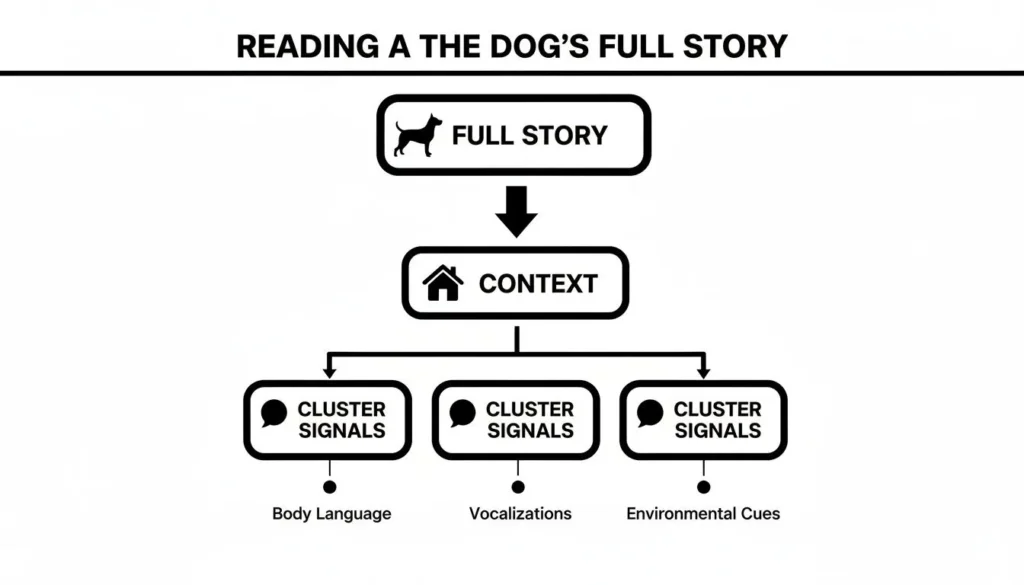
This hierarchy is a good reminder that a single behavior is just one piece of the puzzle. For example, a dog shaking its head might seem like a simple quirk. But when you see it alongside other stress signals, it could point to a bigger problem. If this is something you’ve noticed, you may want to read our guide on why a dog keeps shaking their head.
The Escalation Ladder in Action
As the dog moves up the ladder, their body becomes noticeably stiffer. They might turn their head away, showing the whites of their eyes in a “whale eye.” They may try to creep away slowly or lift a paw in uncertainty. If the pressure continues, so does the climb.
The next rungs on the ladder are much more direct. The dog might freeze entirely, go rigid, and deliver a hard, unblinking stare. This is no longer a polite request—it is a clear warning.
From there, the warnings become vocal. A low growl is an unmistakable signal to back off. If that growl is punished or ignored, the dog learns that their warnings are useless. This is incredibly dangerous, as it can teach a dog to skip the warning rungs and go straight to the top of the ladder.
The final rungs are a snap and, ultimately, a bite. By the time a dog bites, they have likely exhausted every other signal they know to communicate their distress. The bite is a last resort, used only when they feel they have no other choice.
To help you spot these signals before they escalate, we’ve broken them down in this table, showing how a dog’s communication intensifies.
The Ladder of Canine Stress Signals
| Level | Behavior | What the Dog Is Saying |
|---|---|---|
| Subtle (Green) | Yawning, blinking, lip licking, turning head away, sniffing ground. | “I’m a bit uncomfortable with this situation.” |
| Avoidance (Yellow) | Walking away, cowering, tucking tail, pinning ears back, showing whale eye. | “Please stop. I need to get away from this.” |
| Warning (Orange) | Freezing, staring intently, stiffening body, raising hackles, growling. | “I am very serious. Do not come any closer.” |
| Aggression (Red) | Snapping, lunging, biting. | “I have to defend myself. I warned you.” |
Understanding this progression is the single most important skill for preventing dog bites. By recognizing and responding to the earliest, most subtle signals at the bottom of the ladder, you can de-escalate a situation long before it becomes dangerous.
How Your Body Language Speaks to Your Dog
While you’re busy trying to decode every tail wag and ear twitch, your dog is doing the exact same thing to you. This conversation is a two-way street. Dogs are absolute masters at reading human cues, a skill they’ve spent thousands of years perfecting right by our sides.
This incredible talent for interpreting our slightest movements is practically hardwired into their DNA. In one study, service dog puppies just eight weeks old could correctly follow a human’s pointing gesture over two-thirds of the time—with no training whatsoever. It seems dogs are simply born with a head start on understanding us. You can read more about these innate canine abilities to read body language and how deep this connection goes.
But this also means your body language sends powerful signals, whether you mean to or not. Actions we see as perfectly friendly can come across as threatening or intimidating in the dog world.
Human Behaviors That Confuse Dogs
Many of our natural social habits are the exact opposite of polite dog etiquette. What feels like a warm, affectionate gesture to us can easily make a dog feel cornered and anxious, pushing them further up that ladder of stress.
Here are some common human actions that can feel threatening to a dog:
- Direct Eye Contact: For us, it’s a sign of focus and honesty. For a dog, a hard, prolonged stare is a challenge or a threat.
- Patting the Head: A hand reaching down from above can be very intimidating. Most dogs learn to tolerate it, but few actually enjoy it. You’ll often see them show calming signals like lip licking or turning their head away.
- Hugging: A tight hug feels loving to people, but to a dog, it can feel like being trapped with no way out. This is especially true for dogs you don’t know well.
To interact with dogs in a way that builds trust, we have to unlearn our human-centric habits. It’s about shifting our perspective and seeing our own actions from their point of view.
A Better Way to Say Hello
So, how can you approach a dog without setting off alarm bells? The key is to make your body language smaller and less intimidating. This tells the dog you aren’t a threat and gives them the space to control the greeting.
Do’s for Approaching a Dog:
- Turn your body to the side to present a smaller, less confrontational profile.
- Avoid direct eye contact at first. Use soft, glancing looks instead.
- Crouch down to their level rather than looming over them.
- Let the dog make the first move by coming to you for a sniff.
- Offer a gentle pet on their chest, chin, or side instead of reaching over their head.
Don’ts for Approaching a Dog:
- Never rush toward a dog.
- Avoid staring directly into their eyes.
- Don’t lean or tower over the dog’s personal space.
- Never hug a dog you don’t know well (and be cautious even with your own).
- Avoid loud noises or sudden, jerky movements.
Your Emotions Are on Display
Your dog isn’t just watching what you do; they’re feeling your energy. If you’re stressed or anxious, your body will likely be tense, your breathing will be shallow, and your movements will be sharp. Your dog will pick up on every single one of those cues and may become anxious right alongside you.
On the flip side, a calm and confident energy—a relaxed posture, even breathing, and smooth movements—broadcasts a clear signal that everything is okay. Your emotional state is constantly being transmitted through your body language, directly influencing your dog’s behavior and how they see the world.
Applying Your New Skills in the Real World
Alright, you’ve learned the theory. Now it’s time to put it all into practice. Knowing what a lip lick or a tucked tail means is one thing, but using that knowledge to build a better relationship with your dog—that’s where the real magic happens. This is about moving from just watching your dog to truly seeing them.
A great way to start is with a simple 5-Minute Observation challenge. Once a day, just sit back and watch your dog. No commands, no toys, no interaction. Notice the tiny ear flick when a neighbor’s door closes, or the soft sigh they let out when they curl up on their favorite blanket. This simple habit makes you a better observer and helps you get fluent in your dog’s personal dialect.
Transforming Your Training Sessions
Understanding body language will completely change how you approach training. Instead of just drilling commands and waiting for compliance, you can now read how your dog feels about the exercise. This lets you catch the very first signs of stress or confusion before they snowball into real problems.
- Spotting Confusion: Is your dog suddenly sniffing the ground, yawning, or looking everywhere but at you? They’re not being stubborn—they’re likely confused. That’s your signal to take a step back and simplify the task.
- Preventing Shutdown: If you see your dog freeze, tuck their tail, or start lip-licking repeatedly, they’re feeling overwhelmed. Pushing them further will only teach them that training is stressful. This is your chance to end the session on a positive note before they shut down.
When you respond to these signals, you shift from being a drill sergeant to a true partner. For more tips on building this into your routine, check out our complete guide on how to train your dog.
When to Call a Professional
Reading your dog better can solve a lot of minor issues, but some behaviors are too serious to handle on your own. It’s vital to know your limits and when it’s time to call in an expert for everyone’s safety.
Don’t hesitate to seek professional guidance if you observe persistent, intense, or escalating signs of fear, anxiety, or aggression. This isn’t a failure—it’s responsible ownership.
You should get in touch with a pro if your dog shows consistent behaviors like deep, rumbling growls, snapping, or biting. Look for a certified dog trainer, a veterinary behaviorist (DACVB), or a Certified Applied Animal Behaviorist (CAAB). These experts are qualified to find the root of the problem and build a safe, effective plan to address it.
Learning to speak your dog’s silent language is one of the best things you can do for your relationship. It turns a good bond into a great partnership, one built on a solid foundation of trust, respect, and communication.
Frequently Asked Questions About Dog Body Language
The more you learn about your dog’s language, the more questions pop up. It’s a natural part of the process. We’ve gathered some of the most common questions that dog owners ask as they get better at understanding their furry friends.
Why Does My Dog Wag Its Tail and Growl?
A wagging tail next to a low growl is one of the most confusing signals for owners. It’s a classic sign of internal conflict. The wagging tail shows a high level of emotional energy, which isn’t always happiness. The growl, on the other hand, is a clear request for more space.
When you see this, your dog is likely feeling two strong, opposing emotions at once. Maybe they’re excited but also a little scared of a new visitor, or perhaps they’re guarding a favorite toy they want to keep but also feel anxious about it. Your best move is to simply back away and give them the space to sort it out.
Are Some Dog Breeds Harder to Read?
Absolutely. A dog’s physical build can sometimes muffle their body language. For example, breeds with stubby or curly tails, like Pugs and French Bulldogs, can’t signal with them as clearly as a Golden Retriever or German Shepherd can.
Likewise, dogs with long, floppy ears or brachycephalic (flat) faces might struggle to make the subtle facial cues that other dogs use.
This doesn’t mean they aren’t communicating. It just means you have to become an expert at reading their whole body—posture, muscle tension, and movement—to get the full story.
How Do I Tell Healthy Play From a Real Fight?
Healthy, fun play is all about being bouncy, inefficient, and a little goofy. You’ll notice loose, wiggly bodies and big, exaggerated movements. Dogs playing fair will often “self-handicap,” taking turns being the chaser or voluntarily rolling onto their backs. The classic play bow is a dead giveaway that it’s all in good fun.
A real fight is the exact opposite: tense, stiff, and dangerously efficient. The movements are fast and direct, the bodies are rigid, and the goal is to control or harm, not to have a good time. If you’re also wondering about other unusual reactions your dog might have, you may want to learn more about whether you can give a dog Benadryl for certain reactions in our related guide.
At maxijournal.com, we provide clear, approachable commentary on everything from pet health to technology. Explore our daily articles to stay informed and engaged.
Discover more from Maxi Journal
Subscribe to get the latest posts sent to your email.