You’re probably in one of two places right now. You either play one game for hours and wonder if you’re wasting your time, or you’ve started taking ranked seriously and want to know what the actual path looks like.
Both are normal starting points. What matters is whether you treat esports like a fantasy or like a profession. The people who get somewhere don’t just queue more games. They build skill on purpose, compete in the right environments, protect their focus, and make smart decisions about where they fit in the industry.
The Pro Gamer’s Path From Dream to Reality
A lot of players begin with the same thought: “I’m better than most of the people I run into online. Could I do this?” That question isn’t unrealistic anymore. It just needs a reality check attached to it.
Esports is no longer a side corner of gaming culture. The worldwide esports market is projected to reach US$4.8 billion in 2025, and the global esports user base is projected to reach 924.9 million by 2030, with 10.2% user penetration in 2026, according to Statista’s global esports market outlook. That matters because bigger markets create more tournaments, more organizations, more support roles, and more entry points for newcomers.
What most beginners get wrong is thinking “how to get into esports” only means becoming a star player. It can mean that. But it can also mean becoming the analyst who prepares draft plans, the coach who fixes bad habits, the manager who keeps a roster functional, or the creator who builds a reputation around a game.
Treat it like a trade
The first shift is mental. If you want results, stop treating your main game like background entertainment and start treating it like a craft. That means choosing a title deliberately, building repeatable habits, and accepting that progress is usually slower than your ego wants.
Practical rule: Ambition helps at the start. Structure is what gets you through the first year.
There’s also a hard truth worth saying early. Loving games is not the same as being suited for competitive play. Some players have sharp mechanics but weak decision-making. Others are smart but fold under pressure. Some are better built for support roles and don’t realize it yet. That’s not failure. That’s fit.
The real opportunity
The good news is that the modern esports scene gives you more than one way in. Local events, online tournaments, coaching communities, scrim groups, replay review culture, and analytics tools have made the path more visible than it used to be. The bad news is that visibility also means more competition.
If you want to make this real, think in phases:
- Phase one: Pick your lane and build basic competence.
- Phase two: Prove it in ranked and organized play.
- Phase three: Become known for something reliable.
- Phase four: Build a path that can survive setbacks.
That last point matters more than people think. Raw excitement gets a player started. A durable plan keeps them in the game.
Finding Your Place in the Esports Ecosystem
The fastest way to waste a year is to chase the wrong role in the wrong game. Before you grind harder, figure out where you fit.
Start with your primary title. Don’t choose based only on what’s popular. Choose based on three things: whether you enjoy the game enough to survive repetition, whether your strengths match its demands, and whether there’s an active competitive scene you can enter. If you’re still deciding, it helps to compare a few options against the kinds of titles featured in guides to the best PC games to play right now, then narrow your focus to one competitive ecosystem.
Choose one lane before you branch out
A lot of newcomers spread themselves across too many games. That feels productive because you’re always busy. It usually kills progress.
Use a simple filter:
- Interest test: Would you still practice this game when you’re losing?
- Skill test: Do your instincts fit the game’s demands?
- Scene test: Can you find ranked ladders, amateur events, scrims, or communities consistently?
If a game fails two of those, move on. If it passes all three, commit.
The player who specializes usually beats the player who stays “well-rounded” for too long.
Esports career paths beyond playing
If you’re serious about getting into esports, you should understand the whole ecosystem early. The player route is only one path, and not always the best one.
| Role | Core Skills | Primary Responsibilities |
|---|---|---|
| Player | Mechanics, decision-making, communication, consistency | Practice, scrims, ranked play, tournament performance |
| Coach | Strategy, feedback delivery, review structure, leadership | Run practice, review VODs, fix team habits, prepare opponents |
| Data analyst | Python/R, data interpretation, pattern spotting, reporting | Build models, analyze drafts and trends, create reports for teams |
| Caster or host | Game knowledge, speaking, timing, presence | Cover matches, explain plays, engage audiences |
| Team manager | Organization, scheduling, communication, professionalism | Handle logistics, calendars, coordination, player support |
| Content creator | Editing, storytelling, platform knowledge, branding | Stream, make videos, build audience, grow reputation |
The strongest non-player alternative right now is analytics. According to Texas Wesleyan’s article on data analytics in esports, analytics roles are growing 25% year over year in major markets like North America, Europe, and Korea. The same source notes that portfolio holders have a roughly 20% to 30% success rate landing junior roles, and entry-level pay in North America can range from $60,000 to $120,000.
Match your habits to the job
Here’s the blunt version:
- If you love pressure and fast decisions, player might be right.
- If you notice patterns everyone else misses, analyst is a real lane.
- If people improve when you explain things, coaching may suit you.
- If you naturally organize groups and solve problems, management matters more than is often acknowledged.
- If you enjoy building an audience around your game, content can become both a career and a powerful advantage.
Many people force themselves into the player identity because it feels prestigious. That’s backwards. Teams keep people who solve problems. Figure out which problems you solve best.
Mastering Your Craft Through Deliberate Practice
Playing a lot and improving a lot are not the same thing. Most aspiring players grind matches, chase LP or rank, and call it work. That’s activity, not training.
Real improvement starts when you separate practice from performance. Performance is ranked, scrims, or tournament play. Practice is focused work on one weakness at a time.
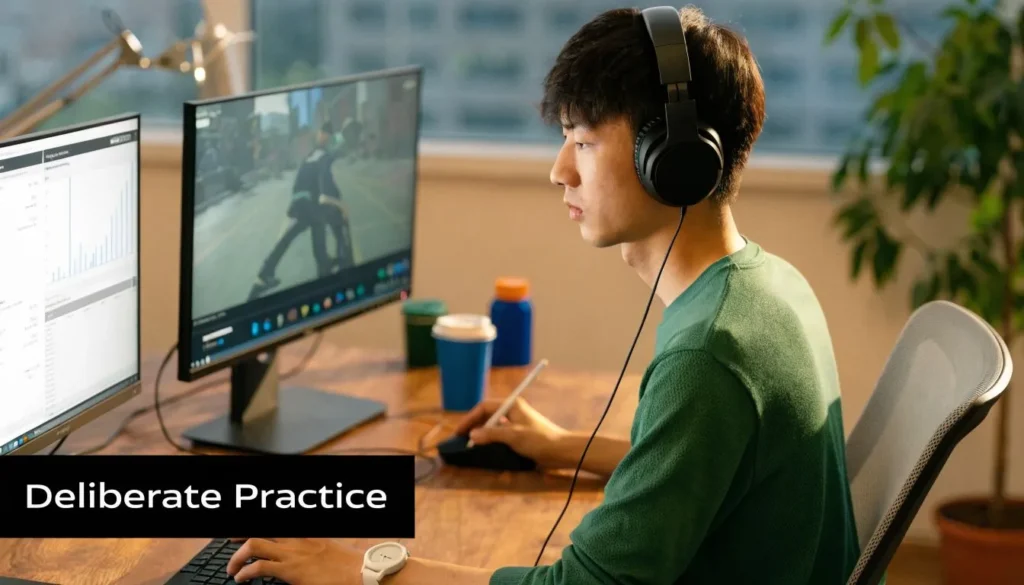
Research summarized in this esports training study notes that pros dedicate an average of 7.75 hours daily to training. It also highlights the importance of mechanical mastery, including precise aiming in FPS games and very high APM in RTS titles, plus a review method built around the scout-script-practice-review-adjust loop.
Build sessions with a purpose
A useful training block has one clear target. Not five. One.
For example:
- In an FPS, your session goal might be crosshair placement under movement.
- In a MOBA, it might be early-wave management or last-hitting under pressure.
- In a fighting game, it could be punish timing or one matchup sequence.
That’s how deliberate practice works. You isolate a skill, repeat it until your execution stabilizes, then pressure-test it in real games.
A practical weekly rhythm looks like this:
- Mechanical work: aim trainer, combo reps, movement drills, or custom practice
- Applied matches: ranked or scrims with a narrow improvement goal
- Review: identify recurring mistakes
- Adjustment: carry only one or two fixes into the next session
Concentration becomes a competitive advantage. If your attention falls apart after a few games, your training quality drops fast. Players who struggle there should spend time improving focus away from the game as well, including methods like the ones covered in this guide on how to improve concentration.
Use VOD review the right way
Most players review replays badly. They either watch passively or they rage at their mistakes. Neither helps.
Use a simple review structure:
- Find one repeated problem. Don’t chase every error.
- Label the cause. Was it mechanical, positional, informational, or emotional?
- Write a correction. Keep it short and testable.
- Bring that correction into your next games.
Review should answer one question: what did I do that I can actually fix this week?
Here’s the kind of mistake log that works:
- Mechanical: missed close-range tracking on moving targets
- Positional: took fights without cover or escape path
- Informational: ignored minimap timing and got flanked
- Emotional: forced a play after a bad round
That last category matters more than many players want to admit. Tilt hides inside “aggression,” “confidence,” and “I wanted to make something happen.”
A short visual walkthrough can help if you’ve never built a training routine before:
What doesn’t work
Some habits look serious but don’t produce much.
- Mindless ranked spam: volume without focus usually reinforces bad habits.
- Constant settings changes: if you change sensitivity, binds, or peripherals every week, you reset your baseline.
- Copying pro routines blindly: the point is the principle, not the exact schedule.
- Reviewing only wins: wins hide mistakes that better opponents will punish.
The players who improve fastest are usually boring in the best way. They repeat the right things, track the same weaknesses for weeks, and don’t chase shortcuts.
Assembling Your Pro-Level Toolkit and Setup
Your setup won’t make you elite. A bad setup can absolutely make you worse.
The goal isn’t to build a flashy battlestation. The goal is to create an environment that gives you clean inputs, stable performance, and enough comfort to stay consistent through long sessions.
Prioritize performance over aesthetics
Start with the pieces that affect feel and consistency the most.
- Monitor: A high refresh rate display matters because smoother motion makes tracking and timing easier. Competitive players usually benefit from prioritizing responsiveness over visual flair.
- Mouse and keyboard: Pick shapes and switches you can use for long sessions without hand strain. Comfort matters more than internet hype.
- Headset: You need reliable positional audio and clear communication. Fancy branding doesn’t matter if footsteps blur together or your mic sounds distorted.
- Stable internet connection: Lag spikes and packet loss can ruin otherwise solid practice. Reliability beats peak speed.
Keep your desk simple. If you play with low sensitivity, leave enough mouse space. If you hunch your shoulders or reach awkwardly for your keyboard, fix that before you spend money on cosmetic gear.
Ergonomics is part of performance
A lot of aspiring players ignore posture until pain forces them to care. That’s a mistake.
Use a chair and desk height that let your shoulders stay relaxed. Keep your wrist position neutral instead of bent hard upward. Place your monitor so you aren’t craning your neck. None of this is glamorous, but consistent body position helps consistent play.
A setup should reduce friction. If something distracts you every session, it’s already costing you performance.
Software that actually helps
Most players only install chat apps and launchers. Add tools that support improvement.
Consider a basic stack like this:
- Discord: team comms, scrim scheduling, VOD sharing
- OBS Studio: record your sessions for review
- Spreadsheet or notes app: track recurring mistakes and goals
- In-game performance tools: use native replay systems, shooting ranges, training modes, and stat pages where available
Also clean up your system. Close background apps you don’t need. Keep drivers updated. Remove overlays or startup clutter that creates performance issues. You don’t need a perfect machine. You need one that behaves predictably every time you play.
Climbing the Competitive Ladder and Building Your Brand
Ranked is your proving ground. It is not your destination.
A lot of players stay trapped in the ladder because ranked gives instant feedback and feels important. But organized competition is different. Teamplay is different. Pressure is different. If you want to get into esports in a real way, you have to leave solo progress behind at some point and start competing where people remember your name.
The ladder to organized competition
The basic progression is straightforward. You build skill in ranked, enter smaller events, join more structured competition, and earn chances with better teams. That pathway is outlined in this beginner guide to esports progression and tournament play, which emphasizes mastering mechanics first, then moving through grassroots tournaments toward higher-level leagues.
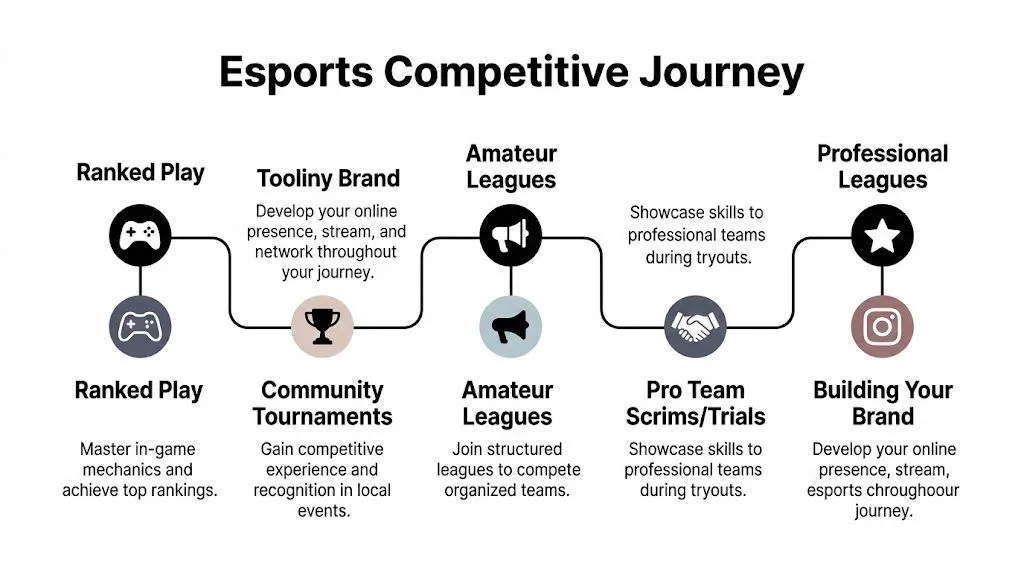
What that looks like in practice:
- Ranked play: reach a level where stronger players stop feeling random and start feeling readable
- Community tournaments: enter online cups, local events, or small leagues
- Amateur team play: scrim regularly, learn structure, handle review and scheduling
- Trials and tryouts: take every serious opportunity seriously
- Higher-level competition: become known as dependable, coachable, and stable under pressure
Find teams the smart way
Don’t wait for a perfect roster to appear. Start where you are.
If you don’t know anyone yet, join game-specific Discord servers, amateur league communities, tournament platforms, and scrim groups. When you look for a team, present yourself like someone people would want to work with. That means clear communication, role clarity, availability, and examples of your play.
A useful player post usually includes:
- Your main role and secondary role
- Your current rank and recent competitive experience
- Your schedule and practice availability
- Your goals and what kind of team you want
- A replay, VOD, or short highlight sample
A bad player post says “LFT, cracked, DM me.” A good one gives people enough information to evaluate fit.
Teams don’t only recruit the most talented player. They recruit the player who seems easiest to trust.
Build your brand while you compete
This is where most ambitious players fall behind. They think branding is for influencers. It isn’t. It’s a safety net and a career multiplier.
A visible player gets more opportunities than an invisible player with similar skill. If coaches, organizers, and other players can see your gameplay, hear how you communicate, and watch how you carry yourself, you become easier to recommend.
That doesn’t mean you need to become a full-time streamer overnight. It means building a consistent professional presence:
- Post match clips with context
- Upload VOD reviews or educational breakdowns
- Keep your social profiles clean and game-focused
- Show up consistently in community spaces
- Document your progress instead of only your highlights
If you want to publish polished clips, basic editing skill goes a long way. Learning how to edit videos for YouTube helps you turn scrim moments, ranked lessons, and review content into something other people will watch.
Brand and competition feed each other. Better results give you better content. Better content gets you seen by better people. That loop matters.
Developing a Pro Mindset for a Sustainable Career
The biggest blind spot in beginner esports advice is health. People talk about mechanics, rank, and tournaments. They don’t talk enough about burnout, stress, injury, and the fact that chasing improvement can wreck your judgment if you don’t manage yourself well.
That’s a serious mistake. Competitive gaming puts players under constant pressure, often with bad sleep, repetitive strain, and emotional volatility. Beginner guides rarely address that reality, even though professional organizations increasingly use sports psychologists and wellness support.
Mental resilience is a skill
You are not weak because losses affect you. You are unprepared if you keep letting that state drive your next game.
Tilt usually starts before the outburst. It shows up as rushed decisions, blame shifting, tunnel vision, and forcing plays to “get momentum back.” Once you notice that pattern, treat it like any other performance issue. Name it, interrupt it, and adjust.
Useful habits include:
- Short reset routines: stand up, breathe, get away from the screen for a few minutes
- Post-match notes: write what happened instead of what your emotions say happened
- Loss limits: if your decision-making is clearly slipping, stop queueing
- Objective review language: replace “I’m terrible” with “I overpeeked three times in the same situation”
Protect your body if you want longevity
Hands, wrists, back, neck, and eyes all matter. Ignore them long enough and your practice volume won’t matter because pain will make your sessions worse.
Keep this simple:
- Stretch before and after long sessions
- Take breaks before pain forces the issue
- Keep sleep as stable as you can
- Do some physical activity outside the chair
- Fix bad posture before it becomes your default
None of that makes you less dedicated. It makes you more durable.
The player who can train well for years beats the player who burns bright for a few months.
Plan for more than one version of success
Esports careers can change fast. Maybe you climb as a player. Maybe you peak in amateur competition and shift into coaching. Maybe your best path becomes analytics, content, or management. Smart competitors plan for that possibility early instead of treating it like surrender.
Build complementary skills while you compete. Learn to review footage. Learn to communicate clearly. Learn basic content production. Learn how teams function. Those skills travel.
A sustainable career in esports is not built on hype. It’s built on skill, reputation, discipline, and the ability to adapt when your first plan changes.
If you’re serious about building a smarter path into competitive gaming, maxijournal.com publishes approachable writing across gaming, health, sports, education, business, and technology. It’s a useful place to keep learning the parts of esports most players ignore until they become urgent.
Discover more from Maxi Journal
Subscribe to get the latest posts sent to your email.