Boosting your concentration isn’t about white-knuckling your way through distractions. It’s a skill you build, one smart habit at a time. Think of it less like a test of willpower and more like a strategic game. By using proven techniques like structured work sessions, designing a focus-friendly space, and prioritizing basics like sleep and exercise, you can work with your brain instead of against it.
Why Is It So Hard to Concentrate Today

If you feel like your focus is under constant assault, you’re not wrong. We live in a world designed for distraction. Every ping, buzz, and notification is engineered to pull you away from what you’re doing, making deep concentration feel like a luxury. It’s a constant tug-of-war between external alerts and our own internal urges, but understanding the fight is the first step to winning it.
At its core, focus is a brain game. To get better at it, you need to know the players. Two of the most critical attention systems are:
- Sustained Attention: This is your brain’s endurance runner. It’s the ability to stick with one thing for a long time, like digging into a complex report or getting lost in a good book.
- Selective Attention: Think of this as your mental bouncer. It filters out all the background noise—the coworker’s conversation, the traffic outside—so you can tune into what’s important right now.
When you’re “in the zone,” these two systems are in perfect sync. Your prefrontal cortex, the CEO of your brain, is expertly directing traffic and shutting down interruptions. But every new email or tempting browser tab forces your brain to switch gears. This constant context-switching is exhausting, and it’s the number one enemy of deep, productive work.
The Science of Effort and Refocusing
It’s not just about dodging distractions; it’s about what happens when one inevitably gets through. The amount of mental energy you spend trying to stay focused actually makes it easier to get back on track.
A fascinating 2024 study uncovered this very link. Researchers found a strong positive correlation between the mental effort put into a task and the ability to refocus after an interruption. In other words, the harder you work to concentrate initially, the faster you can snap back when your mind wanders. This suggests that focus isn’t just about blocking things out; it’s about building a mental muscle that recovers quickly. You can dig into the research yourself on how initial effort impacts refocusing ability on PMC.
This is a game-changer. Concentration isn’t a delicate state that shatters at the first distraction. It’s a resilient skill that gets stronger every time you practice it, and each effort to refocus is like another rep at the mental gym.
The Impact of Modern Life on Your Brain
Our brains are wired to pay attention to what’s new and different. The endless stream of information and alerts from our devices hijacks this natural tendency, training us to crave novelty. This creates a vicious cycle: we get conditioned to seek out distractions, which makes it even harder to maintain sustained focus.
This constant state of high alert can also kick your body’s stress response into gear, making it nearly impossible to relax into a state of deep concentration. It’s a feeling that often mimics anxiety, creating a loop where distraction fuels stress, and that stress obliterates your ability to focus. If that cycle feels all too familiar, it can be useful to learn how to calm anxiety naturally. The goal isn’t to just “try harder,” but to build smarter systems that support your brain’s natural architecture.
Actionable Techniques to Sharpen Your Focus Now
Knowing the science behind concentration is one thing. Actually focusing when a deadline is breathing down your neck is another. The real trick isn’t about forcing yourself to concentrate, but about being strategic with your mental energy.
These methods give your brain the structure it needs to lock in and get the job done.
The Pomodoro Technique: More Than a Timer
You’ve probably heard of the Pomodoro Technique, but its real power is in the psychology, not just the 25-minute timer. It reframes a huge, intimidating project into a series of short, winnable sprints.
That promised 5-minute break is a surprisingly effective reward that keeps your brain on task. It knows a little rest is just around the corner.
This cycle of intense work followed by a brief pause is crucial for preventing mental exhaustion. Our brains aren’t built for eight straight hours of deep focus. These short breaks hit the reset button, so the next sprint feels fresh, not draining.
Embrace Single-Tasking in a Multi-Tasking World
The modern workplace seems to celebrate multitasking, but study after study shows it’s a productivity killer. What we think of as multitasking is really just rapid task-switching, and it burns through your mental fuel and leads to mistakes.
The solution is to commit to single-tasking, even when your to-do list is a mile long.
This doesn’t mean you ignore everything else. It just means you carve out protected time for one thing.
- Scenario: A project manager needs to finalize a budget report, but Slack notifications about other projects keep popping up.
- Single-Tasking Solution: Block 45 minutes on the calendar for “Budget Finalization.” Turn off all notifications and close every irrelevant browser tab. After the 45 minutes are up, take 15 minutes to catch up on messages before moving to the next focused block.
This simple act creates a firm boundary between deep work and shallow, administrative tasks. It signals to your brain—and your team—that this time is off-limits to distractions, which massively improves the quality of your work.
True productivity isn’t about how many things you can juggle at once. It’s about how deeply you can focus on one important thing at a time. Mastering single-tasking is the fastest way to improve concentration and produce higher-quality work.
Reset Your Mind with Strategic Breathing
When your mind is racing and you just can’t seem to settle down, a quick breathing exercise can feel like a mental reset. These techniques work by activating your parasympathetic nervous system—your body’s “rest and digest” mode—which calms the “fight or flight” anxiety that fuels distraction.
One of the fastest and most effective methods is the 4-7-8 breathing technique. It takes less than two minutes and you can do it anywhere.
- Exhale completely through your mouth with a whooshing sound.
- Close your mouth and inhale quietly through your nose for a count of four.
- Hold your breath for a count of seven.
- Exhale completely through your mouth, making that whoosh sound again for a count of eight.
- That’s one full breath. Inhale and repeat the cycle three more times for a total of four breaths.
This exercise gives your mind a single, simple thing to focus on—the rhythm of your breath. It pulls you away from distracting thoughts and is incredibly effective for shifting from a state of chaos to one of calm focus. If you want to explore more practices like this, you can learn how to meditate for stress relief in our detailed guide.
For those moments when you need an immediate boost, having a quick-reference guide is invaluable. Here are some of the most effective techniques you can use right now.
Immediate Focus-Boosting Techniques
| Technique | How It Works | Best For | Key Benefit |
|---|---|---|---|
| Pomodoro Sprints | Work in focused 25-minute intervals, followed by a 5-minute break. | Breaking down large, intimidating tasks into manageable chunks. | Prevents burnout and makes it easier to start difficult work. |
| Single-Tasking | Dedicate a block of time to one task only, eliminating all other distractions. | High-priority projects that require deep thought and accuracy. | Produces higher-quality work and reduces errors. |
| 4-7-8 Breathing | A structured breathing pattern (inhale 4s, hold 7s, exhale 8s) to calm the nervous system. | When you feel scattered, anxious, or overwhelmed before a task. | Quickly reduces stress and clears your mind for focus. |
| “Two-Minute” Rule | If a task takes less than two minutes to complete, do it immediately instead of deferring it. | Clearing small, nagging items from your to-do list that create mental clutter. | Reduces procrastination and builds momentum. |
These techniques provide a practical toolkit for managing your attention. Whether you’re structuring your day with work sprints or calming your mind with a breathing exercise, you’re actively taking back control.
Design Your Environment for Deep Work

Your ability to concentrate isn’t just a mental game; it’s profoundly shaped by your surroundings and daily routines. Improving your focus is about more than just willpower. It’s about deliberately engineering your lifestyle and workspace to make deep work the easiest option.
Think of it like this: you wouldn’t try to have a heart-to-heart conversation next to a roaring jet engine. In the same way, you can’t expect to find deep focus in a space cluttered with mental and physical distractions. By getting your core habits and physical space in order, you create the stable foundation your brain needs to lock in.
Prioritize Sleep to Protect Your Prefrontal Cortex
Let’s be clear: sleep isn’t a luxury. It’s the single most critical pillar for cognitive function. When you’re running on fumes, your prefrontal cortex—the part of your brain handling attention, planning, and impulse control—is the first to go offline.
Even a little sleep debt makes it incredibly difficult to filter out distractions and stay on task. Your brain defaults to a more primitive, reactive state, making complex, thoughtful work feel nearly impossible. If you want to learn how to improve concentration, you have to start with mastering your sleep.
A well-rested brain is a focused brain. Skimping on sleep is like trying to run complex software on a computer with half its RAM. Everything gets slower, glitchier, and is far more likely to crash.
Improving your sleep hygiene is all about building a consistent, relaxing routine that tells your body it’s time to power down.
- Create a “Power-Down” Hour: For the last hour of your day, put away the screens. The blue light from phones and laptops messes with your melatonin production, tricking your brain into thinking it’s still daytime. Read a real book, listen to some chill music, or do some light stretching instead.
- Optimize Your Bedroom: Your bedroom should be a sanctuary for sleep—and nothing else. Keep it cool, dark, and quiet. I’ve found that blackout curtains and a white noise machine can be absolute game-changers.
- Keep a Consistent Schedule: Try to go to bed and wake up around the same time every day, even on weekends. This stabilizes your body’s internal clock (your circadian rhythm), making it much easier to fall asleep and wake up feeling refreshed.
These small tweaks add up, dramatically boosting your brain’s ability to recharge every single night.
Fuel Your Brain for Sustained Focus
What you eat has a direct line to your brain’s performance and ability to concentrate. Your brain is a high-energy organ, so giving it the right fuel is non-negotiable for stable focus. The goal is to sidestep the sharp spikes and crashes in blood sugar that come from processed foods and refined sugars.
Some foods are especially great for brain health and sustained attention. Try to work these into your diet:
- Omega-3 Fatty Acids: You can find these in fatty fish like salmon, as well as in walnuts and flaxseeds. They’re essential for building brain cells and improving the communication between them.
- Antioxidants: Berries, dark chocolate, and leafy greens like spinach help protect your brain from oxidative stress, a process that can wear down cognitive function over time.
- Complex Carbohydrates: Foods like oatmeal and whole grains give you a slow, steady release of glucose. This provides your brain with the consistent energy it needs for long stretches of focus.
Making smarter food choices doesn’t need to be a huge overhaul. Simply swapping a sugary breakfast pastry for a bowl of oatmeal with berries can set you up for a morning of clear-headed work instead of a mid-morning energy crash.
Design a Distraction-Free Workspace
Your physical and digital spaces are packed with triggers that can either help or hurt your concentration. Creating a dedicated “focus zone” is a powerful way to signal to your brain that when you’re here, it’s time to work.
Start with your physical desk. A cluttered desk creates a cluttered mind. Take a minute to clear away anything that isn’t essential for the task in front of you. This simple act cuts down on visual noise and removes the temptation to get sidetracked.
Next, you have to conquer your digital workspace, which is often the biggest source of distraction for most of us.
- Kill Non-Essential Notifications: Every ping from your email, Slack, or social media shatters your focus and forces a costly mental reset. Be ruthless. Turn off every single alert that isn’t absolutely mission-critical.
- Use Focus Apps: Tools that block distracting websites or apps for set periods of time can be incredibly effective. They create a digital fence around your work, protecting your attention.
- Curate Your Browser: Before you dive into a task, close all the unrelated tabs. A clean browser helps you stick to a “one tab, one task” mindset, reinforcing the habit of single-tasking.
By consciously shaping both your physical and digital environments, you remove the friction that makes concentration so hard. You’re creating a clean, dedicated space where deep work can happen naturally.
Building Mental Endurance for Long-Term Focus
Quick focus hacks are useful in a pinch, but they’re not a long-term solution. To truly master your attention, you need to build mental endurance. Think of it less like a sprint and more like training for a marathon—it’s about systematically building your capacity over time, not just hoping for the best on race day.
This involves treating your focus as a muscle. By consistently engaging in specific cognitive exercises, you can literally strengthen your brain’s attention networks. The goal is to make deep concentration your default state, not something you have to fight for.
Train Your Brain with Cognitive Drills
Just like you’d go to the gym to strengthen your body, cognitive drills can fortify your brain’s ability to concentrate. These “brain training” exercises aren’t just for fun; they’re targeted workouts for essential skills like your working memory and processing speed.
A sharp working memory is what lets you hold and juggle information in your head, which is crucial for tackling complex problems. A faster processing speed allows you to absorb and react to new information more efficiently. When you strengthen these two pillars, the entire act of focusing becomes less of a strain.
Here are a few simple drills to get you started:
- The N-Back Test: This classic cognitive test has you track a sequence of items (like letters or shapes) and signal when one repeats from ‘N’ items back. It’s a direct, powerful workout for your working memory.
- Dual-Tasking Exercises: This can be as simple as patting your head while rubbing your stomach. The exercise forces your brain to divide and manage its attention, which improves your ability to handle multiple information streams without getting frazzled.
These drills are meant to push your cognitive limits in a controlled environment, much like lifting weights at the gym. For more on boosting your cognitive toolkit, check out our guide on how to improve memory retention.
The Lost Art of Focused Reading
In an age of constant scrolling and skimming, simply reading a physical book from start to finish has become a powerful act of defiance. Our brains have been rewired to hunt for keywords and jump between snippets of information, a habit that actively erodes our capacity for deep, sustained focus.
Reclaiming this skill is one of the most effective ways to rewire your attention span. The key is to practice deliberate, focused reading.
Grab a physical book—not an article on your tablet or phone—and set a timer for just 15-20 minutes. Your only job is to read. No phones, no notifications, no multitasking. When your mind inevitably wanders, just gently guide it back to the page.
Every time you pull your focus back to the text, you’re doing one more rep of a potent mental exercise. It’s a slow-burn process, but it’s incredibly effective for rebuilding your attention span from the ground up.
Mindfulness as a Core Practice
Mindfulness meditation is probably the single most powerful tool for building mental endurance. It’s direct training for your brain’s attention system. The practice couldn’t be simpler: you sit, pay attention to your breath, and when your mind wanders, you bring it back.
That simple act—noticing you’re distracted and returning your focus to an anchor point—is the fundamental skill of concentration. And the science shows this isn’t just a mental trick; it physically changes your brain. Regular mindfulness has been shown to increase gray matter density in the prefrontal cortex, the very region responsible for attention control and executive function.
Many of us are worried about what technology is doing to our focus. A 2025 King’s College London survey revealed that 70% of people believe technology is attacking their ability to concentrate. Yet, the evidence strongly suggests our attention is trainable. For instance, multiple meta-analyses show that mindfulness meditation can slash mind-wandering by 25-35% after just eight weeks of practice. This science-backed training really works. You can explore more of these findings on attention span resilience from King’s College London.
Create Your Personal Concentration Plan
There’s no one-size-fits-all solution for better concentration. We all have different distraction triggers and unique demands on our time. Real, lasting improvement comes from building a plan that’s tailored to your own life.
This isn’t about trying to cram every technique from this guide into your routine. The goal is to become your own focus coach—to honestly look at your habits, figure out what’s really holding you back, and then pick the strategies that will give you the most bang for your buck. Think of this as your personal playbook for building focus that actually sticks.
The process boils down to a few core practices that work together to build up your mental stamina.
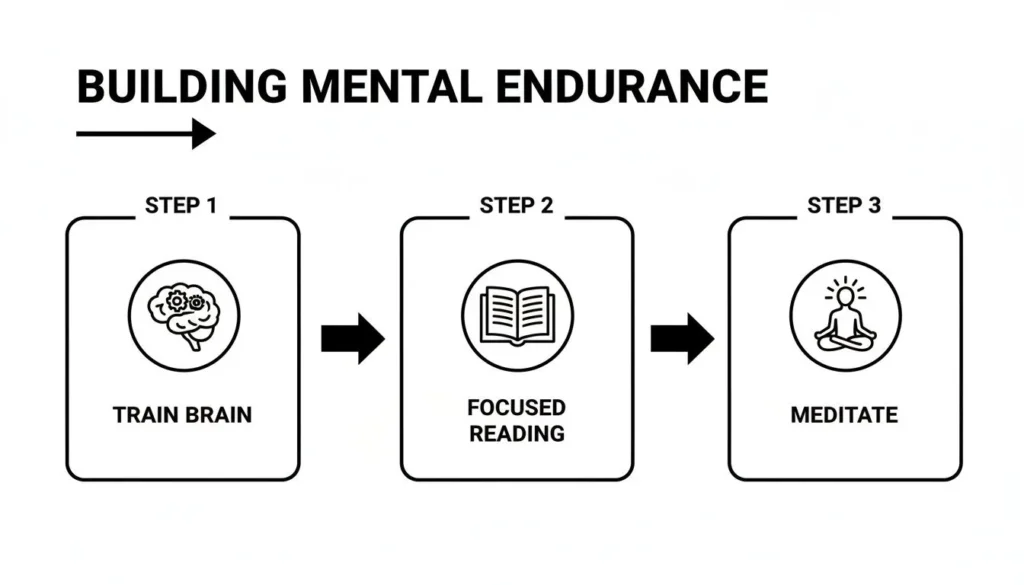
As you can see, this isn’t about some secret hack. It’s about combining active brain training, deliberate reading, and meditation to create a strong foundation. Mental endurance is a skill you develop with consistent practice, not something you’re born with.
Pinpoint Your Personal Concentration Blockers
First things first: you need to play detective. To figure out which strategies will actually help, you have to know what’s breaking your focus in the first place. For the next few days, just pay attention. When you feel your mind start to drift, ask yourself a few questions:
- Is the distraction external? Was it a Slack notification? An email popping up? Someone tapping you on the shoulder? Or just the sight of your phone on the desk?
- Is the distraction internal? Did your mind wander off during a quiet moment? Did you start worrying about another project or replaying an old conversation?
- When is your focus strongest and weakest? Are you laser-focused in the morning but completely fried by 3 PM? Knowing your natural energy rhythm is crucial.
- What kind of tasks are the hardest? Do you struggle with creative work, tedious data entry, or complex problem-solving?
Jot down your findings. A few quick notes in a journal or a phone app can reveal some powerful patterns. You might discover your focus completely tanks after lunch, or that checking email first thing derails your whole morning. This is the data you’ll use to build your plan.
Build Your Daily Focus Schedule
Once you know what you’re up against, you can design a schedule that proactively defends your attention. This isn’t about micromanaging every single minute. It’s about creating a structure that makes deep focus the path of least resistance.
Here’s what a sample plan might look like for someone who gets pulled away by digital pings and hits a wall in the mid-afternoon.
Sample Daily Plan
| Time | Activity | Strategy |
|---|---|---|
| 9:00 – 10:30 AM | Deep Work Block 1 | Single-task on the most important project. Phone is in another room, all chat/email apps closed. |
| 10:30 – 10:45 AM | Strategic Break | Get up and walk away from the desk. Grab some water, stretch, or just look out a window. No screens. |
| 10:45 – 12:00 PM | Deep Work Block 2 | Second focused session. Use the Pomodoro Technique (three 25-minute sprints). |
| 12:00 – 1:00 PM | Lunch & Admin | Eat a brain-friendly lunch away from your desk. Use the last 15 minutes to quickly scan email. |
| 1:00 – 2:00 PM | Shallow Work | Respond to messages, handle quick administrative tasks, and plan the rest of the day. |
| 2:00 – 2:30 PM | Cognitive Training | Do a brain-training game or a 20-minute focused reading session to recharge. |
| 2:30 – 3:30 PM | Collaborative Work | Schedule meetings for this window, when your individual deep focus is naturally lower. |
Notice how this schedule stacks the deck for success. It prioritizes deep work in the morning when focus is typically highest and saves the reactive, low-energy tasks for the afternoon slump.
Your ideal schedule will look different, and that’s the entire point. Use this as a starting point. Tinker with the block lengths, move activities around, and plug in the specific techniques that solve your biggest focus problems.
Measure What Matters to Stay on Track
You can’t improve what you don’t measure. Tracking your progress is the key to staying motivated and making smart tweaks to your plan. Luckily, this doesn’t have to be complicated.
- Journal Your Perceived Focus: At the end of each day, just rate your overall concentration on a scale of 1 to 10. Add a sentence or two about what went well and what didn’t. This gut-check data is incredibly useful.
- Track Your Focus Intervals: How many uninterrupted work blocks did you actually complete? Simply tally your Pomodoro sprints or how many times you managed a 30-minute deep work session without getting derailed.
- Monitor Your Distraction Count: Keep a piece of paper on your desk and make a tally mark every time you catch yourself getting distracted. The goal isn’t to hit zero overnight. It’s about seeing that number slowly shrink over the weeks.
This simple feedback loop shows you what’s working. Maybe you’ll see your focus score jump on days you exercise, or your distraction count plummets when you start leaving your phone in another room. This is how you refine your system and build a focus practice that lasts.
Frequently Asked Questions About Improving Concentration
As you start using these strategies to sharpen your focus, you’ll undoubtedly have some questions. Everyone’s path is different, and figuring out what works best for you is a key part of the process. Below are answers to some of the most common questions we get.
How Long Does It Take to See Improvements in Concentration
This is a big one, and the answer comes in two parts. First, you can get immediate, short-term benefits from some of these techniques. A single 25-minute Pomodoro session or a two-minute breathing exercise can instantly improve your focus for the task you’re working on.
For deeper, more lasting improvements to your mental stamina, however, you need consistency. With habits like daily meditation or regular cognitive training, most people start to feel a real difference in their baseline concentration within four to eight weeks. It’s a lot like physical fitness—you feel great after one workout, but building real strength takes a couple of months of consistent effort.
Can I Improve Concentration if I Have ADHD
Yes, absolutely. While Attention-Deficit/Hyperactivity Disorder (ADHD) presents its own set of focus challenges, many of these strategies can be very effective. They work best as a complement to a professional treatment plan from your doctor or therapist.
Methods that create external structure are often the most helpful for managing ADHD. For example:
- Environmental Design: Setting up a minimal, distraction-free workspace can dramatically cut down on the external cues that pull at your attention.
- Time-Boxing: Using a timer, like in the Pomodoro Technique, gives tasks clear start and stop points. This helps with getting started and staying on track.
- Single-Tasking: Making a firm commitment to do one thing at a time is a powerful way to counter the brain’s tendency to jump between different activities.
These techniques provide an organized framework that makes attention management far more achievable. We always recommend discussing any new strategies with your doctor to build a plan that’s tailored to your specific needs.
Is It Better to Listen to Music or Work in Silence
There’s no one-size-fits-all answer here. The best soundscape for deep work is highly personal and often depends on the task itself. Your best move is to experiment.
Many people find that instrumental music, ambient sounds (like rain or a quiet cafe), or white noise is a game-changer. It creates a consistent audio backdrop that masks sudden, distracting noises from your environment. This is especially effective for repetitive or familiar tasks that don’t require intense cognitive processing.
For highly demanding work—like writing a detailed report, studying for a big exam, or learning something new—complete silence is usually better. These complex tasks need all your available brainpower, and even music without words can subtly compete for your attention.
The only way to know for sure is to test it out. Try one work block with an instrumental playlist and another in total silence. Note how you feel and what you accomplish. You might discover you prefer different audio setups for different kinds of work. Let your own results be your guide.
Ready to dive deeper and discover more ways to enhance your daily life? maxijournal.com publishes fresh insights on health, technology, and personal growth every day. Explore our articles and join a community dedicated to lifelong learning at https://maxijournal.com.
Discover more from Maxi Journal
Subscribe to get the latest posts sent to your email.