So, you want to learn guitar? Let’s cut right to the chase: anyone can do this. The secret isn’t spending years on dense music theory. It’s about learning a few key chords and one simple strumming pattern. That’s it. That combo alone will let you play thousands of popular songs.

Starting Your Guitar Journey With Confidence
Welcome to what I hope will be your first real step into playing music. If you’re picking up a guitar for the very first time, you’re in good company. There are over 50 million guitar players around the globe, and that number is growing fast.
In fact, the pandemic saw a massive spike in new players. In the US alone, 1.6 million people decided that lockdown was the perfect time to finally start learning. If you’ve always had that itch to play, there’s never been a better moment. You can dig into more of these stats over at Joneruinzguitar.com.
Your First Month Guitar Learning Roadmap
This guide is built to take you from “I don’t know where to start” to “I can’t believe I’m playing a song!” We’re going to bypass all the boring stuff and get you playing as quickly as possible. The goal here is to build momentum and actually have fun.
To show you exactly what that looks like, here’s a clear roadmap for what you can realistically accomplish in just your first month.
Your First Month Guitar Learning Roadmap
This table lays out a simple, achievable plan to get you from zero to playing your first song in four weeks.
| Week | Main Focus | Key Skills to Practice |
|---|---|---|
| Week 1 | Getting Comfortable | Proper posture, holding the pick, learning string names, and tuning your guitar. |
| Week 2 | Your First Chord | Mastering the G major chord and making it sound clean without any buzzing notes. |
| Week 3 | Adding More Chords | Learning the C and D major chords and practicing smooth transitions between G, C, and D. |
| Week 4 | Playing Your First Song | Combining chords with a simple down-up strumming pattern to play a basic song. |
Think of this as a game plan. Following a structure like this breaks a huge goal down into small, satisfying wins. Learning guitar is all about muscle memory and showing up consistently, much like building any new routine. If you’re into building good habits, you might find some parallels in our fitness tips for beginners.
The most important thing is to have a clear goal. For many, that goal is simply to play a favorite song for themselves or for friends and family. This guide is built to get you there.
We’re going to cover everything from finding a guitar that feels good in your hands to creating a practice schedule that actually works with your life. My mission is to trade that feeling of being overwhelmed for the pure excitement of making music. Let’s get started.
Choosing Your First Guitar and Essential Gear
Alright, let’s get to the most exciting part: picking out your very first guitar. The biggest decision you’ll make isn’t about brand names or fancy features. It’s about the kind of music you want to play. Do you picture yourself strumming chords by a campfire, or are you itching to plug in and unleash your inner rock god?
My first guitar was this big, beautiful acoustic dreadnought. It had a huge sound, but I quickly found out its thick neck and high action—that’s the space between the strings and the fretboard—was a real battle for my beginner hands. I felt like I was fighting the instrument more than learning it.
Take it from me: go to a local music shop and just hold a few different guitars. You don’t have to play a masterpiece. Just see what feels right in your lap and comfortable in your hands. Comfort is king.
Acoustic Versus Electric: The Great Debate
One of the first questions every new player asks is whether to start on an acoustic or an electric. There’s this old myth that you have to learn on an acoustic first. Let’s just put that to rest right now. The best beginner guitar is the one you can’t wait to pick up and practice with.
Here’s a no-nonsense breakdown to help you figure out which camp you’re in:
- Acoustic Guitars: These are your all-in-one workhorses. You can play them anywhere, anytime. They deliver that classic, full sound you hear in folk, pop, and country. The flip side is their steel strings can be a bit tough on your fingertips at first, and a higher action can make chords feel like a workout.
- Electric Guitars: Electrics are often much easier on the fingers. The strings are typically lighter, and the action is lower, making them a breeze to play. They’re also incredibly versatile; with an amplifier, you can dial in tones for everything from blues and jazz to rock and metal. The catch? You need that extra gear—an amp and a cable—just to be heard.
There’s also the classical guitar. These use soft nylon strings that are incredibly gentle on the fingers, making them a fantastic, often overlooked option for beginners. They’re perfect for classical music, flamenco, and certain folk styles.
Personal insight: If you have smaller hands or are just worried about finger pain, I’d strongly suggest looking at a “concert” or “000” size acoustic, a classical guitar, or just about any electric. They are generally much more forgiving than the full-sized dreadnought acoustics that many beginners (including me, once upon a time) gravitate towards.
Assembling Your Beginner Toolkit
Once you’ve found your guitar, you’ll need a handful of other items to get started. You don’t have to break the bank, but having the right tools from day one makes the entire process feel less like a chore and more like making music.
A Reliable Tuner
Nothing will kill your motivation faster than an out-of-tune guitar. It just sounds awful. A clip-on tuner is non-negotiable. It clips right onto your guitar’s headstock, feels the vibrations, and lets you tune up perfectly, even if the room is noisy.
A Variety of Picks
Picks, or plectrums, are not one-size-fits-all. They come in different thicknesses, and each one creates a different tone. Grab a variety pack with light, medium, and heavy gauges. You’ll probably find that lighter picks feel better for strumming, while heavier ones give you more precision for playing individual notes.
A Comfortable Strap
A strap isn’t just for playing standing up. Even when you’re sitting, a strap helps keep the guitar in the proper position, which is crucial for developing good posture and habits from the start. If you went with an electric, this is an absolute must.
A Practice Amplifier (for Electric Guitars)
If you chose an electric, you need an amp. The good news is that modern practice amps are amazing. Many beginner models have built-in effects like distortion or reverb and, most importantly, a headphone jack for silent practice. Your roommates or family will thank you. A small 10-15 watt amp has more than enough power to get you started.
Mastering Your First Chords and Strumming Patterns
Alright, guitar in hand, tuned up, and ready to go. This is the moment—where you start turning that wooden box into an instrument that actually makes music. The real fun starts now.
But before we jump into making noise, let’s talk about how you hold the guitar. Getting your posture right from the get-go is one of the most important things you can do. It’ll save you from a world of bad habits and discomfort later on.
Whether you’re sitting or standing, the guitar should feel comfortable, almost like it’s part of you. If you’re sitting, grab a chair without armrests and sit up straight. Rest the curve (or “waist”) of the guitar on your right thigh (if you’re right-handed) and tuck it in close to your body. You should be able to let go of the neck without it diving toward the floor.
Getting this right frees up your fretting hand to do its main job: forming chords.
How to Read Chord Diagrams
Chord diagrams are your cheat sheets for playing songs. They’re basically little maps that show you exactly where to put which finger on the fretboard. Just imagine looking at the guitar neck standing straight up.
Here’s a quick breakdown of what you’re seeing:
- Vertical Lines: These are the six strings. The one on the far left is the thickest (low E), and the one on the far right is the thinnest (high e).
- Horizontal Lines: These are the metal frets. The thick line at the very top is the nut, right by the headstock.
- Dots: These tell you where to press down with your fingertips. The numbers inside the dots correspond to your fingers: 1 for the index, 2 for the middle, 3 for the ring, and 4 for the pinky.
- ‘O’ and ‘X’: An ‘O’ over a string means you play it “open” (no finger on it). An ‘X’ means you mute or avoid strumming that string entirely.
This might seem a bit strange at first, but it clicks surprisingly fast. This visual approach is a powerful tool for learning, a concept we explore more in our guide on how to improve memory retention.
Your First Three Essential Guitar Chords
Most people pick up a guitar for a simple reason: they want to play songs. According to research from Fender, about 72% of beginners are motivated by learning a new life skill, and nearly 60% just want to play tunes for themselves or their friends. The fastest way there is by learning a few chords that show up everywhere.
We’re going to start with what I call the “big three”: G Major, C Major, and D Major. These three chords are the foundation for a truly staggering number of songs. In fact, some estimates suggest they appear in around 80% of popular music, from Johnny Cash to Taylor Swift.
Once you have these down, you’ll be able to play along with more songs than you can count.
As this chart shows, choosing the right guitar is the first step in connecting the music you love to the instrument in your hands.
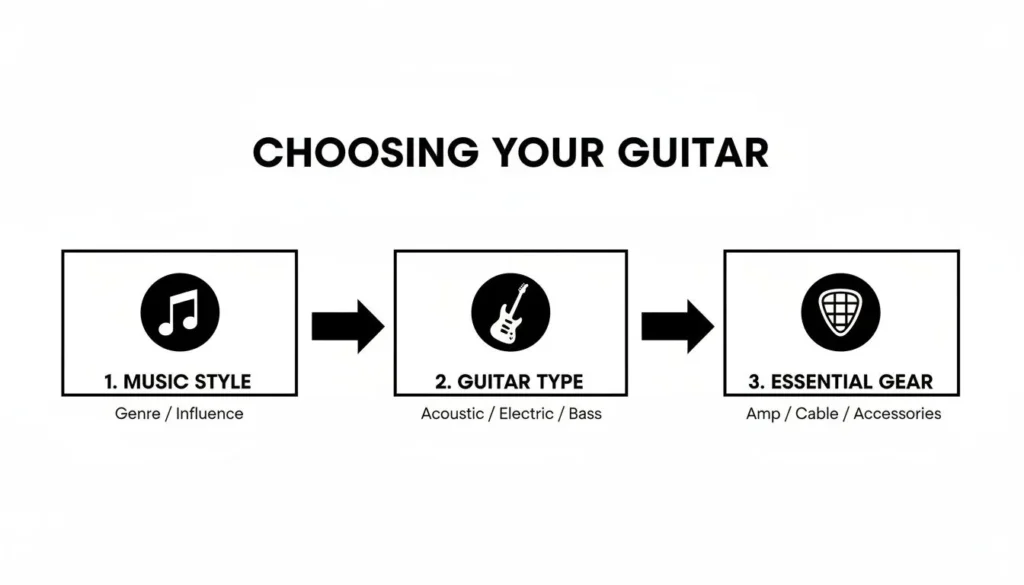
The gear you choose should always serve the music you want to make.
Learning these first few chords is a rite of passage for every guitarist. Use the table below as your guide to getting the finger placement just right.
| Your First Three Essential Guitar Chords | ||
|---|---|---|
| Chord | Finger Placement (E-A-D-G-B-e) | Pro Tip for a Clean Sound |
| G Major | 2nd finger on the 3rd fret of the low E string, 1st finger on the 2nd fret of the A string, and 3rd finger on the 3rd fret of the high e string. Strum all six strings. | Make sure the palm of your hand isn’t touching the high e string, which can mute it. Keep your knuckles bent and press with your fingertips. |
| C Major | 3rd finger on the 3rd fret of the A string, 2nd finger on the 2nd fret of the D string, and 1st finger on the 1st fret of the B string. Avoid strumming the low E string. | This one can be a stretch. Try to form a good arch with your fingers so you don’t accidentally mute the open G and high e strings below them. |
| D Major | 1st finger on the 2nd fret of the G string, 3rd finger on the 3rd fret of the B string, and 2nd finger on the 2nd fret of the high e string. Avoid strumming the low E and A strings. | Your fingers will be bunched up in a small triangle. Focus on pressing straight down with the very tips of your fingers to avoid buzzing against adjacent strings. |
Take your time with these shapes. Accuracy is far more important than speed right now.
Pro Tip: After forming a chord, take a second to pluck each string one by one. If you hear a dead “thud” or a nasty buzz, a finger is out of place. It’s either not pressing hard enough or it’s leaning on a neighboring string. Tweak your hand position until every note rings out clean and clear.
From Clumsy Fingers to Smooth Transitions
Getting a single chord to sound good is the first hurdle. The next is changing between them without a long, awkward pause. It all comes down to one thing: muscle memory. You need to drill these shapes into your fingers until they can find their way home without you thinking about it.
Here’s a simple exercise. Form a G chord. Strum it four times. Now, as slowly as you need to, switch to a C chord. Strum that four times. Finally, move to the D chord and do the same. Forget about rhythm for now. Just focus on landing each chord cleanly.
This will feel painfully slow and clunky at first, but stick with it. This is exactly how your brain builds those new neural pathways.
A great trick is to use an “anchor finger.” For example, when you switch from G to C, your first finger only has to move one string over. When you switch back, it’s an easy move. Finding these little anchors makes your hand feel much more stable and makes the whole transition faster.
Introducing Your First Strumming Pattern
Once you can switch between G, C, and D without staring at your hands the whole time, you’re ready to add some rhythm. The most common, fundamental strumming pattern in all of music is a simple down-and-up motion.
It’s often counted in four beats, with an “up” strum in between each one.
It works like this:
- Down (on beat 1)
- Up (on the “and” after 1)
- Down (on beat 2)
- Up (on the “and” after 2)
- Down (on beat 3)
- Up (on the “and” after 3)
- Down (on beat 4)
- Up (on the “and” after 4)
Try counting it out loud as you play: “1 and 2 and 3 and 4 and…”
Keep your strumming wrist loose and relaxed. The movement should come from a slight rotation of your forearm, not from swinging your entire arm like you’re chopping wood. Practice this pattern on a single chord until it feels automatic. Learning how to play guitar for beginners is all about breaking the big goal down into these small, achievable wins.
Alright, you’ve been putting in the time, your fingers are getting to know the fretboard, and you can move between G, C, and D without a major traffic jam. Now for the fun part—turning those shapes into real, actual music. This is the moment that makes all the practice worth it.
Those three chords you’ve learned—G, C, and D—are like a skeleton key. They unlock a staggering number of songs you already know and love. We’re going to use them to get you playing along to familiar tunes right away, building a small but deeply satisfying song list.
From Chords to Music
The first thing to understand is how these chords work together in the real world. A chord progression is just a fancy term for the order chords are played in a song. You’d be amazed how many hits use the exact same G-C-D progression, just with a different feel or rhythm.
Let’s dive into two classics that are perfect for beginners. The trick isn’t just knowing the chords; it’s knowing when to switch. Fire up the original recordings and really listen for the moment the harmony changes. This trains your ear and makes the whole process feel less mechanical and more musical.
Two Songs You Can Play Right Now
Here are stripped-down versions of two absolute anthems. For now, just focus on playing one measure of a simple down-up strumming pattern for each chord listed in the progression.
| Song | Simplified Chord Progression | Strumming Guide |
|---|---|---|
| “Sweet Home Alabama” by Lynyrd Skynyrd | D – C – G – G (repeat) | Play the D chord for one measure, C for one measure, then hang on the G for two full measures. Then it’s right back to the top. |
| “Leaving on a Jet Plane” by John Denver | G – C – G – C – G – C – D – D (repeat) | You’ll go back and forth between G and C three times before landing on the D chord, where you’ll stay for two measures. |
Don’t sweat it if it’s not perfect. Your number one job right now is to keep the rhythm steady. A slightly buzzy chord played on time sounds a million times better than a pristine chord played a beat late. Just keep that strumming hand moving.
There’s a magical moment for every new guitarist when they first play along with a recording and it actually sounds like the song. That feeling is the rocket fuel that will power you through the inevitable tough spots.
The Power of A Consistent Practice Habit
So, you’re playing songs. How do you get better? The answer isn’t to lock yourself away for hours on a Saturday. In fact, those long, rambling practice sessions are a classic reason beginners burn out and quit. The real secret is short, focused, daily practice.
It might sound crazy, but 15-20 minutes of focused work every single day is way more powerful than a two-hour marathon once a week. Learning guitar is all about building muscle memory, and your brain and fingers build those connections much faster with frequent repetition.
Think of it like hitting the gym. You wouldn’t expect to get in shape by doing one massive three-hour workout every Sunday. It’s the consistent, manageable sessions that build real strength and skill over time.
Designing Your Perfect Practice Routine
A great practice session needs a little structure, but it also has to be fun. If it feels like a chore, you’re not going to stick with it. Here’s a simple 15-minute plan that balances the “work” with the “play.”
A 15-Minute Daily Practice Plan:
- Warm-up (2 minutes): Start with a few simple finger stretches. Then, play each of your main chords (G, C, D) one by one, strumming slowly and checking that every note is ringing out clean.
- Chord Transition Drills (5 minutes): This is your main workout. Fire up a metronome app on your phone to a slow, comfortable speed. Pick one chord change—like G to C—and just practice that one switch for a full minute. Then move on to the next one (C to D, for example).
- Song Practice (6 minutes): Time for your reward. Pick one of the songs you’re working on and just play it. Try playing along with the original recording. The rule is: don’t stop for mistakes. Just keep up with the rhythm as best you can.
- Fun and Experimentation (2 minutes): End the session by just messing around. Seriously. Try a different strumming pattern, try to pick out a simple melody, or just make some noise you think sounds cool. This is vital for keeping your creative spark alive.
This kind of structured routine ensures you’re actively sharpening your skills while constantly reminding yourself why you started—to make music. It transforms the journey of learning how to play guitar for beginners from a daunting mountain into a series of small, enjoyable wins.
Navigating Common Beginner Frustrations
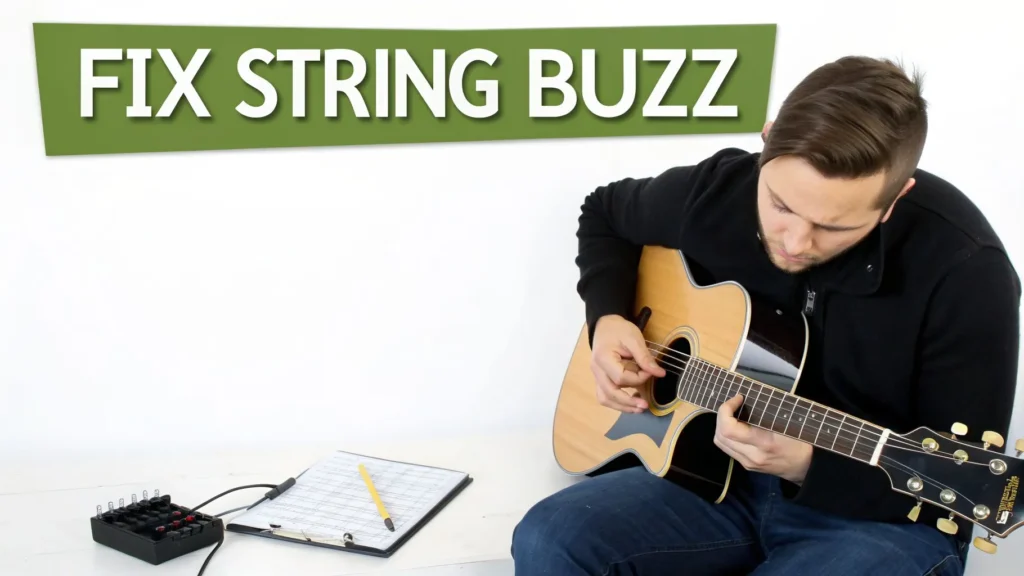
Sooner or later, every guitarist hits a wall. It’s a rite of passage. You’re going to deal with sore fingers, strings that buzz and drive you crazy, and chord changes that feel impossibly slow. This isn’t a sign that you’re failing—it’s a sign that you’re actually learning.
The real skill is knowing how to push through these common roadblocks. Instead of getting discouraged, you can learn to see them as checkpoints on your journey. Let’s walk through how to troubleshoot the most frequent issues that pop up for new players.
Dealing With Sore Fingertips
If your fingertips are tender, congratulations. This is the single most universal experience for new guitarists, and it means you’re putting in the work. Those steel strings are pressing into soft skin, but trust me, it won’t last forever.
Your body will respond by building up calluses—small, hardened patches of skin right where you need them. Think of them as your personal badges of honor. Once they form, you’ll be able to play for much longer periods without any discomfort.
To manage the initial pain and speed up the process:
- Keep your practice sessions short but consistent. 15-20 minutes a day is a great target.
- Focus on using just enough pressure to get a clean note. Pressing too hard is a common mistake.
- If the pain is sharp, take a day off to let your fingers recover. Just don’t stop for a whole week.
Remember, the pain is temporary, but the skill is permanent. The discomfort is a direct investment in your future playing.
Eliminating Annoying String Buzz
That horrible “bzzzt” can kill your motivation fast. When a string buzzes, it means something is stopping it from vibrating freely. The good news is that the culprit is almost always one of two simple technique issues.
First, check your finger pressure. You might not be pressing down firmly enough. The string needs to make solid contact with the fret wire to ring out clearly. Try applying just a little more pressure and listen for the difference.
Second, check your finger placement. Your fingertip should be placed just behind the fret wire, not in the middle of the fret or, even worse, right on top of it. This spot gives you the most leverage with the least effort. Also, make sure you’re arching your fingers so they aren’t accidentally touching—and muting—the strings next to them.
Speeding Up Your Chord Transitions
Do your chord changes feel like they’re happening in slow motion? This is where deliberate, focused practice makes all the difference. Don’t just stumble through songs and hope you get faster. Instead, isolate the chord changes and turn them into a specific drill.
Here’s a simple exercise that works wonders:
- Set a metronome to a very slow tempo, like 60 BPM.
- Pick two chords you’re working on, like G and C.
- On beat one, form the G chord. On beat three, lift your fingers and switch to the C chord.
- Concentrate on moving your fingers efficiently. Try not to lift them high off the fretboard.
- Once you can do this cleanly and in time, nudge the tempo up slightly.
This kind of targeted repetition is what builds the muscle memory you need for smooth, automatic transitions.
Winning the Mental Game
Learning an instrument is an emotional rollercoaster. Some days you’ll feel like you’re on top of the world; other days you’ll feel like you’ve made zero progress. A 2021 Fender analysis found that 1 in 4 new players felt they had stagnated, often due to frustration. You can see more in this report on new guitar players.
Staying motivated is a skill in itself. Celebrate the small wins, like nailing a tricky chord change for the first time or playing a riff without any mistakes. If you start feeling overwhelmed, it often helps to manage any underlying stress. Our guide on how to calm anxiety naturally has some great tips that can apply here, too.
Ultimately, the key is to be patient with yourself and trust the process.
Expanding Your Skills Beyond the Basics
So, you’ve played your first real song. That’s a huge moment. Once you get that first taste of making music, it’s natural to immediately wonder, “Okay, what’s next?” It’s time to build on those first three chords and start unlocking the thousands of other songs waiting for you.
The path forward is all about expanding your chord vocabulary. These new shapes will feel a little foreign at first, but each one you learn adds a new color to your musical palette, opening up a whole new world of possibilities.
Introducing Your Next Set of Chords
The next two chords every beginner should tackle are E minor (Em) and A minor (Am). They’re some of the easiest shapes to learn, and they sound incredible with the G, C, and D chords you’ve already got under your fingers.
- E minor (Em): This one couldn’t be much simpler. Place your 2nd finger on the 2nd fret of the A string and your 3rd finger right below it on the 2nd fret of the D string. That’s it. Go ahead and strum all six strings.
- A minor (Am): This shape should feel familiar, as it’s almost identical to the C major chord. Your 2nd finger goes on the 2nd fret of the D string, your 3rd on the 2nd fret of the G string, and your 1st on the 1st fret of the B string. Just remember to avoid hitting the thickest low E string when you strum.
With those two in your back pocket, it’s time to face what is often the first major hurdle for new players: the dreaded F major chord. It’s the first barre chord most people attempt, and yes, it can be tricky. The secret isn’t brute force—it’s about taking it slow and focusing on solid technique.
A Quick Tip for the F Chord: Don’t burn yourself out trying to nail the full, six-string F barre chord on day one. Start with a simplified four-string version first. This builds the necessary finger strength and muscle memory without all the initial frustration, making the full barre feel way more manageable when you get to it.
Finding Resources for Your Next Steps
As you start getting more advanced, having the right resources is key to staying motivated and making sure you’re learning things correctly. The internet is a massive place, and while there’s a ton of information out there, finding quality, accurate guitar lessons can feel like a chore.
Here are a few places to look that will actually help guide your progress:
- YouTube Channels: Seek out instructors who consistently show clear, close-up shots of both their fretting hand and their strumming hand. For learning new chords and techniques, seeing exactly what’s happening is everything.
- Chord and Tab Websites: A good tab site is an absolute must-have for learning new songs. I’d recommend finding one with a user-rating system so you can easily sort through and find the most accurate versions of songs.
- Practice Apps: Some of the gamified apps out there can make drilling chord changes and scales feel less like work and more like a game. It’s a great way to mix things up.
Eventually, you might hit a plateau or have a specific problem you just can’t solve. That’s a great time to consider finding a local guitar teacher. The personalized feedback you get from a good instructor is something you simply can’t replicate with a video or an app. They’ll spot tiny issues in your technique and give you the exact exercises you need to break through, which can really accelerate your journey of learning how to play guitar for beginners.
Your First Guitar Questions, Answered
Picking up a guitar for the first time is exciting, but it almost always comes with a flood of questions. Everyone from beginners with sore fingers to those wondering about practice schedules has the same concerns. Let’s get those out of the way so you can set some realistic goals.
Feeling a bit lost is part of the process, but trust me, the payoff is huge. Getting a handle on these basics lets you get to the good stuff: making music.
How Long Until I Can Actually Play a Song?
This is the big one, isn’t it? With steady, focused practice, you can genuinely be playing a simple, three-chord song in about four to six weeks. This assumes you’re getting comfortable holding the guitar, forming your first few chords without too much buzzing, and nailing a basic strum.
The biggest mistake is comparing your journey to someone else’s. Remember, short daily sessions are your secret weapon. Even 15-20 minutes a day builds muscle memory way faster than a single, marathon practice session once a week.
Your goal isn’t instant perfection. It’s about getting a tiny bit better every single day. A chord that buzzes a little but is strummed right on the beat sounds miles better than a perfect-sounding chord that’s a second late. Rhythm is king.
Does the Type of Guitar I Start With Matter?
Honestly, the best beginner guitar is the one that gets you excited to pick it up and play. A lot of old-school advice says to start on an acoustic, but an electric guitar is often much easier on your fingers because the strings are lighter and closer to the fretboard.
Here’s what to think about when you’re choosing:
- Your Music: Do you dream of playing acoustic folk songs or gritty electric rock? Let the music you love be your guide.
- Feel: A guitar has to feel right in your arms and hands. Go to a store and just hold a few. You’ll be surprised how different body sizes feel.
- Budget: You absolutely do not need an expensive instrument to start. There are tons of beginner-friendly guitars that play well and won’t break the bank.
At the end of the day, if you love the way your guitar looks and feels, you’ll be much more likely to stick with it.
At maxijournal.com, we believe in making learning accessible and fun. Explore our library of articles on music, arts, and more to keep your creative journey moving forward. Discover your next passion with us.
Discover more from Maxi Journal
Subscribe to get the latest posts sent to your email.