
The secret to actually learning a new language isn’t about finding the perfect app or memorizing endless verb charts. It boils down to something much simpler: Define a personal, motivating goal and build a consistent plan you can stick to. Lasting success comes from having a clear purpose—like ordering coffee confidently on your trip to Paris—not just from tapping away on your phone without a real destination in mind.
Laying the Groundwork for Real-World Communication
Before you even think about downloading an app or cracking open a textbook, there’s a critical first step. You need to lay a solid foundation. This isn’t about grammar drills; it’s about figuring out your personal “why” and picking a language that genuinely pulls you in.
Frankly, without a compelling reason to push through the tough spots, even the most sophisticated learning methods will fall flat. Your motivation is the engine for this entire journey. Are you learning Spanish for that dream backpacking trip through Patagonia? Japanese to connect with your international colleagues on a deeper level? Or maybe French to finally understand your family’s heritage? The more specific and personal your reason, the more likely you are to see it through.
Getting this part right transforms a vague wish into a clear, actionable path.
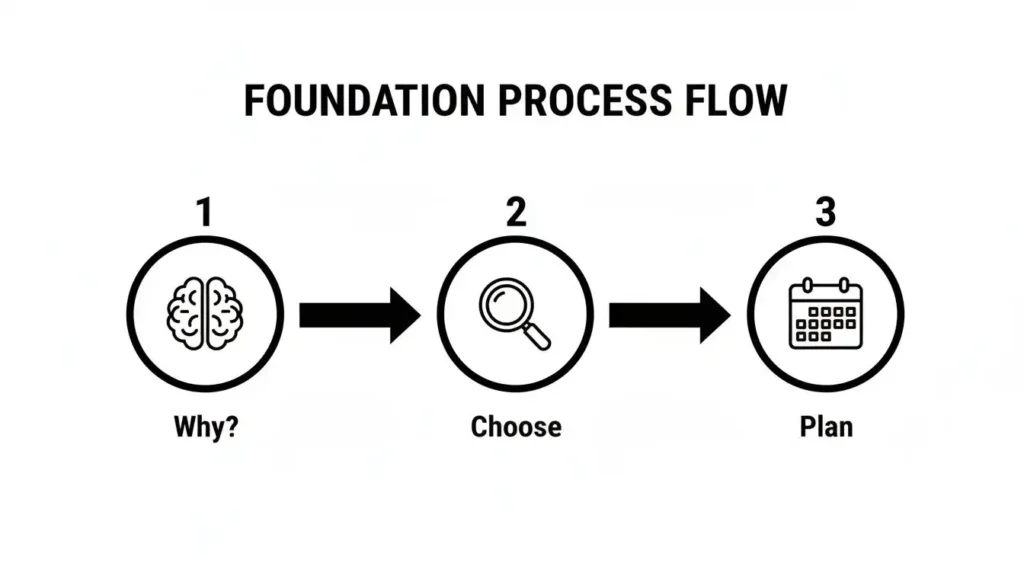
This simple framework gets you started on the right foot: begin with your Why, let that guide you to Choose the right language, and then build a realistic Plan to get there.
Pinpoint Your “Why” with a Tangible Goal
A fuzzy goal like “I want to become fluent” is almost a guarantee of failure. It’s too big and you can’t measure it. What does “fluent” even mean? Instead, frame your motivation around a specific, achievable outcome. This turns an abstract desire into a concrete project you can tackle.
Here are a few examples of goals that actually work:
- For the Traveler: “In six months, I want to be able to navigate a market in Rome, ask for directions, and order a full meal—all in Italian.”
- For the Professional: “Within three months, I need to understand the main points of a business email in German and write a simple, polite reply.”
- For the Hobbyist: “My goal is to watch a Studio Ghibli movie in Japanese with Japanese subtitles and understand 70% of the dialogue within a year.”
These goals are effective because they’re specific, they have a deadline, and they connect directly to something you actually want to do in the real world.
Choose a Language That Hooks You
Forget what’s trendy. The “best” language to learn is the one you won’t get bored of. Let your passions and career be your guide. Don’t just pick a language because it seems popular; pick one that unlocks a world you already love.
Think about it this way:
- A software developer who’s into the global tech scene might get a huge kick out of learning Korean, thanks to South Korea’s massive influence in technology and gaming.
- A chef or a serious foodie could dive into Italian or Vietnamese to read authentic recipes, watch local cooking shows, and get closer to world-renowned culinary traditions.
- A history buff might be drawn to Greek or Arabic to connect more deeply with ancient texts and historical sites on their own terms.
Your personal connection to the language is the single greatest predictor of long-term success. When the language is a gateway to your passions, study stops feeling like a chore and becomes a form of entertainment.
To help you get started, take a few minutes to fill out this simple blueprint. It’s a quick way to get your thoughts organized and create a solid starting point for your language learning journey.
Your Personal Language Learning Blueprint
| Aspect | Guiding Question | Example |
|---|---|---|
| My ‘Why’ | What specific, real-world activity do I want to do in this language? | I want to have a 30-minute conversation with my Spanish-speaking in-laws about our families and daily lives. |
| Timeline | What is a realistic deadline for this initial goal? | I want to achieve this within 9 months. |
| Passion Connection | What hobbies or interests will this language help me enjoy more? | I love watching football, so I’ll follow La Liga and listen to Spanish sports podcasts. |
| Language Choice | Which language directly connects to my ‘why’ and passions? | Spanish (Castilian, to be specific). |
| Motivation Trigger | What’s one thing I can remind myself of when I feel stuck? | I’ll picture myself at the next family dinner, laughing and chatting with everyone without needing a translator. |
This initial planning sets the stage for everything that comes next. A strong “why” makes it infinitely easier to build a sustainable study habit and powers you through the inevitable plateaus every learner faces. It’s the difference between dabbling for a few weeks and making steady, meaningful progress toward genuine communication.
The Push and Pull of Language: Input and Output

When you strip it all down, learning a new language is really just two activities. You take the language in (input), and you push it back out (output). That’s it. But knowing this is one thing; making it work for you is the real challenge.
Think of it like a diet. You need a healthy balance of both. If you only ever consume the language—say, by binge-watching foreign films—but never try to speak, you’re like someone who reads cookbooks but never actually cooks a meal. On the flip side, trying to force complex conversations before you have a decent bank of words and sentence patterns is a fast track to burnout.
The secret is finding a sustainable rhythm between the two.
Building Your Foundation with Comprehensible Input
The single most effective way to absorb a new language is to engage with material you can mostly understand. It’s a concept called comprehensible input, and the idea is simple: find content that’s just a tiny step beyond what you already know. It should be challenging enough to keep you engaged, but not so hard that you feel completely lost.
Imagine it’s your first day learning German. Would you tune into a university philosophy lecture? Of course not. You’d be overwhelmed and probably quit. But what if you found a podcast made specifically for German learners, where the host speaks slowly and uses basic words? That’s the sweet spot.
So, how do you find this magical, just-right content?
- Rewatch a movie you love, but this time with subtitles in your target language. You already know the story, so you can relax and focus on connecting the dialogue you hear and read with the action on screen.
- Find podcasts for learners. For almost any major language, there’s a huge library of podcasts designed for beginner and intermediate levels.
- Pick up graded readers. These are books written with simplified grammar and vocabulary for different proficiency levels. They let you enjoy an actual story without constantly grabbing for a dictionary.
The point of input isn’t to understand every single word. It’s about letting the patterns, rhythm, and flow of the language wash over you in a low-stress way. This consistent, understandable exposure is what builds that gut feeling for what just “sounds right.”
This is how you lay the groundwork. You’re building a mental database that you’ll draw from when it’s time for the other half of the equation.
Making Output Low-Stress and Effective
Output—speaking or writing—is where you flip the switch, turning that passive knowledge into an active, usable skill. For most people, this is the scariest part. But it really doesn’t have to be. The trick is to start small with low-stakes activities that build your confidence.
You don’t need to jump into a live video call on day one. In fact, you shouldn’t. Output can, and should, start as a private practice. Try this: open the voice memo app on your phone and just describe the room you’re in. That’s it. No one else ever has to hear it.
This simple act forces your brain to dig for words and string them together. When you get stuck on a word, you look it up, and that process of searching and finding strengthens the mental connection for next time.
Here are a few other low-pressure ways to start producing the language:
- Write a tiny journal entry. Just two or three sentences about your day. It can be as basic as, “Today I ate pasta. It was good. Tomorrow I will work.”
- Text on a language exchange app. Before you ever hop on a call, just exchange messages with a native speaker. Texting gives you time to think, compose your thoughts, and look things up.
- Narrate your life. As you go about your day, talk to yourself. “I am making coffee. Now I am adding milk.” It feels a bit silly at first, but it’s an incredibly powerful way to make the language part of your world.
Writing is an especially potent form of output because it slows everything down. For anyone who feels that familiar panic when trying to form a sentence, looking into tips on how to overcome writer’s block can actually be a huge help, even in a foreign language. This kind of deliberate practice builds the mental muscles you’ll need for more spontaneous conversations down the road.
Building Your Personalized Learning Toolkit
Alright, you’ve got your goals and your “why.” Now for the fun part: assembling the gear that will actually get you there. The language learning world is flooded with apps, courses, and fancy resources, and it’s ridiculously easy to get overwhelmed.
Let’s be clear: your goal isn’t to use everything. It’s to hand-pick a small, powerful set of tools that fit you and your life. This isn’t about following the latest trend; it’s about building a system that helps you nail your specific goals, whether that’s mastering vocabulary, understanding native speakers, or just getting the courage to speak.
What About Gamified Apps?
Look, apps like Duolingo have their place, especially when you’re just starting out. Their game-like feel is brilliant for one thing: building a daily habit. If you’re the type who struggles to just show up, the streaks and points can be the little dopamine nudge you need to get your 15 minutes in.
They’re great for drilling basic vocabulary and getting a feel for how sentences are put together. But you have to know their limits. These apps are heavy on translating isolated, often weird, sentences that don’t prepare you for the beautiful mess of a real conversation. Think of them as the launchpad, not the entire rocket ship.
Hacking Your Memory With Spaced Repetition
Beyond the cute owl, one of the most powerful weapons in any language learner’s arsenal is a Spaced Repetition System (SRS). It’s a fancy term for smart flashcards. An SRS algorithm figures out the perfect time to show you a piece of information—right before you’re about to forget it. It’s a scientifically-backed way to shove vocabulary from your flimsy short-term memory into your long-term vault.
Apps like Anki (the gold standard for serious learners) or Memrise are the most popular choices. The real secret, though, isn’t the app—it’s how you use it. Don’t just make flashcards with single, lonely words. That’s a rookie mistake. Instead, level up your cards:
- Front: “Я хочу…” (I want…)
- Back: “Я хочу выпить кофе.” (I want to drink coffee.)
- Bonus: Toss in an image of someone drinking coffee and an audio clip of a native speaker saying the sentence.
When you learn words in full sentences, you’re not just memorizing a definition; you’re absorbing grammar and context without even trying. It’s infinitely more effective.
A good SRS deck becomes your personal, hyper-intelligent vocabulary trainer. It knows what you suck at and makes you work on it, ensuring every minute of your study time is spent as efficiently as possible.
Finding Resources That Click With You
The best toolkit is a varied one. Don’t force yourself to stare at flashcards if you hate them. The key is to find what genuinely hooks you and fits into the cracks of your daily life. This is where you can get creative and make learning feel less like a chore and more like a hobby you actually enjoy.
Thanks to the digital boom, your options are endless. The global language-learning app market shot up from USD 4.21 billion in 2023 and is on track to hit USD 16.2 billion by 2033. Why? Because people want to learn on their own terms. Self-paced learning now makes up 62% of the market, proving that short, consistent sessions fit modern life better than old-school cramming. You can dig into these language learning app statistics to see the full picture.
This explosion of resources means there’s something perfect out there for you.
- Love to listen? (Auditory Learner) Find podcasts made for learners in your language. Create a Spotify playlist of music with lyrics you can follow. Listen to audiobooks of stories you already know in English.
- Need to see it? (Visual Learner) Binge-watch TV shows with target-language subtitles. Follow YouTubers from your target country. Use browser extensions that translate words on webpages as you browse.
- Learn by doing? (Kinesthetic Learner) Find a recipe in your target language and actually cook it. Stick labels on everything in your house. Get on a language exchange app and start typing and chatting with real people.
Remember, your toolkit isn’t set in stone. The Duolingo streak that got you hyped in month one might feel stale by month six. As you grow, you’ll graduate to new tools. Maybe you’ll trade the app for the challenge of understanding a native-level podcast. Check in with yourself regularly, see what’s working, and don’t be afraid to swap things out.
Creating an Immersive Environment at Home
You don’t need a plane ticket to surround yourself with a new language. The fastest way to learn is to weave it into your daily life, turning your home into a personal immersion zone where the language finds you, not the other way around.
This isn’t about blocking out hours for grueling study sessions. It starts with small, almost effortless tweaks that build on each other. The whole point is to create constant, low-effort exposure. When you integrate the language into things you already do, learning stops feeling like a chore and becomes a natural, ongoing process.
Transforming Your Digital World
Let’s be real—your phone is probably the first thing you see in the morning and the last thing you see at night. That makes it the perfect place to start.
The single most powerful first step? Change your phone’s language settings. It’ll feel weird for a day or two, sure, but you’ll adapt surprisingly fast. Suddenly, you’re learning essential vocabulary for everyday tasks like “settings,” “messages,” and “calendar” without even trying.
From there, you can pull this digital immersion into your downtime.
- Curate a new soundtrack: Build a playlist with popular artists from a country where your target language is spoken. You’ll pick up slang, rhythm, and cultural references organically. Good audio is a must here, so a solid pair of the best wireless headphones of 2026 can help you catch every little nuance.
- Join online communities: Find a subreddit or a Discord server for learners of your language. Even just lurking and reading through conversations is incredibly valuable input.
- Change your content diet: Follow news outlets, influencers, and meme accounts from your target country on social media. This gives you a real-time feed of how native speakers actually use the language today, not how a textbook thinks they do.
Bringing the Language into Your Physical Space
Your screens are just the beginning. There are tons of ways to turn your physical environment into a learning tool, creating a multi-sensory experience that reinforces what you’re picking up digitally.
A great place to start is the kitchen. Find a simple recipe online—think crepes in French or fresh pasta in Italian—and follow the instructions in the target language. Not only will you learn practical vocabulary for food and cooking, but you also get a delicious meal out of it. Win-win.
This strategy of ‘micro-immersion’ is all about lowering the barrier to entry. You’re not scheduling a two-hour study block; you’re just cooking dinner, but with a linguistic twist. This consistency is far more powerful than sporadic, intense effort.
For adult learners, this kind of consistency is everything. For instance, data shows that language app users who practice five days a week retain 80% more vocabulary than those who only study once in a while. This isn’t just about apps, either. Watching shows in a target language can boost fluency 25% faster. And for professionals, learning English is linked to a 20-30% higher employability in multinational companies. If you’re curious, you can discover more insights about the English language’s global impact and see just how much these small habits can add up.
Gamifying Your Daily Routine
To keep things from feeling stale, turn your daily habits into a game. Grab a pack of sticky notes and start labeling common household items—the chaise (chair), the fenêtre (window), the réfrigérateur (fridge). Seeing these words every single day drills them into your long-term memory without any conscious effort.
This playful approach is exactly what makes many language tools so effective. They use points, leaderboards, and streaks to build a daily habit.
This screenshot shows a perfect example of a gamified learning interface. It encourages users to complete lessons to maintain a “streak,” which is a surprisingly powerful motivator.
This kind of visual feedback turns consistency into a rewarding game, making it far more likely you’ll show up every day, even if it’s just for a few minutes.
Breaking Through Plateaus and Staying Motivated

It happens to every single language learner. You’re flying high, picking up new words, sentences are clicking, and then… bam. You hit a wall. Progress grinds to a halt, and it suddenly feels like you’re treading water.
This is the dreaded language learning plateau. It’s a completely normal part of the process, so don’t let it throw you. The trick isn’t to avoid it—it’s to see it coming and have a plan to smash right through it. If your routine feels stale or you keep tripping over the same mistakes, that’s your sign.
Don’t panic. This is where the real learning begins.
How to Know You’re Stuck
The intermediate plateau is usually the toughest. You’ve blown past the exciting “newbie gains,” where every study session felt like a massive leap forward. Now, progress is slower, harder to see, and that’s when frustration starts to creep in.
Maybe you understand plenty when you listen or read, but the words just won’t come out when you try to speak. Or perhaps you can get your point across, but you’re stuck using the same basic sentences, unable to express more complex ideas. This is your cue to shake things up.
Shaking Up Your Study Routine
When your current methods stop working, the best thing you can do is change them. Drastically. Your brain loves novelty; clinging to the same routine that got you to the plateau won’t get you past it.
Try making one of these strategic shifts:
- Go From Passive to Active: If you’ve been all about input (podcasts, TV shows), flip the script and focus on output. Commit to a week of daily, low-stakes speaking practice, even if it’s just recording voice notes for yourself.
- Switch From Digital to Analog: Sick of staring at apps? Put the phone down. Grab a physical graded reader or a magazine in your target language. The simple tactile experience can re-engage your brain in a totally different way.
- Zero In on Your Weakness: This is where a tutor or a language exchange partner is worth their weight in gold. They can pinpoint the specific grammar mistakes or pronunciation habits that are holding you back—things you might not even notice on your own.
Plateaus aren’t a sign of failure. They’re a sign you’ve outgrown your old learning methods. Think of it as leveling up—you just need a new strategy for the next stage of the game.
This is also a perfect time to explore the flexibility of digital tools. There’s a reason the e-learning market is booming—it lets you pivot your approach on a dime. The global market, valued at USD 85.1 billion in 2025, is expected to hit USD 649 billion by 2035. This growth is partly fueled by cultural waves like K-pop, which led to a 75% jump in Korean language interest in India. As you can see from how the language learning market is evolving, consistent, short bursts of learning—like the 20 minutes a day Duolingo users average—can get you to a conversational level in about six months.
Reconnecting with Your Why
Sometimes the problem isn’t your method, it’s your motivation. The long haul to fluency takes serious resilience. When you feel that drive starting to fade, you have to actively work to rebuild it.
Start by setting a tiny, almost ridiculously achievable goal for the next week. Instead of something vague like “get better at Spanish,” try “learn five new phrases for cooking and use them in a text.” Nailing that small mission gives you a quick win and starts building momentum again.
Here are a few other ways to keep the fire lit:
- Make Your Progress Visible: Keep a simple journal and write down one new thing you learned each day. After a month, look back. You’ll be floored by how much you’ve actually accomplished.
- Reward Your Milestones: Finished your first book? Had your first 10-minute conversation? Treat yourself! Positive reinforcement is a powerful, powerful tool.
- Find Your People: Join a forum, a Discord server, or a local meetup group. Sharing your struggles with people who actually get it is incredibly validating and makes the journey feel less lonely.
Ultimately, long-term motivation is tied to your well-being. If you’re burned out, it’s okay to take a break for a few days. Learning to manage your energy with good mental health and self-care tips can be the very thing that prevents you from giving up entirely. Pushing through frustration is a skill, and it’s just as important as memorizing vocabulary.
Your Top Language Learning Questions, Answered
Once you decide to learn a new language, a flood of questions usually follows. It’s easy to get bogged down by myths and doubts before you even get your footing. Let’s clear the air and tackle the most common concerns head-on.
Think of this as your personal FAQ, built from years of seeing what trips people up. We’ll skip the fluff and give you the straightforward advice you need to start with confidence.
How Long Does It Really Take to Be Conversational?
This is the big one, isn’t it? The honest answer is that it completely depends on what you mean by “conversational” and how consistently you work at it. Being able to order coffee is a world away from debating politics.
A helpful benchmark comes from the Foreign Service Institute (FSI), the folks who train U.S. diplomats. For a native English speaker, they estimate it takes about 600-750 class hours to get to a professional level in a language like Spanish. For something like Japanese, that number jumps to a staggering 2200 hours.
But don’t let those figures intimidate you. Those are for professional proficiency. Reaching a solid, everyday conversational level is a much more manageable goal. With 30-60 minutes of focused study most days, you can absolutely be having real, meaningful conversations within six to twelve months.
Can I Actually Do This with a Full-Time Job?
Yes, you can. The trick is to swap intensity for consistency. You don’t need to carve out massive, two-hour study blocks that you’ll never stick to. The secret is weaving learning into the small, unused pockets of your day.
This is where having a “learning toolkit” comes in handy. Here’s what a totally realistic schedule looks like for someone with a busy life:
- Morning Commute (20 mins): Pop on a language learning podcast.
- Lunch Break (15 mins): Knock out a quick review session on your flashcard app.
- Winding Down (25 mins): Watch an episode of a show you love in your target language (subtitles on, of course).
Just like that, you’ve clocked an hour of learning without derailing your entire evening. It’s all about being smart with the time you already have.
Should I Start by Memorizing Grammar Rules?
This is a classic debate, but the modern consensus is a firm “no.” Please, don’t start with grammar drills. Learning grammar in a vacuum is like reading a book about how to swim without ever getting in the pool. It’s abstract, boring, and ineffective.
Your journey should begin with comprehensible input—that is, listening to and reading things you can mostly understand. This lets your brain do what it does best: recognize and internalize patterns naturally. You’ll start to get a feel for what “sounds right” long before you can recite the rule for it.
Think back to how you learned your first language. Did your parents hand you a grammar textbook? Of course not. You just listened, copied, and figured it out. Embrace that same natural process.
Grammar is a tool for clarification, not a starting point. Once you have some real-world exposure, looking up a specific rule to understand why a sentence works the way it does can be incredibly powerful. But it should always be in service of your input, not the other way around.
Is It a Bad Idea to Learn Two Languages at Once?
For a total beginner, yes, this is generally a bad idea. When you’re just starting out, your brain is working overtime to build an entirely new framework—new sounds, new word order, new everything. Trying to build two of these frameworks at the same time often leads to confusion, frustration, and painfully slow progress in both.
A much smarter approach is to focus on one language until you reach a comfortable intermediate stage (often called a B1 level). By then, the language has a solid foothold in your mind and you’ve established effective learning habits.
Once you hit that milestone, picking up a second language becomes much easier. Your brain has already learned how to learn a language. Get one to a good place, then you can start thinking about adding another.
At maxijournal.com, we publish daily articles on everything from education and technology to arts and travel, giving you fresh perspectives to fuel your curiosity. For more insights and engaging reads, explore our latest posts at https://maxijournal.com.
Discover more from Maxi Journal
Subscribe to get the latest posts sent to your email.

Pingback: Essential Activities and Sites to Visit in Tokyo for 2026
Pingback: Essential Cooking Advice: 10 Tips for Kitchen Newbies
Pingback: Plan Your 2026 Itinerary with 12 Essential Travel Stops
Pingback: Effective Strategies to Enhance Reading Comprehension Skills
Pingback: 10 Key Fitness Tips for Beginners in 2026 to Start Strong