The secret to a successful salary negotiation isn’t about being a master debater. It all comes down to doing your homework before you even think about talking numbers. You need to build a rock-solid, evidence-based case for what you’re asking for.
This means digging into real market data for your role and city, figuring out your absolute bottom line, and being ready to spell out the specific value you’ll bring. When you’ve done this prep work, the conversation shifts. You’re no longer just asking for more money; you’re presenting a logical business decision.
Build Your Negotiation Case Before You Talk Numbers
Walking into a salary negotiation unprepared is like showing up to an exam you didn’t study for. The real work—and the secret to a great outcome—happens long before that first email or phone call. It all starts with building an undeniable case that justifies the compensation you deserve.
Forget those generic salary calculators that spit out vague, unhelpful ranges. Your first move is to become an expert on what the market is actually paying for someone with your skills, in your specific role, in your industry, and in your city.
Conduct Precise Market Research
To get a true sense of your market value, you have to gather hard data. Don’t rely on a single source. The goal is to triangulate your findings from a few different places to create a solid, defensible salary range.
- Analyze Job Postings: Hunt down similar roles at competitor companies. Thanks to new transparency laws, many states and cities now require salary ranges in job descriptions. Try to collect at least 5-7 solid examples.
- Use Industry-Specific Tools: Go deeper than the big job boards. Use specialized platforms like Levels.fyi if you’re in tech, or find the equivalent salary aggregator for your field.
- Talk to Recruiters: Industry-specific recruiters have their finger on the pulse of compensation trends. Even a quick, professional chat can give you priceless, real-time insights, even if you aren’t actively working with them.
Define Your Walk-Away Point
Before you can negotiate with confidence, you have to know your BATNA—your Best Alternative to a Negotiated Agreement. In simple terms, this is your absolute minimum acceptable offer. It’s your walk-away point.
Knowing this number in advance gives you an incredible amount of power. It keeps you from accepting a lowball offer out of fear or desperation.
Your BATNA isn’t just a number; it’s your source of power. It could be staying at your current job, accepting another offer, or even continuing your search. Knowing you have a viable alternative makes you a much more confident negotiator.
Craft Your Value Proposition
Finally, you need to frame your salary request as a smart business decision for them, not just a personal want for you. Put together a simple “value proposition” document for your own reference. This isn’t something you’ll necessarily send over, but it serves as your internal script and confidence booster. This is all about connecting your skills directly to the company’s needs, much like you’d learn how to write a cover letter that grabs attention.
Jot down your top three skills and link each one to a specific problem or goal the company is trying to solve. Follow that up with two or three major accomplishments from past roles, complete with hard numbers (e.g., “Increased Q3 sales by 15%,” or “Reduced customer support tickets by 20%“).
This simple exercise transforms your salary request from a “want” into a clear investment with a proven return.
Understand the 2026 Economic Climate for Salary Budgets
To get the salary you deserve, you have to understand the reality on the other side of the table. One of the biggest mistakes people make is walking into a negotiation blind to the company’s financial constraints.
When you arm yourself with a solid grasp of the economic climate, you gain a massive advantage. It allows you to ground your request in data-driven reality, not just wishful thinking.
For 2026, companies are playing it safe. Economic uncertainty has them tightening their belts, which means salary budgets aren’t as loose as they were a few years ago. This is the stage on which your negotiation will take place, and knowing the backdrop is critical.
The Reality of 2026 Salary Budgets
So, what does this caution look like in actual numbers? The data tells a pretty clear story. Recent projections show U.S. companies are planning a mean salary increase budget of just 3.6% for 2026. This continues the downward slide from 3.8% in 2024, signaling a firm grip on spending.
Why the pullback? A solid 36% of employers point directly to cost management and fears of a potential recession.
Before you start getting discouraged by these numbers, it’s important to see the bigger picture. Below is a quick comparison of projected salary increases across a few global markets.
2026 Projected Salary Increase Budgets by Country
This table offers a snapshot of how different economies are approaching compensation in 2026, based on aggregated survey data. It helps contextualize the numbers you might see in your specific region.
| Country | Projected 2026 Increase | 2025 Actual Increase |
|---|---|---|
| United States | 3.6% | 3.7% |
| Canada | 3.5% | 3.6% |
| United Kingdom | 3.9% | 4.0% |
| Germany | 3.7% | 3.8% |
| India | 8.8% | 9.0% |
| Brazil | 4.5% | 4.7% |
As you can see, while many mature markets are showing modest, slightly declining figures, high-growth regions like India continue to post much stronger numbers. For more detail, you can dig into the full 2026 salary budget report from WorldatWork.
Knowing these figures isn’t a reason to lower your expectations. Far from it. It’s a reason to be more strategic.
Understanding that the average budget is tight allows you to position yourself as an exceptional candidate who warrants an above-average investment. Your negotiation isn’t about asking for a slice of a shrinking pie; it’s about proving you’re the key ingredient they can’t afford to lose.
This is where your preparation becomes everything. The flowchart below breaks down the core components of a rock-solid negotiation strategy.
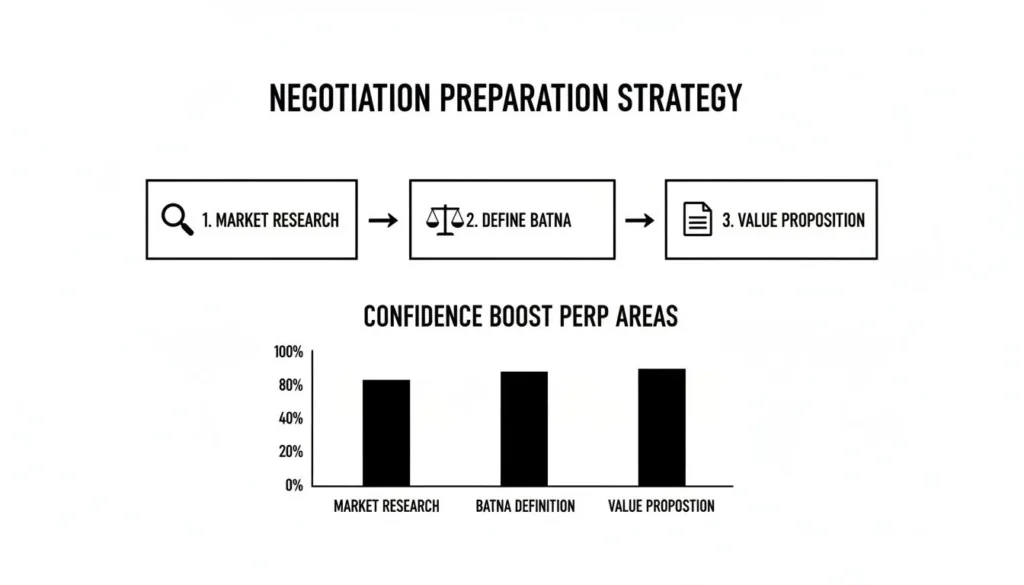
Each of these pillars—market research, defining your BATNA (your walk-away point), and crafting your value proposition—builds on the last to make an undeniable case for your worth.
How to Use This Data to Your Advantage
Even with tight budgets, there is almost always room for a standout candidate. Companies have separate budgets for merit increases and new hires. They know that to land top talent, they have to compete—even if it means stretching beyond the average increase.
This is exactly why asking for 10-20% more than the initial offer is still a smart, standard move. You just have to frame it correctly.
Here’s how to use the economic data in your favor:
- Acknowledge the Climate: Show them you’ve done your homework. A simple line like, “I understand that budgets are a key consideration across the industry right now,” demonstrates commercial awareness and immediately sets a collaborative tone.
- Pivot to Your Value: Don’t pause there. Immediately pivot to what makes you different. Frame your higher salary request not as a simple ask, but as the investment required to secure a candidate who can deliver a significant return.
- Focus on the Long-Term: Position yourself as the solution to their biggest challenges. When you do this, your higher salary starts to look like a bargain compared to the high cost of hiring a less-qualified person or restarting the expensive search process all over again.
How to Frame Your Salary Counteroffer

You’ve done the research, you know your worth, and your confidence is high. Excellent. Now it’s time to translate all that prep work into a calm, professional counteroffer. How you kick off this conversation can make or break the entire negotiation, so the key is to be strategic, gracious, but firm.
Always, always start with genuine gratitude and excitement. They chose you. They want you on their team. Kicking things off by reinforcing that shared enthusiasm keeps the entire interaction positive and makes it feel like you’re working together toward a common goal.
Whatever you do, don’t just reply to the offer email with a new number. Your immediate goal is to get them on the phone. A real conversation—phone or video—is where negotiation truly happens. It allows for nuance, builds personal rapport, and makes it a lot harder for them to give you a flat “no.”
Crafting the Initial Response
Your first email back should be prompt, but not so fast that it looks like you didn’t think about it. Giving it a day shows you’re taking their offer seriously. The only goal of this email is to say thank you and schedule a call. That’s it.
Here’s a simple, effective email script to use after you get the written offer:
“Thank you so much for the offer to join the team as [Job Title]! I’m very excited about the opportunity to contribute to [Company Name] and work with the team on [Specific Project]. I’ve had a chance to review the offer and have a few questions about the compensation package. Would you be available for a brief call tomorrow to discuss?”
This little email does a lot of heavy lifting:
- It’s enthusiastic and appreciative. You’re reinforcing your interest.
- It frames the chat as a “discussion.” This sounds collaborative, not demanding.
- It pushes for a live conversation. This is your primary objective. Don’t mention numbers yet.
Making Your Case on the Phone
Once you’ve got them on the line, stick to the same structured approach. Reiterate your excitement one more time, then smoothly pivot to the salary conversation.
The key here is to present your desired number as a logical conclusion based on data, not an emotional plea. This is where you anchor your ask to all that market research you did earlier.
You could say something like: “I’m really looking forward to getting started. As we discuss the salary, my research for [Job Title] roles here in [City] with my level of experience indicates a compensation range closer to $95,000. Based on the value I know I can bring to your team, would it be possible to get to that number?”
This approach just works. It’s not about what you want; it’s about aligning their offer with your established market value. You’re positioning it as a partnership—two parties working together to land on a number that makes sense for everyone.
How to Handle Common Negotiation Responses

You’ve done the hard part. You stated your counteroffer with confidence, backed up by all that market research. Now comes the really hard part: the silence while you wait for their response.
Rarely does a hiring manager just say, “You’ve got it!” right away. Instead, you’re much more likely to hear a common, almost scripted, rebuttal. Knowing how to field these responses is what separates a good negotiator from a great one.
The absolute key is to remain calm and listen. Their first reaction isn’t the final word; it’s just the next move in a completely normal back-and-forth. If you prepare for these common lines, you can respond with strategy instead of emotion.
When They Say the Salary Is Fixed
One of the oldest lines in the book is, “The salary for this role is tied to a fixed band,” or its close cousin, “Our compensation structure doesn’t allow for that number.” This is a classic move designed to shut down the conversation by making the salary seem completely non-negotiable.
Here’s the reality: even large companies with rigid salary bands have a range within those bands. Your job is to figure out where their offer lands and nudge it toward the top end.
Here’s a great way to respond that acknowledges their process while still probing for wiggle room:
“I appreciate you sharing that context about your compensation bands. Could you help me understand where this offer falls within the band for this level? Given my specific experience with [mention a key skill or project], I’m confident I can deliver results at the higher end of expectations.”
This approach is collaborative, not combative. You’re showing you respect their system while gently reminding them that your high value warrants compensation at the top of their own predefined scale.
When They Say It’s Their Final Offer
Hearing “this is our best and final offer” can feel like you’ve just hit a brick wall. And sometimes, you have. But often, it’s a tactic to test your resolve and see if you’ll just accept it and move on. How you respond depends entirely on your BATNA—your absolute walk-away number.
If their “final” number is still below your minimum, it’s time to express your disappointment politely but firmly. But if the number is livable—just not what you were hoping for—you can pivot the conversation.
- Acknowledge and Pivot: “Thank you for working on this and presenting the final number. While the base salary is lower than my target, I’m still very excited about the role. Given that the salary is firm, would there be flexibility to discuss a one-time signing bonus to help bridge the gap?”
- Explore Other Benefits: “I understand. Could we perhaps explore other areas of the total compensation package, like an additional week of vacation or a professional development stipend?”
This keeps the door open. By shifting the focus away from base salary, you introduce new negotiation points. Companies that are strict on salary are often surprisingly flexible on one-time bonuses or non-monetary perks because those don’t impact long-term salary budgets.
Remember, the goal is to improve the total value of the offer. Base salary is just one piece of the puzzle.
Negotiate the Full Package Beyond Base Salary
A great job offer is so much more than just the base salary. It’s the entire package—the collection of benefits and perks that support your career, your growth, and your life outside of work.
So, what happens when the hiring manager says they can’t budge on your salary request? Don’t panic. This isn’t the end of the road. It’s actually the perfect opening to pivot and negotiate the rest of the compensation package.
When you shift the focus to these other elements, you’re sending a powerful message. It shows you’re thinking about a long-term future with the company, not just chasing a bigger paycheck. It tells them you’re invested in your own productivity, growth, and how you’ll fit into their culture.
Identify High-Value Non-Monetary Perks
Before you even get on the negotiation call, you need a game plan. Make a prioritized list of benefits and perks that are genuinely valuable to you. This way, if the salary talk hits a ceiling, you can smoothly transition the conversation without fumbling.
Think about what would truly make a difference in your day-to-day. Some of the most powerful—and often negotiable—perks include:
- A One-Time Signing Bonus: This is a fantastic tool to bridge the gap if their salary offer is a little lower than your target. Companies often have more wiggle room for a one-time payout than they do for a recurring salary increase that impacts future budgets.
- Flexible or Hybrid Work: The freedom to work from home a few days a week can save you a surprising amount of money and time on commuting. It’s a huge plus for work-life balance and a benefit more employers are willing to grant.
- Professional Development Budget: Ask for a dedicated annual stipend for things like certifications, industry conferences, or online courses. This is a direct investment in your skills, which is a clear win for the company, too.
- Additional Vacation Time: An extra week of PTO can be worth more than a small salary bump, especially when it comes to preventing burnout and staying creative and energized.
Bundle Your Requests Strategically
When you bring up these non-salary items, don’t present them as a laundry list of demands. Bundle them with your salary discussion to frame the conversation around the total value of the offer. You’re showing them you’re a strategic thinker looking at the big picture.
Work-life balance is a massive priority for professionals today. In fact, new data shows 74% of employees would even consider a lower salary if it meant a better work-life balance, making perks like remote work a powerful bargaining chip. Interestingly, while U.S. salary budgets for 2026 are projected to be around 3.6-4.0%, the average increase for fully remote employees is slightly less at 3.6%. You can dig into more of the latest salary negotiation statistics on wifitalents.com. This trend suggests companies might be open to trading a bit of salary for flexibility—a classic win-win scenario.
Here’s how you could phrase it: “I understand there might be constraints on the base salary. To make the total package work for me, could we explore a signing bonus of $X to help offset the bonus I’m leaving behind, along with a hybrid schedule of three remote days per week?”
This approach gives the employer choices. They might not be able to approve every single thing, but it opens multiple doors for them to say “yes” and build an offer that you’ll be genuinely excited about. For more ideas on what to prioritize, you can also read our guide on how to improve work-life balance.
Locking in Your Offer and Getting It in Writing

You did it. After all the back-and-forth, you’ve reached a verbal agreement. It’s a huge win, but hold off on popping the champagne. You’re not quite at the finish line until every single detail is on paper and signed.
A verbal “yes” is a great indicator, but it’s not a binding contract. Your next move is simple: wait for the revised, formal offer letter. This document is your only real protection against misunderstandings or conveniently “misremembered” conversations down the road.
Don’t worry about an offer being pulled just because you asked for it in writing—any legitimate company expects and respects this step. It’s standard practice.
Reviewing the Formal Written Offer
Once that updated letter lands in your inbox, it’s time to put on your detective hat. Read every single line. Compare it against your negotiation notes. This is not the time to skim.
You need to make sure every single term you negotiated is explicitly stated. I recommend making a quick checklist and ticking off each item as you confirm it:
- Base Salary: Is the number exactly what you agreed upon?
- Signing Bonus: If a bonus was part of the deal, is the amount and payout date clearly defined?
- Performance Bonus: Are the target percentage and eligibility criteria spelled out just as you discussed?
- Vacation/PTO: Does it reflect any extra days you successfully added?
- Remote/Hybrid Work: If you agreed on a specific arrangement, like “three days remote per week,” is that policy written down?
Never assume a verbal promise will automatically appear in the final contract. If something is missing, politely point it out. You don’t need to be confrontational. A friendly email is perfect: “This looks great! Could we just add the detail we discussed about the professional development stipend?”
Sending Your Final Acceptance
Once you’ve confirmed the offer letter is 100% accurate, you can finally and officially accept. Your acceptance email should be gracious and enthusiastic, but it also serves as one last, clear piece of documentation.
In the email, reiterate your excitement and briefly summarize the key terms. For instance: “I am thrilled to formally accept the Senior Marketing Manager position with a start date of July 15th. I’m accepting the offer with the agreed-upon base salary of $95,000, a $5,000 signing bonus, and 20 days of PTO.”
This final step ensures you and your new employer are perfectly aligned from day one. It lets you walk into your new role feeling confident, professional, and ready to make an impact.
Frequently Asked Questions About Salary Negotiation
Even after you’ve aced the interviews, the final steps before signing on the dotted line can feel like a minefield. Getting caught off guard by a tricky question can throw off your entire negotiation strategy.
Let’s walk through some of the most common questions and situations you’ll face so you can respond with confidence and land the offer you deserve.
When Is the Best Time to Negotiate Salary?
Timing is everything. The absolute best time to talk money is after you have an official, written job offer in your hands.
Why? At this point, the company has already decided you’re the one. They’ve invested time, effort, and resources into the hiring process, and they want to close the deal. This is when your leverage is at its peak.
If you bring up salary too early, you risk looking like you only care about the paycheck, not the actual job. If they press you for a number before making an offer, your best move is to deflect. Try saying you’re flexible and want to understand the full scope of the role and benefits before discussing specific numbers.
What If the Company Says the Offer Is Non-Negotiable?
First, take a breath. Don’t panic. Is this a hard-and-fast company policy, or is it just a negotiation tactic? Big corporations and government roles sometimes have rigid pay bands, but for many companies, it’s an opening move.
Your goal is to acknowledge what they’ve said but pivot the conversation to other valuable perks.
Try this: “I understand the salary is firm. Given that, would it be possible to explore a one-time signing bonus or an extra week of paid time off to help bridge the gap?”
This simple script shifts the focus away from the number they won’t budge on and toward the things they can be flexible with. It keeps the conversation going and opens the door to improving the total compensation package.
Should I Tell Them My Current Salary?
The short answer is no. You should avoid sharing your current or past salary whenever you can. In many states and cities, it’s actually illegal for employers to even ask this question anymore.
Giving them your old salary anchors the entire negotiation to what you used to make, not what you’re worth on the open market right now.
Instead, pivot the conversation to your target salary for this specific role. A powerful response is, “Based on my research for similar roles with this level of responsibility, and considering my experience, I’m targeting a salary in the range of $X to $Y.”
Once you’ve secured that fantastic new salary, you can focus on making it grow. A solid paycheck is just the first step in building your financial future; learning how to start investing money is a great next move.
For more insightful articles on career growth, business trends, and personal finance, explore the content at maxijournal.com. Our daily writing provides fresh perspectives to help you stay informed and get ahead. Visit maxijournal.com to read more.
Discover more from Maxi Journal
Subscribe to get the latest posts sent to your email.