Let’s be real—no one ever plans on getting hurt. But the best athletes don’t just wait for an injury to happen and then react. They actively build a body that’s resilient enough to handle the grind, turning injury prevention into a strategic advantage for staying in the game longer and performing better.
This guide is all about shifting that focus from the sidelines to the starting line. It’s about treating prevention not as a chore, but as a core part of your training.
Developing a Prevention-First Attitude
Think of your body like a high-performance car. You wouldn’t wait for the engine to seize before getting an oil change, right? The same logic applies here. Injury prevention is about consistent maintenance and smart preparation, not just damage control.
The numbers back this up. The global sports medicine market was valued at an incredible USD 7.30 billion in 2024 and is on track to nearly double by 2033. This boom isn’t just about treating injuries; it’s fueled by a massive shift toward preventing them in the first place. You can dive deeper into the market trends in a report from Grand View Research.
This proactive mindset really boils down to a few key habits:
- Consistency over intensity: Daily mobility work and a proper warm-up will do more for you in the long run than one all-out, risky training session.
- Listen to your body: This is a skill, and it takes practice. You need to learn the difference between the satisfying ache of hard work and the sharp, warning signal of a potential injury.
- Play the long game: Progress isn’t linear. Setbacks happen. Having a long-term perspective keeps you from getting frustrated and rushing back too soon after a tweak or a strain.
“One of the most frustrating aspects of an injury is that it can make you feel powerless. And while you may not be able to heal a broken bone or torn ligament yourself, you can make conscious choices to rest when appropriate and push yourself when it feels right.”
At its heart, a solid prevention strategy is a continuous loop. It’s not a one-and-done checklist.
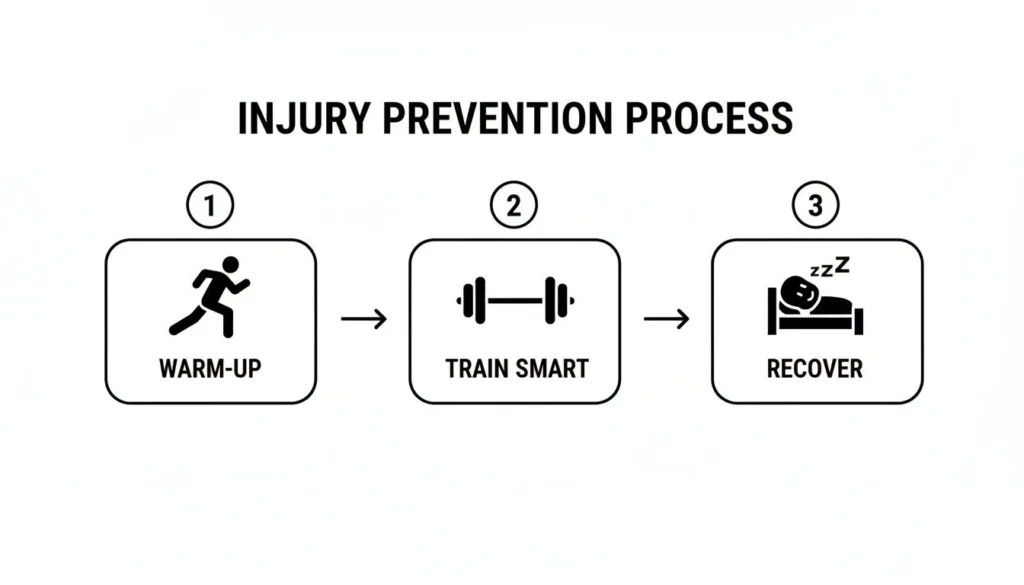
This simple cycle—warm up, train smart, recover—is the foundation of staying healthy. But the mental side is just as important. Staying tuned into your body’s signals is crucial, and mindfulness can be a powerful tool for this. In fact, learning how to meditate for stress relief can give athletes an edge in both performance and physical awareness.
Core Pillars of Sports Injury Prevention
To really get a handle on this, it helps to break down the core components. This table gives you a quick look at the fundamentals of a bulletproof injury prevention strategy and why each piece is non-negotiable.
| Prevention Pillar | Why It Matters | Key Actions |
|---|---|---|
| Warm-Up | Prepares muscles, joints, and nervous system for activity, increasing blood flow and elasticity to reduce strain risk. | Dynamic stretching, light cardio, sport-specific drills. |
| Smart Training | Builds strength and resilience in a structured way, preventing overload from sudden spikes in intensity or volume. | Progressive overload, strength & conditioning, proper form. |
| Recovery | Allows the body to repair and adapt, preventing fatigue-related injuries and chronic overuse issues. | Sleep, nutrition, active recovery (stretching, foam rolling). |
Think of these pillars as the legs of a stool. If you neglect one, the whole thing becomes unstable. A truly effective plan integrates all three into a seamless part of your athletic life.
Priming Your Body with Dynamic Warm-Ups and Mobility

We all have that mental picture: the runner on the starting line, grabbing their ankle and pulling their heel to their glute for a static quad stretch. For years, that “hold and wince” method was what warming up looked like.
We know better now. Holding a cold muscle in a stretched-out position doesn’t do much to get it ready for explosive action. In fact, some evidence suggests it can slightly reduce your power output right when you need it most.
To actually prepare your body for the stress of your sport and seriously cut down your injury risk, you need to get moving. The goal isn’t just to lengthen muscles, but to activate them. A solid warm-up gets your core temperature up, pushes blood to your tissues, and basically tells your nervous system what’s about to happen.
It’s the difference between passively stretching and actively getting ready to perform.
The Power of Dynamic Movement
A dynamic warm-up is all about taking your joints through their full range of motion, slowly ramping up the intensity. Think of it as a dress rehearsal for your workout. You’re signaling to your body what kind of work is coming, which is one of the most fundamental lessons in learning how to prevent sports injuries.
So instead of holding a hamstring stretch for 30 seconds, you’d do controlled leg swings. Instead of a static side-bend, you’d perform walking lunges with a torso twist.
These movements are just flat-out better at prepping you. They mimic what you’re about to do on the field or in the gym, lubricating your joints and improving coordination. Everything just feels smoother from the first rep.
A great warm-up doesn’t just prevent injury; it makes you better at what you’re about to do. It’s the bridge from being cold to being ready for action.
Building Your Pre-Game Routine
Your warm-up has to make sense for your sport. A powerlifter’s prep will look very different from a marathon runner’s, but the core ideas are the same. A well-rounded routine should have a few key parts:
- General Cardio: Start with 5-10 minutes of something light—jogging, cycling, jumping jacks. The mission is simple: get your heart rate up and start to break a light sweat.
- Dynamic Stretching: This is the heart of it. Focus on movements that take your major joints through their full, intended range.
- Activation Drills: These are small, focused exercises to “wake up” the muscles that tend to be lazy, like your glutes and core stabilizers.
A basketball player might do high knees, butt kicks, walking lunges, and arm circles. A weightlifter getting ready to squat, on the other hand, would probably be better off with goblet squats, hip circles, and banded walks to fire up their glutes and hips. Specificity is key.
Unlocking Your Body with Mobility Work
While your warm-up gets you ready for today’s session, mobility is your long game. Mobility isn’t just flexibility; it’s your ability to actively control your joints through their entire range of motion.
Poor mobility is a massive driver of injury. When a joint is stiff, your body finds a workaround, putting extra stress somewhere else. That’s called compensation, and it’s a recipe for disaster.
For instance, if your ankles are tight, your knees might cave inward when you squat, putting them at risk. If your shoulders are locked up, you might over-arch your low back to press something overhead, eventually leading to pain. Targeted mobility work fixes these weak links.
Essential Mobility Drills for Athletes
Try working these into your warm-ups or on your recovery days. You’ll feel the difference.
- Hip Mobility: The hips are central to almost every athletic movement. Drills like 90/90s, frog stretches, and controlled articular rotations (CARs) are fantastic for opening them up.
- Thoracic Spine (Mid-Back) Mobility: If you throw, swing, or change direction, you need a mobile mid-back. Cat-cow stretches and quadruped T-spine rotations are perfect for this.
- Ankle Mobility: Something as simple as a calf stretch against a wall or some ankle CARs can improve your ankle’s range of motion, which helps protect your knees during squats and lunges.
By dedicating just 10-15 minutes to a proper warm-up and mobility routine before you train, you’re making a huge investment in a long, healthy athletic career. You’re not just going through the motions—you’re building a more durable, resilient body.
Building a Resilient Body with Smart Strength and Conditioning

A dynamic warm-up gets your body ready for the game, but it’s smart strength training that builds a body capable of withstanding the game in the first place. It’s a simple truth I’ve seen play out time and again: stronger athletes are just harder to break. Their muscles absorb more force, their ligaments are more robust, and their joints get the support they need.
But let’s be clear—strength training for injury prevention isn’t about slapping as much weight on the bar as you can handle. It’s about building a balanced, durable physique that can meet the unique demands of your sport. Think of this as your blueprint for becoming a more resilient and powerful athlete.
This whole approach is centered on fortifying the tissues that hold you together. The best tools for that job are the foundational movements that strengthen entire patterns, not just single muscles.
Fortifying Your Foundation with Core Lifts
You don’t need a gym full of fancy machines to build an injury-resistant body. The most effective programs are almost always built on a handful of compound movements that have stood the test of time. These exercises create a strong, stable base that acts as your first line of defense against common injuries.
Three movements, in particular, form the bedrock of any solid plan:
- Squats: This is the undisputed king of lower-body exercises for a reason. It forges strength in your quads, hamstrings, glutes, and core—all critical for protecting your knees and lower back from the rigors of sport.
- Deadlifts: A true full-body powerhouse. The deadlift strengthens your entire posterior chain, from your hamstrings all the way up to your traps. This is your ticket to better posture and a fortified spine.
- Presses: Whether it’s an overhead press or a bench press, these movements build powerful shoulders, chests, and triceps. That upper-body strength is non-negotiable for stabilizing the shoulder joint, a notorious hot spot for injuries.
When you focus on mastering these lifts with perfect form, you’re essentially building structural armor. Stronger muscles become better shock absorbers, and more stable joints are far less likely to be pushed into dangerous positions. If you’re new to the gym, checking out some general fitness tips for beginners is a great way to build the confidence to get started.
The Critical Art of Load Management
Having a strong foundation is only half the battle. One of the biggest culprits behind non-contact injuries is simply doing too much, too soon. This is where load management becomes your most important skill. It’s the art and science of managing the stress you place on your body so it can adapt and get stronger, not break down.
Overtraining isn’t a sudden event; it’s a slow burn. It happens when you accumulate more fatigue than your body can recover from. So many athletes get this wrong, pushing through excessive soreness and ignoring their body’s warning signs in the name of “hard work.”
Smart training isn’t about how much you can endure. It’s about finding the minimum effective dose to trigger positive change and then recovering completely. The real goal is consistent progress, not constant exhaustion.
Managing your training load isn’t about guesswork. It means tracking your volume (sets x reps x weight), keeping an eye on your intensity, and making sure recovery is a planned part of your schedule. Winging it is a direct path to the high-risk zone for overuse injuries like tendinitis and stress fractures.
Applying Progressive Overload Safely
The core principle of getting stronger is progressive overload—the idea that you have to continually challenge your body to force it to adapt. But doing this safely is absolutely critical. I’ve seen more athletes sidelined by sudden, massive jumps in training than almost anything else.
Here’s a smarter way to apply this principle without red-lining your system:
- Increase Reps First: Before you even think about adding weight, try to add one or two more reps to your sets with perfect form.
- Add Sets Second: Once you can comfortably hit your target reps, you can add an extra set to increase your total workload.
- Increase Weight Last: Only when you’ve mastered the volume with flawless technique should you add a small amount of weight. A 5-10 pound jump is a great rule of thumb.
This methodical approach ensures you’re building real strength on a solid foundation, not just chasing bigger numbers at the expense of your health.
Another non-negotiable tool in your kit is the deload week. This is a planned week of lower training intensity and volume, usually scheduled every 4-8 weeks. It gives your nervous system and connective tissues a much-needed break to fully recover, which lets you come back stronger. It’s not a week off—it’s a strategic step back that lets you take two giant leaps forward.
Master Your Technique and Choose the Right Gear

You can be the strongest, most well-conditioned athlete on the field, but if your technique is off, you’re leaving a massive gap in your armor. Inefficient movement isn’t just sloppy—it puts dangerous stress on the wrong joints, muscles, and tissues. It’s a ticking clock for a breakdown.
Mastering your form is a cornerstone of injury prevention. Whether we’re talking about your running gait, squat form, or golf swing, every movement has an optimal path. When you repeatedly deviate from it, it’s like driving a car with misaligned wheels. Sooner or later, something’s going to give out.
Audit and Refine Your Movement
First things first: you need an honest look at what you’re actually doing. It’s almost impossible to self-correct without objective feedback because what feels right isn’t always what is right. This is where a simple video analysis can be a complete game-changer.
Just set up your phone and record yourself performing key movements from a few different angles. You might be shocked to see your knees caving in on a squat or your back rounding during a deadlift. This visual evidence is the perfect starting point for making targeted corrections.
Another powerful strategy is to work with a qualified coach. A good coach can spot subtle flaws in your form that you’d never catch on your own. Their expert eye provides the specific cues and drills needed to rebuild your movement patterns from the ground up, turning a potential weakness into a source of real strength and efficiency.
Good technique is all about efficiency. It ensures the right muscles do the work at the right time. This doesn’t just boost performance—it distributes stress evenly across your body, protecting you from overload.
Select the Right Gear for the Job
Beyond how you move is what you use to move. Your equipment, especially your footwear, is the critical interface between your body and your environment. Using worn-out or improper gear is an open invitation for injury.
Think about your running shoes. They have a finite lifespan, typically around 300-500 miles. After that, the cushioning foam breaks down and loses its ability to absorb shock, sending more impact force straight up your legs. The same principle applies to cleats with worn-down studs or a helmet that’s taken one too many hits.
Here’s a practical gear checklist:
- Footwear: Always choose shoes designed for your specific sport. A basketball shoe offers lateral ankle support that a running shoe lacks, while a running shoe is built for the cushioning needed in repetitive forward motion.
- Replacement Schedule: Track the mileage on your shoes or the hours of use on your equipment. Be proactive and replace it before it fails, not after it causes an injury.
- Protective Gear: Make sure helmets, pads, and guards fit properly and are certified for modern safety standards. Ill-fitting equipment can be just as dangerous as wearing no equipment at all.
Why Protective Equipment Matters More Than You Think
Protective gear isn’t just for preventing scrapes and bruises; it’s about mitigating the risk of serious, season-ending injuries. This has become especially true as the intensity and speed of sports continue to rise at all levels.
Interestingly, while some overall injury rates are declining, the severity of injuries is, in some cases, getting worse. A 2023 study highlighted a significant rise in head and neck injuries among high school athletes, with concussions being a primary concern. The research documented an estimated 5.2 million sports injuries in this group, with a staggering 20.9% leading to medical disqualification for the season or even for their entire career.
This trend hammers home why proper equipment is non-negotiable. You can explore more about these sports injury statistics to get a fuller picture of the risks.
Making smart choices about your technique and gear isn’t about blaming your tools; it’s about taking control of every variable you can. By refining your form and investing in the right equipment, you build a much more robust system—one that can handle the demands of your sport safely and effectively.
Make Recovery Your Top Priority with Sleep and Smart Nutrition
Athletes often obsess over every detail of their training but treat recovery as an afterthought. Here’s a hard truth I’ve learned over the years: you don’t actually get stronger on the field or in the weight room. You get stronger while you rest.
Training is the stimulus that breaks your body down. Recovery is the process that builds it back up, making it more resilient than before. Without a solid recovery plan, you’re essentially driving with the emergency brake on, accumulating fatigue that never gets a chance to clear.
This is where smart nutrition and, above all, high-quality sleep become your secret weapons for staying in the game long-term.
Sleep: Your Most Powerful Performance Enhancer
If you’re looking for a single “hack” to boost your performance and bulletproof your body, it’s sleep. It’s hands-down the most powerful recovery tool at your disposal, and it costs nothing.
When you’re in a deep sleep, your body shifts into full-on repair mode. It releases growth hormone to mend damaged muscle fibers and regulates critical hormones like cortisol and testosterone. Skimping on sleep throws that entire delicate system into chaos.
It’s no surprise that chronic sleep deprivation is directly linked to a higher risk of injury. A tired body means slower reaction times, cloudy judgment, and poor coordination—a perfect recipe for a bad step, a missed catch, or a pulled muscle.
For an athlete, getting 7-9 hours of quality sleep isn’t a luxury; it’s a non-negotiable part of your training. It’s just as crucial as your squats, sprints, and skill work.
Fuel the Machine for Repair and Resilience
Think of your nutrition plan as having two jobs: fueling your performance and powering your recovery. What you eat—and when you eat it—has a massive impact on how your body handles the stress of training and bounces back for more.
After a tough session, your body is like a sponge, ready to soak up nutrients to kickstart the rebuilding process. While the old-school “anabolic window” isn’t the 30-minute panic it was once made out to be, refueling within a reasonable timeframe is still crucial.
Your post-workout meal should be built around two key components:
- Protein: These are the literal building blocks for your muscles. Aim for 20-40 grams of high-quality protein after your workout to give your body the raw materials it needs to repair those microscopic tears in your muscles.
- Carbohydrates: Carbs are your body’s primary fuel source. Eating them after a workout is all about restocking the glycogen (stored energy) you just burned, so you’re ready to go for your next session.
It’s just like restocking a warehouse after a big order. If you don’t replace the inventory, you’ll have nothing on the shelves for the next day’s demands.
Don’t Overlook Hydration and Micronutrients
Hydration is so much more than just not being thirsty. Water is the transport system that carries nutrients to your cells, regulates your body temperature, and keeps your joints lubricated. Even a slight dip in hydration can make your blood thicker, forcing your heart to work overtime and tanking your performance.
Your tendons and ligaments, in particular, need water to stay elastic and strong. When they’re dehydrated, they become brittle and much more susceptible to strains and tears. The key is to drink consistently throughout the day—if you wait until you feel thirsty, you’re already behind.
And while protein and carbs get all the attention, tiny micronutrients do a lot of the heavy lifting behind the scenes. Antioxidant-rich foods like berries and leafy greens help fight the inflammation caused by intense exercise. Minerals like magnesium and zinc are also essential for proper muscle function and repair.
A well-rounded diet full of whole foods is the best way to ensure you’re covering all your bases, building a truly resilient body from the inside out.
Fine-Tuning Your Prevention Plan for Your Sport and Age
The big-picture principles—warming up, building strength, getting enough rest—are your foundation for staying injury-free. But to build a truly bulletproof plan, you have to get specific.
Think about it: the physical toll on a marathon runner is completely different from that of a powerlifter or a point guard. If you understand the unique demands and risks of your sport, you can zero in on the areas that need the most attention. That’s how you go from following generic advice to building a smart, personalized strategy.
A runner who logs dozens of miles a week is a prime candidate for overuse injuries like shin splints or runner’s knee. Their prevention plan has to be built around single-leg stability, strong hips, and meticulously managed mileage. A powerlifter, on the other hand, is dealing with massive, acute loads. For them, flawless technique, a rock-solid core, and serious recovery time between heavy days are what stand between them and a back or joint injury.
Targeting Your Efforts for High-Risk Sports
Some sports are just notorious for specific types of injuries. Once you know the common patterns, you can start proactively fortifying your body’s most vulnerable spots.
Take basketball and football. There’s a reason they top the injury charts. The constant sprinting, explosive jumping, and sudden changes of direction put an incredible amount of stress on the lower body. It’s no surprise that basketball alone accounted for around 4.4 million ER visits in the U.S. from 2012 to 2021—that’s 26% of all sports-related injuries.
And where do those injuries happen? A staggering 52.1% of all athletes suffer lower-body injuries, with the knees (21.8%) and ankles (18.7%) taking the biggest hit. You can dig deeper into the numbers with this breakdown of sports injury statistics.
Knowing this, let’s look at how prevention works in the real world:
For Runners (Knee & Shin Pain): The name of the game is building legs that can handle thousands of repetitive impacts. Your focus should be on strengthening the glutes and hips with exercises like single-leg glute bridges and banded lateral walks. These movements build stability and stop your knees from caving inward—a classic recipe for pain.
For Basketball & Soccer Players (Ankle & Knee Sprains): It all comes down to agility and learning how to land properly. Plyometric drills are your best friend here. Think box jumps where you focus on landing softly, and agility ladder drills to sharpen your footwork. Building up the muscles around the ankle and knee gives you the dynamic stability you need to make those sharp cuts without something giving way.
For Throwing Athletes (Shoulder & Elbow Issues): Protecting your shoulder is non-negotiable. You need a dedicated routine for your rotator cuff (using resistance bands for internal and external rotation) and scapular stability (think face pulls and rows). This work is crucial for balancing the powerful muscles you use to throw with the smaller, vital muscles that keep the joint stable.
Your sport tells you where your body is most likely to break down. Your prevention plan is how you build it up to withstand that specific stress.
To help you get started, here’s a quick look at where to focus your efforts for a few popular activities.
Common Injuries and Prevention Focus by Sport
| Sport | Common Injury Areas | Primary Prevention Focus |
|---|---|---|
| Running | Knees, shins, feet (plantar fasciitis), hips | Hip and glute strength, single-leg stability, load management |
| Soccer/Basketball | Ankles (sprains), knees (ACL tears), groin | Agility, proper landing mechanics, plyometrics, hip mobility |
| Weightlifting | Lower back, shoulders, knees | Core stability, proper lifting technique, mobility (hips/shoulders) |
| Tennis/Baseball | Shoulder (rotator cuff), elbow (“tennis elbow”) | Rotator cuff strengthening, scapular stability, technique refinement |
| Swimming | Shoulders (“swimmer’s shoulder”), back | Scapular control, core strength, shoulder mobility |
This table is just a starting point, but it shows how you can begin to think more strategically about your training. A few targeted exercises can make a world of difference.
How Your Strategy Should Evolve With Age
Injury prevention isn’t static; it needs to change as you do. The needs of a teenage athlete are a world away from someone training in their 40s or 50s.
For young athletes, the goal is to build a broad athletic foundation. They need to master fundamental movements—squatting, jumping, running, throwing—before getting too specialized. Pushing a kid into one sport year-round too early is a known cause of burnout and overuse injuries. The focus should be on developing skills and, most importantly, a love for being active, all while carefully managing their training load as they grow.
On the other hand, masters athletes (usually anyone over 35) are dealing with a different set of realities. Their bodies have more mileage, and recovery just takes longer. The priorities have to shift.
- Longer Warm-Ups: Spend that extra five or ten minutes getting your blood flowing and prepping your joints. It’s non-negotiable.
- Making Mobility a Priority: Years of repetitive movements or just sitting at a desk can leave you stiff. Dedicated mobility work for the hips, shoulders, and spine can feel like a game-changer, restoring range of motion and keeping you out of trouble.
- Smarter Recovery: This group benefits immensely from building in more rest days and paying serious attention to sleep and nutrition. This is what gives your body the resources it needs to repair tissue.
For example, a tennis player over 50 might start noticing their shoulder feels pinchy on serves. In addition to rotator cuff exercises, they should look at fine-tuning their swing to be more efficient and less stressful. We actually cover some of this in our guide to improving tennis serve techniques.
By adapting your approach to your sport and your stage of life, you’re creating a smart, sustainable plan for a long and healthy athletic career.
Got Questions? We’ve Got Answers
Even with the best game plan, questions pop up. Let’s tackle some of the most common things athletes ask about staying in the game and off the sidelines. Think of this as the practical side of injury prevention.
How Do I Know if It’s “Good Pain” or “Bad Pain?”
Learning to listen to your body is a skill, and it starts with understanding pain. We’ve all felt that satisfying, general muscle ache a day or two after a killer workout. That’s Delayed Onset Muscle Soreness (DOMS), and it’s what I’d call “good pain.” It’s a dull, widespread ache that fades away within 48-72 hours.
“Bad pain,” on the other hand, is an alarm bell. It’s usually sharp, stabbing, and you can point to the exact spot it hurts on a joint or bone. If the pain makes you wince, forces you to limp or alter your form, or simply won’t go away with rest, you need to back off immediately.
Your body doesn’t lie. Sharp, specific pain is its way of screaming “STOP!” Learning to listen is probably the single most important injury prevention habit you can build.
Seriously, How Often Do I Need a Rest Day?
There’s no single magic number, as it really depends on your sport, how hard you’re training, and your personal recovery signals. But a great rule of thumb is to schedule at least one to two rest days every week.
And remember, “rest” doesn’t have to mean becoming one with your couch. So many athletes find that active recovery—light, low-impact movement—works wonders. This could be things like:
- A slow walk or an easy spin on a bike
- Spending some quality time with a foam roller
- A gentle yoga session or some light stretching
This kind of activity keeps the blood moving, which helps clear out metabolic waste and deliver nutrients to your muscles without piling on more stress. If you’re constantly feeling run down and your motivation is tanking, that’s a huge sign you need to build more true recovery into your week.
Does Stretching After I Train Actually Prevent Injuries?
A dynamic warm-up before you start is non-negotiable. Static stretching after your workout, however, serves a different purpose. When your muscles are warm and much more pliable, holding stretches is a great way to improve your overall flexibility and range of motion over the long haul.
Better mobility absolutely plays a role in keeping you injury-free, as it helps your joints move through their full range without strain. But don’t think of it as a silver bullet. Post-workout stretching is just one piece of the puzzle, and it works best when you also nail the other big recovery factors, like getting enough sleep and fueling your body properly.
At maxijournal.com, we publish daily insights on health, sports, and science to help you perform your best. Explore more articles and join our community at https://maxijournal.com.
Discover more from Maxi Journal
Subscribe to get the latest posts sent to your email.