When it comes down to it, training your dog is really about two things: clear communication and positive reinforcement. Forget everything you’ve heard about being the “alpha.” This is about building a genuine, trusting relationship by rewarding the behaviors you want to see, not punishing the ones you don’t. The result? A confident, happy dog who is actually excited to learn.
Building Your Foundation for Success
Starting this training journey is one of the most rewarding things you’ll do with your new best friend. It’s so much more than just teaching “sit” or “stay”—you’re creating a shared language built on patience and mutual respect. This is a partnership.
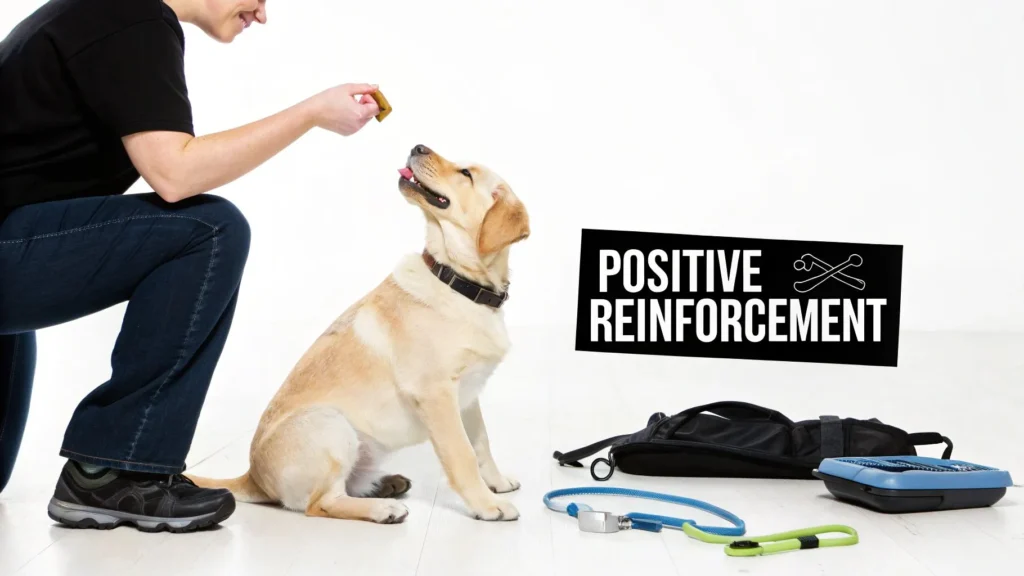
The entire philosophy we’ll be using is positive reinforcement. It’s a science-backed method that’s both simple and incredibly effective: you reward your dog for making good choices. When your pup sits when asked, they get something they love, like a tasty treat, a “good boy!,” or a quick game of tug. This simple act makes them want to do it again.
Not only is this approach more fun for both of you, but it’s also proven to be safer and more effective. Research shows that positive reinforcement can slash aggression by up to 80% compared to old-school, punishment-based methods. When you add a simple tool like a clicker, that success rate for teaching basic commands can jump to nearly 90%.
Think of yourself less as a drill sergeant and more as a coach. A well-trained dog isn’t afraid of making mistakes; they’re confident enough to try to get it right because they know good things happen when they do.
Assembling Your Training Toolkit
Before you dive in, gathering a few key items will make your sessions way more productive. You don’t need a bunch of expensive gadgets, just the right tools to keep your dog focused and motivated. Getting this stuff ready ahead of time means you can give your dog your full attention when it matters most.
Here’s a quick look at the essentials you’ll need to get started with positive reinforcement training.
| Tool | Purpose | Pro Tip |
|---|---|---|
| High-Value Treats | To motivate and reward your dog instantly. These should be extra special—not their regular kibble. | Cut treats into pea-sized pieces so you can do lots of repetitions without overfeeding. Soft treats work best for quick rewards. |
| A Clicker | To precisely mark the exact moment your dog does the right thing. | “Charge” the clicker first: click, then immediately give a treat. Repeat this 10-15 times so your dog learns that the sound means a reward is coming. |
| A Standard Leash | For control and safety during training sessions, especially outdoors. | A simple 6-foot nylon or leather leash is perfect. Avoid retractable leashes—they teach dogs to pull and offer very little control. |
| A Treat Pouch | To keep your hands free and provide immediate access to rewards. | Fumbling in your pockets is slow. A waist-pouch lets you reward your dog the second they succeed, which is crucial for clear communication. |
Having the right gear is a great first step, but remember that a successful training plan also requires a calm, focused dog.
Understanding your dog’s emotional state is a huge piece of the puzzle. If you’re working with a dog that gets easily stressed or anxious, it’s worth exploring ways to build their confidence outside of your formal training sessions. You can find some great strategies in our guide on how to calm anxiety naturally.
Teaching the Core Obedience Cues
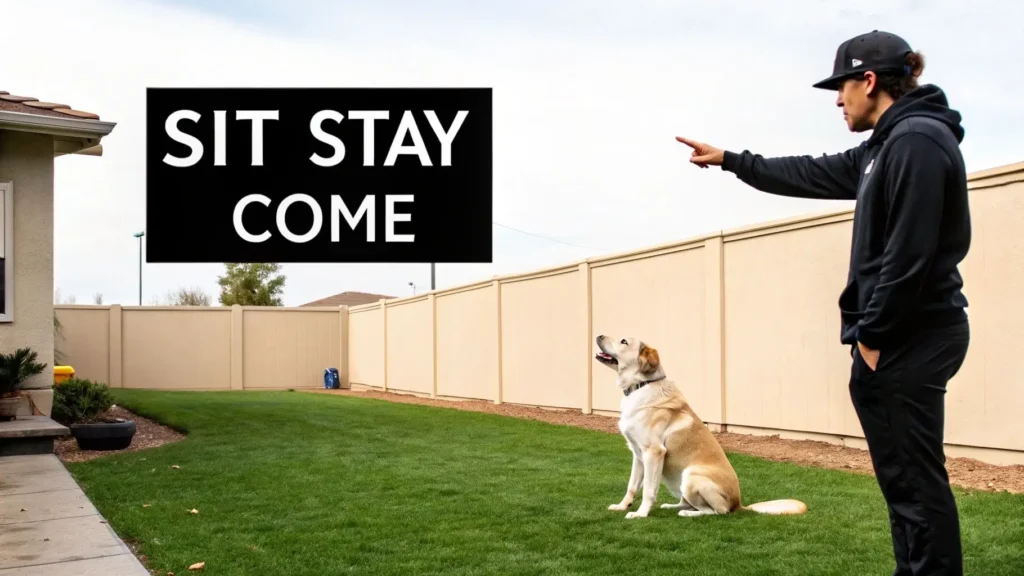
Alright, now for the good stuff—teaching the foundational commands that every well-behaved dog should know. These aren’t just party tricks; they’re the building blocks of communication and safety. When your dog masters these cues, you’re not just teaching them to follow orders, you’re building a language that strengthens your bond and can literally save their life.
The secret sauce here is keeping your training sessions short, fun, and frequent. A puppy’s brain is like a sponge, but it has a tiny attention span. Stick to multiple 5-10 minute sessions throughout the day. It’s far more effective than one long, drawn-out lesson that just leads to frustration for both of you.
Mastering the Sit Command
‘Sit’ is the classic starting point for a reason. It’s a natural position for a dog, making it relatively easy to teach, and it’s the perfect, polite default behavior. Need to put their food down without them jumping all over you? Ask for a ‘Sit’. Greeting someone on the sidewalk? ‘Sit’ keeps all four paws on the ground.
An easy way to get started is with a technique called luring. Grab a tasty, high-value treat and hold it right at your dog’s nose. Now, slowly guide the treat up and back over their head, towards their tail. As their head goes up to follow it, their rear end will naturally go down.
The instant their butt hits the floor, mark that moment with a clicker or a sharp “Yes!” and pop the treat in their mouth. Do this a few times, and then start saying your verbal cue, “Sit,” right as you begin the luring motion. It won’t take long for them to connect the word with the action.
Building a Reliable Stay
‘Stay’ is a non-negotiable safety command. This is all about teaching impulse control, and it’s what stops your dog from bolting through an open door or running toward a busy street. It takes time and a lot of patience to build duration and distance, so don’t rush this one.
Start with a ‘Sit’. Then, give your ‘Stay’ cue with a clear hand signal, like an open palm facing your dog. Take a single, tiny step back. If they hold their position for even one second, step back to them, mark it with a “Yes!”, and reward.
- Practice Scenario: The doorbell rings. Instead of a chaotic scramble at the door, you can put your dog in a ‘Sit’ and ‘Stay’ a few feet back, giving you room to welcome your guest calmly.
- Increase Difficulty Gradually: Only add more time or distance when your dog is acing the current level. If they break the ‘Stay,’ it’s not a big deal. Just calmly lead them back to their spot and try again, but make it easier this time.
Here’s a training mantra to live by: progress over perfection. Some days will feel like a massive breakthrough, while others might feel like you’ve gone backward. Celebrate every small win and stick with it. Consistency is the engine that drives reliable behavior.
The Life-Saving Come Command
If you teach your dog only one thing, make it a rock-solid recall. The ‘Come’ command has to be the best word your dog has ever heard, signaling that amazing things are about to happen. Your goal is for your dog to drop whatever they’re doing—sniffing something fascinating, chasing a squirrel—and come flying back to you.
To get this right, you can never use ‘Come’ for something negative. Don’t call them to you for a bath, a nail trim, or to go in their crate if they don’t like it. You are building a powerful history of pure positivity with this word.
Start simple, in a boring place like your living room.
- Say your dog’s name followed by an upbeat, happy “Come!”
- The second they even look your way, start praising them.
- When they get to you, throw a party! Give them an incredible, high-value treat or play a quick game of tug.
Once they’ve nailed it indoors, take it to a securely fenced yard. Always keep it positive. Always make it a celebration. This is how to train your dog to believe that you are the most exciting thing in their world. A good recall is your safety net.
Nailing House and Leash Manners
A well-behaved dog makes everything easier, turning everyday tasks into moments you can actually enjoy together. Two areas that can make or break your daily sanity are house-training and leash walking. Get these right, and you’ll build a confident dog and a much happier life for both of you.
The secret to successful house-training is simple: a predictable routine. Dogs, and especially puppies, are creatures of habit. A consistent schedule for potty breaks, lined up with the times they’re most likely to need to go, is your golden ticket.
A Blueprint for Accident-Free Living
Let’s get one thing straight: house-training is not about punishing accidents. It’s about preventing them from ever happening. By managing your pup’s world and sticking to a schedule, you set them up to win every time, which builds a positive habit loop around doing their business in the right spot.
Your schedule is your most important tool. Here are the non-negotiable times to take your dog outside:
- First thing in the morning: The very moment they wake up.
- Last thing at night: Make it the final stop before you turn in.
- After every nap: Waking up almost always means a full bladder.
- After a good play or training session: All that excitement gets things moving.
- Roughly 15-30 minutes after meals: Let their food settle, then it’s time to head out.
When you get to your designated potty spot, use a simple cue like “Go potty.” Keep them on a leash and try to stand still to limit distractions. The second they finish, throw a little party—shower them with praise and a super tasty treat. That immediate reward is what connects the dots in their brain: “Pottying outside makes amazing things happen!”
My Two Cents: Think of house-training as a management game. If you can’t have eyes on your dog, they need to be in a crate or a puppy-proofed space. Every accident inside reinforces the wrong behavior, while every success outside builds the right one.
Learning to read your dog is the other half of the puzzle. Watch for the classic signs: circling, whining, scratching at the door, or sniffing the floor like a detective on a case. The moment you spot these, drop what you’re doing and hustle them outside.
Turning Walks from a Battle into a Bond
A walk should be a chance to decompress, not a contest of wills that leaves you with a sore arm. If your dog is dragging you down the street, it’s time to teach them that walking nicely is way more rewarding than pulling.
A classic method that works wonders is the “Be a Tree” technique. As soon as your dog pulls and the leash goes taut, just stop. Plant your feet and become completely still. No yanking, no scolding—just an abrupt end to the forward motion.
The instant they ease up on the tension, maybe by glancing back or taking a step toward you, praise them and start walking again. It doesn’t take long for them to learn that pulling gets them nowhere, but a loose leash keeps the adventure going.
Another great exercise I love is the “Silky Leash” game. As you’re walking, randomly reward your dog with a treat whenever the leash is slack and they’re trotting happily by your side. This teaches them that sticking close to you is the best place to be.
Interestingly, new tech is also giving us a hand. Some innovative smart collars are showing an 88% compliance rate in leash training by using gentle vibration cues. That’s a huge leap from the 55% success rate seen with traditional methods. As this technology becomes more common, it could help owners see better results much faster. You can read the full research about these advancements in training technology to see what’s on the horizon.
Ultimately, leash training comes down to teaching your dog that you are more interesting than the rest of the world. By becoming the source of all good things—treats, praise, and the walk itself—you’ll have their focus, even when that squirrel is taunting them from a branch.
Solving Common Behavior Problems
Every dog owner has been there. That moment when you’re just completely stumped by something your dog is doing. It could be the frantic barking every time the mail carrier walks by, the heartbreaking sight of your favorite sneakers turned into a chew toy, or the muddy paw prints on your friend’s clean shirt from an over-enthusiastic greeting.
These moments are frustrating, no doubt. But the secret is to look past the action itself and figure out the “why” behind it. Most of these “bad” behaviors aren’t a sign of a bad dog at all—they’re just a dog’s way of communicating an unmet need. Think boredom, anxiety, too much pent-up energy, or simply not understanding our weird human rules. When we address the root cause, we can find solutions that build our dog’s confidence instead of creating fear.
Decoding Destructive Chewing
Walking in to find pillow stuffing everywhere or teeth marks on a table leg is a classic, especially with puppies. But here’s the thing: chewing is a perfectly normal, natural dog behavior. It soothes a puppy’s gums when they’re teething and helps adult dogs blow off steam when they’re bored or stressed.
Our job isn’t to stop the chewing entirely, but to channel it onto the right things.
Start by puppy-proofing your space. Get anything tempting—shoes, remote controls, kids’ toys—out of reach. Then, build up an awesome arsenal of “legal” things to chew. We’re talking durable rubber toys you can stuff with peanut butter or treats, dental chews, and puzzle toys that really make them think.
Make their toys the most exciting things in the room. If you see your dog eyeing the couch cushion, make a sharp noise like a clap or a firm “Ah-ah!” to interrupt them. Immediately redirect their attention by offering one of their special toys. When they take it and start chewing, lay on the praise. It’s a simple, powerful lesson: “Chewing this is great! Chewing that is not.”
Managing Unwanted Jumping
A dog who jumps on people is usually just screaming, “HI! I’M SO HAPPY TO SEE YOU!” While the intention is sweet, it can be scary for kids, knock over an older person, and is generally just bad manners. The best way to stop it is to take away the very thing they’re jumping for: your attention.
The next time your dog jumps, turn your back completely. Fold your arms, look up at the ceiling—anything to signal you’re not engaging. Don’t say a word. Don’t push them off. Just become a boring statue. The second all four of their paws are on the floor, turn back and give them some calm praise and a gentle pat.
For those really persistent jumpers, teach them what to do instead. “Sit” is the perfect alternative greeting. Have your dog on a leash when guests arrive. As the person walks up, ask for a sit. If your dog’s butt stays on the floor, they get the reward they want—attention and maybe a treat. If they jump, the person simply takes a step back, and you try again. It teaches them to think before they leap.
Key Takeaway: Unwanted behaviors are often just normal dog behaviors happening in the wrong context. Instead of asking “How do I stop this?”, try asking “What do I want my dog to do instead?”. Teaching an alternative is always more effective than punishing the mistake.
Addressing Excessive Barking and Anxiety
Barking is how dogs talk, but when it becomes constant, it can wear on your nerves and your relationship with the neighbors. The first step is to play detective and find the trigger. Are they barking at every person who walks past the window? That’s likely territorial. Do they only bark when you leave the house? That could be separation anxiety. Or is it happening randomly? Could be plain old boredom.
Understanding the motivation behind a behavior is the key to solving it.
Decoding Common Dog Behaviors
Before you can fix a behavior, you have to understand where it’s coming from. This table breaks down some of the most common issues, their likely causes, and how you can approach them with positive, effective methods.
| Behavior | Common Cause | Positive Solution |
|---|---|---|
| Jumping on People | Excitement, seeking attention, trying to greet face-to-face. | Ignore the jumping by turning your back. Reward with attention only when all four paws are on the floor. Teach “Sit” as an alternative greeting. |
| Destructive Chewing | Boredom, anxiety, teething pain (in puppies), exploration. | Provide plenty of appropriate chew toys. Puppy-proof the environment. Interrupt and redirect to a toy. Increase exercise and mental stimulation. |
| Excessive Barking | Territorial defense, boredom, separation anxiety, seeking attention. | Identify the trigger. Manage the environment (e.g., block windows). Increase mental/physical exercise. For anxiety, consult a professional for desensitization protocols. |
| Digging in Yard | Instinct, boredom, trying to escape, hunting for critters, trying to cool down. | Provide a designated “digging pit” with sand or loose soil. Increase exercise. Make the yard more engaging with toys and training games. |
| Pulling on Leash | Excitement, desire to get somewhere faster, lack of training. | Use a no-pull harness. Stop walking when the leash is tight and only move forward when it’s loose. Reward your dog for walking by your side. |
By reframing the problem from “my dog is being bad” to “my dog needs help,” you can approach training with more patience and find a solution that works for both of you.
This flowchart gives a great visual for house training, which, like any other behavior, is all about clear communication and a solid routine.
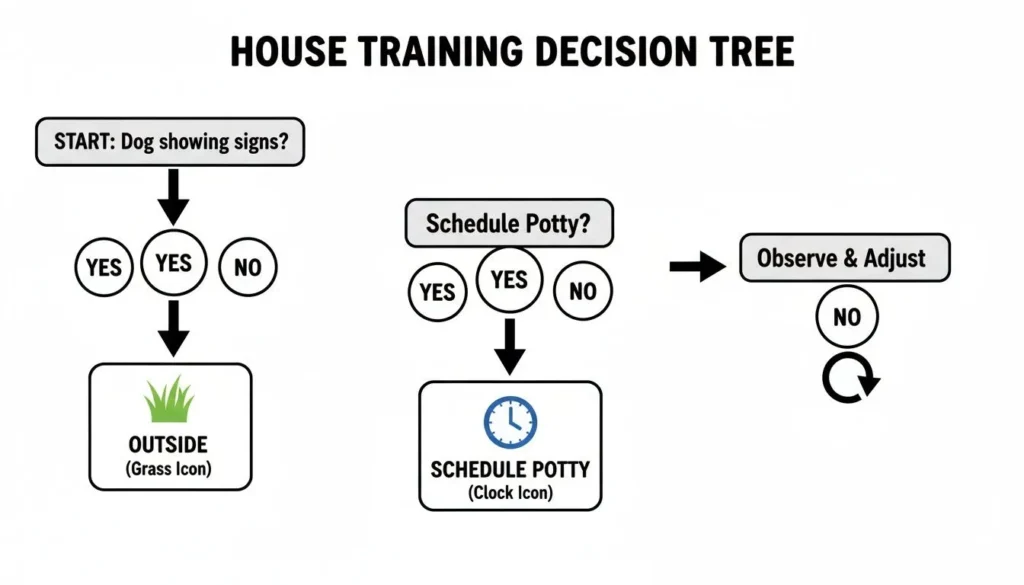
Just like the flowchart shows, success hinges on recognizing your dog’s signals and being consistent. Those same principles apply to almost any behavior you want to change.
For territorial barking, something as simple as applying frosted window film can be a game-changer. If it’s boredom, more exercise and brain games like puzzle toys are your best bet. Separation anxiety, however, is a much deeper issue rooted in real distress. It’s a huge problem—some studies suggest up to 70% of dogs show signs of it. A careful, structured plan using crate training and gradually increasing alone time can see an 82% success rate in about six weeks.
The growing awareness of these challenges is clear when you look at the industry itself. The dog training services market was valued at a whopping $27.6 billion in 2022 and is still growing. You can see more about these trends in the dog training market that show just how committed owners are becoming. At the end of the day, solving these problems isn’t about finding a quick fix. It’s about learning to see the world from your dog’s perspective and teaching them better ways to communicate in our human world.
Integrating Training into Your Daily Life
Great dog training isn’t about blocking off huge chunks of your day for formal lessons. Not at all. The real magic, the kind that creates lasting results, happens when you weave small, productive moments into the fabric of your everyday routine. The secret is turning normal activities into chances to reinforce good behavior, making it a natural part of your dog’s life.
This whole approach is often called “lifestyle training.” It’s all about moving the learning process out of structured sessions and into the real world where it actually counts. So, instead of just practicing ‘Sit’ in the living room for ten minutes, you’ll start asking for it before you put their food bowl down, before you open the door for a walk, or right before clipping on the leash. Suddenly, every little interaction becomes a mini-lesson.
Turning Routines into Reinforcement
Think about it—how many things do you already do with your dog every single day? Meal times, potty breaks, walks, and even just chilling on the couch are all prime opportunities for a little practice. By attaching a quick training moment to these already-established habits, you create consistent practice without ever adding more to your to-do list.
Mealtimes, for instance, are a golden opportunity to work on impulse control.
- Before the Bowl Goes Down: Ask your dog for a solid ‘Sit’ or ‘Down-Stay.’ Only lower the food bowl when they’re calm. If they pop up and break their stay, just lift the bowl back up and try again. It won’t take long for them to learn that polite patience is what makes the food appear.
- During Your Own Meal: Is your dog a professional beggar at the table? This is the perfect time to practice the ‘Go to Your Place’ command. Send them to their bed or a specific mat and toss them a treat every so often for staying there quietly.
These small actions, repeated daily, build incredibly powerful habits. Your dog starts to understand that good manners aren’t just for “training time”—they’re just how the world works. This kind of consistency is everything; it helps your dog generalize commands to all sorts of different situations.
The goal here is to make training invisible. It should feel less like a chore and more like a natural, ongoing conversation you’re having with your dog. This constant, low-key reinforcement is what truly solidifies behaviors for the long haul.
Getting the Whole Household on Board
One of the biggest hurdles I see in dog training is inconsistency between family members. It’s a classic problem: one person lets the dog jump up for a cuddle while another scolds them for the exact same thing. Your dog is just left confused by the mixed messages. This can seriously slow down, or even completely derail, your progress.
For any training to actually stick, everyone must use the same rules and cues. It’s non-negotiable. Get the family together for a quick meeting to get on the same page.
- Agree on the Cue Words: Is it “Down” or “Off” for jumping? “Leave It” or “Drop It” when they grab a stray sock? Decide on one and stick to it.
- Standardize the Rules: Is the dog allowed on the furniture or not? Do they get scraps from the table? (Hint: The answer to that last one should always be no!)
- Coordinate Rewards: Make sure everyone is rewarding the behaviors you want to see.
This unified front creates the clear, predictable environment your dog needs to learn efficiently. When the rules are the same no matter who is holding the leash, your dog can understand what’s expected and build confidence much faster. Plus, this consistency is fantastic for your dog’s overall well-being, both mentally and physically—a great complement to their daily exercise. If you’re looking to add more structured activity into the mix, you can find some great fitness tips for beginners that might just inspire you and your four-legged partner.
Ultimately, weaving training into your daily life is about shifting your mindset. Every walk, every feeding, every commercial break becomes another chance to practice and strengthen that amazing bond you share.
Frequently Asked Dog Training Questions
Even with the perfect training plan, you’re going to have questions. Everyone does. Hitting a wall with a stubborn behavior or just feeling unsure is a totally normal part of the process. So, let’s walk through some of the most common questions I hear from dog owners just starting out.
How Long Should My Training Sessions Be?
Keep it short, fun, and frequent. Think of it less like a marathon study session and more like a series of quick, upbeat commercial breaks.
For most dogs, and especially for puppies, 5-10 minute sessions are the sweet spot. You can sprinkle several of these throughout your day. This approach keeps your dog tuned in and excited, preventing the frustration and boredom that kills progress.
A pro tip: always end on a win. Finish with a command your dog knows inside and out, then shower them with praise and a high-value treat. This builds their confidence and makes them eager for the next session.
What’s the Best Age to Start Training a Puppy?
Honestly? The moment they walk through your door. Don’t wait. Training begins the day you bring your puppy home, which is usually around 8 weeks old.
From day one, you’re not just teaching commands; you’re teaching them how to live in your world. This is the perfect time to start with house-training fundamentals, crate acclimation, and even super simple cues like ‘Sit.’ Getting these basics down early sets a powerful foundation for everything else.
Keep in mind, the most critical socialization window for a puppy is between 3 and 16 weeks old. During this period, giving them safe, positive exposure to new sights, sounds, people, and other dogs is just as important as any formal obedience work.
What if My Dog Just Isn’t Getting It?
Hitting a plateau is common, and it usually means we need to tweak our approach. First, check your surroundings. Is the TV on? Are kids running around? Too many distractions can make it impossible for a dog to focus. Try moving to a quieter, more boring room.
Next, take an honest look at your reward. A piece of their dinner kibble might not cut it when you’re asking for something difficult. You might need to up the ante with what trainers call “high-value” treats. Think tiny bits of real chicken, cheese, or a special soft treat they only get during training.
Also, be a detective about your own signals. Are your verbal cues and hand signals crisp and consistent every single time? If you’re saying “Sit” but sometimes waving your hand differently, you could be sending mixed messages. If you’re still stuck, don’t hesitate to call in a certified professional trainer for a fresh set of eyes.
How Can I Stop My Dog From Jumping on Everyone?
Jumping is almost always an enthusiastic, albeit rude, way of saying “HI! PAY ATTENTION TO ME!” Our job is to teach them a more polite way to ask for that attention.
The secret is to teach an alternative behavior that actually works for them. Instruct your family and any guests to completely ignore your dog when they jump. That means turning their back, avoiding eye contact, and staying quiet until all four paws are on the floor. No exceptions.
At the same time, you’ll teach your dog that a calm ‘Sit’ is the magic word that makes petting and praise happen. Consistency is everything here. Every single person who greets your dog needs to be on the same page for this new polite habit to stick. For some great visual examples of your polite pup, check out our guide on how to take better photos and capture those perfect moments.
Discover more from Maxi Journal
Subscribe to get the latest posts sent to your email.