Writing a good cover letter is all about connecting the dots. Your resume lists the facts—your skills, your experience, your qualifications. But your cover letter? That’s where you tell the story. It’s your chance to go beyond the bullet points, build a direct bridge to the company’s needs, and show them the person behind the professional history.
A powerful cover letter needs a tailored introduction to grab their attention, body paragraphs packed with specific examples of your value, and a closing that projects confidence. This personal touch is often the one thing that lifts an application from the “maybe” pile straight to the top.
Why Cover Letters Still Matter in Your Job Search
Let’s be real. At some point, you’ve probably wondered, “Does anyone actually read these things anymore?” In a world of one-click applications and automated screening systems, it’s a fair question. It’s tempting to see the cover letter as an outdated formality, especially when a job posting marks it as “optional.”
But skipping it is a massive missed opportunity. Your resume is the what, but the cover letter is the why. It’s your single best shot to inject some personality, explain a career pivot, or connect your experience to the company’s problems in a way a list of past jobs never could.
The Undeniable Impact on Hiring Decisions
Don’t just take my word for it. The data shows a clear picture: cover letters aren’t just getting read; they’re actively shaping hiring decisions.
A 2023 survey revealed that a staggering 83% of hiring managers read most of the cover letters they receive, even if they aren’t required. What’s more, 94% of those managers said a strong cover letter positively influences their decision to schedule an interview. If you’re curious, you can dig into the full survey about these cover letter statistics to see the details.
This completely debunks the myth that your letter is destined for the digital trash bin. In a crowded job market, an effective cover letter is one of your most powerful tools. It helps you:
- Stand Out From the Crowd: So many applicants just fire off a generic resume. A letter tailored to the company shows you’ve done your homework and are genuinely interested.
- Tell a Compelling Story: This is your space to weave your experiences into a narrative that clicks with the company’s mission and culture.
- Address Potential Red Flags: Have an employment gap or switching industries? A cover letter is the perfect place to address it on your own terms.
- Showcase Your Communication Skills: Clear, confident, and persuasive writing is a critical soft skill in almost any role. Your letter is Exhibit A.
To put it all in perspective, here’s a quick breakdown of what makes a cover letter work.
The Anatomy of an Effective Cover Letter
This table summarizes the essential parts of a cover letter and why each one matters. Think of it as your blueprint for making a great first impression.
| Component | Purpose | Key Takeaway |
|---|---|---|
| Contact Information | Provides your name, phone, email, and LinkedIn profile for easy follow-up. | Make it professional and easy to find. |
| Greeting | Addresses the hiring manager by name to show you’ve done your research. | Personalization is key. Avoid “To Whom It May Concern.” |
| Opening Hook | Grabs the reader’s attention with a compelling statement about your value or passion. | Start strong; don’t just state the job you’re applying for. |
| Body Paragraphs | Connects your top 2–3 qualifications directly to the job description’s requirements. | Use specific examples and metrics to prove your impact. |
| “Why This Company” Pitch | Shows genuine interest in the company’s mission, values, or recent achievements. | Demonstrate that you want this job, not just any job. |
| Closing & Call to Action | Confidently summarizes your fit and expresses enthusiasm for an interview. | End with a clear, proactive statement that encourages the next step. |
Ultimately, a cover letter isn’t just another document to check off your list.
A well-crafted cover letter is a strategic conversation starter. It tells a hiring manager not only what you’ve done but also how you think and what you can contribute to their specific challenges.
Learning how to write one is a critical investment in your career. It’s what turns your application from a flat list of facts into a persuasive argument for why you’re the one they need to talk to. It’s the human element that makes all the difference.
Translating the Job Description into Your Story
Sending a generic cover letter is the quickest route to the rejection pile. Here’s the single most important thing to understand about writing a cover letter that works: it’s not about you—it’s about them. Before you type a single word, you need to put on your detective hat and dissect the job description to figure out what the company is really struggling with.
Your mission is to shift your thinking from “Here’s what I’ve done” to “Here’s how I solve the exact problems you’re facing.” This simple change transforms your letter from a boring resume summary into a compelling business case for why you’re the perfect hire.
Decoding the Company’s Needs
Think of a job description as a company’s wish list. It’s a jumble of must-have skills, daily responsibilities, and clues about their culture. Your job is to read between the lines and understand the why behind each bullet point. Don’t just scan for keywords; look for patterns.
I always recommend breaking the description down into three distinct buckets:
- Action Verbs: Look for words like “manage,” “develop,” “analyze,” or “streamline.” These verbs tell you exactly what they need someone to do and reveal the core challenges of the role.
- Required Qualifications: These are the deal-breakers, like “5+ years of experience in project management” or “Proficiency in Python.” You absolutely have to address these directly.
- Cultural Cues: Pay attention to phrases like “fast-paced environment,” “collaborative team,” or “strong sense of ownership.” These aren’t just fluff; they tell you the kind of person who will actually succeed and be happy there. This is how you show you’re a good fit, not just a good worker.
Sorting the requirements this way helps you build a targeted response instead of just listing your skills. It proves you didn’t just read the job description—you actually understood it.
Your goal is to mirror the company’s language back to them, but framed through your own unique achievements. This shows you’re not just qualified; you’re the specific solution they’ve been looking for.
From Vague Requirement to Compelling Example
This is where the magic happens. You need to connect their needs to your past successes with hard proof. This is also where most people drop the ball, making generic claims instead of showing tangible results.
Let’s look at a real-world scenario. A job posting for a Marketing Manager has this classic line: “Must be a strong team player with excellent communication skills.”
The average applicant writes: “I am a strong team player with excellent communication skills.” It’s forgettable and, frankly, proves nothing.
A top-tier applicant, however, turns that requirement into a mini-story. You might write something like this:
“In my last role, I spearheaded a cross-functional project to launch our new product line. By setting up daily check-ins with the sales, design, and engineering teams, I kept everyone aligned on our core objectives. This proactive communication led to a 15% faster time-to-market and a launch that beat sales targets by 20%.”
See the difference? This example is powerful because it:
- Shows, Doesn’t Tell: It doesn’t just claim teamwork; it shows you leading a team to a successful outcome.
- Includes Metrics: The numbers (15% faster, 20% over target) offer undeniable proof of your value.
- Addresses the Real Need: It demonstrates you can communicate effectively to drive business results, which is what they really mean by “team player.” If you’re looking to sharpen your presentation skills, our guide on how to improve public speaking offers some great tips.
This detective work is the absolute foundation of a cover letter that gets you an interview. When you meticulously analyze the job post and translate each requirement into a compelling, evidence-backed story, you make it impossible for the hiring manager to ignore you. You’re no longer just another applicant; you’re a problem-solver who’s already thinking about their business.
Once you’ve broken down the job description, it’s time to build your cover letter, section by section. Think of it less like writing a stuffy formal letter and more like assembling a powerful, persuasive argument for why you’re the right person for the job. A cookie-cutter approach just won’t work here. Every single sentence has to earn its place.
We’re going to move beyond the predictable and into territory that actually gets a hiring manager’s attention. You’d be surprised how small adjustments to your language and structure can completely change the game, turning a standard application into a compelling story they’ll want to finish.
Crafting an Unforgettable Opening Hook
Your first couple of sentences are, without a doubt, the most important. The vast majority of applicants lead with some variation of the painfully dull, “I am writing to apply for the [Job Title] position I saw on [Platform].” It’s direct, sure, but it’s also a complete waste of precious real estate. You have seconds—literally—to grab their interest.
So, instead of stating the obvious, come out swinging. Lead with your value, your passion for their work, or a direct connection you have to the company. The goal is to make the reader immediately think, “Okay, this is different. Tell me more.”
Here are a few ways to pull this off:
The Achievement Lead: Don’t bury the lede. Start with your most impressive, relevant accomplishment.
- Before: “I am writing to express my interest in the Social Media Manager position.”
- After: “Driving a 45% increase in organic engagement for a leading B2B tech brand taught me that real social media success comes from building a genuine community, not just chasing vanity metrics.”
The Passion Lead: Show them you’re invested in what they do by connecting your personal enthusiasm to their mission.
- Before: “Please accept this letter as my application for the Non-Profit Program Coordinator role.”
- After: “Ever since I started volunteering at a local food bank in college, I’ve been driven to find scalable solutions to food insecurity—a mission your organization has championed for over a decade.”
The Referral Lead: If someone recommended you, drop their name right at the start. It’s an instant credibility booster.
- Before: “I am applying for the Sales Associate position.”
- After: “My former colleague, Jane Doe, suggested I reach out about the Sales Associate opening. She was confident my experience cultivating client relationships at XYZ Corp would be a perfect match for your team’s goals.”
Each of these revised openings immediately tells the hiring manager something critical about you: you deliver results, you genuinely care about their work, or you’re already a known quantity. That’s infinitely more powerful than a generic intro.
Building the Body with the PAR Method
You’ve hooked them—great. Now, the body of your letter is where you back it all up with proof. This isn’t the time to just rehash your resume or list job duties. You need to demonstrate your impact using a simple but incredibly effective framework: Problem-Action-Result (PAR).
The PAR method helps you frame your accomplishments as mini-stories, which makes them far more memorable and persuasive than a dry list of responsibilities. For each key requirement you pulled from the job description, structure your experience like this.
- Problem: Briefly set the stage. What was the challenge or situation?
- Action: Get specific. What steps did you personally take to tackle it?
- Result: Quantify the outcome. Use numbers to show the positive impact.
The PAR method transforms your story from “I was responsible for…” to “I achieved X by doing Y.” You sound less like a passive employee and more like an impact player.
Let’s look at how this works for a Project Manager role that calls for “improving team efficiency.”
Weak Example: “I was responsible for managing project timelines and ensuring tasks were completed on schedule. I am proficient in Asana and have strong organizational skills.”
PAR Example: “My previous team was struggling with missed deadlines because of a disorganized workflow (Problem). I took the lead on implementing and customizing an Asana-based project tracking system, then ran training sessions to get the whole team on board (Action). Within three months, we cut our missed deadlines by 40% and boosted our on-time project delivery rate to 95% (Result).”
See the difference? The second example doesn’t just claim skills; it shows them in action, solving a real business problem and delivering a measurable win. That’s what hiring managers are desperate to find.
This flowchart breaks down the analysis you need to do before writing, so you can pick the right problems to highlight.
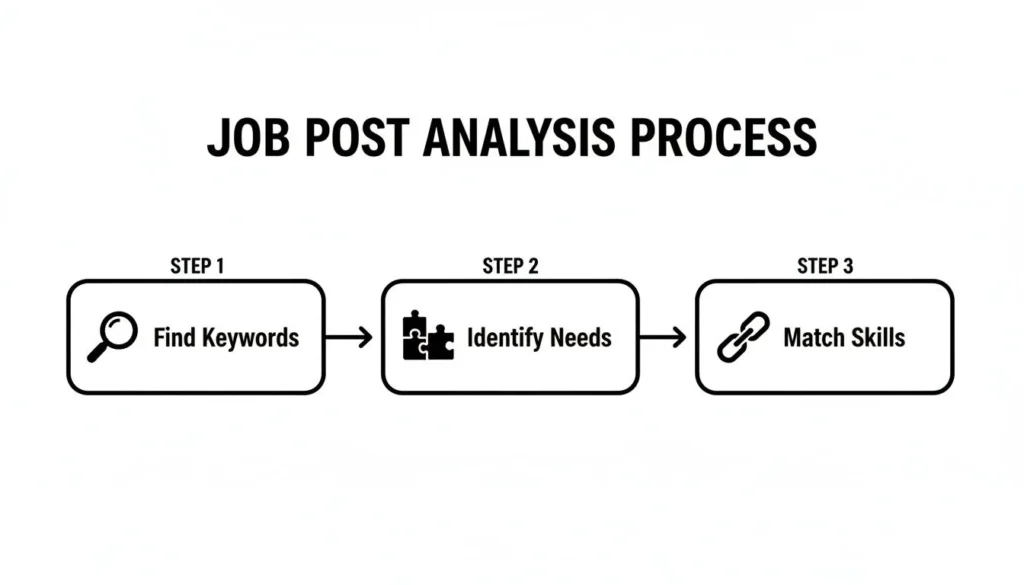
This process ensures that the achievements you share are laser-focused on the company’s pain points and the exact keywords from the job post.
Closing with Confidence and a Clear Call to Action
Your final paragraph needs to tie everything together with a confident, forward-looking tone. The goal is simple: restate your interest, give them one last reminder of your core value, and make it incredibly easy for them to take the next step.
Steer clear of weak, passive closings that leave the ball entirely in their court. Phrases like “I hope to hear from you soon” or “Thank you for your time and consideration” are polite, but they have zero punch.
You want a closing that is both professional and proactive. A strong call to action signals that you’re genuinely excited and ready to dive deeper into the conversation.
Here’s a quick comparison:
Weak Closing: “Thank you for reviewing my application. I have attached my resume for your review and hope to be considered for this position. I look forward to hearing from you.”
Strong Closing: “I am confident that my experience in streamlining workflows and driving team efficiency can make a direct impact on your department’s success. I’m eager for the opportunity to discuss how my approach to project management can help your team achieve its upcoming goals. Thank you for your time and consideration.”
The stronger closing reinforces your key selling point (“streamlining workflows”), directly connects it to their success, and expresses enthusiasm for a specific discussion. It’s a confident, professional way to end your letter, leaving a lasting impression that practically begs for an interview invitation.
Finding Your Voice and Keeping It Concise
You’ve got the structure down and your best achievements are ready to go. Now for the tricky part: the vibe. Tone and length are the subtle but powerful elements that can either draw a hiring manager in or push them away. A letter packed with amazing accomplishments can completely fall flat if it sounds arrogant, robotic, or is just too long to bother with.
Finding the right voice is a balancing act. You need to project confidence without being boastful, and come across as professional but not stiff. The sweet spot is letting your personality peek through while maintaining a tone of respect and competence.
Matching Your Tone to the Industry
There’s no single “correct” tone for a cover letter. It all depends on the company culture. A letter for a strait-laced financial firm will sound completely different from one for a fast-and-loose tech startup. The real skill is adapting your language to mirror the environment you’re hoping to join.
- For Corporate or Formal Roles (Finance, Law, Government): Keep it traditional and professional. Stick to formal language, steer clear of overly casual phrases, and highlight accomplishments that show you’re stable, precise, and reliable.
- For Creative or Startup Roles (Tech, Marketing, Design): You have a lot more freedom to be conversational. Here, showing your passion, creativity, and collaborative spirit is often just as crucial as your technical skills. A more relaxed and enthusiastic voice can really make you stand out.
Think of it this way: your tone should make the hiring manager feel like you’d fit right in from day one. Do a little digging on the company’s website, LinkedIn, and social media to get a feel for how they communicate.
The Power of Brevity
In the world of hiring, less is almost always more. Recruiters are drowning in applications, and a dense, full-page letter is a one-way ticket to the “skim” pile—or worse, the trash. Being concise is a skill in itself. It tells the reader you respect their time and can communicate effectively.
The trend toward shorter letters is undeniable. A recent survey found that 66% of job seekers now believe the ideal cover letter is half a page or less. This data signals a huge preference for brevity, with just 1% thinking a letter should ever go over a single page. If you’re having trouble trimming things down, our article on how to overcome writer’s block has some great strategies.
Aim for a punchy, impactful letter between 150 and 300 words. This forces you to focus only on your most relevant achievements and ensures every sentence works hard to sell your value.
Practical Tips for Cutting the Fluff
Editing is where a good cover letter becomes a great one. The goal is to slice away every word that isn’t doing heavy lifting, leaving behind only the strongest, most compelling language. Think of it as writing with a scalpel.
Here are a few ways to start trimming:
- Kill the Filler Words: Ditch phrases like “I believe,” “I feel,” “in my opinion,” and “due to the fact that.” They add zero value and just take up space.
- Use Strong Action Verbs: Swap passive phrases for active ones. Instead of “I was responsible for managing the team,” just say “I managed a team of five…” It’s direct and confident.
- Combine Choppy Sentences: Look for places where you can merge related ideas into a single, more elegant sentence.
- Read It Out Loud: This is the ultimate test. If you stumble over a sentence or run out of breath, it’s a clear sign it’s too clunky or long. The hiring manager will trip over it, too.
By being ruthless in your editing, you’ll create a polished letter that’s easy to read and hard to ignore. It shows you’re a clear, confident communicator who gets straight to the point—a trait that’s valuable in any job.
Real Cover Letter Examples You Can Actually Use
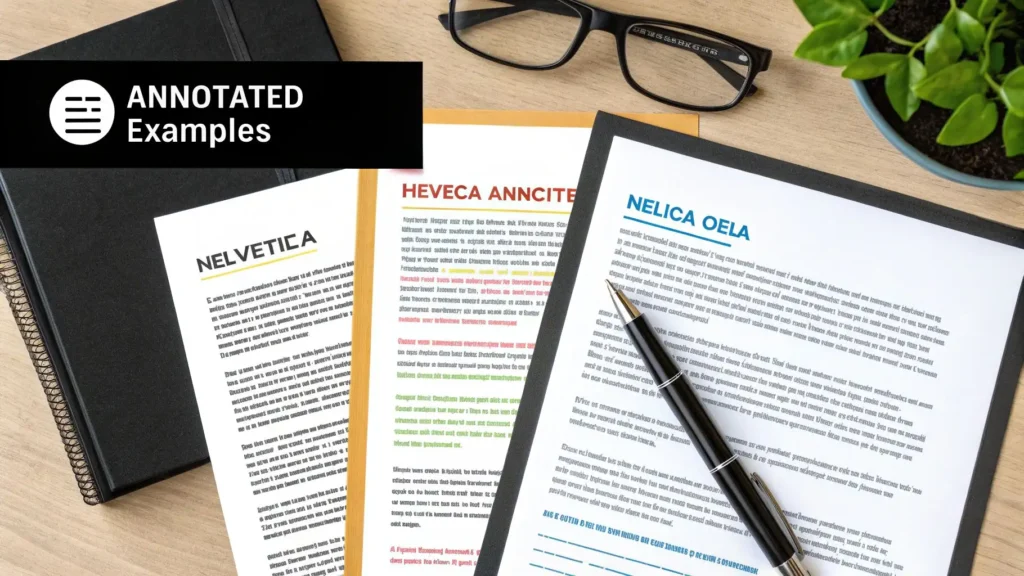
Knowing the theory is one thing, but seeing it play out in the real world is where the magic happens. It’s easy to talk about a “strong hook” or the importance of tailoring your message, but what does that actually look like on the page?
To bridge that gap, I’ve put together three distinct cover letter examples. Each one tackles a common career situation and comes with annotations breaking down why certain phrases and structures land so well. Think of these less as templates and more as annotated blueprints you can borrow from for your own job search.
Example 1: The Career Changer
Let’s start with one of the toughest challenges: switching careers. Imagine a teacher, Alex, trying to move into a corporate training role. The biggest hurdle is always connecting your past experience to the new job’s needs in a way that makes perfect sense to the hiring manager. This is how you build that bridge.
The Scenario: Alex has 8 years of experience as a high school English teacher. He’s applying for a “Learning and Development Specialist” position at a tech company that emphasizes creating engaging training materials and boosting employee performance.
Subject: Former Educator with a Passion for Developing Talent
Dear [Hiring Manager Name],
For eight years, I’ve specialized in transforming complex information into digestible, engaging lesson plans that have consistently lifted student performance by over 15%. I’m excited to bring this expertise in curriculum design and performance metrics to the Learning and Development Specialist role at InnovateTech.
(Why this works:) The opening immediately reframes “teaching” into corporate-speak. Words like “curriculum design” and “performance metrics” directly address the job’s core functions and show Alex understands their world.
At Northwood High, I did more than just teach; I developed a new digital literacy program that was adopted district-wide, training 50+ teachers on its implementation. This involved assessing knowledge gaps, creating targeted training modules, and tracking progress—skills that I see are central to this role.
(Why this works:) Alex uses a specific, quantifiable achievement. Training “50+ teachers” is a perfect substitute for training employees, making his experience feel incredibly relevant.
My passion lies in helping people unlock their potential. I am confident my ability to foster engagement and measure learning outcomes will help your team build a world-class training program. I am eager to discuss how my unique background can bring a fresh perspective to InnovateTech.
(Why this works:) The closing is confident and forward-looking. It ties his personal motivation directly to the company’s goals and ends with a clear call to action.
Example 2: The Recent Graduate
When you’re fresh out of college, you’re selling potential, not a long track record. The key is to leverage academic projects, internships, and any hands-on experience to prove you’re ready to contribute from day one.
The Scenario: Maria just graduated with a Marketing degree and is applying for an entry-level “Marketing Assistant” role. The company wants someone proactive, great with social media, and quick on their feet.
Subject: Marketing Graduate Eager to Drive Your Social Engagement
Dear [Hiring Manager Name],
As the project lead for my senior capstone, I developed and executed a digital marketing campaign for a local non-profit that increased their Instagram engagement by 300% in just three months. I’m thrilled by the opportunity to bring that same hands-on energy and results-driven approach to the Marketing Assistant position at Creative Solutions.
(Why this works:) Maria leads with her most impressive, relevant achievement. That 300% metric is impossible to ignore and instantly validates her skills.
During my internship at BrightLocal, I was tasked with analyzing competitor social media strategies. I created weekly reports that identified key content trends, which our team used to pivot our own content calendar. This led to a 25% increase in follower growth over one quarter.
(Why this works:) This paragraph proves she has real-world experience beyond the classroom. It shows she can think strategically and contribute to team goals.
I’ve been a follower of Creative Solutions’ innovative campaigns for years, and I am keen to learn from the best. I am confident my skills in content creation and data analysis will make me a valuable addition to your team. I am available to discuss my qualifications further at your earliest convenience.
(Why this works:) The closing demonstrates genuine, specific interest in the company, setting her apart from candidates who are just blasting out applications.
Example 3: The Experienced Professional
Once you have years of experience under your belt, the game changes. Your cover letter isn’t about listing every job you’ve ever had; it’s about curating your biggest wins and aligning them with the strategic needs of the role you want.
The Scenario: David is a Senior Project Manager with 10+ years of experience. He’s applying for a “Director of Operations” position where the main goal is to streamline processes and manage large-scale company projects.
Subject: Senior PM with a Decade of Experience in Process Optimization
Dear [Hiring Manager Name],
In my current role as Senior Project Manager at Global Corp, I led an initiative that overhauled our production workflow, resulting in a 20% reduction in project costs and a 30% improvement in delivery times. I believe my expertise in driving operational efficiency is an ideal match for the challenges of your Director of Operations position.
(Why this works:) David’s opening is all about high-impact results. He immediately positions himself as a strategic problem-solver who saves money and time—exactly what a Director of Operations does.
My leadership experience extends to managing cross-functional teams of up to 25 people and overseeing budgets exceeding $5 million. I am particularly proud of successfully navigating a complex software migration project that came in under budget and ahead of schedule, with zero downtime.
(Why this works:) Here, he demonstrates the scale of his experience. Mentioning budgets over $5 million and teams of 25 people clearly communicates he’s ready for a director-level role.
I am deeply impressed by your company’s commitment to sustainable growth. I am confident that my strategic planning and process improvement skills can help accelerate that mission. I look forward to discussing how I can contribute to your continued success.
(Why this works:) The closing feels like a conversation between peers. It’s confident, connects his skills to the company’s high-level mission, and sets the stage for a strategic discussion, not just an interview.
Common Cover Letter Questions Answered
Even with the best game plan, you’re bound to run into a few tricky situations when you sit down to write. From wrestling with word counts to figuring out what to do with an anonymous hiring manager, let’s clear up some of the most common questions that trip people up.
Getting these little details right can make all the difference, giving you the confidence that your application is as polished as it can be.
How Long Should a Cover Letter Be?
Keep it short and punchy. The sweet spot for a modern cover letter is between 250 and 400 words. That usually lands you somewhere between half and three-quarters of a single page.
Hiring managers are busy, and they appreciate you getting straight to the point. A long, rambling letter that just rehashes your resume is a surefire way to lose their attention.
Stick to a simple, powerful structure:
- A killer opening to grab their attention.
- One or two body paragraphs highlighting your most relevant wins.
- A confident closing that tells them what you want next.
This approach keeps your message tight, focused, and respectful of their time.
What if I Can’t Find the Hiring Manager’s Name?
It happens more often than you’d think. You’ve dug through the company website, scoured LinkedIn, and stared at the job posting until your eyes blurred, but a name is nowhere to be found.
Whatever you do, please avoid dusty, generic greetings like “To Whom It May Concern” or “Dear Sir or Madam.” They scream “I didn’t try very hard.”
Instead, go with a professional, title-based salutation. It shows you still put in the effort to be specific. Good alternatives include:
- “Dear Marketing Department Hiring Manager”
- “Dear Senior Analyst Search Committee”
- “Dear Head of Product Development”
This move shows you’re resourceful and keeps the tone professional.
A targeted greeting, even without a specific name, shows you’re thinking like a problem-solver. It proves you went the extra step that many other applicants simply won’t.
Is It Okay to Use AI to Write My Cover Letter?
Using AI as a writing partner? Smart. Letting it write the whole thing for you? A big mistake.
AI tools are fantastic for brainstorming a few opening lines, catching an embarrassing typo, or suggesting a stronger verb to make a sentence land better. Think of it as a helpful assistant.
The problem is that purely AI-generated text almost always sounds robotic and soulless. It can’t tell your unique career story, fake genuine enthusiasm, or pick up on the subtle cultural cues that show you’re a perfect fit. Use AI to polish your draft, but the heart and soul of the letter have to be 100% you.
Job searching is stressful enough, so finding ways to manage that pressure is a valuable skill. Learning how to calm anxiety naturally can genuinely help you navigate the process with a clearer head.
Should I Bother Writing One if It’s Optional?
Yes. A thousand times, yes.
Think of an “optional” cover letter as a secret opportunity. It’s a direct invitation to leapfrog over the huge pile of applicants who will take the easy way out and skip it. When a hiring manager is staring at two nearly identical resumes, the one with a thoughtful, personalized letter is going to win every single time.
This is your one real shot to tell a story, explain why you’re fired up about this specific company, and connect your skills to their mission. A resume just can’t do that. Don’t waste the opportunity.
Discover more from Maxi Journal
Subscribe to get the latest posts sent to your email.