
Think of your author bio as more than just a footnote at the end of an article or on a book jacket. It’s your digital handshake, your first impression. Let’s be real: in a sea of writers, this little block of text is often the first thing agents, publishers, and readers look at to decide if you’re worth their time.
When it’s done right, an author bio is a powerful tool. It can build instant credibility and turn someone just browsing into a loyal fan.
A good bio doesn’t just list facts about you—it sells your story. It’s your prime opportunity to forge a real connection with your audience, showing off both your expertise and your personality. And in today’s publishing world, that’s more critical than ever.
Why Your Bio Matters More Than Ever
The explosion of self-publishing has completely changed the game, making a sharp author bio a non-negotiable for anyone who wants to get noticed. Self-published authors now account for a staggering 30-34% of all book sales in major English-speaking markets. That’s some serious competition.
For independent writers, a compelling bio can be the difference-maker. You can dig deeper into these trends in the latest WIPO report on the global publishing industry.
This isn’t just about book sales, either. It’s about every single platform where you show up as a writer. Think about it:
- Amazon Author Page: Your bio is right there next to your books. It gives readers a reason to trust you and maybe even click to see what else you’ve written.
- Guest Post Submissions: An editor at a publication like maxijournal.com will glance at your bio to quickly gauge your credibility before they even get to your pitch.
- Social Media Profiles: On platforms like X or Instagram, a punchy bio can be what convinces someone to follow you instead of just scrolling on by.
An effective author bio does three things really well: it informs, it persuades, and it connects. It tells people who you are, convinces them you know your stuff, and makes you seem like a real person they’d want to know.
The Foundation of a Strong Bio
So, before we jump into the nitty-gritty of writing, let’s talk about what makes a bio work. It’s all about striking the right balance between professional accomplishments and relatable, human details. You’re not just rattling off a resume; you’re telling a micro-story about who you are.
A bio for a sci-fi novelist who also happens to be an astrophysicist is going to have a completely different vibe than one for a debut romance author who loves to bake. And that’s exactly how it should be. Both can be incredibly effective because they’re authentic to the writer and their audience.
The goal is to build trust while being memorable. Ultimately, your bio is an invitation. You’re welcoming readers into your world and giving them a reason to stick around.
Crafting the Core Elements of Your Bio
Every powerful author bio is built from the same handful of ingredients. Before you even think about writing, you need to get these core components lined up. It’s like prepping your mise en place before cooking; it just makes the whole process smoother and the final result a heck of a lot better.
Forget generic advice. We’re talking about a clear blueprint here. This means figuring out how to show off your credentials, weave in your personality, and nail down your niche. Let’s break down exactly what you need to gather for maximum impact.
Start with Your Strongest Credentials
Your credentials are the bedrock of your authority. They’re the hard facts that tell readers, editors, and agents that you actually know what you’re talking about. This isn’t the time to be modest—it’s about building instant trust.
Start by making a list of your most relevant accomplishments. What makes you the perfect person to be writing this book or article?
- Formal Education: Got a degree or certification directly related to your topic? Use it. A Ph.D. in marine biology is a must-have for a non-fiction book on ocean life, but maybe not so critical for a historical romance.
- Professional Experience: Have you worked in the industry you’re writing about? A former detective writing a crime thriller has instant credibility that money can’t buy.
- Publishing History: Mention any previous publications, especially if they’re with known outlets. This could be other books, articles in respected journals, or even a widely-read blog.
- Awards and Recognition: If you’ve won an award, been a finalist, or hit a bestseller list, that goes right at the top. This is pure gold in terms of social proof.
Even a debut author can establish authority. Something like, “Jane Doe is a software engineer with over a decade of experience at leading tech firms,” immediately gives her weight for a sci-fi novel about AI, even without a single book to her name yet.
Inject Your Unique Personality
Credentials build trust, but personality is what builds a real connection. People want to connect with a human, not a resume. This is your chance to let your voice shine through and make yourself someone they remember.
One small, well-chosen personal detail can make your bio so much more engaging. It makes you relatable and helps you stand out from a sea of authors who all sound the same.
Your bio is a micro-story about you. A touch of personality transforms it from a dry list of facts into something that resonates with readers on an emotional level.
Think about what makes you tick. A sci-fi author who’s also an amateur astronomer adds a cool layer of authentic passion. A food blogger who mentions their ongoing quest to find the world’s best taco just feels more genuine and approachable.
A few ideas to get you started:
- A quirky hobby that connects to your genre.
- A quick mention of where you live, especially if it’s relevant to your writing.
- A fun fact that hints at your sense of humor or unique perspective.
This is also where you control the tone. A humor writer’s bio better be funny. A thriller writer’s bio could have a touch of mystery. Aligning your personality with your genre is a smart way to build your author brand. For authors growing a newsletter, this personal touch is exactly what convinces people to sign up. You can learn more about how to build an email list in our deep-dive guide.
Clearly Define Your Niche
Last but not least, your bio has to clearly state what you do. Who do you write for, and what do you write about? A vague bio like “John Smith is a writer” is a massive missed opportunity. You have to be specific.
Nailing your niche helps the right readers find you and tells them exactly what to expect. It acts as a filter, pulling in your ideal audience while politely telling others this might not be for them—and that’s a good thing.
Your niche statement should be tight and crystal clear. For instance:
- “…a fantasy author who writes epic tales inspired by Norse mythology.”
- “…a business writer focused on helping startups scale sustainably.”
- “…a poet whose work explores the intersection of nature and technology.”
This level of detail is crucial. A tech writer’s bio will lean on their technical expertise and publications in industry journals. A fantasy novelist, on the other hand, will highlight their world-building skills and previous novels. By gathering these three core elements—credentials, personality, and niche—you’ll have everything you need to build a bio that feels authentic and works hard for you.
Adapting Your Bio for Different Platforms
Your author bio is definitely not a one-size-fits-all kind of deal. Think of it more like a chameleon. The punchy, 280-character blurb that gets traction on social media would look flimsy and out of place on your book jacket or personal website. To really connect with readers, you have to learn how to adapt your core message for maximum impact, no matter where you are.
It all comes down to thinking strategically about each platform’s audience and its purpose. Someone browsing Amazon is a potential customer. A connection request on LinkedIn is a professional peer. Each one needs a slightly different touch when it comes to the bio’s length, tone, and what you’re asking them to do next.
Your Bio on Professional and Social Platforms
Let’s start with the places where professional networking and casual chatter live side-by-side. Platforms like LinkedIn, X (formerly Twitter), and Instagram each have their own unwritten rules for what makes a good bio.
LinkedIn is essentially your digital resume, so the tone needs to be professional and focused on your accomplishments. This is the perfect spot for a polished, third-person bio that highlights career milestones, industry expertise, and maybe a few speaking gigs. Your goal here is to establish yourself as a thought leader in your field.
Social media, on the other hand, is all about that personal touch.
- For X or Instagram: A short, first-person bio usually hits the right note. It feels more direct and conversational, which is exactly what you want when you’re trying to build a community.
- Show Some Personality: Don’t be afraid to inject a bit of humor, mention a quirky hobby, or use emojis that reflect your author brand. This is your chance to be relatable and human.
This is the perfect playground to experiment with your voice. You can also use this space to link out to your other profiles, creating a more connected web presence. A strong social media game can seriously boost your author platform. If you need some pointers, we’ve got a helpful guide on how to increase engagement on Instagram.
Tailoring Your Bio for Publishing Contexts
When it comes to the publishing world, the stakes can feel a bit higher. The bio you craft for your Amazon page, a guest post, or your own website is there to do a specific job: either build your credibility or drive sales.
Your Amazon Author Page is prime real estate. Anyone who lands there is already curious about your work. Your bio should be written in the third person and stick to around 100-200 words. The key is to blend your credentials with a dash of personality, giving readers a reason to trust your storytelling and maybe even check out your other books.
The bio has become an essential credibility tool in a crowded market. With an estimated 0.01% of books selling over 100,000 copies, your bio is a critical way to stand out. The sweet spot is a 100-200 word bio in the third person that includes specific stats (like “guest on 10 podcasts”) and a clear link to your portfolio. This simple strategy has been shown to boost submission acceptance rates by as much as 25% for journals covering a variety of topics.
The image below breaks down the core elements you should be balancing every time you write a bio.
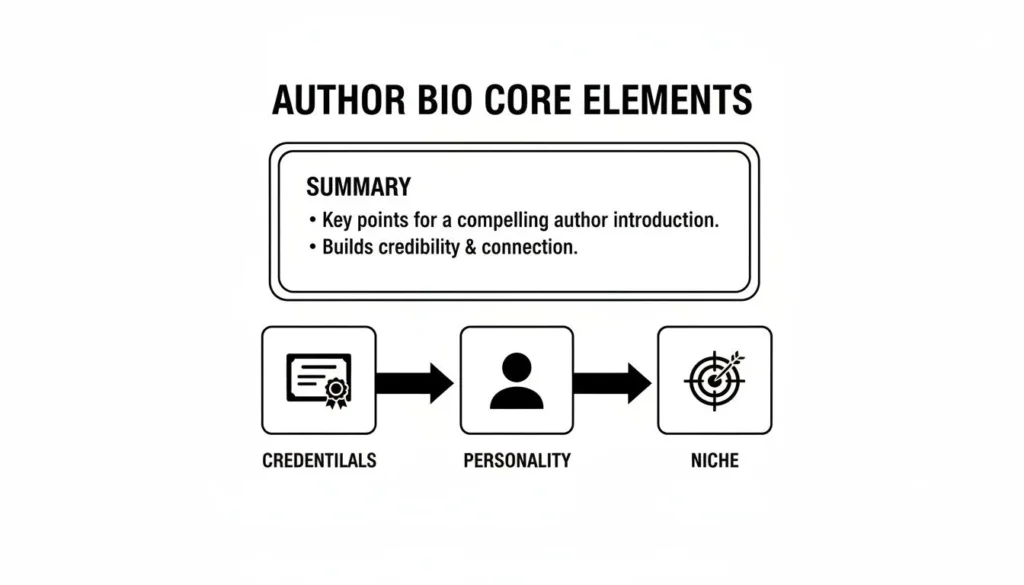
As you can see, every solid bio finds the right mix of credentials, personality, and niche focus to create an introduction that actually works.
For guest post bylines, you have to be much more concise—we’re talking just 25-50 words. Its main job is to establish your authority on the topic of the article and drive some traffic back to your home base. Always wrap it up with a clear call-to-action, like “Read more from Jane at her website” or “Find her new book, [Book Title], on Amazon.”
Finally, your personal website’s “About” page is where you have the most freedom. You can actually have a couple of versions here: a quick bio for the homepage and a longer, more detailed first-person story on the dedicated about page. This is your opportunity to tell your full story, share the ups and downs of your writing journey, and connect with your readers on a much deeper level.
A platform-specific bio shows you understand your audience. It signals that you respect their time and are there to provide value, whether that’s through a professional connection, an entertaining read, or an expert opinion.
To make this a little easier to digest, here’s a quick-glance guide for adapting your bio across different platforms.
Author Bio Adaptation Guide for Different Platforms
This table breaks down how to tweak your bio based on where it will be seen, covering everything from word count to your main objective.
| Platform | Ideal Length (Words) | Point of View | Key Focus | Example Call-to-Action |
|---|---|---|---|---|
| Amazon Author Page | 100-200 words | Third Person | Building reader trust and showcasing your catalog of work. | “Explore all of John’s fantasy novels here.” |
| LinkedIn Profile | 50-150 words | Third Person | Professional achievements, industry expertise, and career history. | “Connect with me to discuss collaborations in tech.” |
| Guest Post Bylines | 25-50 words | Third Person | Establishing immediate topic authority and driving traffic. | “Download her free writing guide at authorwebsite.com.” |
| Personal Website | 250+ words | First or Third | Telling your personal story and building a loyal community. | “Sign up for my newsletter for exclusive updates.” |
Once you master the art of adaptation, you can ensure that every bio you write is working as hard as possible to open doors, build your brand, and connect you with the right audience.
Writing Your Author Bio from the Ground Up
Staring at a blank page trying to summarize your entire career can be daunting, but building your bio from scratch doesn’t have to feel like a root canal. The trick is to stop trying to write the perfect sentence right out of the gate.
Think of it more like building with LEGOs. First, we’ll dump all the pieces out on the floor. Then, we’ll sort through them and start clicking them together to create something that actually looks like you.
This approach helps you sidestep that initial paralysis. If you’re really feeling stuck, our guide on how to overcome writer’s block has a few more tricks to get the words moving.
For now, let’s just start by making a list. No editing, no judging.
Brainstorm Your Unique Story
First things first: create a master document—a “brag sheet,” if you will—of everything that makes you you. This isn’t your bio. It’s the raw material you’ll pull from later. Forget about sounding polished for a second and just get everything down.
Your list should be a mix of the professional and the personal:
- Credentials and Experience: What degrees or certifications do you have? List any relevant jobs, past or present. Did you spend 10 years as a journalist, work as a software engineer, or teach high school biology? Get it all on the page.
- Accomplishments: Note any awards you’ve won, bestseller lists you’ve hit, or impressive publications you’ve been featured in. This could be anything from a major literary prize to a short story published in your favorite online journal.
- Life Experiences: Think about the unique experiences that shape your writing. Maybe you trekked through the Andes while researching your adventure novel or worked as a vet tech before penning your cozy mystery series. These are the details that add texture and authenticity.
- Personal Interests: What do you geek out about? Jot down your hobbies and passions. Are you an amateur astronomer, a competitive baker, or an avid kayaker? These are the humanizing tidbits that make you relatable.
At this stage, more is definitely more. You’re just collecting all the puzzle pieces. We’ll decide which ones to use later.
Crafting a Compelling Opening Line
That first sentence is everything. It has to hook the reader and immediately establish who you are and what you do. It’s your elevator pitch, distilled into a single, punchy line.
If you’re already an established author, leading with your biggest accomplishment is a no-brainer.
Example: “Blake Crouch is a bestselling novelist and screenwriter, known for his mind-bending thrillers like Dark Matter and Recursion.”
This opener is fantastic because it instantly signals genre, success, and specific books readers might recognize. Credibility, established.
But what if you’re a debut author without a laundry list of awards? No problem. You can craft an equally strong opening by leaning into your professional identity or unique expertise.
Example: “Jane Doe is a Professor of Anthropology at UCLA and author of the forthcoming novel Bloodlines: The Legacy of American Family Trauma.”
This approach immediately positions her as an expert on her topic, giving her book instant authority. Your goal is to give the reader a compelling reason to trust your voice from the very first word.
Weaving a Cohesive Narrative
With your brainstormed list in hand and a killer opening line, it’s time to assemble the body of your bio. The secret here is to be selective. Don’t just throw facts at the reader; weave them into a micro-story where every detail serves a purpose.
Just ask yourself one simple question for every detail you consider adding: Does this build my credibility or help me connect with my ideal reader?
For example, a Yale historian who mentions spending a decade researching World War II is directly reinforcing their authority for a historical novel set in that period. On the other hand, a cozy romance author who mentions living in a cottage with her two mischievous cats is building a relatable, on-brand persona.
Your bio isn’t just a list of facts; it’s a curated narrative. Choose details that align with your author brand and strategically guide the reader’s perception of who you are and why your work matters.
This is also your chance to add that final, personal touch that makes you memorable. A single, well-chosen detail—a witty one-liner or a mention of where you live—can turn a dry CV into something genuinely human.
Example: “She lives in Toronto with her husband and son, where she’s perpetually in search of the city’s best coffee.”
That simple closing line makes the author feel like a real person. It adds a layer of warmth and relatability that invites readers to connect, which is exactly what a great author bio is all about.
Author Bio Templates and Real-World Examples
Theory is great, but let’s be honest—sometimes the best way to figure out what to write is to see what other people are doing successfully. When you’re staring at a blank page, a little inspiration goes a long way. That’s what this section is all about.
We’re going to move from simple, fill-in-the-blank structures you can use right now to real-world examples from authors who are nailing it. We’ll pick apart their bios to see what makes them tick, looking at their hooks, the personality they inject, and how they get you to click that “follow” button.
Fill-in-the-Blank Author Bio Templates
Think of these as your starting blocks, not a rigid set of rules. Just plug in your details where you see the brackets, and you’ll have a solid draft ready to be polished.
1. The Short Bio Template (Under 50 words)
This one is your go-to for social media profiles, article bylines, or anywhere else where every character counts.
Template: [Full Name] is a [Your Role, e.g., novelist, journalist, historian] who writes about [Your Niche]. They are the author of [Most Notable Work] and live in [City/State]. Find more of their work at [Your Website].
Example in Action: Maria Chen is a tech journalist who writes about the human side of artificial intelligence. She is the author of The Digital Ghost and lives in Austin, TX. Find more of her work at mariachenwrites.com.
2. The Standard Bio Template (50-100 words)
This is the workhorse. It’s perfect for the back of your book, your Amazon author page, or when you’re being introduced as a speaker.
Template: [Full Name] is the [award-winning/bestselling] author of [Genre] novels, including [Book Title 1] and [Book Title 2]. With a background in [Relevant Experience/Degree], their work explores themes of [Key Themes]. They have been featured in [Publication/Media Outlet]. [Full Name] lives in [Location], where they [Fun Personal Detail]
Example in Action: David Reed is the award-winning author of historical fiction novels, including The Last Scribe and Echoes of Rome. With a background in classical archaeology, his work explores themes of power and legacy in the ancient world. He has been featured in History Today. David lives in Philadelphia, where he attempts to grow Roman-era herbs in his garden.
3. The Long Bio Template (100+ words)
Save this longer version for your website’s “About” page or a press kit. It gives you the space to really tell your story and make a connection.
This longer format allows you to weave a narrative, connecting your professional credentials with your personal journey. It’s your best opportunity to build a deeper connection with your most engaged readers.
- Template: [Full Name] writes [Genre] stories that [Describe Your Mission or Style]. Their passion for [Topic] began when [Short Origin Story]. They pursued this interest by [Educational/Professional Milestone], which led to the publication of their [debut/latest] book, [Book Title]. Their work has earned [Awards/Recognition]. In addition to writing, [Full Name] enjoys [Hobby 1] and [Hobby 2]. They live in [Location] with [Family/Pets]. Connect with them on [Social Media Platform].
Real-World Examples Deconstructed
Now, let’s break down a few bios from the wild to see exactly why they’re so effective.
Example 1: The Non-Fiction Expert (Amanda Ripley)
“Amanda Ripley is an investigative journalist and a New York Times bestselling author. Her latest book is High Conflict: Why We Get Trapped and How We Get Out.”
- Why It Works: This bio is a masterclass in efficiency. It kicks off with two heavy-hitting credentials: “investigative journalist” and “New York Times bestselling author.” Right away, you know she’s a credible expert. The book title itself clearly defines her niche, telling you exactly what to expect from her work. No fluff, all substance.
Example 2: The Fiction Powerhouse (Blake Crouch)
“Blake Crouch is a bestselling novelist and screenwriter. His novels include Upgrade, Recursion, Dark Matter, and the Wayward Pines trilogy, which was adapted into a television series for FOX.”
- Why It Works: This is all about social proof. He doesn’t just say he’s a bestseller; he lists his well-known titles to prove it. The mention of the FOX television adaptation is the real power move here—it’s a massive signal of credibility that tells you his stories are compelling enough for a huge audience.
Example 3: The Guest Contributor
For anyone writing guest posts, the bio is your bridge for turning one-time readers into long-term followers. A solid formula starts with a key credential, hooks them in the middle with your specific niche, and finishes with a clear call to action.
This strategy is what helps many of the 2,000+ indie authors on Amazon hit the $100,000 earnings mark, taking advantage of the high 60-80% royalty rates that come with self-publishing. As online book sales are expected to double by 2034, bios loaded with social proof are becoming the norm, especially on multi-genre hubs like maxijournal.com. You can dig into more book sales statistics to see just how big this trend is getting.
Common Author Bio Mistakes and How to Fix Them
You can spend hours crafting the perfect author bio, only to have a few small, avoidable mistakes trip you up at the finish line. Knowing what to watch for is the final step in making sure your bio lands with the right impact, every single time. Let’s walk through some of the most common pitfalls I see and, more importantly, how to fix them.
One of the biggest issues? Being way too vague. A bio that just says, “John Doe is a writer from Ohio,” is a massive missed opportunity. It does nothing to establish his expertise or connect with a specific audience, leaving readers with zero reason to care.
Failing to Connect or Show Authority
Another frequent mistake is cramming in details that just don’t belong. Your decade as an accountant probably doesn’t matter for your fantasy novel—unless, of course, the protagonist is a magical CPA. Every single detail you include must serve a purpose: either to build authority or create a connection.
Here’s a quick rundown of other errors I see all the time:
- Forgetting the Call-to-Action: You wrote a great bio, but then you left the reader hanging. What should they do next? Always guide them somewhere, whether it’s your website, social media profile, or newsletter signup.
- Using Stuffy Language: Unless your audience is purely academic, ditch the overly formal tone and jargon. Your bio should sound like you. Keep it approachable and consistent with your author brand.
- Letting it Get Stale: An outdated bio can seriously hurt your credibility. If you’ve published a new book, won an award, or hit a major milestone, your bio needs to reflect that. Yesterday.
Your author bio is a living document. I tell my clients to review it every few months. Update it with any significant career achievements to keep it fresh, accurate, and effective.
Think of this process as the final quality check on your professional image. Fixing these small issues ensures all your hard work pays off, presenting a polished, inviting persona that makes readers want to dive into your world. A strong, error-free bio is a non-negotiable part of learning how to write author bio content that truly works for you.
Frequently Asked Questions About Author Bios
Even with the best templates and examples in hand, a few tricky questions always seem to pop up when you sit down to actually write your bio. Let’s tackle some of the most common ones I hear from authors so you can get unstuck and finalize a bio that works.
How Often Should I Update My Bio?
Your author bio isn’t a “set it and forget it” piece of text. Think of it as a living document that grows with your career.
As a general rule, it’s smart to review it every six months or so just to make sure everything still feels current. More importantly, though, you need to update it immediately after any major career milestone.
What counts as a major milestone?
- You’ve published a new book or a significant article.
- You’ve won an award or hit a bestseller list.
- You’ve pivoted your professional focus to a new niche.
Letting your bio get stale is a surefire way to look out of touch. Keeping it fresh ensures you’re always putting your best, most impressive foot forward.
Should My Bio Be in First or Third Person?
Ah, the classic question. The answer is simple: it depends entirely on where the bio is going to live. Neither is right or wrong, but they each send a very different signal.
The third-person perspective (e.g., “Jane Doe is an author…”) is the gold standard for most professional and formal situations. You’ll want to use this for your book jackets, official press kits, guest post bylines, and your Amazon Author Page. It creates a polished, professional distance that feels authoritative.
On the other hand, the first-person perspective (e.g., “I am an author…”) is your go-to for building a more personal connection. It’s perfect for platforms where you want to be more conversational and direct with your audience, like your personal blog’s “About” page, your social media profiles, and your newsletters.
Key takeaway: Let the platform dictate the point of view. When in doubt, third-person is the safer, more traditional bet for professional outlets. First-person is for when you want to sound like you’re talking directly to a friend.
Can I Include Personal Hobbies?
Yes, and you absolutely should—but with a little bit of strategy. A well-chosen personal detail is often the secret ingredient that makes an author bio truly memorable and helps you connect with readers on a human level.
The trick is to pick hobbies or interests that feel authentic to your author brand and would likely resonate with your ideal reader.
For instance, a sci-fi author who mentions they’re an amateur astronomer adds a fascinating layer of credibility. A cozy mystery writer who loves to bake reinforces the exact warm, comforting vibe of their books. You’re looking for that one small detail that makes a reader think, “Hey, I like this person,” not one that feels completely random or out of place.
Discover more from Maxi Journal
Subscribe to get the latest posts sent to your email.
Pingback: Best Email Subject Line Practices for Open Rates in 2026