For more than a century, black holes were the stuff of theory and imagination, confined to chalkboards and artist renderings. They were a prediction, not a photograph. But that all changed with the fiery, donut-like portraits of M87* and Sagittarius A*.
These aren’t just pictures. They are monumental scientific achievements, finally giving us a direct look at a black hole’s shadow cast against a backdrop of superheated, glowing gas.
The First Real Images of Black Holes Ever Captured
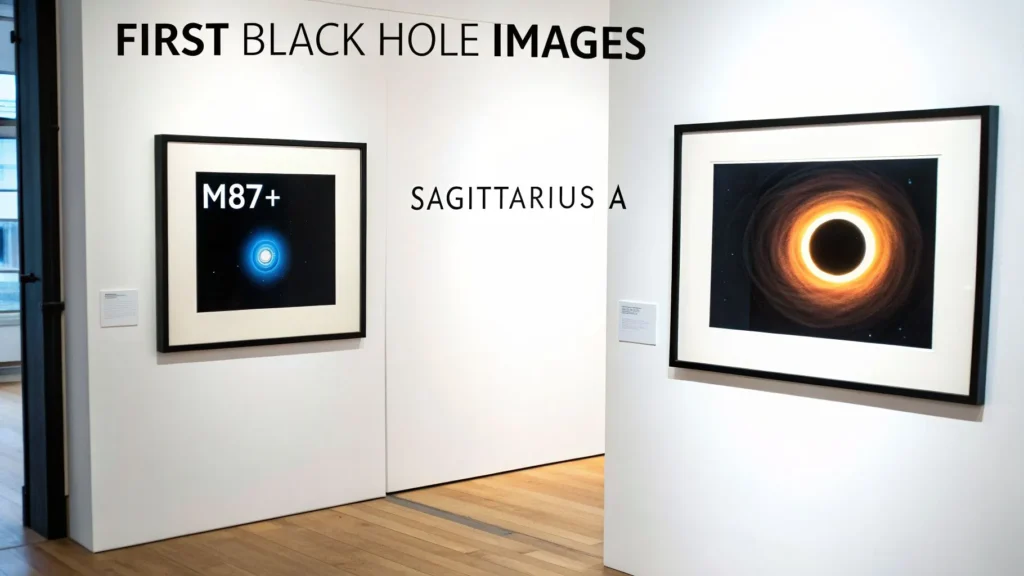
The world stood still in 2019 when the Event Horizon Telescope (EHT) collaboration unveiled the first-ever direct image of a black hole. It was a moment that turned science fiction into documented fact. The image showed the supermassive black hole at the heart of the Messier 87 galaxy, a beast we call M87*.
Getting this shot was a global undertaking of incredible scale. It involved synchronizing a network of eight radio observatories across four continents, effectively creating a virtual telescope as large as our planet. It took two years of meticulous observation just to gather enough data to piece the image together. You can learn more about this incredible story in our guide on how the first black hole was discovered.
Comparing the Titans: M87* and Sagittarius A*
Just a few years later, in 2022, the EHT team delivered again. This time, they released the first image of Sagittarius A* (pronounced “Sagittarius A-star”), the supermassive black hole hiding in the center of our own Milky Way galaxy.
Though both images reveal the same core physics—a dark central void ringed by light—they show two vastly different cosmic monsters.
M87* is a distant, colossal giant. It sits 55 million light-years away and is one of the most massive black holes we know of, packing the mass of 6.5 billion suns. Its sheer size and relatively slow-moving environment made it the perfect first target.
Sagittarius A* is our local leviathan. It’s much closer at only 27,000 light-years away, but it’s also much smaller, weighing in at “just” 4 million solar masses. Imaging Sgr A* was a whole different ballgame because the gas around it swirls so fast, changing its look from minute to minute.
Capturing the image of Sagittarius A* was like trying to take a clear picture of a puppy chasing its tail. The rapid movement of gas created a flickering, dynamic target that required far more advanced imaging techniques than those used for the more static M87*.
Having these two images is a game-changer for science. They let astronomers test Albert Einstein’s theory of general relativity under the most extreme conditions imaginable, and across different scales. The fact that both have a similar ring-like structure is powerful proof that our understanding of physics holds up, even at the edge of oblivion.
Comparing the First Two Black Hole Images
Here’s a quick side-by-side look at what makes these two cosmic landmarks unique.
| Feature | M87* | Sagittarius A* (Sgr A*) |
|---|---|---|
| Location | Center of Messier 87 Galaxy | Center of Milky Way Galaxy |
| Distance from Earth | ~55 million light-years | ~27,000 light-years |
| Mass (Solar Masses) | ~6.5 billion | ~4 million |
| Apparent Size in Sky | Similar to Sgr A* despite distance | Similar to M87* due to proximity |
| Image Published | 2019 | 2022 |
| Orbital Period of Gas | Days to weeks | Minutes |
While M87* is a distant titan and Sgr A* is our galactic neighbor, seeing them both has opened a new chapter in our exploration of the universe’s most mysterious objects.
From Theory to First Light: A Century in the Making
Those incredible images of black holes we see today didn’t just appear out of nowhere. They’re the result of a scientific journey that stretches back more than 100 years, starting long before we had any pictures at all. For decades, black holes were just bizarre concepts scribbled on chalkboards, rooted in Albert Einstein’s theory of general relativity from 1915.
Einstein’s work showed how massive objects could literally bend space and time. Just a year later, in 1916, a German physicist named Karl Schwarzschild took those equations and found a startling solution. He described an object so dense that its gravity would trap everything, including light. This was the very first mathematical prediction of a black hole.
For a long time, that’s all they were—a mathematical oddity. Most scientists, Einstein included, found the idea too strange to be real. They were just too extreme to exist anywhere in our actual universe.
The Shift from Theory to Observation
Everything started to change in the mid-20th century, thanks to the birth of X-ray astronomy. Suddenly, scientists could see the universe in a whole new way, picking up on violent, high-energy events that were totally invisible to regular telescopes. This new tool led straight to the first real proof that black holes were out there.
In 1964, a rocket detected a powerful X-ray source in the Cygnus constellation. This source, dubbed Cygnus X-1, was a complete mystery. It wasn’t until 1971 that astronomers Paul Murdin and Louise Webster figured it out. They saw that the X-rays were coming from superheated gas being ripped away from a giant star and pulled toward an invisible companion. The only thing with enough gravitational muscle to do that and stay hidden was a black hole.
This was the smoking gun. Cygnus X-1 provided the first hard evidence that black holes weren’t just theory. It changed the scientific conversation from if they exist to how we can go about finding and studying them.
This breakthrough built on decades of theoretical work, like Roy Kerr’s 1963 solutions describing the rotating black holes we now think are the most common type. Even so, it took over 40 years for the scientific world to fully accept these cosmic monsters as real objects. You can explore more of this history on the journey of black hole discovery on Space.com.
Paving the Way for a Picture
The confirmation of Cygnus X-1 kicked off a new era of black hole hunting. Astronomers started finding more candidates across the galaxy by looking for that same tell-tale sign: the X-ray glow of matter being devoured by an unseen force.
Each discovery added more weight to the evidence and fueled a bigger ambition—to take a direct picture. Scientists knew this would require a telescope the size of a planet, a seemingly impossible task. But that challenge pushed them to develop the very techniques that made the Event Horizon Telescope possible.
This long history of scientific grit highlights that the famous images of black holes didn’t appear overnight. They are the culmination of a century of work, involving:
- Theoretical Foundations: Starting with Einstein and Schwarzschild’s equations.
- Observational Evidence: The landmark discovery of Cygnus X-1 and other candidates.
- Technological Advancement: The rise of radio astronomy and interferometry.
The path from a weird solution in an equation to that iconic glowing ring is a real testament to human curiosity. This century-long quest keeps pushing us to ask new questions about the cosmos, like wondering about the ultimate fate of our universe. On that note, you might be interested in our article exploring if there is an end to the universe. The road to imaging a black hole was long, but it completely transformed how we see gravity and the universe itself.
How to Photograph Something Invisible
It sounds like a paradox, doesn’t it? How on earth do you take a picture of an object famous for trapping all light? The short answer is, you don’t. Instead, scientists use an absolutely brilliant method to capture the black hole’s silhouette. They photograph the shadow it casts against the superheated, chaotic swirl of gas and dust racing around it.
Pulling this off requires a telescope the size of a planet. That’s not something you can build out of metal and glass. It’s an achievement made possible only through incredible global teamwork.
The technique behind this scientific marvel is called Very Long Baseline Interferometry (VLBI). Think about a regular telescope for a second. The bigger the dish (or lens), the sharper the final image. To get the kind of mind-boggling resolution needed to see a black hole’s shadow from millions of light-years away, you’d need a telescope dish thousands of miles wide—something we could never physically construct.
VLBI is the clever workaround. Rather than one colossal dish, the Event Horizon Telescope (EHT) links a whole network of separate radio telescopes scattered across the globe. We’re talking observatories from the mountains of Hawaii to the deserts of Chile, and even one at the South Pole.
Creating an Earth-Sized Telescope
Getting all these observatories to work as one is the real secret sauce. Every single telescope in the EHT network has an unbelievably precise atomic clock. As they all stare at the same target, like M87* or Sagittarius A*, they record the radio waves that wash over them from the black hole’s neighborhood.
Here’s the trick: because the telescopes are in different spots on Earth, those radio waves arrive at each one at slightly different times.
That tiny, almost infinitesimal delay is the golden ticket. By comparing the arrival times of the signals at every site, scientists can use the principles of interference to stitch together a picture with far more detail than any single telescope could dream of capturing.
It’s a bit like trying to see your reflection in a shattered mirror. Each telescope is just one small shard, giving you a tiny, distorted piece of the puzzle. But if you know the exact position of every single shard, you can use a computer to piece together the complete, clear image the whole mirror would have shown.
This process essentially creates a “virtual” telescope with a lens as wide as the biggest gap between any two observatories in the network—basically, the diameter of Earth. Of course, for those of us just trying to get a decent shot on our phone, our guide on how to take better photos covers the basics on a slightly more terrestrial scale.
From Data to Donut
The sheer volume of data these telescopes collect is staggering. We’re talking petabytes of information—so much that it’s physically impossible to send over the internet. Instead, the data is saved onto stacks of high-capacity hard drives, which are then flown by plane to central processing centers.
This is where the real magic happens. At these supercomputing facilities, specialized algorithms—developed over decades by teams of astrophysicists and computer scientists—get to work. They take on the monumental job of correlating the data from all those hard drives, painstakingly lining up the signals using the atomic clock timestamps, correcting for things like atmospheric distortion, and weaving the separate data streams into a single, cohesive image.
The infographic below gives a simplified look at the journey from theory to proof.
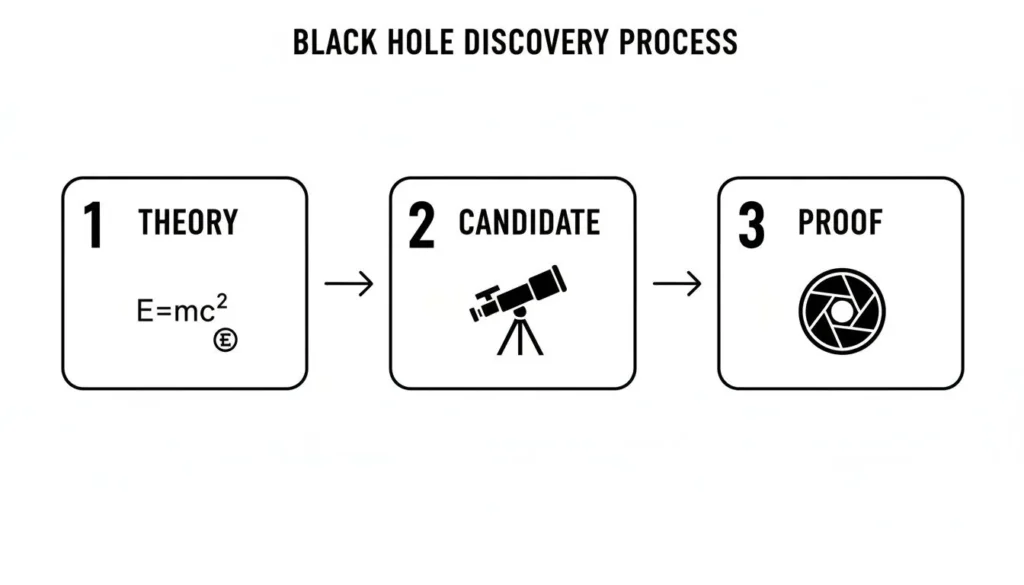
This diagram really captures the century-long path from Einstein’s ideas on paper to the incredible, tangible proof captured by the EHT collaboration. Because the EHT is essentially a telescope with a lot of holes in it, there are gaps in the data. To fill them in, the imaging teams use sophisticated algorithms to test billions of possibilities and find the single image that best fits all the radio signals they collected, all while obeying the laws of physics.
The final result isn’t a “photograph” in the way we normally think of one. It’s a reconstruction—a data-driven portrait of the shadow cast by one of the universe’s most mysterious objects. It’s a stunning testament to human ingenuity, turning our entire planet into a lens to see the unseeable.
Decoding the Donut: What Are We Actually Seeing?
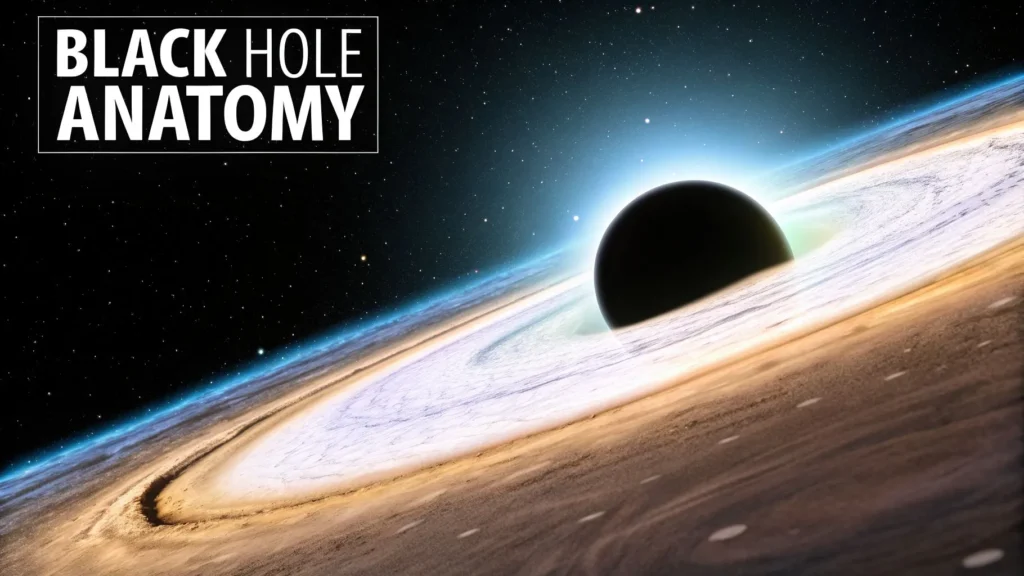
When you first see the famous images of a black hole, “fiery donut” is probably the first thing that comes to mind. But that glowing ring is so much more than a blurry circle. It’s a portrait of physics pushed to its absolute limits, a data-rich map showing the chaotic dance between matter and light at the very edge of oblivion.
Every part of these groundbreaking pictures tells a story about the black hole’s incredible power. To really get what you’re looking at, we have to break down the image’s anatomy, piece by piece. Think of it less like a photo and more like a scientific diagram painted with light from across the universe.
The Dark Heart: The Black Hole Shadow
The first thing that grabs your eye is the dark patch right in the middle. This is the black hole shadow, and it’s the closest we can get to actually “seeing” the black hole itself. But it’s not the event horizon. It’s the event horizon’s visual footprint, cast against the glowing material behind it.
Here’s an analogy: if you hold a ball in front of a bright lamp, the shadow it casts on the wall is always bigger than the ball. It’s the same idea here. The black hole’s gravity is so intense that it warps the path of light, creating a dark circular area that’s about 2.5 times larger than its event horizon.
This shadow exists because any ray of light that gets too close is sucked into the black hole, caught in what’s called a “photon capture zone.” It’s the ultimate point of no return, even for light. The shadow’s size and shape were predicted perfectly by Einstein’s theory of general relativity, so measuring it lets scientists put our core understanding of gravity to the test.
The black hole shadow is a direct visual confirmation of one of the most mind-bending ideas in physics. It shows us the scale of the black hole’s gravitational influence on light itself, proving that space and time are warped just as Einstein predicted over a century ago.
The Glowing Ring of Trapped Light
That iconic, bright ring surrounding the darkness isn’t a solid object. It’s made of photons—particles of light—that are trapped in a wild, high-speed orbit around the black hole. This feature is often called the photon ring or photon sphere.
This light comes from the superheated gas swirling around and even behind the black hole. Gravity bends that light, and some of it is deflected right toward our telescopes on Earth, creating the image we see. In the most extreme cases, some of that light actually orbits the black hole one or more times before finally escaping in our direction.
All of these bent and trapped light rays are what form that distinct ring. The material generating the light is part of the accretion disk—a spinning, pancake-shaped cloud of gas, dust, and shredded stars pulled in by the black hole’s gravity. As this stuff spirals inward, friction heats it to billions of degrees, causing it to glow intensely in radio waves, which is exactly the kind of light the EHT was built to detect.
Why Is One Side Brighter Than the Other?
You might notice that in the images of black holes like M87*, the ring isn’t evenly lit. One side is clearly brighter, giving it a crescent-like look. This isn’t a mistake or some random fluke. It’s a fascinating and crucial phenomenon called relativistic beaming.
The gas in the accretion disk is spinning around the black hole at unbelievable speeds, getting close to the speed of light. Because of the effects of special relativity, something really cool happens:
- Approaching Side: The part of the disk spinning toward us gets a “brightness boost.” Its light waves are compressed and amplified, making it look much brighter from our perspective.
- Receding Side: The part of the disk moving away from us appears dimmer. Its light waves get stretched out and de-intensified.
This effect is powerful proof that all that material is in motion. By seeing which side is brighter, scientists can figure out the direction the black hole is spinning. For M87*, the brighter bottom half tells us that the side of the disk nearest to Earth is rotating clockwise. These aren’t just static snapshots; they are dynamic portraits revealing motion and energy in a way few images ever could.
The Role of Simulations and Artist Renderings
Those incredible images of black holes from the Event Horizon Telescope (EHT) are genuine scientific triumphs, but they don’t give us the complete picture on their own. To truly grasp what we’re looking at—and to push the very laws of physics to their limits—scientists depend on two other powerful tools: computer simulations and artist renderings.
These digital creations are absolutely essential for translating raw, fuzzy data into a deeper understanding of the cosmos.
Think of the actual black hole image as a single, mysterious photograph. To make any sense of it, scientists first need a massive photo album of what a black hole could look like under an almost infinite number of different conditions. That’s exactly where simulations come in. Using powerful supercomputers, astrophysicists construct digital black holes from the ground up, all based on Albert Einstein’s theories.
These aren’t just fancy drawings; they are incredibly complex models that have to follow the laws of general relativity to the letter. From there, scientists can tweak countless variables to generate thousands upon thousands of possible black hole images.
Building a Digital Universe
The process is a bit like being a cosmic film director. In their simulations, scientists can adjust all the key parameters to see how the final “shot” changes. They create a huge library of possibilities by modifying:
- Black Hole Spin: Is the black hole spinning, and if so, how fast? Is it clockwise or counter-clockwise?
- Accretion Disk Properties: What’s the temperature of the superheated gas? How dense is it, and how chaotic is its flow?
- Viewing Angle: Are we looking down on the black hole from the top, viewing it from the side, or somewhere in between?
By running thousands of these models, they assemble a comprehensive catalog of potential black hole appearances. When the EHT finally delivers its real image, researchers compare it against this massive library. The simulation that provides the closest match to the real-world data gives them their best guess about the black hole’s true properties. It’s a powerful method for testing whether Einstein’s theories really work in the most extreme places in the universe.
It’s a bit like a police sketch artist creating multiple portraits based on a witness’s description. The scientists create thousands of “sketches” based on the laws of physics, then find the one that matches the “eyewitness” data from the telescope.
Visualizing the Unseen
While simulations are all about scientific precision and data, artist renderings and scientific visualizations have a different but equally vital job: they help all of us imagine what we can’t see yet. These are those stunning, high-definition pictures of black holes you see in documentaries and movies.
One of the most famous examples is the black hole “Gargantua” from the film Interstellar. Developed in close partnership with Nobel laureate physicist Kip Thorne, Gargantua wasn’t just a cool special effect. It was a scientifically rigorous visualization built on real relativistic equations, showing how a rapidly spinning black hole would bend light and warp the space around it. Renderings like this let us explore features our current telescopes can’t resolve, like the razor-thin accretion disk or the distorted view of distant stars.
These visualizations close the gap between abstract mathematics and human intuition, translating the complex language of gravity into visuals we can all connect with. It’s a creative process, not so different from what you might find in guides to graphic design software for beginners, where technical tools are used to bring compelling ideas to life.
In the end, simulations and renderings are two sides of the same cosmic coin. One is for meticulous, data-driven science, and the other is for inspiration and education. Together, they are indispensable tools for turning a blurry, donut-shaped image into a profound window into how our universe works.
Answering Your Questions About The Black Hole Pictures
Those incredible images of black holes have sparked a ton of curiosity, and for good reason. We’re staring at objects that completely bend our everyday rules of reality. So, it’s only natural to have questions.
Let’s clear up some of the most common points of confusion. From why they look a bit fuzzy to where those fiery colors come from, getting these details straight adds a whole new level of appreciation for what the EHT team accomplished.
Why Are the Black Hole Images So Blurry?
The slightly soft focus of the black hole images comes down to two things: mind-boggling distance and the absolute limits of our current technology. The black hole M87*, for example, is 55 million light-years away. Trying to get a sharp picture of something that far out is a monumental task.
Scientists often use a great analogy: trying to see M87*’s shadow is like standing on Earth and attempting to photograph a single donut sitting on the surface of the Moon. It’s an insane challenge that pushes physics and engineering to their breaking point.
Even though the Event Horizon Telescope (EHT) is an engineering marvel, its resolving power is just enough to make out the basic silhouette. A few key things contribute to that blur:
- Sheer Distance: This is the big one. You need a telescope the size of a planet just to resolve that tiny sliver of the sky.
- A Wobbly Atmosphere: Our own atmosphere bends and distorts the radio waves from space before they ever hit the dishes on the ground. This adds a layer of “noise” that has to be painstakingly filtered out.
- A Cosmic Mosh Pit: The gas whipping around the black hole is a superheated, chaotic storm moving at nearly the speed of light. Like a long-exposure photo of a race car, that motion naturally blurs the final picture.
The exciting part is that this will get better. As more telescopes join the EHT network, the “virtual lens” of our planet-sized telescope gets bigger and sharper. Clearer images are definitely in our future.
Are the Colors in the Images Real?
No, those brilliant oranges and yellows are not what you’d see with your own eyes. Scientists add these “false colors” to make invisible information visible to us.
Think of it this way: the EHT isn’t a standard camera capturing visible light. It’s a network of radio telescopes that detect radio waves—a form of light our eyes can’t perceive. The raw data is just a massive spreadsheet of signal strengths coming from different points around the black hole.
Applying a color map to this data is a crucial step in scientific visualization. It translates complex numerical data into an intuitive visual format that highlights the most important features.
For M87* and Sagittarius A*, the color palette was chosen to show intensity. The brightest colors, like white and yellow, represent the strongest radio signals. This is where the gas is hottest, densest, and glowing most fiercely. The darker reds and blacks show weaker signals or areas with less glowing material. This simple trick is what makes the bright ring and dark central shadow pop right out.
What Is the Next Big Step for Imaging Black Holes?
The next giant leap for the EHT team is to go from still photos to making movies of black holes. The material zipping around a black hole like Sagittarius A* moves so fast that the view can change in just a few minutes or hours. Capturing that dance would be a game-changer.
A black hole movie would let us watch, almost in real-time, as matter takes its final plunge past the event horizon. More importantly, it could give us our first direct look at one of the most powerful processes in the cosmos: the launch of relativistic jets. These are colossal beams of matter and energy fired from the poles of some black holes at nearly the speed of light.
Pulling this off will require some serious upgrades to the EHT. The roadmap includes:
- Adding More Telescopes: Expanding the array improves image sharpness and gives more continuous coverage, which is essential for a movie.
- Going to Space: Putting one or more telescopes in orbit would completely eliminate the blur from our atmosphere and create a much larger virtual telescope, promising breathtakingly sharp images.
- Faster Data Crunching: Developing new algorithms to process the torrent of data needed to string individual frames into a smooth video.
These efforts won’t just give us prettier pictures. They’ll let us test Einstein’s theories of gravity in the most extreme environment we know, watching it work in real time.
How Can I Use These Black Hole Images?
Here’s one of the best parts: these historic images belong to everyone. The official pictures of M87* and Sagittarius A* were released to the public under a Creative Commons Attribution 4.0 International (CC BY 4.0) license.
This is huge for students, teachers, journalists, and artists. It means you are free to download, share, and build upon the images for almost any reason—even for commercial projects—as long as you give proper credit. All you have to do is include the credit line: “EHT Collaboration.”
If you’re planning to use the images, it’s always a good idea to go straight to the source. The official Event Horizon Telescope website, along with sites for its partners like the National Science Foundation (NSF) or NASA, are the best places to get high-resolution downloads and confirm the usage guidelines. This commitment to open access ensures these images of black holes can inspire and teach people all over the globe.
At maxijournal.com, we are committed to bringing you clear and engaging stories from the frontiers of science, technology, and beyond. We believe that complex topics can be made accessible to everyone. Explore our diverse range of articles and join our community of curious readers at https://maxijournal.com.
Discover more from Maxi Journal
Subscribe to get the latest posts sent to your email.