The role of a manager has fundamentally changed. Gone are the days of simple task management. Today’s leaders are expected to inspire hybrid teams, navigate flatter company structures, and work alongside new technologies like AI.
Building modern leadership skills for managers isn’t just a “nice-to-have” anymore—it’s a requirement for survival and growth in this new world of work.
Why Modern Leadership Skills Matter More Than Ever

The old top-down, command-and-control model of management is officially obsolete. A manager’s real value now comes from their ability to coach, empower, and inspire their team to do their best work. This shift demands a completely different skill set than what was needed just a few years ago.
Modern workplaces throw unique challenges at managers. Organizational structures are getting flatter, giving managers a much wider span of control. At the same time, hybrid work models and persistent low employee engagement add layers of complexity.
The Widening Gap in Manager Effectiveness
The data paints a pretty stark picture. In a rare and worrying decline, manager engagement actually dropped from 30% to 27% in 2025. This trend was especially sharp among younger and female managers.
To make matters worse, the average manager today oversees nearly three times the number of direct reports they did back in 2017. It’s no wonder that 51% of CHROs list leadership development as their absolute top priority. You can explore more on these emerging leadership trends for the years ahead.
This gap between the demands on a manager and their ability to deliver is precisely where strong leadership skills make all the difference. They are the crucial link between strategy and execution, and their effectiveness directly shapes morale, productivity, and retention.
A manager’s ability to connect with their team on a human level is the single greatest determinant of that team’s success. Technical skills get you the job, but people skills make you a leader.
Core Leadership Pillars for Modern Managers
To bridge this gap, leaders need to move beyond traditional management duties. The table below breaks down the five core pillars of modern leadership, showing how the focus has shifted from a traditional mindset to a modern one ready for 2026 and beyond.
| Leadership Pillar | Traditional Focus | Modern Application (2026+) |
|---|---|---|
| Communication | Delivering top-down instructions and status updates. | Creating psychological safety and giving feedback that inspires growth. |
| Emotional Intelligence | Maintaining professional distance and managing tasks. | Leading with empathy to build trust and strong relationships. |
| Strategic Decision-Making | Relying on hierarchy and past precedent for decisions. | Blending data, intuition, and team input to make agile judgments. |
| Coaching | Being the “boss” who has all the answers and directs work. | Developing talent and guiding team members to unlock their potential. |
| Delegation | Offloading tasks to free up the manager’s time. | Empowering team members with meaningful ownership and responsibility. |
Mastering these five areas will give you the tools you need to not just survive, but thrive in today’s demanding environment. It’s also worth noting that many of these skills are now being enhanced by AI tools, a topic we dive into in our report on the latest artificial intelligence news today.
This guide is built to help you master these five essential pillars:
- Communication: Move beyond simple updates. Learn to foster an environment of psychological safety and deliver feedback that genuinely helps people grow.
- Emotional Intelligence: Build the self-awareness and empathy required to lead with compassion and create powerful team bonds.
- Strategic Decision-Making: Learn to blend hard data with your gut instinct to make sound judgments quickly and with confidence.
- Coaching: Make the critical shift from being a “boss” to becoming a developer of talent, guiding your people to unlock their full potential.
- Delegation: Go beyond just offloading tasks. Learn to truly empower your team by entrusting them with meaningful responsibilities that drive growth.
Mastering Communication and Emotional Intelligence
Great leadership isn’t about just assigning tasks or passing down information. It’s built on a foundation of genuine human connection. This means going way beyond the standard check-ins and creating an environment where people feel safe, heard, and understood.
This is where emotional intelligence (EQ) comes in. A manager with a high EQ can read a room, handle tough conversations with grace, and build the kind of deep trust that turns a group of employees into a truly cohesive team.
Building a Foundation of Psychological Safety
Psychological safety is the bedrock of any team that consistently performs at a high level. It’s the shared belief that no one will be shamed or punished for asking questions, admitting a mistake, or floating a new idea. As the manager, you are the chief architect of this environment.
Here are a few practical ways to start building it:
- Model Vulnerability: Be the first to admit when you’ve made a mistake or don’t have all the answers. This gives your team permission to be human, too, and it builds trust faster than projecting a flawless image ever could.
- Encourage Dissent: Don’t just tolerate different viewpoints—actively seek them out. When someone disagrees with you, thank them for sharing their perspective instead of immediately getting defensive.
- Reframe Failure: Treat mistakes as data points for learning. Instead of asking, “Why did you mess this up?” try, “What did we learn from this, and how can we use it to get better?”
This isn’t just feel-good advice. Recent research shows that organizations that prioritize human skills like EQ and collaboration are nearly twice as likely to see superior business outcomes. The data is clear: a manager’s ability to foster a supportive space is a massive performance driver.
Giving Feedback That Inspires Growth
Giving constructive feedback is one of the toughest parts of the job, but it’s absolutely critical. Your goal is never to criticize—it’s to spark growth. To do it right, your feedback must be specific, timely, and focused on the behavior, not the person.
Let’s look at a common scenario. Your team member, Alex, just gave a presentation that had a few data errors.
- Poor Feedback: “Your presentation was sloppy. You need to be more careful.” This is vague, personal, and just plain demotivating.
- Effective Feedback: “I noticed a couple of the figures on the Q2 forecast slide didn’t line up with our latest report. For the next client meeting, let’s double-check the data together beforehand. Your delivery was really confident, and I want to make sure the data is just as strong.” This is specific, focused on the action, and gives a clear path forward.
A manager’s job isn’t to have all the answers but to create an environment where the best ideas can emerge. This happens when people feel safe enough to speak up and respected enough to be heard.
Mastering these skills isn’t a side quest; it’s directly tied to better business results. When you get EQ and communication right, you see an immediate impact on morale and productivity. To explore this connection further, take a look at our guide on proven employee engagement strategies. By investing in these human-first skills, you stop being just a task manager and become the leader your team deserves.
Becoming a Coach Instead of a Boss
The old-school image of a manager as a taskmaster is fading fast. Let’s be honest, it was never that effective anyway. True leadership isn’t about dictating every move; it’s about shifting your mindset from “boss” to “coach.” Your primary job is to build up your people’s capabilities, not just oversee their work.
When you coach, you empower your team to discover their own solutions. This builds a powerful sense of ownership and sharpens their problem-solving skills. By offering guidance instead of just giving out answers, you create a team that’s more self-reliant, motivated, and capable of handling challenges without you.
Asking Powerful Questions
One of the biggest shifts you can make is to stop providing immediate answers. Instead, start asking powerful, open-ended questions. This single change can completely transform your one-on-one meetings from status updates into growth sessions.
Imagine one of your team members, Maria, is completely stuck on a new project.
- The Boss Approach: “You look overwhelmed. Here’s what to do: reorganize the data, call the vendor, and then report back to me.”
- The Coach Approach: “I can see this is a tough one. What part is feeling the most challenging right now? What are a couple of options you’ve thought about for your next step?”
The coach approach puts Maria in control. It acknowledges the difficulty of the task but pushes her to think for herself. This builds her confidence for the next challenge, and the one after that.
A manager who acts as a coach doesn’t create followers; they develop future leaders. Your success is measured not by your team’s dependence on you, but by their ability to succeed without you.
A huge part of great coaching is emotional intelligence. This simple process of listening and empathizing before you respond is key.
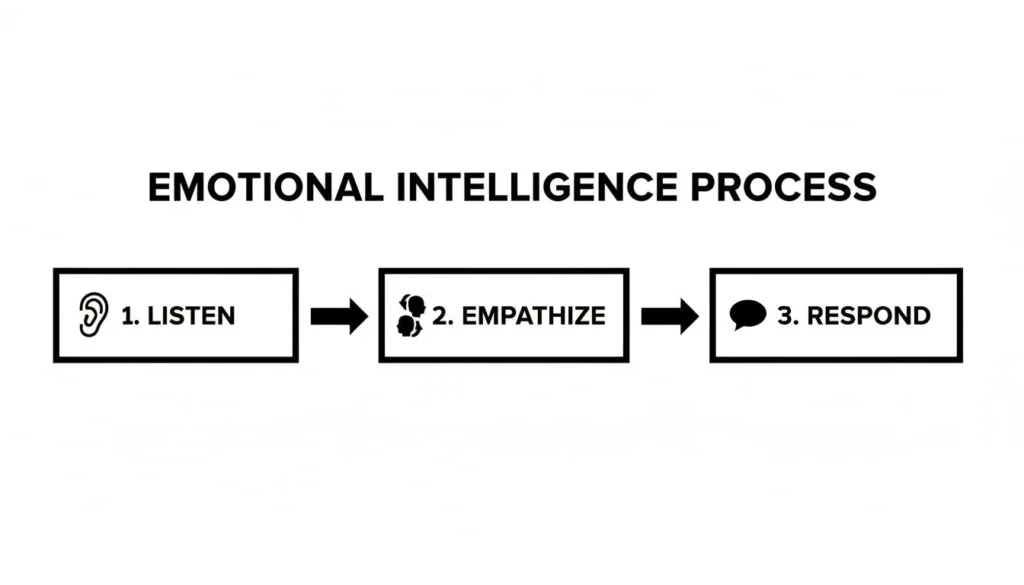
Following this flow helps you understand the real issue, not just the symptom you see on the surface.
Guiding Career Development
Your coaching role isn’t just about the here-and-now. It’s also about your team’s future. One of your most important jobs is to help them see a career path for themselves right where they are. This means having regular, forward-looking chats that go beyond daily to-do lists.
Use these conversations to figure out what they want and how that lines up with the company’s needs. You can guide them by:
- Pinpointing Strengths: Help them see what they’re truly great at and find projects where they can shine.
- Mapping a Path: Talk about what skills they need to get to their next goal, whether it’s a promotion or a lateral move into a new area.
- Creating Opportunities: Be their advocate. Actively seek out stretch assignments or chances for them to work with other parts of the business.
When you invest in their growth, you’re not just getting better performance. You’re building loyalty. Time and time again, people leave jobs because they don’t feel appreciated and see no path for advancement. Coaching is one of your best tools for keeping great talent.
Making Strategic Decisions and Delegating with Confidence

As a manager, you’re constantly forced to make big calls, often without all the facts. It’s a tough spot. But the best leaders I’ve worked with understand a simple truth: real power isn’t about holding all the cards, it’s about dealing them out.
This is where decision-making and delegation become your two most powerful skills. The goal isn’t just to make a choice, but to make a smart choice that your team is bought into. You do that by blending hard data with the real-world experience of the people on the ground.
Get Beyond the Spreadsheet
Data is your starting point, not the whole story. Relying on numbers alone is a classic trap that leads to “analysis paralysis.” The secret is to bring your team into the conversation early. Their intuition is a data point you can’t find on a chart.
Think about choosing a new software platform.
- The Lone Wolf Approach: You could lock yourself in a room for a week, comparing feature lists and pricing until your eyes glaze over.
- The Team-Based Approach: Or, you could grab a few of the people who will actually use the tool every day. They’ll tell you in five minutes if the user interface is a nightmare or if it will actually fit into their workflow—things a spec sheet will never reveal.
When you pull your team in, you get a better decision and they get a sense of ownership. It’s no wonder that only 28% of executives feel their company makes high-quality strategic decisions. There’s a huge gap that collaborative, grounded managers can fill.
Delegation isn’t about just getting tasks off your plate. It’s about growing your people. The real goal is to hand over ownership, build their confidence, and free yourself up for the strategic work that only you can do.
Delegate to Develop, Not Just to Do
Stop thinking of delegation as just assigning work. See it as a development tool. When you hand over a project with real responsibility, you’re telling your team member, “I trust you, and I’m invested in your growth.”
The key is to delegate the outcome, not every single step. Give them the “what” and the “why,” then give them the space to figure out the “how.”
Here’s a simple framework for making it a growth opportunity:
- Match the Mission to the Person: Find a project that pushes their boundaries but doesn’t throw them completely in the deep end.
- Give Them the Full Briefing: Don’t just hand off a task. Explain why it matters and how it connects to the team’s larger goals.
- Define What a “Win” Looks Like: Be crystal clear about the desired result, but let them chart their own course to get there.
This kind of trust is an accelerant. According to research from Zenger Folkman’s Leadership Skills Report, shared power and influence dramatically boost performance, while top-down commands fall flat. Building this trust is fundamental to how to improve employee productivity and create a team that can handle whatever comes its way.
Leading Through Change and Building Team Resilience
If there’s one thing you can count on in management, it’s that things will change. It could be a full-blown company restructuring, a shift to new AI tools, or a sudden pivot in market strategy. Your ability to steer the ship through that turbulence is what separates a manager from a true leader.
But this isn’t about just managing a project plan from A to B. It’s about having a deep well of personal resilience and knowing how to cultivate that same strength within your team. That’s a tall order, especially when you’re feeling the pressure yourself.
Navigating the Leadership Burnout Crisis
The modern manager’s role is relentless. Recent findings from DDI’s Global Leadership Forecast 2025 are pretty sobering: a staggering 71% of leaders are dealing with heightened stress, which is causing 40% to think about quitting.
This “quiet cracking,” as they call it, points to a massive crisis in leadership resilience that inevitably trickles down to your team. If you want to dig deeper into this, you can discover more insights about leadership trends on ddi.com.
This pressure makes it almost impossible to be the supportive leader your team needs. So, let’s be clear: managing your own resilience isn’t selfish. It’s the first and most critical step. You have to put on your own oxygen mask before you can help anyone else.
Your team will take its cues from you. If you project panic and uncertainty, that’s what they will feel. But if you lead with calm, transparent confidence, you give them an anchor in the storm.
Communicating Change with Transparency
The moment a big organizational change is announced, fear and uncertainty fill the air. Your job is to cut through that static with clear, honest communication. Vague corporate platitudes just make things worse.
Here’s a better way to handle it:
- Communicate Early and Often: Don’t wait until you have all the answers. Share what you know, as soon as you know it. Be upfront about what’s still up in the air. Silence creates a vacuum, and rumors love a vacuum.
- Explain the “Why”: People are far more likely to get on board with a change if they understand the reason behind it. Connect the dots for them—explain the business case and how this helps the company in the long run.
- Open the Floor for Questions: You have to make it safe for people to voice their concerns and ask the hard questions. Host town halls, use anonymous Q&A tools, and make it known that your door (or DM) is open for one-on-one chats.
Turning Resistance into an Opportunity
Resistance to change is not just normal; it’s a completely human reaction. Your goal shouldn’t be to squash it, but to understand where it’s coming from. This is where empathy becomes your most powerful tool.
When a team member pushes back, they aren’t trying to be difficult. They’re usually voicing a fear—fear of being laid off, fear of not having the right skills for the new world, or fear of their role becoming obsolete.
Imagine your company is rolling out a new AI-powered analytics platform. Most of the team is curious, but one of your most seasoned employees is openly skeptical. “This will never work for our clients,” they say in a team meeting.
Your gut reaction might be to shut it down. Don’t. Get curious instead.
Pull them aside and ask questions that show you value their experience:
- “What specific concerns do you have about how this might affect our client relationships?”
- “From your experience, what are the biggest landmines we need to watch out for as we roll this out?”
- “In your opinion, what would have to be true for this tool to actually be a win for us?”
By truly listening, you do two things: you validate their expertise, and you transform them from a resistor into a critical advisor. This is how you turn disruption into a growth opportunity and build a team that isn’t just resilient but genuinely adaptable.
Common Questions About Developing Leadership Skills
As you start putting these leadership strategies into practice, you’re bound to run into some practical questions. It happens to every manager. Here are our answers to a few of the most common ones we get.
How Do I Actually Measure Leadership Growth?
It’s tough to measure “soft skills” like leadership with a single number, but it’s not impossible. The trick is to look at tangible business outcomes and how your team’s behavior is changing.
Are projects running smoother with fewer communication snags? Are your one-on-ones evolving from simple status updates into more strategic conversations about the future? These are your first signs of progress.
For more concrete data, you can track a few key metrics:
- Employee Engagement Scores: Pay attention to trends in your quarterly or annual surveys. A noticeable uptick in scores related to manager support and clear communication is a great sign.
- Team Retention Rates: Top performers don’t stick around for bad managers. If your retention rate is stable or improving, you’re creating an environment where people want to stay and grow.
- Project Success Rates: A huge indicator of your growth is your team’s ability to hit deadlines and quality goals without you having to jump in and micromanage every detail.
The best measure of your leadership isn’t really about you at all—it’s about your team. When you see them solving problems on their own, taking initiative, and feeling comfortable enough to take smart risks, that’s when you know your skills are truly advancing.
What Is the Most Important Skill for a New Manager?
If you’re new to management and feeling the pressure, put all your energy into one skill first: effective communication. It’s the absolute foundation for everything else. You can’t delegate tasks, coach effectively, or build a shred of trust without it.
Start by mastering your one-on-one meetings. Your goal is to turn them into a safe space for real dialogue, not just a list of updates. Work on active listening—that means hearing what’s being said, but also picking up on what’s not being said. Then, practice giving feedback that is both direct and kind.
How Do I Adapt My Leadership for a Remote Team?
Managing a remote or hybrid team demands a much more deliberate leadership style. You lose the spontaneous “water cooler” chats, so you have to be the one who intentionally creates clarity and connection.
The secret is to over-communicate with purpose. This isn’t about scheduling more meetings. It’s about being more intentional. Use shared documents for real-time project updates, set crystal-clear expectations for chat response times, and make sure every single meeting has a purpose and an agenda.
Above all, you have to operate from a place of trust. Remote leadership thrives when you manage outcomes, not activity. Give your team the autonomy to own their work and position yourself as a source of support, not a digital supervisor. That’s how you build the psychological safety a remote team needs to do its best work.
At maxijournal.com, we publish daily insights across a wide range of topics to keep you informed and inspired, from business leadership to the latest in technology and culture. Explore our full collection and find your next favorite read at https://maxijournal.com.
Discover more from Maxi Journal
Subscribe to get the latest posts sent to your email.